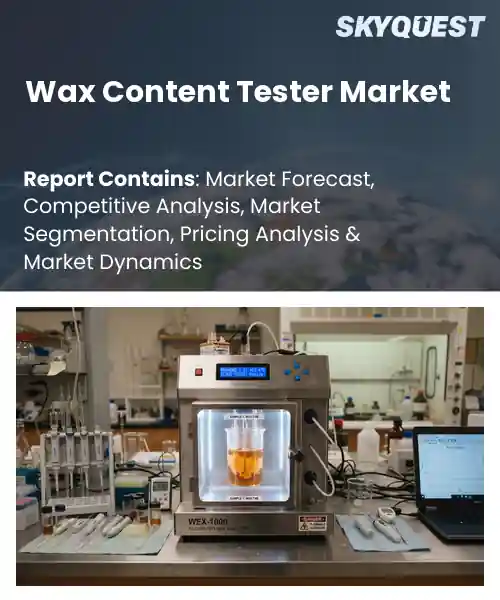
Wax Content Tester Market
Report ID: SQMIG45J2849
Report ID: SQMIG45J2849
[email protected]
USA +1 351-333-4748
Report ID:
SQMIG45J2849 |
Region:
Global |
Published Date: August, 2026
Pages:
157
|Tables:
118
|Figures:
77


Global Wax Content Tester Market size was valued at USD 148.0 Million in 2024 and is poised to grow from USD 156.44 Million in 2025 to USD 243.75 Million by 2033, growing at a CAGR of 5.7% during the forecast period (2026-2033).
The global wax content tester market comprises instruments that quantitatively measure wax concentrations in petroleum, cosmetics, and food‑grade oils, enabling producers to meet regulatory limits and maintain product quality. Its importance has risen as tighter environmental standards and consumer expectations compel manufacturers to control wax‑induced viscosity and stability issues. Historically, the market emerged in the 2000s when petroleum refineries adopted spectroscopic analyzers to avoid pipeline blockages, and later expanded into the beauty sector where manufacturers used near‑infrared devices to ensure consistent lotion textures. Over the past decade, technological advances such as handheld Raman probes have accelerated adoption across batch producers. An emerging driver that fuels market expansion is the integration of automated quality‑control lines in large‑scale oil refineries, where real‑time wax content data directly dictate processing parameters such as temperature gradients and solvent dosing. When detectors relay instantaneous readings, operators can adjust crystallization zones, thereby reducing energy consumption and avoiding costly shutdowns caused by wax plugging. This capability has prompted equipment manufacturers to bundle testers with SCADA platforms, creating a niche for software services. Consequently, producers of greases and bio‑lubricants are adopting portable units to verify compliance with ASTM standards, opening revenue streams for vendors and reinforcing the market’s trajectory.
How is AI improving precision and efficiency in the wax content tester market?
AI is reshaping wax content testing by embedding machine‑learning algorithms into sensor platforms, enabling real‑time interpretation of spectral data and automatic calibration adjustments. These smart systems learn from each measurement, reducing operator bias and shortening the time needed to reach reliable results. Integration with cloud‑based analytics allows laboratories to track performance trends across batches, improving consistency and traceability. As the industrial wax market expands, manufacturers seek faster, more accurate quality checks, and AI‑driven testers meet that demand by streamlining workflows and lowering maintenance costs, making the testing process both more precise and economically efficient.In June 2024, an AI‑enhanced wax content tester was launched, cutting analysis cycles and boosting repeatability, which directly supports the market’s push for higher productivity and tighter quality control.
Market snapshot - (2026-2033)
Global Market Size
USD 148.0 Million
Largest Segment
Manual Wax Content Tester
Fastest Growth
Automatic Wax Content Tester
Growth Rate
5.7% CAGR
To get more insights on this market click here to Request a Free Sample Report
Global wax content tester market is segmented by product type, sample type, application, end user and region. Based on product type, the market is segmented into Manual Wax Content Tester and Automatic Wax Content Tester. Based on sample type, the market is segmented into Crude Oil, Petroleum Products, Lubricants and Specialty Oils. Based on application, the market is segmented into Quality Control, Research & Development and Process Monitoring. Based on end user, the market is segmented into Oil & Gas Companies, Testing Laboratories, Refineries and Research Institutes. Based on region, the market is segmented into North America, Europe, Asia Pacific, Latin America and Middle East & Africa.
Automatic Wax Content Tester segment dominates because it delivers rapid, high precision measurements that align with production line speeds, minimizing downtime and labor intensity. The integration of digital data logging and remote diagnostics satisfies industrial demands for traceability and real time decision making. Operators favor its repeatability and reduced human error, which enhances refinery efficiency. Consequently, manufacturers prioritize automated solutions to meet tightening quality standards and sustain competitive processing margins.
However, Manual Wax Content Tester segment is witnessing the strongest growth as small scale producers and field service teams seek portable, cost effective instruments for on site analysis. Its simplicity and low capital outlay enable rapid deployment in remote locations, driving broader adoption across emerging oil projects and encouraging manufacturers to innovate compact designs.
Crude Oil segment dominates because it represents the primary feedstock whose wax content directly impacts downstream processing efficiency and product quality. Accurate measurement of wax in crude informs blending strategies, pipeline flow assurance, and refinery yield optimization. The high economic stakes associated with wax precipitation problems compel operators to invest in reliable testing, making crude analysis the cornerstone of quality assurance programs across the industry worldwide and regulatory compliance requirements.
Meanwhile, Specialty Oils segment emerges as a high growth area as lubricant markets expand. These oils contain wax fractions needing precise characterization for performance validation, prompting tester adoption. The surge in specialty formulations and tighter standards fuels demand for analysis, positioning this segment to accelerate market expansion and create opportunities for suppliers.
To get detailed segments analysis, Request a Free Sample Report
North America maintains a leading position through a combination of deep industrial expertise, extensive research and development capabilities, and a mature regulatory environment that emphasizes product quality and safety. The region benefits from a concentration of major manufacturers and end‑user industries such as automotive, aerospace, and packaging, which demand precise wax analysis for performance optimization. Strong collaboration between equipment suppliers, academic institutions, and industry associations drives continuous innovation, while well‑established distribution networks ensure rapid adoption of advanced testing solutions. Additionally, a skilled technical workforce and a culture of stringent quality assurance reinforce the market’s resilience and attractiveness, cementing North America’s dominance in the global landscape.
Wax Content Tester Market in the United States is propelled by a robust demand from high‑volume manufacturing sectors that require exacting control over wax properties. The presence of leading technology providers and a proactive approach to standardization foster an environment where new testing methodologies are quickly integrated. Collaborative research initiatives between universities and industry accelerate the development of next‑generation instruments, while a strong emphasis on compliance with rigorous quality standards sustains ongoing investment in sophisticated testing capabilities.
Wax Content Tester Market in Canada benefits from a diversified industrial base that includes petrochemical processing, renewable fuel production, and specialty coatings. Close proximity to major North American supply chains facilitates the rapid deployment of advanced testing equipment. Government support for innovation and a focus on environmental stewardship encourage the adoption of precise wax analysis to meet both domestic and export requirements. Skilled engineering talent and collaborative industry clusters further reinforce Canada’s role as a significant contributor to the regional market.
Europe’s expansion is driven by a strong emphasis on sustainability, stringent quality regulations, and a thriving ecosystem of specialty chemical manufacturers. The region’s commitment to reducing environmental impact pushes companies to adopt precise wax testing to optimize formulations and improve product lifecycle performance. Collaborative networks among research institutions, equipment suppliers, and end‑users foster rapid technology transfer and innovation. Additionally, the presence of well‑established standards bodies ensures consistent testing protocols, enhancing confidence across diverse market segments. This confluence of regulatory rigor, sustainability focus, and collaborative innovation fuels Europe’s rapid market growth.
Wax Content Tester Market in Germany is anchored by a powerful chemical and automotive industry that demands high‑precision analysis for performance and compliance. The country’s strong engineering tradition and extensive R&D infrastructure support the development of cutting‑edge testing solutions. Close cooperation between manufacturers and research institutes accelerates the introduction of advanced methodologies, while rigorous national standards reinforce the need for reliable wax measurement. This environment sustains Germany’s position as a dominant force within the European market.
Wax Content Tester Market in the United Kingdom is experiencing swift growth due to a dynamic blend of innovative startups and established manufacturers focused on high‑value sectors such as aerospace and specialty polymers. The UK’s proactive regulatory framework encourages the adoption of precise testing to meet stringent quality benchmarks. Strong links between academic research centers and industry accelerate the commercialization of novel testing technologies, while a vibrant investment climate supports rapid scaling of capabilities. These factors collectively drive the fastest expansion within the European landscape.
Wax Content Tester Market in France is emerging as a notable segment, propelled by a growing emphasis on renewable energy and high‑performance coatings. French manufacturers are increasingly integrating sophisticated wax analysis to enhance product efficiency and meet evolving environmental standards. Collaborative initiatives between research laboratories and industrial partners foster the development of tailored testing solutions. Government incentives for green technologies further stimulate adoption, positioning France as an emerging contributor to the broader European market.
Asia Pacific is strengthening its role through rapid industrialization, expanding petrochemical complexes, and a heightened focus on quality assurance across diverse manufacturing sectors. The region’s commitment to technological advancement is evident in substantial investments in modern testing equipment and the establishment of specialized training programs. Growing awareness of environmental and performance standards drives companies to adopt precise wax analysis to optimize product formulations. Collaborative efforts between local equipment manufacturers and global technology leaders facilitate knowledge transfer, while emerging market demands encourage continuous innovation, collectively enhancing the region’s market stature.
Wax Content Tester Market in Japan benefits from a sophisticated manufacturing landscape that includes electronics, automotive, and high‑tech materials. The country’s dedication to precision engineering and rigorous quality control drives the integration of advanced wax testing solutions. Strong partnerships between domestic instrument makers and research institutions accelerate the development of customized testing platforms. A culture of continuous improvement and adherence to exacting standards ensures that wax analysis remains a critical component of product development and quality assurance in Japan.
Wax Content Tester Market in South Korea is propelled by a vibrant chemical industry and a focus on high‑performance consumer goods. The nation’s rapid adoption of cutting‑edge technologies and emphasis on stringent quality metrics encourage the deployment of sophisticated wax testing equipment. Collaborative ecosystems linking universities, technology firms, and manufacturers foster innovation in testing methodologies. Government initiatives supporting advanced manufacturing further reinforce the market’s growth, positioning South Korea as a key player in the regional landscape.
To know more about the market opportunities by region and country, click here to
Buy The Complete Report
Growing Demand For Product Quality
Adoption Of Automated Testing Solutions
High Initial Equipment Investment
Limited Technical Expertise Availability
Request Free Customization of this report to help us to meet your business objectives.
The competitive landscape of the global wax content tester market is shaped by intense rivalry among specialized instrumentation firms, with recent M&A activity and strategic partnerships driving technology integration and geographic expansion. Companies are accelerating product innovation through advanced spectroscopy and AI‑enabled analytics, while collaborations with petrochemical producers and laboratory service providers enhance market reach and accelerate adoption of next‑generation testing solutions.
Top Player’s Company Profile
Recent Developments
SkyQuest’s ABIRAW (Advanced Business Intelligence, Research & Analysis Wing) is our Business Information Services team that Collects, Collates, Correlates, and Analyses the Data collected by means of Primary Exploratory Research backed by robust Secondary Desk research. As per SkyQuest analysis the global wax content tester market is projected to expand at a 5.7 percent CAGR through 2033, driven chiefly by the growing demand for product quality that pushes manufacturers to verify wax levels across batches, while the second engine of adoption of automated testing solutions shortens analysis time and reduces human error. The automatic wax content tester segment leads the market because its rapid, high‑precision readings fit production‑line speeds, whereas high initial equipment investment remains a notable restraint limiting uptake among smaller players. North America dominates the landscape thanks to its mature industrial base, strong R&D ecosystem and stringent regulatory climate, reinforcing the region’s leadership in market share.
| Report Metric | Details |
|---|---|
| Market size value in 2024 | USD 148.0 Million |
| Market size value in 2033 | USD 243.75 Million |
| Growth Rate | 5.7% |
| Base year | 2024 |
| Forecast period | (2026-2033) |
| Forecast Unit (Value) | USD Million |
| Segments covered |
|
| Regions covered | North America (US, Canada), Europe (Germany, France, United Kingdom, Italy, Spain, Rest of Europe), Asia Pacific (China, India, Japan, Rest of Asia-Pacific), Latin America (Brazil, Rest of Latin America), Middle East & Africa (South Africa, GCC Countries, Rest of MEA) |
| Companies covered |
|
| Customization scope | Free report customization with purchase. Customization includes:-
|
To get a free trial access to our platform which is a one stop solution for all your data requirements for quicker decision making. This platform allows you to compare markets, competitors who are prominent in the market, and mega trends that are influencing the dynamics in the market. Also, get access to detailed SkyQuest exclusive matrix.
Table Of Content
Executive Summary
Market overview
Parent Market Analysis
Market overview
Market size
KEY MARKET INSIGHTS
COVID IMPACT
MARKET DYNAMICS & OUTLOOK
Market Size by Region
KEY COMPANY PROFILES
Methodology
For the Wax Content Tester Market, our research methodology involved a mixture of primary and secondary data sources. Key steps involved in the research process are listed below:
1. Information Procurement: This stage involved the procurement of Market data or related information via primary and secondary sources. The various secondary sources used included various company websites, annual reports, trade databases, and paid databases such as Hoover's, Bloomberg Business, Factiva, and Avention. Our team did 45 primary interactions Globally which included several stakeholders such as manufacturers, customers, key opinion leaders, etc. Overall, information procurement was one of the most extensive stages in our research process.
2. Information Analysis: This step involved triangulation of data through bottom-up and top-down approaches to estimate and validate the total size and future estimate of the Wax Content Tester Market.
3. Report Formulation: The final step entailed the placement of data points in appropriate Market spaces in an attempt to deduce viable conclusions.
4. Validation & Publishing: Validation is the most important step in the process. Validation & re-validation via an intricately designed process helped us finalize data points to be used for final calculations. The final Market estimates and forecasts were then aligned and sent to our panel of industry experts for validation of data. Once the validation was done the report was sent to our Quality Assurance team to ensure adherence to style guides, consistency & design.
Analyst Support
Customization Options
With the given market data, our dedicated team of analysts can offer you the following customization options are available for the Wax Content Tester Market:
Product Analysis: Product matrix, which offers a detailed comparison of the product portfolio of companies.
Regional Analysis: Further analysis of the Wax Content Tester Market for additional countries.
Competitive Analysis: Detailed analysis and profiling of additional Market players & comparative analysis of competitive products.
Go to Market Strategy: Find the high-growth channels to invest your marketing efforts and increase your customer base.
Innovation Mapping: Identify racial solutions and innovation, connected to deep ecosystems of innovators, start-ups, academics, and strategic partners.
Category Intelligence: Customized intelligence that is relevant to their supply Markets will enable them to make smarter sourcing decisions and improve their category management.
Public Company Transcript Analysis: To improve the investment performance by generating new alpha and making better-informed decisions.
Social Media Listening: To analyze the conversations and trends happening not just around your brand, but around your industry as a whole, and use those insights to make better Marketing decisions.
REQUEST FOR SAMPLE
 REQUEST FREE CUSTOMIZATION


Want to customize this report? This report can be personalized according to your needs. Our analysts and industry experts will work directly with you to understand your requirements and provide you with customized data in a short amount of time. We offer $1000 worth of FREE customization at the time of purchase.
Feedback From Our Clients


 USA (+1) 351-333-4748

