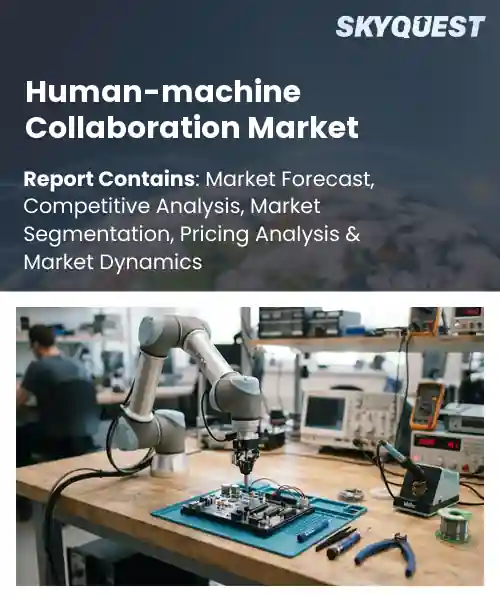
Human-machine Collaboration Market
Report ID: SQMIG45E3325
Report ID: SQMIG45E3325
[email protected]
USA +1 351-333-4748
Report ID:
SQMIG45E3325 |
Region:
Global |
Published Date: September, 2026
Pages:
157
|Tables:
155
|Figures:
78


Global Human-Machine Collaboration Market size was valued at USD 2.6 Billion in 2024 and is poised to grow from USD 2.81 Billion in 2025 to USD 5.29 Billion by 2033, growing at a CAGR of 8.2% during the forecast period (2026-2033).
The human‑machine collaboration market comprises technologies that let workers and intelligent systems share tasks, augment decisions, and co‑create outcomes in real time. Its primary driver is the need for productivity gains in manufacturing sectors, where labor shortages and exploding data volumes stretch traditional processes. Over the past decade, advances in cloud‑based AI, edge computing, and natural‑language interfaces have turned speculative research into deployable platforms such as collaborative robots on automotive lines and AI‑assisted design tools in architecture. These developments matter because they turn computational capacity into actionable insight, letting firms shorten cycles, cut errors, and stay competitive in economies globally. A second key factor shaping the human‑machine collaboration market is the rise of AI ecosystems that embed collaborative agents directly into operational workflows. When enterprises adopt integration, data silos dissolve, enabling feedback loops that improve both machine learning models and human performance. For example, a logistics provider that pilots picking robots linked to a cloud scheduler sees a 15 % reduction in fulfillment time, which lowers labor costs and frees staff to focus on customer service. This cause‑effect chain creates a cycle: higher efficiency attracts investment, spurs innovation, and expands the addressable market across sectors such as healthcare, finance, and energy.
How is AI-driven automation reshaping the human‑machine collaboration market?
AI driven automation is turning machines into active collaborators rather than passive tools. The market now focuses on three pillars: adaptive interfaces that respond to user intent, real time data synthesis that informs decisions, and seamless handoff between human expertise and algorithmic execution. Industries such as manufacturing, healthcare and finance are deploying smart workcells where robots learn from operator adjustments and software assistants surface relevant insights during routine tasks. Enterprises are also embedding AI into collaborative platforms to streamline communication and accelerate project cycles. This shift creates a fluid partnership that speeds problem solving and reduces manual effort while keeping humans in control of strategic choices.In March 2024 Microsoft launched Copilot for Teams, delivering AI generated meeting summaries and actionable task suggestions that let employees focus on creative work while the system handles routine coordination, illustrating how AI driven automation fuels productivity and deepens human machine collaboration across global teams in daily.
Market snapshot - (2026-2033)
Global Market Size
USD 2.6 Billion
Largest Segment
Collaborative Robotics
Fastest Growth
Wearable Assistance Systems
Growth Rate
8.2% CAGR
To get more insights on this market click here to Request a Free Sample Report
Global human-machine collaboration market is segmented by collaboration type, technology, application, deployment, end-use industry and region. Based on collaboration type, the market is segmented into Collaborative Robotics, Human-Machine Interfaces, Wearable Assistance Systems, Intelligent Automation and Others. Based on technology, the market is segmented into Artificial Intelligence, Machine Vision, Force and Torque Sensing, Natural Language Processing and Others. Based on application, the market is segmented into Assembly, Material Handling, Inspection and Quality Control, Maintenance and Others. Based on deployment, the market is segmented into Stationary, Mobile, Wearable and Others. Based on end-use industry, the market is segmented into Automotive, Electronics, Manufacturing, Healthcare, Logistics and Warehousing, Aerospace and Defense and Others. Based on region, the market is segmented into North America, Europe, Asia Pacific, Latin America and Middle East & Africa.
Collaborative robotics segment dominates because it directly integrates machines with human operators, enabling shared workcells that enhance productivity while maintaining safety. Its ability to perform repetitive or heavy tasks alongside humans reduces fatigue and error rates, creating a compelling value proposition for manufacturers seeking flexible automation. The tangible benefits of reduced cycle times and improved ergonomics drive widespread adoption across diverse production lines and enable rapid retooling for new product variants.
However, wearable assistance systems are witnessing the strongest growth momentum as they empower operators with real time guidance and biomechanical support on the shop floor. Advances in lightweight sensors and augmented reality overlays drive their uptake, expanding use cases beyond assembly into maintenance and training, thereby accelerating market expansion and new opportunity creation.
Machine vision segment leads because it provides precise visual perception that enables autonomous decision making for collaborative systems. By translating complex imaging data into actionable insights, it allows robots and interfaces to detect defects, guide motions, and adapt to variability without human intervention. This capability underpins higher throughput and consistency, making it indispensable for manufacturers aiming to combine speed with quality, thereby cementing its central role in market evolution.
On the other hand, natural language processing is emerging as the key high growth area as it enables voice driven interaction between workers and machines. Improved conversational AI reduces training barriers and facilitates hands free command issuance, expanding adoption across assembly and maintenance tasks, and opening pathways for market penetration and service models.
To get detailed segments analysis, Request a Free Sample Report
North America leads due to a confluence of mature technology ecosystems, robust venture capital support, and a culture that embraces digital transformation across industry sectors. The region benefits from a deep talent pool in artificial intelligence, robotics, and software engineering, fostering rapid prototyping and deployment of collaborative solutions. Strong partnerships between academia, research institutions, and enterprise accelerate innovation cycles, while regulatory frameworks encourage responsible integration of machines alongside human workers. Moreover, the presence of global headquarters for many technology providers ensures early access to cutting‑edge tools, creating a self‑reinforcing cycle of adoption and refinement that consolidates North America’s leadership position.
Human-machine Collaboration Market in the United States is driven by a relentless focus on productivity enhancement and competitive advantage. Enterprises across manufacturing, logistics, and services are embedding collaborative robots and AI assistants to augment skilled labor. A vibrant startup scene introduces novel interaction platforms, while large corporations invest heavily in research collaborations that push the boundaries of seamless human‑machine teamwork. This ecosystem is further supported by a regulatory climate that balances innovation incentives with safety standards, encouraging widespread deployment.
Human-machine Collaboration Market in Canada emphasizes sustainability and workforce development as core pillars. Organizations leverage collaborative technologies to improve operational efficiency while meeting environmental commitments. Government initiatives promote skill upskilling and reskilling programs, ensuring a labor force capable of interfacing effectively with intelligent systems. Industry clusters in areas such as aerospace and clean technology adopt human‑machine solutions to maintain global competitiveness, fostering a collaborative culture that integrates advanced automation with human expertise.
Europe’s rapid expansion stems from a strategic alignment of policy ambition, research excellence, and industry readiness. The European Union promotes digital sovereignty and inclusive automation, encouraging cross‑border collaboration and standardization that lower entry barriers for new technologies. World‑class research institutions generate breakthroughs in machine learning and ergonomics, feeding a vibrant ecosystem of startups and established manufacturers. Demand for high‑skill, low‑impact labor solutions in sectors ranging from automotive to healthcare fuels adoption, while a strong emphasis on ethical AI and worker safety builds trust, accelerating market penetration across the continent.
Human-machine Collaboration Market in Germany is anchored by its engineering heritage and strong industrial base. Precision manufacturing and automotive sectors integrate collaborative robots to enhance flexibility and reduce cycle times. Research partnerships between technical universities and firms accelerate the development of intuitive interfaces that align machine actions with human intent. The national focus on Industry 4.0 creates an environment where digital twins and real‑time data analytics complement human expertise, fostering a seamless blend of automation and craftsmanship.
Human-machine Collaboration Market in the United Kingdom experiences swift growth driven by an agile technology sector and proactive government incentives. Financial services, creative industries, and advanced manufacturing adopt AI‑driven assistants to augment decision‑making and creative processes. A thriving startup ecosystem delivers modular collaborative platforms that integrate quickly with existing workflows. Emphasis on reskilling initiatives ensures that workers gain the competencies needed to interact safely and productively with autonomous systems, reinforcing the United Kingdom’s position as a fast‑moving market.
Human-machine Collaboration Market in France is emerging through a blend of artistic innovation and industrial application. Aerospace and luxury manufacturing sectors experiment with collaborative robots to preserve craftsmanship while increasing throughput. National research agencies fund interdisciplinary projects that explore human‑centric design, ensuring technology aligns with cultural expectations of work. Growing awareness of productivity challenges in services prompts adoption of conversational AI tools that support employees, positioning France as an emerging hub where creativity and collaboration intersect.
Asia Pacific strengthens its position through a combination of rapid digital adoption, government-led smart manufacturing agendas, and a culture that values technological leapfrogging. Nations in the region invest heavily in infrastructure that supports seamless connectivity, enabling real‑time human‑machine interaction across supply chains. Talent pipelines focused on robotics, data science, and human factors accelerate the creation of localized solutions tailored to diverse industrial landscapes. Collaborative ecosystems link multinational corporations with agile local innovators, fostering knowledge transfer and scaling of advanced collaborative systems that enhance productivity while respecting regional work practices.
Human-machine Collaboration Market in Japan integrates precision robotics with a deep respect for human craftsmanship. Manufacturing firms adopt collaborative robots to complement skilled artisans, enhancing efficiency without compromising quality. Government initiatives promote the development of safe, intuitive interfaces that align with cultural emphasis on harmony between humans and machines. Academic research in humanoid robotics and cognitive ergonomics fuels continuous improvement, positioning Japan as a leader in sophisticated, human‑centric automation.
Human-machine Collaboration Market in South Korea thrives on a strong technology infrastructure and proactive industry policies. Electronics and automotive manufacturers deploy collaborative robots to increase flexibility and reduce downtime. National programs encourage convergence of AI, IoT, and robotics, creating smart factories where humans and machines co‑operate seamlessly. Emphasis on continuous learning ensures the workforce adapts to evolving collaborative tools, reinforcing South Korea’s role as a dynamic innovator in the regional market.
To know more about the market opportunities by region and country, click here to
Buy The Complete Report
Increasing Adoption Of AI
Enhanced Human Machine Interaction
Data Privacy Concerns
High Implementation Costs
Request Free Customization of this report to help us to meet your business objectives.
The human‑machine collaboration market is shaped by intense rivalry as tech giants and niche innovators vie for ecosystem dominance. Competitive pressure drives rapid AI‑driven workflow automation, prompting Microsoft’s acquisition of Nuance to strengthen clinical AI, Google’s partnership with Boston Dynamics to embed advanced perception in robots, and IBM’s launch of Watson Orchestrate to streamline cross‑functional tasks.
Top Player’s Company Profile
Recent Developments
SkyQuest’s ABIRAW (Advanced Business Intelligence, Research & Analysis Wing) is our Business Information Services team that Collects, Collates, Correlates, and Analyses the Data collected by means of Primary Exploratory Research backed by robust Secondary Desk research. As per SkyQuest analysis the global human‑machine collaboration market is set to expand at an 8.2 % CAGR, driven primarily by the increasing adoption of AI which enables seamless task sharing and real‑time decision support. A second catalyst is the evolution of intuitive interfaces and advanced sensors that enhance human‑machine interaction, lowering training barriers and boosting productivity. The collaborative robotics segment leads the market by integrating machines directly with operators to improve safety and efficiency. North America dominates the landscape thanks to its mature technology ecosystem and strong venture support. However, stringent data‑privacy regulations pose a restraint, adding compliance complexity and slowing broader deployment.
| Report Metric | Details |
|---|---|
| Market size value in 2024 | USD 2.6 Billion |
| Market size value in 2033 | USD 5.29 Billion |
| Growth Rate | 8.2% |
| Base year | 2024 |
| Forecast period | (2026-2033) |
| Forecast Unit (Value) | USD Billion |
| Segments covered |
|
| Regions covered | North America (US, Canada), Europe (Germany, France, United Kingdom, Italy, Spain, Rest of Europe), Asia Pacific (China, India, Japan, Rest of Asia-Pacific), Latin America (Brazil, Rest of Latin America), Middle East & Africa (South Africa, GCC Countries, Rest of MEA) |
| Companies covered |
|
| Customization scope | Free report customization with purchase. Customization includes:-
|
To get a free trial access to our platform which is a one stop solution for all your data requirements for quicker decision making. This platform allows you to compare markets, competitors who are prominent in the market, and mega trends that are influencing the dynamics in the market. Also, get access to detailed SkyQuest exclusive matrix.
Table Of Content
Executive Summary
Market overview
Parent Market Analysis
Market overview
Market size
KEY MARKET INSIGHTS
COVID IMPACT
MARKET DYNAMICS & OUTLOOK
Market Size by Region
KEY COMPANY PROFILES
Methodology
For the Human-machine Collaboration Market, our research methodology involved a mixture of primary and secondary data sources. Key steps involved in the research process are listed below:
1. Information Procurement: This stage involved the procurement of Market data or related information via primary and secondary sources. The various secondary sources used included various company websites, annual reports, trade databases, and paid databases such as Hoover's, Bloomberg Business, Factiva, and Avention. Our team did 45 primary interactions Globally which included several stakeholders such as manufacturers, customers, key opinion leaders, etc. Overall, information procurement was one of the most extensive stages in our research process.
2. Information Analysis: This step involved triangulation of data through bottom-up and top-down approaches to estimate and validate the total size and future estimate of the Human-machine Collaboration Market.
3. Report Formulation: The final step entailed the placement of data points in appropriate Market spaces in an attempt to deduce viable conclusions.
4. Validation & Publishing: Validation is the most important step in the process. Validation & re-validation via an intricately designed process helped us finalize data points to be used for final calculations. The final Market estimates and forecasts were then aligned and sent to our panel of industry experts for validation of data. Once the validation was done the report was sent to our Quality Assurance team to ensure adherence to style guides, consistency & design.
Analyst Support
Customization Options
With the given market data, our dedicated team of analysts can offer you the following customization options are available for the Human-machine Collaboration Market:
Product Analysis: Product matrix, which offers a detailed comparison of the product portfolio of companies.
Regional Analysis: Further analysis of the Human-machine Collaboration Market for additional countries.
Competitive Analysis: Detailed analysis and profiling of additional Market players & comparative analysis of competitive products.
Go to Market Strategy: Find the high-growth channels to invest your marketing efforts and increase your customer base.
Innovation Mapping: Identify racial solutions and innovation, connected to deep ecosystems of innovators, start-ups, academics, and strategic partners.
Category Intelligence: Customized intelligence that is relevant to their supply Markets will enable them to make smarter sourcing decisions and improve their category management.
Public Company Transcript Analysis: To improve the investment performance by generating new alpha and making better-informed decisions.
Social Media Listening: To analyze the conversations and trends happening not just around your brand, but around your industry as a whole, and use those insights to make better Marketing decisions.
REQUEST FOR SAMPLE
 REQUEST FREE CUSTOMIZATION


Want to customize this report? This report can be personalized according to your needs. Our analysts and industry experts will work directly with you to understand your requirements and provide you with customized data in a short amount of time. We offer $1000 worth of FREE customization at the time of purchase.
Feedback From Our Clients


 USA (+1) 351-333-4748

