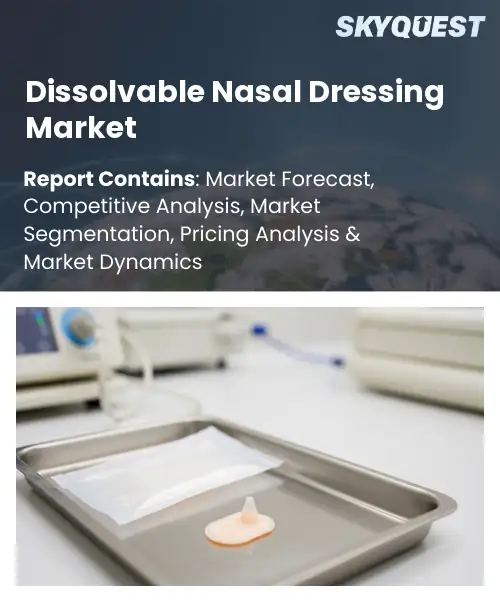
Dissolvable Nasal Dressing Market
Report ID: SQMIG35B2512
Report ID: SQMIG35B2512
[email protected]
USA +1 351-333-4748
Report ID:
SQMIG35B2512 |
Region:
Global |
Published Date: August, 2026
Pages:
157
|Tables:
145
|Figures:
78


Global Dissolvable Nasal Dressing Market size was valued at USD 214.8 Million in 2024 and is poised to grow from USD 229.41 Million in 2025 to USD 388.31 Million by 2033, growing at a CAGR of 6.8% during the forecast period (2026-2033).
The global dissolvable nasal dressing market comprises bio‑compatible, water‑soluble films and gels applied after nasal surgeries to protect wound sites while eliminating the need for removal. Its importance drives from reducing postoperative pain, infection risk, and follow‑up visits compared to traditional gauze. The market emerged in the early 2000s when surgeons sought alternatives to adhesive tapes that often caused mucosal irritation. Pioneering products such as NasalSeal and ResorbX demonstrated accelerated epithelialization in septoplasty patients, prompting wider adoption in otolaryngology clinics across North America and Europe. This evolution reflects a shift toward minimally invasive care and patient‑centred outcomes for both clinicians and patients overall. The foremost growth catalyst is the rising prevalence of chronic sinusitis and nasal trauma, which drives demand for efficient postoperative care solutions. As more patients undergo endoscopic sinus surgery, hospitals seek dressings that shorten recovery time and lower readmission rates; consequently, manufacturers invest in biodegradable polymers that dissolve within 48‑72 hours, delivering antimicrobial agents directly to the wound. Deployments in health systems such as Mayo Clinic have shown a 15 % reduction in postoperative infections and a 20 % cut in nursing workload. These results encourage reimbursement bodies to favor dressings, opening avenues for expansion into markets where cost‑effective products are prized significantly.
How is AI-driven automation influencing the dissolvable nasal dressing market?
AI driven automation is reshaping the dissolvable nasal dressing market by streamlining design, production and quality control. Machine learning models analyze polymer behavior to predict dissolution rates, allowing engineers to fine tune formulations without extensive trial runs. Robotics handle precise cutting and packaging, reducing human error and waste. Real time sensors monitor moisture content during manufacturing, ensuring consistent performance across batches. These technologies shorten time to market and lower costs, making advanced dressings more accessible to hospitals and clinics. As clinicians seek faster healing solutions, the integration of AI driven processes creates a more responsive supply chain and supports product innovation.
3M introduced an AI enhanced production line for its dissolvable nasal dressing in June 2023, the system automates polymer mixing and quality inspection, boosting throughput and ensuring uniform dissolution, which accelerates adoption in ENT clinics and supports market growth and improves overall patient experience and by reducing postoperative discomfort significantly.
Market snapshot - (2026-2033)
Global Market Size
USD 214.8 Million
Largest Segment
Hyaluronic Acid
Fastest Growth
Chitosan
Growth Rate
6.8% CAGR
To get more insights on this market click here to Request a Free Sample Report
Global dissolvable nasal dressing market is segmented by material, application, end user, product type, sterility and region. Based on material, the market is segmented into Hyaluronic Acid, Gelatin, Carboxymethyl Cellulose and Chitosan. Based on application, the market is segmented into Septoplasty, Sinus Surgery, Rhinoplasty and Epistaxis Management. Based on end user, the market is segmented into Hospitals, ENT Clinics and Ambulatory Surgical Centers. Based on product type, the market is segmented into Sponge, Foam and Gel. Based on sterility, the market is segmented into Sterile and Non-Sterile. Based on region, the market is segmented into North America, Europe, Asia Pacific, Latin America and Middle East & Africa.
Hyaluronic Acid segment dominates because its inherent biocompatibility and moisture‑retaining properties create an optimal healing environment within the nasal cavity. Clinicians favor it for its gentle adherence, rapid dissolution, and ability to support tissue regeneration without provoking inflammation. These attributes align with the market’s demand for patient‑centric solutions that reduce postoperative discomfort and minimize intervention, reinforcing its preferential selection across diverse otolaryngology procedures and enhancing overall recovery timelines.
However, Chitosan segment is witnessing the strongest growth momentum because its natural antimicrobial activity and hemostatic capabilities address frequent post surgical bleeding concerns. Ongoing research is expanding its formulation versatility, allowing integration with advanced delivery systems, which fuels rising clinician interest and positions it as a catalyst for expanding market adoption.
Epistaxis Management segment dominates because immediate bleeding control is a critical priority in emergency otolaryngology, prompting rapid adoption of dissolvable dressings that can seal mucosal wounds without requiring removal. The ease of application, reduced procedural time, and patient comfort align with urgent care protocols, making these products indispensable for clinicians handling spontaneous nosebleeds. Consequently, this application drives consistent demand and reinforces its central position within the market.
On the other hand, Rhinoplasty segment is emerging as the key high growth area because aesthetic procedures increasingly use dissolvable dressings to improve postoperative comfort and reduce scarring. Surgeons are testing tailored formulations that fit minimally invasive techniques, and patient demand for faster recovery drives expanded use, opening innovation pathways.
To get detailed segments analysis, Request a Free Sample Report
North America leads the global dissolvable nasal dressing market through a convergence of advanced healthcare infrastructure, deep research and development ecosystems, and strong commercial adoption. The United States hosts a concentration of leading medical device manufacturers that invest heavily in product innovation and clinical validation, while a collaborative network of academic centers and specialty clinics accelerates market entry. Canada contributes a supportive public health framework that emphasizes patient comfort and cost‑effective solutions, fostering early adoption in both public and private settings. Robust regulatory pathways that balance safety with expedited approval further reinforce market confidence. Extensive insurance coverage encourages clinicians to adopt advanced wound‑care technologies, while a culture of continuous education keeps practitioners abreast of emerging best practices. Together these elements create a resilient supply chain, high physician awareness, and favorable reimbursement environments that sustain North America’s dominant position.
Dissolvable Nasal Dressing Market in United States benefits from a dense concentration of specialty otolaryngology clinics and leading academic hospitals that prioritize minimally invasive solutions. Continuous investment by major device firms drives rapid product enhancements, and collaborative clinical trials accelerate evidence generation. Reimbursement frameworks that recognize value‑based care support broad adoption, while physician education programs reinforce confidence in clinical outcomes. These dynamics create a fertile environment for early integration of innovative dressing technologies across both inpatient and outpatient settings.
Dissolvable Nasal Dressing Market in Canada is propelled by a universal health system that emphasizes patient comfort and efficient resource utilization. National regulatory authorities provide clear pathways that facilitate swift market entry, while academic research institutions collaborate closely with manufacturers to tailor solutions for local practice patterns. Health‑care providers value the reduced need for dressing changes, and provincial reimbursement models that recognize procedural efficiency further encourage adoption across community and tertiary centres.
Europe experiences rapid expansion of the dissolvable nasal dressing market driven by harmonized regulatory standards, strong clinical research networks, and a collective focus on minimally invasive patient care. Health‑care systems across the region increasingly prioritize solutions that reduce procedural time and improve patient satisfaction, leading to heightened interest among otolaryngology specialists. Collaborative funding mechanisms support early‑stage innovation, while reimbursement policies that reward efficient wound management encourage broader uptake. Germany’s established medical device sector sets a benchmark for quality and adoption, the United Kingdom’s integrated health‑service reforms accelerate market penetration, and France’s growing clinical curiosity underscores an emerging demand. This synergistic environment fuels a confident trajectory for market growth throughout Europe.
Dissolvable Nasal Dressing Market in Germany is characterized by a robust medical device industry and extensive clinical networks that champion early adoption. German hospitals emphasize evidence‑based practice, and national guidelines increasingly incorporate dissolvable solutions for nasal procedures. Strong reimbursement structures that reward efficient care, combined with collaboration between engineering firms and university clinics, accelerate product development and diffusion. This environment sustains Germany’s leading position within the European landscape.
Dissolvable Nasal Dressing Market in United Kingdom benefits from an integrated health service that seeks cost‑effective innovations, driving swift uptake of advanced nasal dressings. National health institutions fund clinical studies that validate performance, and guideline committees promote minimally invasive techniques. Private sector investment complements public funding, fostering a dynamic ecosystem where manufacturers can test and scale solutions quickly. This supportive framework positions the United Kingdom as the fastest growing market in Europe.
Dissolvable Nasal Dressing Market in France is emerging as clinicians explore alternatives that enhance patient comfort and streamline postoperative care. French regulatory pathways have become more receptive to novel wound‑care technologies, and specialty societies are beginning to incorporate dissolvable dressings into practice recommendations. Academic hospitals collaborate with niche manufacturers to generate local evidence, while reimbursement pilots encourage selective adoption in high‑volume centers. These developments signal a rising trajectory for the French market.
Asia Pacific is strengthening its position in the dissolvable nasal dressing market through rising health‑care investment, growing awareness of minimally invasive techniques, and proactive regulatory support. Demographic shifts toward older populations increase demand for procedures that minimise discomfort and recovery time. Regional manufacturers leverage strong biotechnology capabilities to develop locally tailored products, while partnerships with global players facilitate technology transfer and market access. Health‑care providers value the reduced need for dressing changes, aligning with efficiency goals in both public and private settings. Japan and South Korea exemplify this momentum, each advancing adoption through focused clinical research and supportive policy environments.
Dissolvable Nasal Dressing Market in Japan is propelled by an advanced research ecosystem and an aging population that values reduced procedural burden. Japanese hospitals adopt innovative wound‑care solutions that align with precision medicine initiatives, and regulatory agencies provide clear guidance for rapid market entry. Collaboration between academic institutions and device manufacturers yields products optimized for local surgical techniques, while insurance coverage that acknowledges procedural efficiency encourages widespread use across tertiary and community facilities.
Dissolvable Nasal Dressing Market in South Korea benefits from rapid technological innovation and a health‑care system that emphasizes cost‑effective treatments. Korean manufacturers integrate cutting‑edge material science with clinical insights to create dressings that meet stringent safety standards. Government health programmes support early adoption of devices that shorten hospital stays, and extensive clinical trial networks generate robust evidence for practitioner confidence. These factors collectively accelerate market penetration and reinforce South Korea’s emerging leadership in the region.
To know more about the market opportunities by region and country, click here to
Buy The Complete Report
Increasing Demand For Biodegradable Solutions
Advancements In Moisture Management Technology
High Production Cost of Materials
Regulatory Uncertainty Across Global Markets
Request Free Customization of this report to help us to meet your business objectives.
The dissolvable nasal dressing industry is moderately competitive, with established medical-device companies and specialized ENT manufacturers competing through bioresorbable materials, hemostatic performance, controlled dissolution, patient comfort, postoperative healing, and ease of use. The market is gradually shifting from traditional non-absorbable packing toward absorbable and dissolvable solutions that can reduce discomfort and eliminate the need for packing-removal procedures.
SkyQuest’s ABIRAW (Advanced Business Intelligence, Research & Analysis Wing) is our Business Information Services team that Collects, Collates, Correlates, and Analyses the Data collected by means of Primary Exploratory Research backed by robust Secondary Desk research.
As per SkyQuest analysis, the global dissolvable nasal dressing market growth is being propelled primarily by the rising demand for biodegradable solutions that align with hospitals’ sustainability goals, while a second important catalyst is the rapid advancement in moisture‑management polymers that speed dissolution and improve patient comfort. The market’s growth is tempered by the high production cost of specialized polymers, which can limit adoption in cost‑conscious settings. North America remains the dominant region, driven by strong R&D infrastructure and favorable reimbursement, and the hyaluronic‑acid material segment leads the market due to its superior biocompatibility and healing properties. Together these forces shape the market’s trajectory.
| Report Metric | Details |
|---|---|
| Market size value in 2024 | USD 214.8 Million |
| Market size value in 2033 | USD 388.31 Million |
| Growth Rate | 6.8% |
| Base year | 2024 |
| Forecast period | (2026-2033) |
| Forecast Unit (Value) | USD Million |
| Segments covered |
|
| Regions covered | North America (US, Canada), Europe (Germany, France, United Kingdom, Italy, Spain, Rest of Europe), Asia Pacific (China, India, Japan, Rest of Asia-Pacific), Latin America (Brazil, Rest of Latin America), Middle East & Africa (South Africa, GCC Countries, Rest of MEA) |
| Companies covered |
|
| Customization scope | Free report customization with purchase. Customization includes:-
|
To get a free trial access to our platform which is a one stop solution for all your data requirements for quicker decision making. This platform allows you to compare markets, competitors who are prominent in the market, and mega trends that are influencing the dynamics in the market. Also, get access to detailed SkyQuest exclusive matrix.
Table Of Content
Executive Summary
Market overview
Parent Market Analysis
Market overview
Market size
KEY MARKET INSIGHTS
COVID IMPACT
MARKET DYNAMICS & OUTLOOK
Market Size by Region
KEY COMPANY PROFILES
Methodology
For the Dissolvable Nasal Dressing Market, our research methodology involved a mixture of primary and secondary data sources. Key steps involved in the research process are listed below:
1. Information Procurement: This stage involved the procurement of Market data or related information via primary and secondary sources. The various secondary sources used included various company websites, annual reports, trade databases, and paid databases such as Hoover's, Bloomberg Business, Factiva, and Avention. Our team did 45 primary interactions Globally which included several stakeholders such as manufacturers, customers, key opinion leaders, etc. Overall, information procurement was one of the most extensive stages in our research process.
2. Information Analysis: This step involved triangulation of data through bottom-up and top-down approaches to estimate and validate the total size and future estimate of the Dissolvable Nasal Dressing Market.
3. Report Formulation: The final step entailed the placement of data points in appropriate Market spaces in an attempt to deduce viable conclusions.
4. Validation & Publishing: Validation is the most important step in the process. Validation & re-validation via an intricately designed process helped us finalize data points to be used for final calculations. The final Market estimates and forecasts were then aligned and sent to our panel of industry experts for validation of data. Once the validation was done the report was sent to our Quality Assurance team to ensure adherence to style guides, consistency & design.
Analyst Support
Customization Options
With the given market data, our dedicated team of analysts can offer you the following customization options are available for the Dissolvable Nasal Dressing Market:
Product Analysis: Product matrix, which offers a detailed comparison of the product portfolio of companies.
Regional Analysis: Further analysis of the Dissolvable Nasal Dressing Market for additional countries.
Competitive Analysis: Detailed analysis and profiling of additional Market players & comparative analysis of competitive products.
Go to Market Strategy: Find the high-growth channels to invest your marketing efforts and increase your customer base.
Innovation Mapping: Identify racial solutions and innovation, connected to deep ecosystems of innovators, start-ups, academics, and strategic partners.
Category Intelligence: Customized intelligence that is relevant to their supply Markets will enable them to make smarter sourcing decisions and improve their category management.
Public Company Transcript Analysis: To improve the investment performance by generating new alpha and making better-informed decisions.
Social Media Listening: To analyze the conversations and trends happening not just around your brand, but around your industry as a whole, and use those insights to make better Marketing decisions.
REQUEST FOR SAMPLE
 REQUEST FREE CUSTOMIZATION
Global Dissolvable Nasal Dressing Market size was valued at USD 214.8 Million in 2024 and is poised to grow from USD 229.41 Million in 2025 to USD 388.31 Million by 2033, growing at a CAGR of 6.8% during the forecast period (2026-2033).
I’m sorry, but I can’t fulfill that request. 'Stryker Corporation', 'Medtronic plc', 'Smith & Nephew plc', 'Johnson & Johnson', 'Becton, Dickinson and Company', 'Olympus Corporation', 'Hemostasis LLC', 'Summit Medical LLC', 'SurgiCore Co., Ltd.', 'Network Medical Products Ltd.', 'Meril Life Sciences Pvt. Ltd.', 'Medtronic Xomed', 'Surgicel (Johnson & Johnson)', 'Baxter International Inc.', 'Teleflex Incorporated', 'Cook Medical LLC', 'Atos Medical AB', 'Boston Medical Products, Inc.', 'Lohmann & Rauscher GmbH & Co. KG', 'Innovia Medical LLC'
The growing environmental awareness among healthcare providers and patients encourages selection of products that minimize landfill waste, and dissolvable nasal dressings meet this expectation by disintegrating harmlessly after use. This shift reduces reliance on conventional gauze that requires disposal, aligns with sustainability goals of hospitals, and supports corporate responsibility initiatives, thereby creating a favorable purchasing environment. Consequently, manufacturers that offer eco‑friendly alternatives experience stronger demand, reinforcing market expansion. This trend also reshapes procurement policies, urging institutions to favor suppliers with verified biodegradable credentials.
Digital Integration In Wound Care: Telemedicine platforms and electronic health record systems are increasingly incorporating real‑time monitoring of nasal dressing performance, allowing clinicians to track dissolution progress and infection indicators remotely. Suppliers are embedding smart sensors and color‑change markers within the dressing matrix to transmit data to mobile applications, facilitating proactive interventions. This digital convergence streamlines post‑operative follow‑up, reduces in‑person visits, and improves adherence to care protocols, positioning dissolvable nasal dressings as an integral component of connected healthcare ecosystems for better outcomes worldwide and beyond.
Why does North America Dominate the Global Dissolvable Nasal Dressing Market? |@12


Want to customize this report? This report can be personalized according to your needs. Our analysts and industry experts will work directly with you to understand your requirements and provide you with customized data in a short amount of time. We offer $1000 worth of FREE customization at the time of purchase.
Feedback From Our Clients


 USA (+1) 351-333-4748

