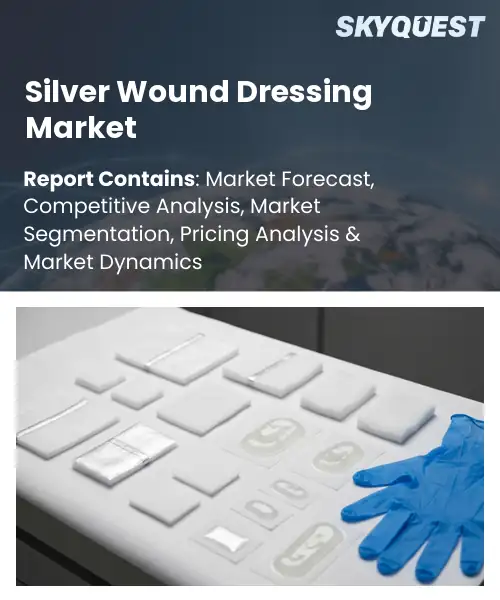
Silver Wound Dressing Market
Report ID: SQMIG35A3488
Report ID: SQMIG35A3488
[email protected]
USA +1 351-333-4748
Report ID:
SQMIG35A3488 |
Region:
Global |
Published Date: May, 2026
Pages:
157
|Tables:
186
|Figures:
79


Global Silver Wound Dressing Market size was valued at USD 1.03 Billion in 2024 and is poised to grow from USD 1.08 Billion in 2025 to USD 1.56 Billion by 2033, growing at a CAGR of 4.7% during the forecast period (2026-2033).
Rising concerns around infections people end up getting in healthcare environments, and antibiotic resistance, are some of the main factors driving the global silver wound dressing market growth. Silver wound dressings are designed in a way that they can release ionic silver, which gives a broad antimicrobial effect, so bioburden goes down, and biofilm growth can be helped to not happen or slow down, yet at the same time they still support moist wound healing. The market matters a lot because wound infections can raise patient morbidity, keep someone in the hospital longer, and generally make healthcare costs climb.
Over time, the silver wound dressing market outlook changes from the early use of silver sulfadiazine for burn care, into more modern types like silver-impregnated foams, hydrogels, alginates, and nanocrystalline dressings. Brands include Acticoat, Aquacel Ag, and others in that lane. Adoption has widened too, not just in hospitals but also in outpatient clinics, long-term care, and home healthcare, since there’s a stronger need for infection control solutions that actually work in everyday settings.
One big growth driver is the rising prevalence of chronic wounds, especially among older adults and people with diabetes. These conditions create constant clinical strain and economic pressure, which nudges clinics toward advanced antimicrobial wound care products. As chronic wounds show up more often, providers tend to look for options that can block infections, speed healing, and reduce how often antibiotics are needed while also lowering hospital readmissions. So, hospitals and payers often treat silver wound dressings as cost-effective wound management tools.
For example, nanocrystalline silver dressings used in diabetic foot ulcer care can help stop the situation from turning into severe infections. That can mean fewer cases needing systemic antibiotics or surgical action. Due to this, manufacturers see growth potential for expanding into outpatient care and in growing healthcare markets across developing regions.
AI is basically reshaping the market by boosting diagnosis, making wound care more personalized, and supporting product development. Some key parts are AI-driven wound assessment that helps decide when antimicrobial silver is the right move, and sensor-enabled dressings that track infection-related signals and moisture levels. Then there is machine learning that supports better formulation choices and manufacturing workflows. Right now, the landscape shows pilot deployments in clinics where clinicians use digital imaging and analytics to select targeted antimicrobial therapy, avoid unnecessary overtreatment, and guide patients into better healing routes. This can be witnessed in image analysis for wound size and bioburden estimates, and even smart dressing prototypes that push real-time information into care routines, so decisions happen faster and patient comfort stays in focus.
Market snapshot - (2026-2033)
Global Market Size
USD 1.03 Billion
Largest Segment
Silver Foam Dressings
Fastest Growth
Silver Hydrofiber Dressings
Growth Rate
4.7% CAGR
To get more insights on this market click here to Request a Free Sample Report
The global silver wound dressing market is segmented by product type, wound type, application, end user, material type, distribution channel, and region. Based on product type, the market is segmented into Silver Foam Dressings, Silver Alginate Dressings, Silver Hydrofiber Dressings, Silver Hydrocolloid Dressings, Silver Barrier Dressings, Silver Antimicrobial Dressings and Others. Based on wound type, the market is segmented into Burns, Surgical Wounds, Diabetic Foot Ulcers, Pressure Ulcers, Venous Leg Ulcers, Traumatic Wounds and Others. Based on application, the market is segmented into Infection Prevention, Moist Wound Healing, Chronic Wound Management, Acute Wound Management and Others. Based on end user, the market is segmented into Hospitals, Clinics, Ambulatory Surgical Centers, Homecare Settings and Others. Based on material type, the market is segmented into Foam-based Dressings, Alginate-based Dressings, Hydrogel-based Dressings, Fabric-based Dressings and Others. Based on distribution channel, the market is segmented into Hospital Pharmacies, Retail Pharmacies, Online Pharmacies and Medical Supply Distributors. Based on region, the market is segmented into North America, Europe, Asia Pacific, Latin America and Middle East & Africa.
As per the silver wound dressing market analysis, the silver foam dressings segment dominates because the mix of high absorbency with conformability fits a wide range of exudative wounds. That, in turn, can cut down on dressing change frequency and makes the clinical workflow feel a bit easier, even when teams are busy. On top of that, the steady antimicrobial delivery from silver-impregnated foams supports infection control protocols too, so clinicians tend to show preference, and formularies follow suit.
However, the Silver Hydrofiber Dressings category is picking up the strongest growth momentum. The gel-forming tech and a more controlled silver release helps with exudate management, especially for chronic wounds. Clinician uptake is rising for long-dwelling applications, and indications are widening too, which pulls in more manufacturer investment. New product launches are coming in faster, and they basically open more room for outpatient and homecare use.
According to the silver wound dressing market forecast, the Hospitals segment led the market because centralized purchasing, institutional formularies, and infection control committees end up concentrating decision-making for advanced wound care. That concentration channels demand toward silver dressings that are already proven. High volumes of complex surgical wounds and pressure injuries also push for validated antimicrobial solutions, so specialist wound teams standardize products. These procurement realities make manufacturers steer toward hospital-focused innovations and supply agreements, and that helps keep availability consistent across inpatient care pathways.
Whereas the Homecare Settings category is predicted to have the largest silver wound dressing market share. As care keeps shifting toward outpatient and home-based chronic wound management, demand for easy-to-use silver dressings climbs. Better product designs, caregiver training, telemedicine support , and reimbursement pressure to reduce hospital stays are all nudging manufacturers to build home-friendly formats. That opens up new commercialization pathways too, and keeps the category moving ahead.
To get detailed segments analysis, Request a Free Sample Report
As per the silver wound dressing market regional forecast, North America dominates the market, because there’s an integrated ecosystem that ties together advanced clinical infrastructure with a solid manufacturer footprint and well-established procurement routes. Deep wound management know-how, along with common adoption of innovative antimicrobial therapies, keeps steady clinical pull. Strong regulatory rules and a steady stream of clinical evidence make products feel credible, and boost clinician confidence a lot.
United States Silver Wound Dressing Market
The Silver Wound Dressing industry in the United States benefits from concentrated clinical know-how and hospitals rolling antimicrobial therapies into everyday practice. There are broad commercial footprints and dependable distribution, so availability stays across many care environments. Clinician familiarity with silver-based modalities and cooperative programs between suppliers and wound care centers helps keep acceptance high. Procurement habits in large health systems, and an emphasis on evidence based practice, reinforce how silver dressings fit into standard wound care and even support patient outcomes overall.
Canada Silver Wound Dressing Market
In Canada, the Silver Wound Dressing sector is shaped by strong engagement from both hospitals and community care, with advanced wound management practices showing up consistently. Regional procurement frameworks and manufacturer, healthcare partnerships improve access to silver-based solutions. Clinical networks and dedicated wound clinics push adoption through guideline-driven use and practitioner training. There’s also a clear focus on antimicrobial stewardship and patient-centric care pathways which supports careful integration of silver dressings across different care settings.
Europe is seeing rapid growth in the silver wound dressing market, pushed by clinicians needing antimicrobial effectiveness and institutions spending proactively on advanced wound care, and then there are national health systems leaning toward evidence-based interventions that include these newer dressings in their care protocols. At the same time, people are more aware of biofilm-related wound difficulties, so clinical attention keeps shifting toward silver-based options, with more emphasis than before. Established device companies and flexible local manufacturers expand portfolios, while distribution gets support from clinical studies and guideline inclusion. Add in cross-border collaboration among reference centers, clinician education activities, and targeted reimbursement structures, and regulatory support and antimicrobial stewardship attention, and adoption across the region widens noticeably.
Germany Silver Wound Dressing Market
The German Silver Wound Dressing Market points to a strong emphasis on clinical evidence and hospital adoption that helps keep a leadership position. There’s also a dense map of specialized wound centers and hospitals that actively support procurement, which helps drive uptake of advanced antimicrobial dressings. Domestic and international manufacturers stay active with focused product development and clinical cooperation. Guideline aligned practice, clinician training initiatives, and tenders within healthcare institutions support silver based dressing integration across care environments.
United Kingdom Silver Wound Dressing Market
The Silver Wound Dressing Market in the United Kingdom is characterized by rising adoption, mostly driven by focused clinical pilots, specialized services, and changing procurement methods across public and private care. Industry collaboration with teaching hospitals helps run real-world evaluation and clinician training. Recognition of antimicrobial strategies in complex wound care is increasing, which supports broader use. Patient-centric pathways and localized formularies allow targeted implementation of silver-based dressings across care environments.
France Silver Wound Dressing Market
The French Silver Wound Dressing Market is gaining momentum, mainly from adoption in hospitals and ambulatory care, backed by involvement from clinical centers of excellence. National and regional attempts to standardize wound care, and the way manufacturers concentrate on localized product design, help clinicians get more comfortable with these options faster. At the same time, cooperative research and education programs tend to reinforce confidence in silver-based solutions. Meanwhile, procurement practices are still moving forward, and there is more focus on patient outcomes, so this supports wider adoption across care pathways as well as different settings.
Asia Pacific is strengthening its grip on the silver wound dressing market, not only by pushing domestic innovation but also by expanding clinical capacity and using more and more sophisticated regulatory routes that actually make commercialization easier. A lot of regional makers are spending on formulation and delivery improvements, while the big, international brands tend to adjust their tactics for local procurement and what clinicians are doing day to day. There’s also this growing focus on upgraded wound management in tertiary hospitals as well as community care, and with clinician education, and a few demonstration projects, clinical acceptance is rising. Meanwhile, regional clinical research centers are generating local proof , so clinicians feel more sure, and then regulatory alignment and supply chain work help market entry feel smoother and distribution more widespread for silver based wound care items.
Japan Silver Wound Dressing Market
Silver Wound Dressing Market Japan blends advanced clinical study, careful hospital adoption, and a solid domestic manufacturing base, which together help antimicrobial dressings get used broadly. Academic groups and clinical hubs help produce evidence, and they also train practitioners. Local producers tend to prioritize innovation in formulations as well as delivery mechanisms, and some companies partner up to tune their products to hospital protocols. The push toward integrated wound care pathways, along with quality outcome tracking, helps adoption spread across different care environments.
South Korea Silver Wound Dressing Market
Silver Wound Dressing Market South Korea shows fast momentum, with innovation translating quickly into real clinical practice, helped by active collaboration between industry and major medical centers. There’s a clear emphasis on device development and materials science, which supports tailored delivery designs, while urban hospital networks and specialized clinics make it easier to evaluate and adopt. Export-oriented production, together with global partnerships, supports tech transfer and expands access to advanced silver dressings across both hospital wards and outpatient settings, at scale.
To know more about the market opportunities by region and country, click here to
Buy The Complete Report
Rising Prevalence Of Chronic Wounds
Advances In Dressing Technologies
Regulatory Approval Complexity
Concerns About Cytotoxicity Risks
Request Free Customization of this report to help us to meet your business objectives.
The global silver wound dressing competitive landscape is driven by major incumbents doing focused M&A and distribution alliances, while newer agile innovators differentiate using antimicrobial delivery technologies. Some of the notable strategic moves are 3M buying Acelity in 2019, Argentum Bravida setting up international distribution partnerships for Silverlon, and Imbed Biosciences rolling out Microlyte Ag L lidocaine as a differentiated product innovation with that sharper edge.
Top Player’s Company Profile
Recent Developments in the Silver Wound Dressing Market
SkyQuest’s ABIRAW (Advanced Business Intelligence, Research & Analysis Wing) is our Business Information Services team that Collects, Collates, Correlates, and Analyses the Data collected by means of Primary Exploratory Research backed by robust Secondary Desk research.
As per SkyQuest analysis, the global silver wound dressing market is driven mainly by the rising prevalence of chronic wounds in aging and diabetic populations, which raises the need for antimicrobial dressings, and it is further supported by advances in dressing technologies that enhance silver delivery and everyday usability. Regulatory approval complexity is still a noticeable limitation, because it slows down new product launches across different regions. North America keeps leading the market, largely due to strong clinical infrastructure and established procurement pathways. Silver foam dressings are leading in both value and how much people use them, mostly for how well they soak up fluid, how they fit and stick around uneven areas, and how reliably they can deliver antimicrobials. The manufacturers that can manage regulatory stuff smoothly and also spell out clear clinical benefits are usually the ones that will grab more of the coming growth.
| Report Metric | Details |
|---|---|
| Market size value in 2024 | USD 1.03 Billion |
| Market size value in 2033 | USD 1.56 Billion |
| Growth Rate | 4.7% |
| Base year | 2024 |
| Forecast period | (2026-2033) |
| Forecast Unit (Value) | USD Billion |
| Segments covered |
|
| Regions covered | North America (US, Canada), Europe (Germany, France, United Kingdom, Italy, Spain, Rest of Europe), Asia Pacific (China, India, Japan, Rest of Asia-Pacific), Latin America (Brazil, Rest of Latin America), Middle East & Africa (South Africa, GCC Countries, Rest of MEA) |
| Companies covered |
|
| Customization scope | Free report customization with purchase. Customization includes:-
|
To get a free trial access to our platform which is a one stop solution for all your data requirements for quicker decision making. This platform allows you to compare markets, competitors who are prominent in the market, and mega trends that are influencing the dynamics in the market. Also, get access to detailed SkyQuest exclusive matrix.
Table Of Content
Executive Summary
Market overview
Parent Market Analysis
Market overview
Market size
KEY MARKET INSIGHTS
COVID IMPACT
MARKET DYNAMICS & OUTLOOK
Market Size by Region
KEY COMPANY PROFILES
Methodology
For the Silver Wound Dressing Market, our research methodology involved a mixture of primary and secondary data sources. Key steps involved in the research process are listed below:
1. Information Procurement: This stage involved the procurement of Market data or related information via primary and secondary sources. The various secondary sources used included various company websites, annual reports, trade databases, and paid databases such as Hoover's, Bloomberg Business, Factiva, and Avention. Our team did 45 primary interactions Globally which included several stakeholders such as manufacturers, customers, key opinion leaders, etc. Overall, information procurement was one of the most extensive stages in our research process.
2. Information Analysis: This step involved triangulation of data through bottom-up and top-down approaches to estimate and validate the total size and future estimate of the Silver Wound Dressing Market.
3. Report Formulation: The final step entailed the placement of data points in appropriate Market spaces in an attempt to deduce viable conclusions.
4. Validation & Publishing: Validation is the most important step in the process. Validation & re-validation via an intricately designed process helped us finalize data points to be used for final calculations. The final Market estimates and forecasts were then aligned and sent to our panel of industry experts for validation of data. Once the validation was done the report was sent to our Quality Assurance team to ensure adherence to style guides, consistency & design.
Analyst Support
Customization Options
With the given market data, our dedicated team of analysts can offer you the following customization options are available for the Silver Wound Dressing Market:
Product Analysis: Product matrix, which offers a detailed comparison of the product portfolio of companies.
Regional Analysis: Further analysis of the Silver Wound Dressing Market for additional countries.
Competitive Analysis: Detailed analysis and profiling of additional Market players & comparative analysis of competitive products.
Go to Market Strategy: Find the high-growth channels to invest your marketing efforts and increase your customer base.
Innovation Mapping: Identify racial solutions and innovation, connected to deep ecosystems of innovators, start-ups, academics, and strategic partners.
Category Intelligence: Customized intelligence that is relevant to their supply Markets will enable them to make smarter sourcing decisions and improve their category management.
Public Company Transcript Analysis: To improve the investment performance by generating new alpha and making better-informed decisions.
Social Media Listening: To analyze the conversations and trends happening not just around your brand, but around your industry as a whole, and use those insights to make better Marketing decisions.
REQUEST FOR SAMPLE
 REQUEST FREE CUSTOMIZATION
Global Silver Wound Dressing Market size was valued at USD 1.03 Billion in 2024 and is poised to grow from USD 1.08 Billion in 2025 to USD 1.56 Billion by 2033, growing at a CAGR of 4.7% during the forecast period (2026-2033).
The global silver wound dressing competitive landscape is driven by incumbents executing targeted M&A and distribution alliances while agile innovators differentiate through antimicrobial delivery technologies. Notable strategic moves include 3M acquiring Acelity in 2019, Argentum Bravida forming international distribution partnerships for Silverlon, and Imbed Biosciences launching Microlyte Ag L idocaine as a differentiated product innovation. 'Smith & Nephew', 'Mölnlycke Health Care', 'Convatec', '3M', 'Coloplast', 'Integra LifeSciences', 'B. Braun', 'Medline Industries', 'Cardinal Health', 'Essity', 'Hartmann Group', 'Derma Sciences', 'Urgo Medical', 'Winner Medical', 'Hollister Incorporated', 'Lohmann & Rauscher', 'Advanced Medical Solutions', 'Axio Biosolutions', 'Nitto Denko', 'DeRoyal Industries'
The increasing incidence of chronic wounds raises clinical demand for advanced topical therapies, and silver dressings are valued for their antimicrobial properties that support infection control and wound bed stabilization. Healthcare providers favor solutions that reduce dressing change frequency and support healing in complex wound types, which positions silver based products as preferred options in many care settings. Growing clinician familiarity and positive patient tolerance further encourage adoption, allowing manufacturers to expand product lines and distribution while meeting unmet needs within diverse patient populations.
Integration With Advanced Biomaterials: Integration with advanced biomaterials is driving design evolution in silver wound dressings, combining antimicrobial silver with hydrophilic matrices, electrospun nanofibers and bioactive polymers to promote moisture balance, cell migration and reduced dressing change frequency. These composite architectures enable controlled silver release, improved conformability and enhanced biocompatibility, supporting personalized wound therapies for diverse wound etiologies. Collaboration between material scientists and clinicians accelerates translation of multifunctional dressings that address patient comfort, scar management and chronic wound microenvironment modulation while preserving antimicrobial efficacy.
Why does North America Dominate the Global Silver Wound Dressing Market? |@12


Want to customize this report? This report can be personalized according to your needs. Our analysts and industry experts will work directly with you to understand your requirements and provide you with customized data in a short amount of time. We offer $1000 worth of FREE customization at the time of purchase.
Feedback From Our Clients


 USA (+1) 351-333-4748

