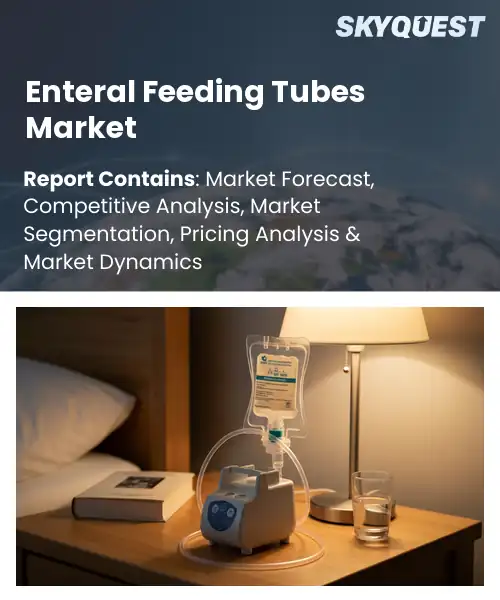
Enteral Feeding Tubes Market
Report ID: SQMIG35J2482
Report ID: SQMIG35J2482
[email protected]
USA +1 351-333-4748
Report ID:
SQMIG35J2482 |
Region:
Global |
Published Date: June, 2026
Pages:
157
|Tables:
150
|Figures:
78


Global Enteral Feeding Tubes Market size was valued at USD 2.8 Billion in 2024 and is poised to grow from USD 2.93 Billion in 2025 to USD 4.23 Billion by 2033, growing at a CAGR of 4.7% during the forecast period (2026-2033).
Major factor driving the enteral feeding tubes market is demographic and epidemiological changes leading to increasing demand for long-term nutrition support. The market for enteral feeding tubes, used to deliver nutrients directly into the gastrointestinal tract for patients unable to swallow, encompasses nasogastric, nasojejunal, gastrostomy and jejunostomy devices used in hospitals, long-term care facilities and home settings. Why it matters to the sector Infection is reduced, hospital stays are shortened and quality of life is improved with consistent enteral nutrition. Solutions are motivators for clinicians to adopt. Over time, the market has expanded from just inpatient use to include outpatient and home care. Examples include the growing use of percutaneous endoscopic gastrostomy procedures and new innovations in silicone tubes.
Beyond these structural changes, the growth of home healthcare and supportive reimbursement policies that create direct demand for user-friendly enteral devices are major drivers of global growth. With aging populations and higher chronic disease prevalence boosting long-term feeding needs, hospitals are discharging patients earlier and clinicians require reliable outpatient solutions, leading manufacturers to create softer materials, anti-reflux features, and compatible pumps. This innovation has led to fewer complications and less burden on caregivers and increased acceptance by families; for example, stroke survivors with percutaneous tubes monitored by telehealth are not readmitted. Vendors thus have obvious commercial opportunities in smart-pump integrations, single-use disposables and emerging-market distribution.
How is AI improving patient outcomes in the enteral feeding tubes market?
AI is improving outcomes for patients in the enteral feeding tubes market by offering smarter guidance monitoring for placement and tailored nutrition strategies. Key features include AI assisted navigation to reduce risk of misplacement and aspiration, continuous sensor driven monitoring to identify intolerance early and predictive analytics to individualise feeding regimens to individual physiology. Hospitals and NICU teams are looking at these approaches through real-world studies and device clearances and the market is trending toward integrated smart systems. Such a trend is evident in recent company activity. Gravitas Medical has started a multicenter NICU study April 2026 ENvue is developing navigation technologies February 2026 Luminoah is showcasing systems in early 2026
Luminoah April 2026: FDA clearance of the Luminoah Flow system shows how AI enabled closed loop enteral nutrition integrates automated monitoring and adaptive delivery to minimize intolerance and complications while improving nutritional consistency. This innovation fuels market adoption and hospital efficiency with simplified workflows and greater confidence in the clinical setting.
Market snapshot - (2026-2033)
Global Market Size
USD 2.8 Billion
Largest Segment
Systemic Therapies
Fastest Growth
Biologic Therapies
Growth Rate
4.7% CAGR
To get more insights on this market click here to Request a Free Sample Report
Global enteral feeding tubes market is segmented by reatment type, drug class, route of administration, distribution channel, end user and region. Based on reatment type, the market is segmented into Topical Therapies, Systemic Therapies, Biologic Therapies and Phototherapy. Based on drug class, the market is segmented into Corticosteroids, Antihistamines, Immunosuppressants, Biologics, Neuromodulators and Others. Based on route of administration, the market is segmented into Topical, Oral, Injectable and Intravenous. Based on distribution channel, the market is segmented into Hospital Pharmacies, Retail Pharmacies and Online Pharmacies. Based on end user, the market is segmented into Hospitals, Dermatology Clinics, Ambulatory Care Centers and Homecare Settings. Based on region, the market is segmented into North America, Europe, Asia Pacific, Latin America and Middle East & Africa.
Hospital Pharmacies segment dominates as they are central procurement and clinical coordination hubs for enteral feeding tubes, concentrating purchasing power, sterile storage and clinician driven selection of specialized devices. Integration with nutrition support teams, in house sterilization and product evaluation capabilities drives adoption of clinically validated tubes and accessories, and hospital formularies and protocolized care reinforce consistent use across acute and post acute pathways in the Enteral Feeding Tubes Market.
However, the fastest growth in the Enteral Feeding Tubes Market is coming from Online Pharmacies, as the convenience of ecommerce and direct patient delivery lowers access friction. New demand channels and the ability to reach wider patient populations are being created by digital ordering, subscription models and greater product availability, driving adoption of home nutrition care.
Hospitals dominate the segmentation as they concentrate complex clinical cases with advanced enteral feeding tube placement, monitoring and multidisciplinary nutrition support that set best practice protocols and device evaluation standards that influence procurement preferences. Adoption of higher specification tubes and securement systems is driven by capital equipment, clinical training programs and infection prevention infrastructure. Manufacturer innovation and standards are influenced by hospital led clinical evidence and guideline development across the Enteral Feeding Tubes Market.
Meanwhile, Homecare Settings are emerging as the fastest growing user in the Enteral Feeding Tubes Market as outpatient care shifts and patient preference for home nutrition increase demand for devices. Manufacturers are now able to offer simplified kits and service models that extend their market reach as improvements in portable pumps, caregiver training and support through telehealth add to the options for safe home management.
To get detailed segments analysis, Request a Free Sample Report
The global market for enteral feeding tubes is dominated by North America, driven by robust healthcare infrastructure, considerable investment in medical device innovation, and established clinical pathways for adoption. Broad use is enabled by well-established hospital networks and specialized long term care facilities, while collaborative networks between clinicians, academia and manufacturers accelerate development of products and clinical validation. New technologies can enter and scale up the market through reimbursement frameworks and regulatory clarity, and a robust distribution and service ecosystem allows timely access across care settings. Demand for higher specification devices is being driven by focus on patient safety, infection control protocols and training programmes. The region also benefits from a dense concentration of key industry players, which drives competitive differentiation through ongoing product improvements and targeted physician engagement.
Market for Enteral Feeding Tubes The United States has a mature demand base supported by sophisticated acute and chronic care pathways, strong clinician engagement and rapid adoption of minimally invasive and safety focused devices. Leading manufacturers still compete on the basis of product innovation, evidence development and the degree of service support they provide. This is driven by supply chain resilience, wide-ranging payer coverage mechanisms and consistent adoption by hospitals, outpatient clinics and home care providers.
The Enteral Feeding Tubes Market Canada is characterized by a dedication to fair access in various care environments, incorporation of optimal practice guidelines and a concentration on the safety and training of the device. Provincial procurement models assist product selection and standardization, and collaborative research efforts help adapt technology to local clinical needs. Manufacturers must provide durable, user friendly solutions and post market support that clinicians in a variety of remote healthcare settings expect.
Strong clinical awareness, harmonised regulatory pathways and demand for improved patient outcomes in acute and long term care settings are spurring rapid expansion in Europe. Rapid dissemination of innovations targeting safety, ease of use and infection control has been facilitated by increased collaboration between hospitals, research organizations and manufacturers. Standardization is being driven by national procurement strategies and cross border clinical guidelines. Device adaptation to home based and ambulatory care settings is being driven by diversified care delivery models. The existence of specialized device makers and active clinical societies helps produce evidence and professional training, which speeds up adoption by clinicians looking for safe, patient-centered enteral feeding solutions. Several health systems have favorable reimbursement policies and there is increasing private provider interest, supplementing public sector procurement and allowing for greater penetration of the market. Focus on aftercare services, device compatibility and patient education differentiate offerings and allow for sustained use across complex care pathways.
Enteral Feeding Tube Market Germany has a well established medical technology sector, strong clinical research networks and structured hospital procurement processes that favor high quality, evidence backed devices. The clinician’s need for robust, safety oriented solutions drives manufacturers to focus on clinical validation and product longevity. Collaborations with industry and certified training programs improve procedural skills and distribution networks ensure timely and efficient distribution to tertiary hospitals and specialized care centers.
The United Kingdom Enteral Feeding Tubes Market is driven by the active adoption by clinicians, progressive procurement practices and focus on community based care pathways. Working with manufacturers and healthcare trusts on pilots to test usability and efficiency and to foster innovation. Clinicians have confidence in device safety, training and post market surveillance. Manufacturers are providing modular, compatibility-oriented devices and strong service models to support scaling across hospital and home environments.
Enteral Feeding Tubes Market is a market that is becoming committed to safety, clinician education and customization for different care pathways. Public hospitals and specialized care centers are interested in evidence based choice and compatibility with existing systems. Manufacturers are refining their products to make insertion easier, reduce infection risk, and enhance patient comfort, and collaborations with clinical societies are supporting training and the creation of guidelines. Also, additional support for integrating home care drives adoption outside of acute settings.
Asia Pacific is building its position with increasing clinical capacity, strategic investment in the manufacturing of medical devices and increasing focus on localized product development to cater for the diverse patient populations and care settings. With the growth of hospital chains and the improvement of home healthcare services, the demand for flexible and user-friendly enteral feeding products is increasing. Regional manufacturers are raising quality standards and partnering with global companies to gain access to advanced technologies and clinical expertise. Training initiatives and increased clinician awareness support correct device use, while improved distribution infrastructure reduces time to care in urban and less accessible areas, together enhancing the region’s role in the global market. 4) Cost pressure: Manufacturers are finding themselves under more pressure to be efficient in production and to offer value in features. Regulations are catching up and becoming clearer to allow the approval of more contemporary designs. Regional competitiveness and attractiveness for collaboration with international stakeholders can be enhanced through the focus on after-care services and remote monitoring, and the alignment of device offerings to long-term patient management needs.
Enteral Feeding Tubes Market The technology in Japan is characterized by constant refinement, high standards of quality and close interaction between manufacturers and clinical institutions. Preference for precision engineered devices. Innovation in comfort and safety features. Clinicians and procedures are trained in hospitals; domestic producers work with global partners on refined solutions. Patient centered design focus supports uptake across urban and rural settings in acute care and home based services.
Enteral Feeding Tubes Industry South Korea is gaining momentum with strong medical manufacturing capabilities, quick adoption of proven designs and collaborations with global innovators. Hospitals prefer easy to use devices with good infection control, therefore, user friendly and safety enhanced devices are developed. Local evidence is generated faster through government-backed initiatives and collaboration on clinical research. Manufacturers are emphasizing scalable manufacturing and integrated aftercare services to allow use across hospital, clinic and home care settings.
To know more about the market opportunities by region and country, click here to
Buy The Complete Report
Rising Chronic Disease Burden
Technological Advancements In Devices
Risk Of Device Related Complications
High Cost Of Advanced Products
Request Free Customization of this report to help us to meet your business objectives.
Competitive focus narrows to safety led product differentiation and access innovation: incumbents like B. Braun, Cardinal, Nutricia and Fresenius aim to roll-out and partner with distribution to get customers on to the ENFit connectors whereas challengers have to launch new access paths, connected feeders. We saw some recent, concrete progress with the recent launches of Alsteni's (FDA 510k engagement of its intraoral anchored platform) and Luminoah's (portable, connected feeding system), thereby positioning clinical partnerships and regulatory processes as competitive levers.
SkyQuest’s ABIRAW (Advanced Business Intelligence, Research & Analysis Wing) is our Business Information Services team that Collects, Collates, Correlates, and Analyses the Data collected by means of Primary Exploratory Research backed by robust Secondary Desk research.
As per SkyQuest analysis, the global enteral feeding tubes market is being propelled by expansion of home healthcare and supportive reimbursement policies and by rapid technological advancements such as smart device integration that enable monitoring and closed loop systems. Nevertheless device related complications including infection and dislodgement remain a meaningful restraint that limits broader adoption. North America remains the dominating region because of advanced healthcare infrastructure and strong clinical adoption, while Hospital Pharmacies are the dominating segment due to centralized procurement and nutrition support teams driving clinical selection. These dynamics create opportunities for manufacturers to focus on user friendly designs, remote monitoring and value based service models.
| Report Metric | Details |
|---|---|
| Market size value in 2024 | USD 2.8 Billion |
| Market size value in 2033 | USD 4.23 Billion |
| Growth Rate | 4.7% |
| Base year | 2024 |
| Forecast period | (2026-2033) |
| Forecast Unit (Value) | USD Billion |
| Segments covered |
|
| Regions covered | North America (US, Canada), Europe (Germany, France, United Kingdom, Italy, Spain, Rest of Europe), Asia Pacific (China, India, Japan, Rest of Asia-Pacific), Latin America (Brazil, Rest of Latin America), Middle East & Africa (South Africa, GCC Countries, Rest of MEA) |
| Companies covered |
|
| Customization scope | Free report customization with purchase. Customization includes:-
|
To get a free trial access to our platform which is a one stop solution for all your data requirements for quicker decision making. This platform allows you to compare markets, competitors who are prominent in the market, and mega trends that are influencing the dynamics in the market. Also, get access to detailed SkyQuest exclusive matrix.
Table Of Content
Executive Summary
Market overview
Parent Market Analysis
Market overview
Market size
KEY MARKET INSIGHTS
COVID IMPACT
MARKET DYNAMICS & OUTLOOK
Market Size by Region
KEY COMPANY PROFILES
Methodology
For the Enteral Feeding Tubes Market, our research methodology involved a mixture of primary and secondary data sources. Key steps involved in the research process are listed below:
1. Information Procurement: This stage involved the procurement of Market data or related information via primary and secondary sources. The various secondary sources used included various company websites, annual reports, trade databases, and paid databases such as Hoover's, Bloomberg Business, Factiva, and Avention. Our team did 45 primary interactions Globally which included several stakeholders such as manufacturers, customers, key opinion leaders, etc. Overall, information procurement was one of the most extensive stages in our research process.
2. Information Analysis: This step involved triangulation of data through bottom-up and top-down approaches to estimate and validate the total size and future estimate of the Enteral Feeding Tubes Market.
3. Report Formulation: The final step entailed the placement of data points in appropriate Market spaces in an attempt to deduce viable conclusions.
4. Validation & Publishing: Validation is the most important step in the process. Validation & re-validation via an intricately designed process helped us finalize data points to be used for final calculations. The final Market estimates and forecasts were then aligned and sent to our panel of industry experts for validation of data. Once the validation was done the report was sent to our Quality Assurance team to ensure adherence to style guides, consistency & design.
Analyst Support
Customization Options
With the given market data, our dedicated team of analysts can offer you the following customization options are available for the Enteral Feeding Tubes Market:
Product Analysis: Product matrix, which offers a detailed comparison of the product portfolio of companies.
Regional Analysis: Further analysis of the Enteral Feeding Tubes Market for additional countries.
Competitive Analysis: Detailed analysis and profiling of additional Market players & comparative analysis of competitive products.
Go to Market Strategy: Find the high-growth channels to invest your marketing efforts and increase your customer base.
Innovation Mapping: Identify racial solutions and innovation, connected to deep ecosystems of innovators, start-ups, academics, and strategic partners.
Category Intelligence: Customized intelligence that is relevant to their supply Markets will enable them to make smarter sourcing decisions and improve their category management.
Public Company Transcript Analysis: To improve the investment performance by generating new alpha and making better-informed decisions.
Social Media Listening: To analyze the conversations and trends happening not just around your brand, but around your industry as a whole, and use those insights to make better Marketing decisions.
REQUEST FOR SAMPLE
 REQUEST FREE CUSTOMIZATION
Global Enteral Feeding Tubes Market size was valued at USD 2.8 Billion in 2024 and is poised to grow from USD 2.93 Billion in 2025 to USD 4.23 Billion by 2033, growing at a CAGR of 4.7% during the forecast period (2026-2033).
Competition is concentrated on safety driven product differentiation and access innovation, with established manufacturers pursuing ENFit connector adoption and distribution partnerships while challengers advance new access routes and connected feeders. Recent concrete moves include Luminoah progressing a portable, connected feeding system and Alsteni moving an intraoral anchored platform toward FDA 510k engagement, making clinical partnerships and regulatory milestones decisive competitive levers. 'Cardinal Health', 'Avanos Medical', 'B. Braun SE', 'Fresenius Kabi', 'Danone Nutricia', 'Vygon Group', 'ConvaTec Group', 'Cook Medical', 'Applied Medical Technology (AMT)', 'Boston Scientific Corporation', 'Becton, Dickinson and Company', 'Medtronic plc', 'Moog Medical Devices Group', 'Angiplast Private Limited', 'Romsons Group', 'Medela AG', 'Well Lead Medical Co., Ltd.', 'Bicakcilar Medical Devices', 'Fuji Systems Corporation', 'GBUK Group Ltd.'
The increasing prevalence of chronic illnesses that impair swallowing and digestion leads to sustained demand for enteral nutrition, prompting healthcare providers and caregivers to rely more frequently on feeding tubes for long term nutritional support. This creates pressure on manufacturers to expand offerings that address varied clinical needs and patient settings, encouraging product development, wider distribution, and training initiatives. As a result, market activity intensifies because healthcare systems prioritize continuity of care, outpatient management, and solutions that improve patient comfort and reduce complications.
Home Care Adoption Growth: Shifts toward decentralized healthcare and patient preference for home treatment are expanding acceptance of enteral feeding outside institutional settings. Manufacturers tailor products for ease of use, caregiver training and remote monitoring to support long term domiciliary therapy. Increased payer recognition of home delivery benefits, coupled with designs that emphasize portability and simplified maintenance, creates opportunities for new distribution channels, care models and partnerships focused on improving patient quality of life while reducing dependence on acute care environments with ancillary support.
Why does North America Dominate the Global Enteral Feeding Tubes Market? |@12


Want to customize this report? This report can be personalized according to your needs. Our analysts and industry experts will work directly with you to understand your requirements and provide you with customized data in a short amount of time. We offer $1000 worth of FREE customization at the time of purchase.
Feedback From Our Clients


 USA (+1) 351-333-4748

