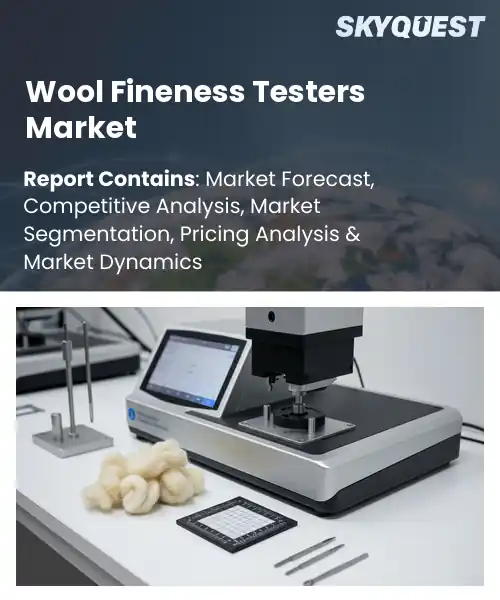
Wool Fineness Testers Market
Report ID: SQMIG45J2694
Report ID: SQMIG45J2694
[email protected]
USA +1 351-333-4748
Report ID:
SQMIG45J2694 |
Region:
Global |
Published Date: July, 2026
Pages:
157
|Tables:
145
|Figures:
78


Global Wool Fineness Testers Market size was valued at USD 164.9 Million in 2024 and is poised to grow from USD 173.8 Million in 2025 to USD 264.72 Million by 2033, growing at a CAGR of 5.4% during the forecast period (2026-2033).
The global wool fineness testers market revolves around instruments that quantify fiber diameter to certify quality and price. Its primary driver is the escalating demand for wool in fashion and textiles, where fineness directly influences softness, strength, and thermal performance. Historically, producers relied on manual micrometer techniques, but the 1990s saw the introduction of optical fiber diameter analyzers that offered higher repeatability. Today, digital laser‑diffraction systems dominate, delivering sub‑micron accuracy and rapid throughput. For instance, Australian Merino growers have adopted automated testers to meet stringent export standards, while Chinese garment factories integrate them to reduce waste and enhance product consistency. Building on that demand, the market’s next key factor is the integration of quality management systems, which unlocks new growth avenues for manufacturers seeking traceability and sustainability. As retailers impose stricter provenance requirements, wool processors embed tester outputs into enterprise resource planning platforms, enabling grading and automated pricing adjustments. This connectivity reduces manual errors, shortens batch release cycles, and lowers inventory costs, prompting midsize farms in New Zealand to invest in testers that feed directly into export documentation. Simultaneously, the rise of smart textile applications such as wearable insulation creates opportunities for instruments to support research labs developing fine fibers, further expanding the market’s scope.
How is AI-driven automation reshaping the wool fineness testers market?
AI driven automation is redefining wool fineness testing by embedding machine learning algorithms into handheld and bench‑top instruments. Sensors now capture fiber diameter data in real time, while software interprets patterns to flag out‑of‑spec samples without manual calculation. This reduces operator fatigue and eliminates subjective bias, leading to more consistent quality control across mills and research labs. Laboratories are adopting integrated platforms that combine imaging, data logging and cloud‑based reporting, allowing producers to track batch performance instantly. The shift also supports traceability initiatives, as digital records can be linked to breeding and processing decisions, creating a feedback loop that improves flock management and product value.SheepUSA March 2026 introduced an AI enabled fineness testing module that plugs into existing testers, cutting analysis time and boosting repeatability, thereby accelerating market efficiency.
Market snapshot - (2026-2033)
Global Market Size
USD 164.9 Million
Largest Segment
Optical Wool Fineness Testers
Fastest Growth
Airflow Wool Fineness Testers
Growth Rate
5.4% CAGR
To get more insights on this market click here to Request a Free Sample Report
Global wool fineness testers market is segmented by product type, measurement method, application, end user, operation and region. Based on product type, the market is segmented into Optical Wool Fineness Testers, Airflow Wool Fineness Testers and Projection Microscopes. Based on measurement method, the market is segmented into Optical Analysis, Airflow Method and Image Analysis. Based on application, the market is segmented into Wool Grading, Textile Manufacturing, Quality Control and Research. Based on end user, the market is segmented into Wool Processing Companies, Textile Manufacturers, Testing Laboratories and Research Institutes. Based on operation, the market is segmented into Benchtop and Portable. Based on region, the market is segmented into North America, Europe, Asia Pacific, Latin America and Middle East & Africa.
Optical Wool Fineness Testers segment dominates because it offers direct visual assessment of fiber diameter, enabling technicians to quickly interpret fineness without complex calibration. The intuitive interface aligns with traditional grading workflows, reducing training time and operational errors. Its ability to integrate with existing laboratory software further enhances data traceability, fostering confidence among users. Consequently, manufacturers prioritize this technology to meet stringent quality standards and maintain competitive advantage.
However, Airflow Wool Fineness Testers segment is witnessing growth as manufacturers seek non contact measurement for throughput environments. Advances in sensor precision reduce variability while integration with sorting lines accelerates production cycles. This momentum expands market reach encouraging investment in next generation airflow solutions that promise efficiency and lower labor dependence.
Projection Microscopes segment dominates because it delivers high resolution imaging that captures fine fiber details essential for precise quality assessment. The ability to project enlarged images onto a screen facilitates collaborative inspection, reducing reliance on individual expertise. Its compatibility with digital capture tools streamlines record keeping and audit trails, meeting regulatory expectations. Consequently, testing laboratories adopt this technology to ensure consistent product standards and enhance operational confidence.
On the other hand, Portable operation segment is emerging as the growth area as field technicians require mobility for on site assessments. Battery powered designs and rugged casings enable use in processing environments, expanding the tester’s reach beyond the laboratory. This flexibility drives broader adoption, opening revenue streams and encouraging manufacturers to innovate compact durable solutions.
To get detailed segments analysis, Request a Free Sample Report
Europe’s dominance stems from a deep-rooted textile heritage combined with cutting‑edge research ecosystems that continuously refine wool quality standards. The region benefits from a dense network of specialized manufacturers that integrate precision engineering with rigorous quality control, fostering high confidence among end users. Strong regulatory frameworks promote consistent testing protocols, while sustainability initiatives drive demand for accurate fineness measurement. Collaborative ties between academic institutions and industry leaders accelerate innovation, ensuring that European solutions remain at the forefront of performance and reliability. This confluence of tradition, technology, and policy creates a resilient market environment that sustains Europe’s leading position.
Germany Wool Fineness Testers Market
Wool Fineness Testers Market in Germany is propelled by a reputation for engineering excellence and a robust manufacturing base that emphasizes precision instrumentation. The country’s textile clusters demand reliable testing solutions to maintain high product standards, encouraging local firms to invest heavily in research and development. Close cooperation between universities and industry accelerates the adoption of advanced measurement techniques, reinforcing Germany’s role as a benchmark for quality assurance in wool processing.
United Kingdom Wool Fineness Testers Market
Wool Fineness Testers Market in the United Kingdom thrives on a blend of historic wool production and modern analytical capabilities. Leading research institutions contribute to the development of sophisticated testing methodologies, while a vibrant fashion sector seeks consistent fineness data to support premium branding. Collaborative initiatives between manufacturers and regulatory bodies ensure that testing practices align with evolving market expectations, positioning the United Kingdom as a hub for both traditional and innovative wool quality solutions.
France Wool Fineness Testers Market
Wool Fineness Testers Market in France benefits from a strong emphasis on luxury textiles and a culture of meticulous craftsmanship. French manufacturers prioritize exacting fineness measurements to uphold the reputation of high‑end apparel, driving demand for reliable testing equipment. Government‑supported research programs foster continuous improvement in analytical techniques, while close ties between design houses and testing service providers create a seamless feedback loop that sustains France’s leadership in refined wool assessment.
The rapid expansion in North America is fueled by a surge in premium apparel and technical textile applications that require precise wool fineness data. Companies are investing in advanced testing technologies to meet stringent quality expectations and to differentiate their products in competitive markets. Strong collaboration between research institutions and industry accelerates the development of innovative measurement solutions, while supportive trade policies facilitate the flow of equipment and expertise across borders. Growing consumer awareness of sustainability further amplifies the need for accurate fineness assessment, positioning North America as a dynamic growth engine for the sector.
United States Wool Fineness Testers Market
Wool Fineness Testers Market in the United States is characterized by a vibrant ecosystem of technology providers and textile manufacturers seeking high‑performance testing tools. The country’s emphasis on research and development drives the introduction of next‑generation instruments that enhance accuracy and efficiency. A broad base of end‑users, ranging from fashion houses to industrial fabric producers, creates sustained demand for reliable fineness measurement, reinforcing the United States as a pivotal market for advanced testing solutions.
Canada Wool Fineness Testers Market
Wool Fineness Testers Market in Canada benefits from a strong focus on quality assurance within its textile and apparel sectors. Collaborative networks between academic research centers and equipment manufacturers foster the adoption of refined testing practices. The Canadian market places high value on sustainability and traceability, prompting manufacturers to seek precise fineness data to support eco‑friendly product claims, thereby strengthening the country’s role in the broader North American landscape.
Asia Pacific is strengthening its position through a combination of rising demand for high‑performance fabrics and proactive government support for textile innovation. The region’s manufacturers are increasingly adopting digital testing platforms that improve speed and accuracy, while strategic partnerships with global technology firms accelerate knowledge transfer. Emphasis on export‑oriented production drives the need for internationally recognized fineness standards, encouraging local firms to invest in state‑of‑the‑art testing equipment. This collaborative and technology‑focused approach is elevating Asia Pacific’s influence in the global market.
Japan Wool Fineness Testers Market
Wool Fineness Testers Market in Japan is driven by a culture of meticulous quality control and a strong tradition of textile craftsmanship. Japanese manufacturers prioritize precision instruments that align with exacting standards, fostering continuous improvement in testing accuracy. Partnerships between research institutes and equipment suppliers enable rapid integration of innovative measurement techniques, reinforcing Japan’s reputation for excellence in wool fineness assessment.
South Korea Wool Fineness Testers Market
Wool Fineness Testers Market in South Korea is propelled by a dynamic textile sector that embraces advanced automation and digital analytics. The country’s focus on high‑tech manufacturing encourages the deployment of sophisticated testing solutions that enhance productivity and data reliability. Collaborative initiatives between universities and industry players support the development of cutting‑edge fineness measurement technologies, positioning South Korea as an emerging leader in the regional market.
To know more about the market opportunities by region and country, click here to
Buy The Complete Report
Increasing Demand for High‑Quality Wool
The textile industry’s focus on premium apparel drives manufacturers to adopt precise wool fineness testing, ensuring fiber consistency and meeting consumer expectations for softness and durability. By integrating advanced testing equipment, producers can reduce material waste, improve product quality, and enhance brand reputation. This alignment with quality‑centric market demands encourages investment in testing solutions, fostering sustained growth for suppliers of wool fineness testers across regions that prioritize high‑end garment production. Additionally, retailers increasingly require certification of fiber specifications, further prompting manufacturers to incorporate reliable testing processes into their production lines.
Adoption Of Automated Testing Solutions
Automation in wool fineness testing reduces manual errors and shortens analysis time, enabling faster decision‑making on raw material selection. Laboratories equipped with digital microscopes and AI‑driven image analysis can perform high‑throughput assessments while maintaining accuracy. This efficiency supports larger production volumes and lowers operational costs, making advanced testing equipment attractive to both small‑scale artisans and industrial manufacturers. As supply chains seek greater responsiveness, the shift toward automated solutions accelerates market expansion for vendors offering integrated, user‑friendly testing platforms globally today.
High Capital Investment Required
The sophisticated technology and precision components integral to wool fineness testers entail substantial upfront costs, limiting accessibility for smaller manufacturers and research facilities. Organizations must allocate significant budgetary resources for equipment purchase, installation, and staff training, which can delay adoption decisions. This financial barrier discourages rapid market penetration, especially in emerging economies where cost sensitivities dominate procurement strategies. Consequently, the high capital requirement curtails demand growth, confining market expansion to well‑funded enterprises and slowing overall adoption rates. Additionally, financing options remain limited for niche applications.
Stringent Regulatory Compliance
Wool fineness testing equipment must adhere to rigorous standards concerning measurement accuracy, safety, and environmental impact, which vary across regions. Manufacturers are compelled to undergo extensive certification processes and maintain documentation to satisfy authorities such as textile regulatory bodies and occupational health agencies. This compliance burden increases product development timelines and operational expenses, discouraging some suppliers from entering the market or launching new models quickly. The resulting hesitation to invest in compliant technologies slows market momentum, particularly where regulatory frameworks are continuously evolving.
Request Free Customization of this report to help us to meet your business objectives.
The competitive landscape of the global wool fineness testers market is shaped by intense rivalry among manufacturers seeking to differentiate through advanced automation, precision analytics, and integrated software platforms. Recent strategic moves include acquisitions of niche sensor technology firms, joint development agreements with textile research institutes, and the rollout of AI‑driven defect detection modules to enhance product consistency and reduce testing cycle times. These actions reflect a clear focus on leveraging innovation and collaboration to capture market share in a sector driven by stringent quality standards.
Top Player’s Company Profile
Recent Developments
SkyQuest’s ABIRAW (Advanced Business Intelligence, Research & Analysis Wing) is our Business Information Services team that Collects, Collates, Correlates, and Analyses the Data collected by means of Primary Exploratory Research backed by robust Secondary Desk research. As per SkyQuest analysis the global wool fineness testers market is being propelled primarily by the rising demand for high‑quality wool, which pushes manufacturers to adopt precise testing to meet premium apparel standards, while a second driver comes from the rapid uptake of automated testing solutions that cut analysis time and improve consistency. Europe remains the dominant region thanks to its strong textile heritage and stringent quality regulations, and the optical wool fineness testers segment leads the market because of its intuitive visual assessment and easy software integration. However, the high capital investment required for advanced instruments restrains adoption, especially among smaller producers, tempering overall growth.
| Report Metric | Details |
|---|---|
| Market size value in 2024 | USD 164.9 Million |
| Market size value in 2033 | USD 264.72 Million |
| Growth Rate | 5.4% |
| Base year | 2024 |
| Forecast period | (2026-2033) |
| Forecast Unit (Value) | USD Million |
| Segments covered |
|
| Regions covered | North America (US, Canada), Europe (Germany, France, United Kingdom, Italy, Spain, Rest of Europe), Asia Pacific (China, India, Japan, Rest of Asia-Pacific), Latin America (Brazil, Rest of Latin America), Middle East & Africa (South Africa, GCC Countries, Rest of MEA) |
| Companies covered |
|
| Customization scope | Free report customization with purchase. Customization includes:-
|
To get a free trial access to our platform which is a one stop solution for all your data requirements for quicker decision making. This platform allows you to compare markets, competitors who are prominent in the market, and mega trends that are influencing the dynamics in the market. Also, get access to detailed SkyQuest exclusive matrix.
Table Of Content
Executive Summary
Market overview
Parent Market Analysis
Market overview
Market size
KEY MARKET INSIGHTS
COVID IMPACT
MARKET DYNAMICS & OUTLOOK
Market Size by Region
KEY COMPANY PROFILES
Methodology
For the Wool Fineness Testers Market, our research methodology involved a mixture of primary and secondary data sources. Key steps involved in the research process are listed below:
1. Information Procurement: This stage involved the procurement of Market data or related information via primary and secondary sources. The various secondary sources used included various company websites, annual reports, trade databases, and paid databases such as Hoover's, Bloomberg Business, Factiva, and Avention. Our team did 45 primary interactions Globally which included several stakeholders such as manufacturers, customers, key opinion leaders, etc. Overall, information procurement was one of the most extensive stages in our research process.
2. Information Analysis: This step involved triangulation of data through bottom-up and top-down approaches to estimate and validate the total size and future estimate of the Wool Fineness Testers Market.
3. Report Formulation: The final step entailed the placement of data points in appropriate Market spaces in an attempt to deduce viable conclusions.
4. Validation & Publishing: Validation is the most important step in the process. Validation & re-validation via an intricately designed process helped us finalize data points to be used for final calculations. The final Market estimates and forecasts were then aligned and sent to our panel of industry experts for validation of data. Once the validation was done the report was sent to our Quality Assurance team to ensure adherence to style guides, consistency & design.
Analyst Support
Customization Options
With the given market data, our dedicated team of analysts can offer you the following customization options are available for the Wool Fineness Testers Market:
Product Analysis: Product matrix, which offers a detailed comparison of the product portfolio of companies.
Regional Analysis: Further analysis of the Wool Fineness Testers Market for additional countries.
Competitive Analysis: Detailed analysis and profiling of additional Market players & comparative analysis of competitive products.
Go to Market Strategy: Find the high-growth channels to invest your marketing efforts and increase your customer base.
Innovation Mapping: Identify racial solutions and innovation, connected to deep ecosystems of innovators, start-ups, academics, and strategic partners.
Category Intelligence: Customized intelligence that is relevant to their supply Markets will enable them to make smarter sourcing decisions and improve their category management.
Public Company Transcript Analysis: To improve the investment performance by generating new alpha and making better-informed decisions.
Social Media Listening: To analyze the conversations and trends happening not just around your brand, but around your industry as a whole, and use those insights to make better Marketing decisions.
REQUEST FOR SAMPLE
 REQUEST FREE CUSTOMIZATION


Want to customize this report? This report can be personalized according to your needs. Our analysts and industry experts will work directly with you to understand your requirements and provide you with customized data in a short amount of time. We offer $1000 worth of FREE customization at the time of purchase.
Feedback From Our Clients


 USA (+1) 351-333-4748

