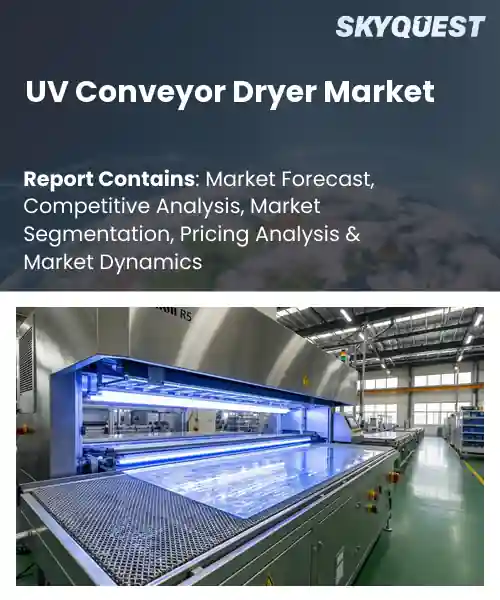
UV Conveyor Dryer Market
Report ID: SQMIG20I3836
Report ID: SQMIG20I3836
[email protected]
USA +1 351-333-4748
Report ID:
SQMIG20I3836 |
Region:
Global |
Published Date: August, 2026
Pages:
157
|Tables:
145
|Figures:
78


Global Uv Conveyor Dryer Market size was valued at USD 710.0 Million in 2024 and is poised to grow from USD 760.41 Million in 2025 to USD 1316.33 Million by 2033, growing at a CAGR of 7.1% during the forecast period (2026-2033).
The UV conveyor dryer market comprises systems that transmit ultraviolet radiation through a moving web to cure inks, coatings, and adhesives in a rapid process. The technology’s significance is defined in terms of fast cures, high output, and low energy consumption compared to drying processes that involve heat application. It began in the auto industry at the end of the 1990s, and has been adopted into flexible packaging, graphic arts, and electronics as companies looked for environmentally friendly alternatives. In the last two decades, the technology’s adoption has accelerated due to the rise in the stringency of regulations governing volatile organic compounds and the introduction of LED-based UV devices that require less maintenance, marking its transformation from the niche apparatus to an essential technology in global trade.
The key trend driving the global UV conveyor dryer sector is the rising need for high‑speed printing in packaging, where curing and environmental compliance are essential. Producers of beverage cans, manufacturers of snack packaging and companies that produce medical labels are partners of UV dryers because of line speeds consistently exceeding 100 m/min, pigments becoming solid instantaneously, and reduced amount of waste which results in lower costs due to reduced amounts of inventory. Higher productivity motivates the introduction of modular dryers that easily integrate into production lines bringing about the increase in the demand for LED lighting source suppliers and analytics services. Therefore, areas with strict regulations in the field of packaging industry such as Europe and North America start adopting better technologies faster while other markets develop as big companies move their production there for better efficiency.
How is Ai-Driven Automation Influencing Efficiency in the UV Conveyor Dryer Market?
AI is indirectly transforming the global UV conveyor dryer market by enabling intelligent control, predictive maintenance, and process optimization. As AI analyzes real-time data on UV intensity, substrate, ink, temperature, and conveyor speed, systems can automatically adjust curing parameters, reducing energy consumption while maintaining consistent drying quality. IST METZ is exploring AI-based algorithms to dynamically control curing parameters according to job requirements. Consequently, AI adoption can reduce operating costs, minimize defects, extend equipment life, and improve production uptime, encouraging manufacturers to invest in smarter UV conveyor dryers.
Market snapshot - (2026-2033)
Global Market Size
USD 710.0 Million
Largest Segment
Industrial UV Conveyor Dryers
Fastest Growth
Custom UV Conveyor Dryers
Growth Rate
7.1% CAGR
To get more insights on this market click here to Request a Free Sample Report
Global uv conveyor dryer market is segmented by product type, uv lamp type, application, conveyor width, end user and region. Based on product type, the market is segmented into Bench-Top UV Conveyor Dryers, Industrial UV Conveyor Dryers and Custom UV Conveyor Dryers. Based on uv lamp type, the market is segmented into Mercury Vapor, LED UV and Others. Based on application, the market is segmented into Printing, Electronics, Packaging and Others. Based on conveyor width, the market is segmented into Up to 300 mm, 301–600 mm and Above 600 mm. Based on end user, the market is segmented into Printing Industry, Electronics Manufacturing and Others. Based on region, the market is segmented into North America, Europe, Asia Pacific, Latin America and Middle East & Africa.
Based on the global conveyor dryer market growth, industrial UV conveyor dryers segment dominates because manufacturers prioritize high throughput and consistent cure quality for large scale operations. Such dryers combine the advanced conveyor arrangement with reliable UV lamps, allowing continuous processing of large-volume material webs. Their high capability of adhering to challenging production schedules and achieving low defect rates renders them popular among industries in search of continuous improvement. Hence, they form the basis for the market demand and affect specifications.
However, custom UV conveyor dryers are witnessing the strongest growth momentum as niche applications demand tailored curing solutions. Flexible design options allow adaptation to irregular product geometries and specialized coating formulations, attracting sectors that cannot be served by standard equipment. This customization drives market entry and expands the addressable base.
LED UV segment dominates because it offers energy efficiency and start up, eliminating warm up delays that lamps require. The technology produces stable output of photons of a wide range in wavelengths which increases the penetration of cure and minimizes the amount of heat affecting heat sensitive substrates. It has a longer lifespan allowing thus to save on the maintenance costs, therefore being ideal for production processes looking for sustainable and reliable results.
Meanwhile, mercury vapor technology is emerging as an area of growth as upgrades drive demand for output. Its broad spectral range remains essential for curing thick inks and specialty coatings, prompting manufacturers to retrofit lines instead of replacing systems. This cycle fuels rapid adoption and expands market opportunities for mercury‑based solutions.
To get detailed segments analysis, Request a Free Sample Report
As per the global conveyor dryer market share, Asia Pacific dominates the industry due to a confluence of advanced manufacturing capabilities, strong demand from high‑growth packaging sectors, and proactive adoption of energy‑efficient technologies. The area benefits from having a wide variety of engineers ready for work and an environment that encourages constant innovation, allowing products to be developed quickly and connected to smart controls. Moreover, well-structured supply chains and partnerships between manufacturers and end-users solidify the leadership position in the market, while legislation encourages the use of UV curing to comply with the existing regulations. Furthermore, the focus on environmental safety makes manufacturers use UV technologies to minimize volatile organic compound emissions and, therefore, comply with global environmental targets. State support of advanced manufacturing as well as presence of automotive and electronics production centers allows large-scale introduction of UV conveyor dryers into different areas of production.
UV conveyor dryer market in Japan is shaped by a strong emphasis on precision engineering and a mature automotive supply chain that demands high‑quality surface finishes. To develop UV solutions that address the needs of electronics, medical devices, and packaging industries, local companies utilize their significant R&D capabilities, resulting in quick cycles and low environmental impact. The cooperation of the industry organization and technology companies makes the process of information and technology generation more efficient.
UV conveyor dryer market in South Korea benefits from a vibrant electronics manufacturing ecosystem and aggressive investment in smart factory technologies. Local manufacturers are concentrating their efforts on the application of sophisticated sensor networks and Internet connectivity in systems of ultraviolet conveyor. Consequently, they can provide real-time control and enhance energy efficiency. The close partnership between research institutes and manufacturers promotes the implementation of new technologies necessary for compliance with strict quality regulations for coatings used in cars, consumer products, and high-tech plastics.
Based on global conveyor dryer regional forecast, North America experiences rapid expansion of the industry as manufacturers pursue higher productivity and tighter environmental compliance across diverse end‑use sectors. The focus of the area on advanced packaging solutions as well as light weight automotive components underpins the need for quick, solvent-free curing solutions which increase throughput while decreasing emissions. Large investments into digital manufacturing as well as Industry 4.0 projects lead to the performance of smart controls as well as data analytics systems to UV conveyor technology, that is ensuring predictive maintenance as well as power savings. Moreover, collaborative research of equipment manufacturers as well as major consumer goods producers speeds up the implementation of UV technologies capable of meeting specific requirements of different substrates. Moreover, undertaken measures in the field of legislation regulating volatile organic compounds matter create a positive background for utilizing UV curing technologies, driving the market forward.
UV conveyor dryer market in the United States is propelled by a robust demand from packaging, automotive, and electronics manufacturers seeking rapid, low‑VOC curing solutions. The focus of home equipment companies is the merging of laser and LED technologies to attain energy delivery as well as footprint. The close partnership between research universities and industry takes innovation to another level in sensor-driven control processes while sustainability programs push the use of UV technology to minimize the carbon impact in supply chains.
UV conveyor dryer market in Canada benefits from an emphasis on sustainable manufacturing and a packaging sector that values rapid, solvent‑free curing. Local system integrators value the implementation of modular designs, allowing the company to tailor the machines according to various production lines which enhances the flexibility of small and medium enterprises. Collaboration with government research programs to encourage the development of UV technologies. Environmental regulations also promote the use of low emission curing processes in the automotive and consumer goods markets.
As per global conveyor dryer regional outlook, Europe strengthens its position in the industry through a combination of stringent environmental regulations, deep engineering expertise, and a collaborative ecosystem that links manufacturers with research institutions. The region’s determination to cut down emissions of volatile organic compounds entails greater adoption of UV curing technology among manufacturers of automotive coatings, sophisticated packaging and medical devices. Investments in advanced photon sources and cutting‑edge control algorithms make it possible for producers to improve energy efficiency of the process and meaningfully control it as well. Cross‑border cooperation and cooperation of business associations simplify dissemination of knowledge and quick deployment of solutions standard across the continent. In addition, the concentration of major automotive and consumer goods clusters contributes to the form of solid demand base making Europe a center for ground‑breaking UV conveyor dryer application.
UV conveyor dryer market in Germany is driven by a strong automotive sector and a tradition of precision engineering that demands high‑quality surface finishes. In order to be able to fulfill different production needs, producers are committing significant amount of money to the development of effective lighting sources and systems of modules. Joint research projects with engineering institutes lead to production of advanced monitoring systems, while environmental initiatives stimulate the transformation towards low-VOC UV curing in packaging and industrial coating processes all over the world.
UV conveyor dryer market in the United Kingdom benefits from a vibrant chemical manufacturing base and a growing demand for sustainable packaging solutions. The market participants are paying attention to incorporating UV systems powered by LED that can provide fast curing time and use less energy. Meanwhile, government regulations aimed at limiting solvent emission motivate more widespread use of UV conveyor dryers in such industries as automotive, aviation, and consumer goods.
UV conveyor dryer market in France is shaped by a strong presence of packaging manufacturers and a commitment to environmental stewardship. French suppliers of equipment are concentrating on small-sized UV systems with strong efficiency in the implementation of their policies of energy savings. The collaborative projects with the scientific centers take photon management technologies forward, making it possible to carry out an accurate curing of thin layers and complex shapes. The advantages provided by the stimulation of emissions processes by the government lead to the wider usage of UV dryers in the production of cars, planes, and devices.
To know more about the market opportunities by region and country, click here to
Buy The Complete Report
Increasing Demand for Sustainable Packaging
The growing importance of eco-friendly manufacturing is pushing original equipment manufacturers (OEMs) to use UV conveyor dryers owing to their quick curing, low emissions of volatile organic compounds, compliance with tough sustainability regulations, and energy requirements. Manufacturers value the possibility to get high-quality finishes with solvent-free technologies, which is in line with corporate environmental initiatives and environmental consumer preference for greener products. Conforming to this requirement speeds up the investments in UV drying systems and increases the number of industries, such as automotive, electronic, and packing worldwide.
Advancements In UV Technology Efficiency
The use of smart controls and IoT connectivity in UV conveyor dryers provides better operation efficiency as it allows monitoring of speed, temperature and energy consumption in real time. With the use of these technologies, manufacturing facilities can implement principles of Industry 4.0 that improve automation and data-driven decision-making capabilities of plants. Low waste levels, high production output and better product traceability allow manufacturers to implement innovations in their operations which contributes into growth of the market of advanced manufacturing technologies on the global scale.
High Initial Capital Expenditure
Many small and medium-sized companies face a financial barrier because of the considerable initial expense of UV conveyor dryer systems. Such businesses usually have limited capital budgets and thus must allocate their resources to activities that give an immediate return on investment. The requirement of skilled installation, training, and maintenance of the systems adds to the overall ownership costs of the systems and discourages many companies from using new technology. Therefore, the rate of adoption of the technology is lower in the aforementioned segments than in the other areas of the market, resulting in slower growth overall in the market.
Regulatory Compliance Complexity
Strict and diverse safety standards regulating the exposure to UV rays and ozone discharge in various areas make it necessary for producers to take extra safety measures and certification procedures, which may prolong the period of project implementation and increase costs of compliance. The need to comply with local and international standards frequently necessitates the designing of unique systems that complicate the engineering process thus slowing down the launch of the product. All these regulatory barriers create uncertainty risks for investors and make companies hesitate to implement the technology of UV conveyor dryer quickly enough, which results in the slow development of the market.
Request Free Customization of this report to help us to meet your business objectives.
The global UV conveyor dryer market outlook is competitive, with major players including IST METZ, Excelitas Technologies, Dr. Hönle, Nordson, GEW, Dymax, and American Ultraviolet. Businesses engage in rivalry through developments in the UV-LED field, conservation of energy, and utilization of automation along with conveyers configured for particular purposes. While Excelitas concentrates on the use of integrated UV curing conveyor systems, Hönle highlights flexible LED technology. IST METZ has expertise in manufacturing both LED and UV technologies of a high intensity.
Top Player’s Company Profile
Recent Developments in Global UV Conveyor Dryer Market
SkyQuest’s ABIRAW (Advanced Business Intelligence, Research & Analysis Wing) is our Business Information Services team that Collects, Collates, Correlates, and Analyses the Data collected by means of Primary Exploratory Research backed by robust Secondary Desk research.
As per SkyQuest analysis the global UV conveyor dryer industry is being propelled chiefly by the rising demand for sustainable packaging which pushes manufacturers toward low‑VOC, fast‑cure solutions, while a second momentum comes from advances in UV technology efficiency such as smart controls and IoT integration that boost productivity and traceability. The primary restraint remains the high initial capital expenditure required for equipment purchase and installation, which deters cost‑sensitive firms. Asia Pacific stands out as the dominating region thanks to its strong manufacturing base and supportive regulations, and the industrial UV conveyor dryer segment leads the market because large‑scale producers value high throughput and consistent cure quality.
| Report Metric | Details |
|---|---|
| Market size value in 2024 | USD 710.0 Million |
| Market size value in 2033 | USD 1316.33 Million |
| Growth Rate | 7.1% |
| Base year | 2024 |
| Forecast period | (2026-2033) |
| Forecast Unit (Value) | USD Million |
| Segments covered |
|
| Regions covered | North America (US, Canada), Europe (Germany, France, United Kingdom, Italy, Spain, Rest of Europe), Asia Pacific (China, India, Japan, Rest of Asia-Pacific), Latin America (Brazil, Rest of Latin America), Middle East & Africa (South Africa, GCC Countries, Rest of MEA) |
| Companies covered |
|
| Customization scope | Free report customization with purchase. Customization includes:-
|
To get a free trial access to our platform which is a one stop solution for all your data requirements for quicker decision making. This platform allows you to compare markets, competitors who are prominent in the market, and mega trends that are influencing the dynamics in the market. Also, get access to detailed SkyQuest exclusive matrix.
Table Of Content
Executive Summary
Market overview
Parent Market Analysis
Market overview
Market size
KEY MARKET INSIGHTS
COVID IMPACT
MARKET DYNAMICS & OUTLOOK
Market Size by Region
KEY COMPANY PROFILES
Methodology
For the UV Conveyor Dryer Market, our research methodology involved a mixture of primary and secondary data sources. Key steps involved in the research process are listed below:
1. Information Procurement: This stage involved the procurement of Market data or related information via primary and secondary sources. The various secondary sources used included various company websites, annual reports, trade databases, and paid databases such as Hoover's, Bloomberg Business, Factiva, and Avention. Our team did 45 primary interactions Globally which included several stakeholders such as manufacturers, customers, key opinion leaders, etc. Overall, information procurement was one of the most extensive stages in our research process.
2. Information Analysis: This step involved triangulation of data through bottom-up and top-down approaches to estimate and validate the total size and future estimate of the UV Conveyor Dryer Market.
3. Report Formulation: The final step entailed the placement of data points in appropriate Market spaces in an attempt to deduce viable conclusions.
4. Validation & Publishing: Validation is the most important step in the process. Validation & re-validation via an intricately designed process helped us finalize data points to be used for final calculations. The final Market estimates and forecasts were then aligned and sent to our panel of industry experts for validation of data. Once the validation was done the report was sent to our Quality Assurance team to ensure adherence to style guides, consistency & design.
Analyst Support
Customization Options
With the given market data, our dedicated team of analysts can offer you the following customization options are available for the UV Conveyor Dryer Market:
Product Analysis: Product matrix, which offers a detailed comparison of the product portfolio of companies.
Regional Analysis: Further analysis of the UV Conveyor Dryer Market for additional countries.
Competitive Analysis: Detailed analysis and profiling of additional Market players & comparative analysis of competitive products.
Go to Market Strategy: Find the high-growth channels to invest your marketing efforts and increase your customer base.
Innovation Mapping: Identify racial solutions and innovation, connected to deep ecosystems of innovators, start-ups, academics, and strategic partners.
Category Intelligence: Customized intelligence that is relevant to their supply Markets will enable them to make smarter sourcing decisions and improve their category management.
Public Company Transcript Analysis: To improve the investment performance by generating new alpha and making better-informed decisions.
Social Media Listening: To analyze the conversations and trends happening not just around your brand, but around your industry as a whole, and use those insights to make better Marketing decisions.
REQUEST FOR SAMPLE
 REQUEST FREE CUSTOMIZATION
Global Uv Conveyor Dryer Market size was valued at USD 710.0 Million in 2024 and is poised to grow from USD 760.41 Million in 2025 to USD 1316.33 Million by 2033, growing at a CAGR of 7.1% during the forecast period (2026-2033).
The UV conveyor dryer market is shaped by intensified rivalry as manufacturers pursue advanced LED‑based curing, integration of IoT monitoring, and expansion into high‑speed packaging lines; recent M&A activity such as a leading dryer supplier acquiring a niche LED technology firm, and strategic alliances between equipment makers and specialty ink producers, underscores the push for differentiated performance and broader end‑user reach. 'American Ultraviolet', 'IST METZ GmbH & Co. KG', 'Hönle Group', 'Excelitas Technologies Corp.', 'Phoseon Technology', 'Dymax Corporation', 'Nordson Corporation', 'GEW (EC) Limited', 'UV Technology Ltd.', 'Uvitron International, Inc.', 'Heraeus Noblelight GmbH', 'Miltec UV', 'Air Motion Systems', 'Integration Technology Ltd.', 'Prime UV-IR Systems', 'UV Process Supply, Inc.', 'Omnicure', 'UV Cure Technology', 'Sunkiss UV', 'Hanovia Limited'
Sustainable Packaging Integration: Manufacturers are increasingly pairing UV conveyor dryers with recyclable and bio‑based packaging solutions to meet consumer demand for greener products. The rapid adoption of lightweight, low‑emissivity films enhances curing efficiency while reducing material waste. This synergy enables faster line speeds and lower energy consumption, reinforcing brand sustainability narratives. As retailers prioritize eco‑friendly supply chains, producers are compelled to integrate UV drying technology that supports compliant, circular packaging ecosystems, driving broader market acceptance across multiple industry segments worldwide and regional markets.
Why does Asia Pacific Dominate the Global UV Conveyor Dryer Market? |@12


Want to customize this report? This report can be personalized according to your needs. Our analysts and industry experts will work directly with you to understand your requirements and provide you with customized data in a short amount of time. We offer $1000 worth of FREE customization at the time of purchase.
Feedback From Our Clients


 USA (+1) 351-333-4748

