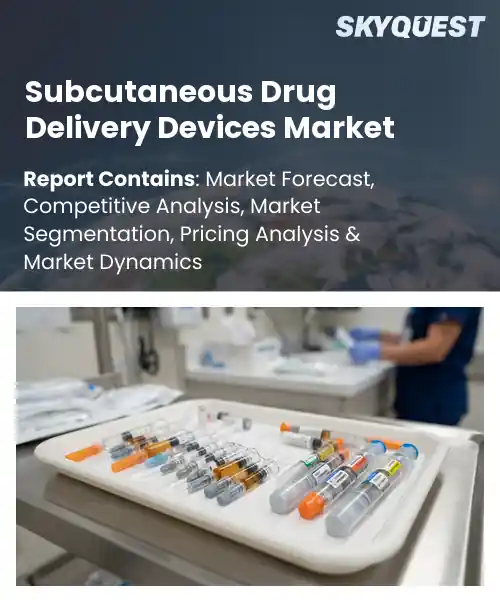
Subcutaneous Drug Delivery Devices Market
Report ID: SQMIG35A4599
Report ID: SQMIG35A4599
[email protected]
USA +1 351-333-4748
Report ID:
SQMIG35A4599 |
Region:
Global |
Published Date: October, 2026
Pages:
157
|Tables:
148
|Figures:
78


Global Subcutaneous Drug Delivery Devices Market size was valued at USD 28.5 Billion in 2024 and is poised to grow from USD 31.69 Billion in 2025 to USD 74.1 Billion by 2033, growing at a CAGR of 11.2% during the forecast period (2026-2033).
The global subcutaneous drug delivery devices market comprises technologies such as autoinjectors, pen injectors, wearable patches, and microneedle systems that administer therapeutics beneath the skin. Its significance stems from the ability to deliver biologics, vaccines, and medicines with greater patient convenience and reduced reliance on clinical settings. The primary driver has been the rise in biologic therapeutics, especially monoclonal antibodies for oncology and autoimmune disorders, which require pain‑minimized administration. Over the past decade, companies like Novo Nordisk and Johnson & Johnson have expanded their portfolios, while regulatory incentives for delivery have accelerated adoption, turning a segment into a billion‑dollar industry. The pivotal factor shaping the market is the convergence of digital health platforms with subcutaneous delivery devices, expanding therapeutic reach and data‑driven care pathways. Embedding sensors and connectivity into pens and autoinjectors enables adherence monitoring, dosage verification, and remote clinician alerts, which boost patient confidence and reduce hospital visits. For instance, Bluetooth‑enabled insulin pens linked to diabetes apps have cut missed doses by 20 % in programs across Europe. This overlay creates revenue through subscription analytics services and opens partnership opportunities with telehealth providers, thereby accelerating market penetration among chronic‑disease populations. Regulatory backing and cost savings together improve patient outcomes globally.
How is AI enhancing precision and automation in the subcutaneous drug delivery devices market?
AI is reshaping subcutaneous drug delivery by improving precision and automating dosing decisions. Machine learning models analyze glucose trends, patient activity and physiological signals to predict optimal insulin or medication amounts. Integrated sensors feed real time data to embedded processors that adjust infusion rates without manual input. This reduces user error and enhances therapeutic consistency, making devices more attractive to clinicians and patients. Companies are embedding AI into wearable pumps, patch type injectors and smart pens, creating closed loop systems that respond instantly to changing conditions. The market is moving toward fully autonomous delivery, driven by demand for convenience and better disease control.Insulet June 2023, introduced an AI enabled dosing module for its Omnipod system that continuously learns from user patterns and sensor inputs to fine tune insulin delivery. The enhancement shortens response time, improves therapeutic accuracy and strengthens market adoption of smart subcutaneous devices and supports broader integration with digital health platforms.
Market snapshot - (2026-2033)
Global Market Size
USD 28.5 Billion
Largest Segment
Pen Injectors
Fastest Growth
Wearable Injectors
Growth Rate
11.2% CAGR
To get more insights on this market click here to Request a Free Sample Report
Global subcutaneous drug delivery devices market is segmented by device type, usability, drug type, application, end user and region. Based on device type, the market is segmented into Prefilled Syringes, Autoinjectors, Pen Injectors, Wearable Injectors and Other Subcutaneous Delivery Devices. Based on usability, the market is segmented into Reusable and Disposable. Based on drug type, the market is segmented into Biologics, Insulin, Monoclonal Antibodies and Other Injectable Drugs. Based on application, the market is segmented into Diabetes, Autoimmune Diseases, Oncology, Hormonal Disorders and Other Applications. Based on end user, the market is segmented into Hospitals & Clinics, Home Healthcare and Ambulatory Care Centers. Based on region, the market is segmented into North America, Europe, Asia Pacific, Latin America and Middle East & Africa.
Prefilled syringes segment dominates because they combine ease of use with precise dosing, which addresses the core demand for safety and patient confidence in self administration. Their ready to inject format eliminates preparation steps, reducing contamination risk and supporting adherence across chronic therapies. Manufacturers benefit from streamlined production and regulatory familiarity, reinforcing supply chain stability and encouraging widespread adoption among healthcare providers and patients alike through consistent performance and low error rates globally.
However, autoinjectors segment emerges as the most rapidly expanding area, driven by rising demand for hands free administration and discreet treatment among active patients. Continuous innovation in ergonomic design and smart connectivity enhances user experience, prompting broader acceptance across chronic disease management and fueling pipeline investments that accelerate market momentum.
Insulin segment leads because it serves the largest patient population with well established treatment protocols, creating persistent demand for reliable delivery devices. The chronic nature of diabetes drives continuous usage, encouraging manufacturers to refine device compatibility and safety features. Strong payer support and longstanding clinical confidence further embed insulin focused injectors in both institutional and home settings, solidifying their market position. These factors also stimulate ongoing investment in device ergonomics and user education, reinforcing adoption across diverse care environments.
Meanwhile, monoclonal antibodies segment is witnessing the strongest growth momentum, propelled by expanding therapeutic indications and the shift toward biologic therapies that require subcutaneous administration. Advances in formulation stability and device compatibility lower barriers for patients, prompting broader clinical uptake and encouraging manufacturers to develop tailored delivery systems that accelerate market expansion.
To get detailed segments analysis, Request a Free Sample Report
North America maintains a leading position because of a mature healthcare infrastructure, strong reimbursement mechanisms, and a concentration of innovative biotech firms that prioritize injectable therapies. The region benefits from an advanced regulatory environment that accelerates product approvals while ensuring safety, encouraging manufacturers to launch sophisticated subcutaneous delivery platforms. Robust physician adoption, driven by familiarity with self‑administration devices and patient preference for convenient at‑home treatment, further reinforces market depth. Additionally, extensive collaboration between device manufacturers, pharmaceutical companies, and academic research centers fosters continuous product refinement and integration of digital health features. The presence of large payer networks and well‑established distribution channels ensures broad patient access, sustaining the region’s dominance in the global landscape.
United States Subcutaneous Drug Delivery Devices Market
Subcutaneous Drug Delivery Devices Market in United States is propelled by a highly integrated ecosystem that links leading pharmaceutical innovators with device engineers. Strong clinician advocacy for needle‑free technologies and extensive patient education programs drive acceptance. Payers support cost‑effective home administration, while health system initiatives emphasize chronic disease management. Continuous investment in digital connectivity and data analytics enhances therapeutic adherence, positioning the United States as a benchmark for advanced device adoption.
Canada Subcutaneous Drug Delivery Devices Market
Subcutaneous Drug Delivery Devices Market in Canada benefits from a publicly funded healthcare system that emphasizes equitable access to innovative therapies. Collaborative networks among research hospitals, biotech incubators, and device manufacturers accelerate translation of novel delivery concepts. Provincial reimbursement frameworks encourage use of self‑administered options, reducing hospital burden. Growing patient awareness and supportive regulatory pathways further consolidate Canada’s role as a supportive environment for subcutaneous technology diffusion.
The rapid expansion of the Subcutaneous Drug Delivery Devices Market in Europe is underpinned by a confluence of regulatory cohesion, patient‑centric healthcare policies, and robust research ecosystems across the continent. Harmonized approval processes enable manufacturers to launch devices across multiple jurisdictions with reduced administrative friction, while national health services prioritize therapies that minimize hospital visits and improve quality of life. Demographic shifts toward an ageing population increase demand for self‑administrable treatments, prompting investment in user‑friendly platforms. Strong collaboration between leading pharmaceutical firms and device innovators, supported by academic research hubs, fuels continuous improvement and integration of smart connectivity features. Additionally, reimbursement strategies that reward long‑term cost savings reinforce adoption across both established and emerging markets within Europe.
Germany Subcutaneous Drug Delivery Devices Market
Subcutaneous Drug Delivery Devices Market in Germany is characterized by a technologically advanced manufacturing base and deep clinical research capacity. Leading medical device clusters collaborate closely with pharmaceutical stakeholders to co‑develop precision delivery systems. Reimbursement policies that favor home‑based therapy align with patient preferences for convenience, while stringent quality standards ensure high product reliability. Government incentives for digital health integration further accelerate adoption of connected injection platforms, solidifying Germany’s dominant position within the European landscape.
United Kingdom Subcutaneous Drug Delivery Devices Market
Subcutaneous Drug Delivery Devices Market in United Kingdom is experiencing accelerated uptake driven by progressive NHS initiatives that prioritize outpatient care and self‑administration. A vibrant biotech sector and strong academic partnerships accelerate innovation, while regulatory frameworks that streamline device approvals encourage market entry. Patient empowerment programs and digital health strategies enhance adherence and data capture, making the United Kingdom a focal point for next‑generation subcutaneous technologies. The convergence of policy support and technology adoption fuels its rapid expansion relative to neighboring markets.
France Subcutaneous Drug Delivery Devices Market
Subcutaneous Drug Delivery Devices Market in France is emerging as a focal point for innovative delivery solutions thanks to supportive health authority guidelines that encourage early‑stage clinical integration. Collaborative networks linking hospitals, research institutes, and device manufacturers foster rapid prototyping and localized testing. Reimbursement models that reward reduced hospital utilization create incentives for physicians to prescribe self‑administrable options. Growing patient awareness of the benefits of minimally invasive therapy further stimulates market momentum, positioning France as an emerging hub within the broader European framework.
The Asia Pacific region is strengthening its position in the Subcutaneous Drug Delivery Devices Market through a blend of rising chronic disease prevalence, expanding middle‑class populations, and proactive government initiatives that endorse home‑based care. Nations such as Japan and South Korea lead in integrating advanced robotics and sensor technologies into injection devices, creating highly intuitive user experiences. Collaborative research programs between pharmaceutical giants and local device firms accelerate adaptation of global best practices to regional patient needs. Health insurance reforms that cover self‑administration reduce financial barriers, while digital health platforms enhance patient monitoring and engagement. This synergistic environment propels the region toward becoming a pivotal arena for next‑generation subcutaneous delivery solutions.
Japan Subcutaneous Drug Delivery Devices Market
Subcutaneous Drug Delivery Devices Market in Japan benefits from a sophisticated healthcare infrastructure that emphasizes precision medicine and patient safety. Strong governmental support for innovation encourages incorporation of smart electronics and wearable sensors into injection devices. Aging demographics amplify demand for convenient at‑home treatment modalities, prompting clinicians to adopt user‑friendly platforms. Collaborative ventures between domestic device manufacturers and multinational pharmaceutical companies accelerate technology transfer, while reimbursement schemes that recognize long‑term cost efficiencies reinforce market growth.
South Korea Subcutaneous Drug Delivery Devices Market
Subcutaneous Drug Delivery Devices Market in South Korea is propelled by a technology‑forward environment and proactive health policy that encourages adoption of digital therapeutic solutions. Robust investment in research and development within biotech clusters fuels creation of compact, connected injection systems. National health insurance coverage that includes self‑administered therapies lowers patient out‑of‑pocket costs, enhancing accessibility. Partnerships between leading pharmaceutical firms and local device innovators streamline product customization for Korean patient preferences, reinforcing the nation’s emerging leadership in the broader Asia Pacific landscape.
To know more about the market opportunities by region and country, click here to
Buy The Complete Report
Rising Preference For Self‑Administration
Advancements In Wearable Injector Technology
High Cost Of Advanced Devices
Regulatory Hurdles For Combination Products
Request Free Customization of this report to help us to meet your business objectives.
The competitive landscape is shaped by major players accelerating M&A activity, forging strategic partnerships, and advancing micro‑needle and wearable technologies to capture the growing demand for painless, self‑administered therapies; for example, Becton Dickinson’s acquisition of a micro‑needle platform and Insulet’s joint venture with a biotech firm to integrate closed‑loop insulin delivery illustrate how consolidation and collaboration are driving differentiation and market share gains.
Top Player’s Company Profile
Recent Developments
SkyQuest’s ABIRAW (Advanced Business Intelligence, Research & Analysis Wing) is our Business Information Services team that Collects, Collates, Correlates, and Analyses the Data collected by means of Primary Exploratory Research backed by robust Secondary Desk research. As per SkyQuest analysis, the global subcutaneous drug delivery devices market is propelled primarily by the rising preference for self‑administration, which fuels demand for easy‑to‑use, at‑home solutions, while the high cost of advanced devices restrains adoption in cost‑sensitive settings. North America remains the dominant region thanks to its mature healthcare infrastructure and strong reimbursement support, and prefilled syringes continue to lead the device‑type segment because they combine precise dosing with simplicity. A second major driver is the rapid advancement of wearable injector technology that integrates sensors and connectivity, enhancing patient adherence and opening new revenue streams through digital health services.
| Report Metric | Details |
|---|---|
| Market size value in 2024 | USD 28.5 Billion |
| Market size value in 2033 | USD 74.1 Billion |
| Growth Rate | 11.2% |
| Base year | 2024 |
| Forecast period | (2026-2033) |
| Forecast Unit (Value) | USD Billion |
| Segments covered |
|
| Regions covered | North America (US, Canada), Europe (Germany, France, United Kingdom, Italy, Spain, Rest of Europe), Asia Pacific (China, India, Japan, Rest of Asia-Pacific), Latin America (Brazil, Rest of Latin America), Middle East & Africa (South Africa, GCC Countries, Rest of MEA) |
| Companies covered |
|
| Customization scope | Free report customization with purchase. Customization includes:-
|
To get a free trial access to our platform which is a one stop solution for all your data requirements for quicker decision making. This platform allows you to compare markets, competitors who are prominent in the market, and mega trends that are influencing the dynamics in the market. Also, get access to detailed SkyQuest exclusive matrix.
Table Of Content
Executive Summary
Market overview
Parent Market Analysis
Market overview
Market size
KEY MARKET INSIGHTS
COVID IMPACT
MARKET DYNAMICS & OUTLOOK
Market Size by Region
KEY COMPANY PROFILES
Methodology
For the Subcutaneous Drug Delivery Devices Market, our research methodology involved a mixture of primary and secondary data sources. Key steps involved in the research process are listed below:
1. Information Procurement: This stage involved the procurement of Market data or related information via primary and secondary sources. The various secondary sources used included various company websites, annual reports, trade databases, and paid databases such as Hoover's, Bloomberg Business, Factiva, and Avention. Our team did 45 primary interactions Globally which included several stakeholders such as manufacturers, customers, key opinion leaders, etc. Overall, information procurement was one of the most extensive stages in our research process.
2. Information Analysis: This step involved triangulation of data through bottom-up and top-down approaches to estimate and validate the total size and future estimate of the Subcutaneous Drug Delivery Devices Market.
3. Report Formulation: The final step entailed the placement of data points in appropriate Market spaces in an attempt to deduce viable conclusions.
4. Validation & Publishing: Validation is the most important step in the process. Validation & re-validation via an intricately designed process helped us finalize data points to be used for final calculations. The final Market estimates and forecasts were then aligned and sent to our panel of industry experts for validation of data. Once the validation was done the report was sent to our Quality Assurance team to ensure adherence to style guides, consistency & design.
Analyst Support
Customization Options
With the given market data, our dedicated team of analysts can offer you the following customization options are available for the Subcutaneous Drug Delivery Devices Market:
Product Analysis: Product matrix, which offers a detailed comparison of the product portfolio of companies.
Regional Analysis: Further analysis of the Subcutaneous Drug Delivery Devices Market for additional countries.
Competitive Analysis: Detailed analysis and profiling of additional Market players & comparative analysis of competitive products.
Go to Market Strategy: Find the high-growth channels to invest your marketing efforts and increase your customer base.
Innovation Mapping: Identify racial solutions and innovation, connected to deep ecosystems of innovators, start-ups, academics, and strategic partners.
Category Intelligence: Customized intelligence that is relevant to their supply Markets will enable them to make smarter sourcing decisions and improve their category management.
Public Company Transcript Analysis: To improve the investment performance by generating new alpha and making better-informed decisions.
Social Media Listening: To analyze the conversations and trends happening not just around your brand, but around your industry as a whole, and use those insights to make better Marketing decisions.
REQUEST FOR SAMPLE
 REQUEST FREE CUSTOMIZATION


Want to customize this report? This report can be personalized according to your needs. Our analysts and industry experts will work directly with you to understand your requirements and provide you with customized data in a short amount of time. We offer $1000 worth of FREE customization at the time of purchase.
Feedback From Our Clients


 USA (+1) 351-333-4748

