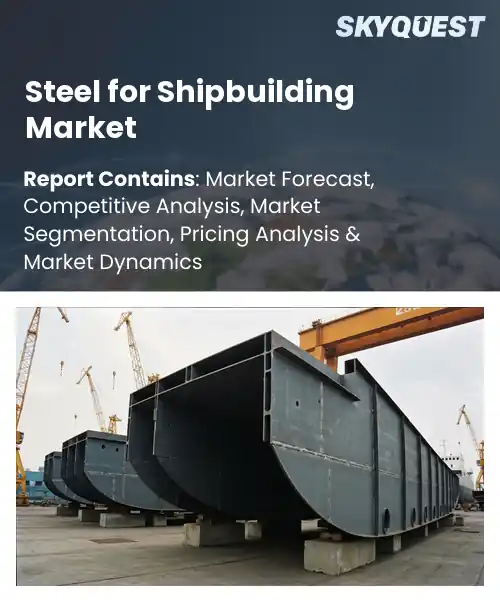
Steel for Shipbuilding Market
Report ID: SQMIG15O2047
Report ID: SQMIG15O2047
[email protected]
USA +1 351-333-4748
Report ID:
SQMIG15O2047 |
Region:
Global |
Published Date: March, 2026
Pages:
157
|Tables:
119
|Figures:
77


Global Steel for Shipbuilding Market size was valued at USD 166.0 Billion in 2024 and is poised to grow from USD 175.13 Billion in 2025 to USD 268.77 Billion by 2033, growing at a CAGR of 5.5% during the forecast period (2026-2033).
Key Takeaways : Market Trends & Insights
The global steel for shipbuilding market growth is driven because shipping companies need to build new hulls which will last longer while improving their operational efficiency. The market provides plate and structural components which are essential for merchant ships and naval ships and offshore platforms because they support national security and create jobs in the industrial sector. The production process transitioned from creating mild carbon steels to producing high-strength low-alloy materials which resist corrosion because Japan and South Korea dominated shipbuilding while China expanded its production capabilities as seen in LNG carrier orders. The material specifications increase because of existing regulatory requirements and technological advancements which create new material challenges.
The shipping industry requires both fuel-efficient ships and alternative-fuel ships because operators need to lower their operational costs. This demand for higher-strength thinner plates and specialized cryogenic steels has led steelmakers to develop new HSLA grades and controlled-rolling processes. The need for prefabricated cut-to-length sections and tighter tolerances from LNG-fueled containership builders and methanol-capable tanker builders leads to business opportunities for upstream mills who can sell their processed products and logistics services. The demand for large diameter monopiles and jacket components in offshore wind and offshore construction projects leads to increased requirements for heavy plate production which must meet long-term supply agreements and downstream processing needs.
AI improves corrosion monitoring for shipbuilding steel through its combination of sensor data and image recognition and predictive modeling which helps detect early deterioration while establishing inspection priorities and repair paths. The current systems process photographs together with ultrasonic data and environmental data to create condition records which build digital twins that show how corrosion develops. The need for longer asset lifespans together with stricter maintenance budgets has driven shipyards and shipowners to implement continuous monitoring systems alongside cloud-based analytics. AI transforms the routine hull image process into standardized reports while platforms provide maintenance planning tools which decrease repair costs. The AI-based asset integrity solution rollout within Ardmore Shipping occurred on November 2025 when the company introduced SteelCorrs Digital Paint Report application across its entire fleet to create automatic corrosion reports which track corrosion status through AI image analysis.
Market snapshot - 2026-2033
Global Market Size
USD 166.0 Billion
Largest Segment
Hot Rolled Plates
Fastest Growth
Steel Pipes & Tubes
Growth Rate
5.5% CAGR
To get more insights on this market click here to Request a Free Sample Report
The global steel for shipbuilding market is segmented based on steel product type, material grade or standard, vessel application, supply thickness, and region. In terms of steel product type, the market is divided into hot rolled plates, steel sections, and steel pipes and tubes. Based on material grade or standard, it is categorized into normal strength, high strength, and corrosion-resistant or stainless steel. By vessel application, the market includes tankers and bulk carriers, container ships, passenger or cruise ships, naval and defense vessels, and offshore platforms and FPSOs. In terms of supply thickness, it is segmented into thin plates, medium or heavy plates, and extra heavy plates. Regionally, the market is analyzed across North America, Europe, Asia Pacific, Latin America, and the Middle East & Africa.
As per the global steel for shipbuilding market analysis, the Hot Rolled Plates segment dominates because its ability to supply large, continuous steel plates supports efficient hull and deck fabrication with fewer joints and more uniform stress distribution. The shipyard industry selects these materials because their predictable mechanical characteristics and standard fabrication compatibility and welding properties produce construction advantages which yield better structural performance for primary hull construction and major panel production.
However, the Steel Pipes & Tubes sector experiences rapid expansion because ship architects use tubular systems to create fluid routes and structural support for their latest ship designs. The combination of better forming and welding capabilities with higher grade alloys leads to wider use in modular assembly applications which drive both new building projects and retrofitting operations while enabling the development of lightweight system integrations.
According to the global steel for shipbuilding market forecast, the Corrosion Resistant/Stainless Steel segment dominates because its resistance to chloride attack and marine corrosion significantly lowers maintenance needs and extends service life for critical components and exposed structures. The operators require operational durability, which reduces maintenance needs. The industry specification process has shifted towards using these grades for corrosion-prone areas because they provide better availability while reducing overall equipment failure risk.
Whereas, the high strength category is anticipated to have the highest steel for shipbuilding market share because designers want to make products lighter while achieving better fuel economy using stronger and thinner materials. The combination of metallurgical advancements with modern welding procedures has enabled wider material to use in both hull sections and structural components which drives the demand for performance-oriented steel products and leads suppliers to develop new processing capabilities.
To get detailed segments analysis, Request a Free Sample Report
As per the steel for shipbuilding market regional forecast, the market gives Asia Pacific the largest market share because of its extensive industrial systems and centralized shipbuilding capacity which enables domestic steel usage through its complete supply chain network. High strength marine steels and specialized marine steels have continuous demand from naval construction clusters and commercial shipyards because their location near steel producing plants enables them to obtain materials at lower costs. Technological cooperation between shipbuilders and steelmakers leads to rapid development of customized steel materials through their combined efforts which create new steel grades and production techniques. Government policies that support maritime trade and ship construction for export and fleet renewal activities strengthen market dominance in the industry. Advanced materials and fabrication techniques prove easy to adopt by skilled workers who have experience working on large projects which helps Asia Pacific maintain its status as the dominant market hub in the region.
The Japanese steel for shipbuilding sector shows its characteristics through its development of advanced metallurgical knowledge and its steelmakers building partnerships with major shipyards and its production of high-performance marine grades. The specialized steel market exists because shipbuilders need lightweight materials that can withstand fatigue which they have built through their years of experience in complex vessel construction. Suppliers who work together with end users can achieve material qualification through joint efforts because domestic manufacturing maintains high standards of quality and dependable supply which leads to consistent procurement methods and operational resilience.
The South Korean steel for shipbuilding industry operates through vertically integrated supply systems which enable shipbuilders to obtain materials from their nearest steel sources while their suppliers quickly meet design needs. The naval construction industry receives support from domestic steel producers who work with shipyards to create steel grades suitable for heavy plate materials. Companies improve their material procurement system through efficient logistics operations and bulk purchasing power and ongoing process enhancements which enable the timely delivery of materials for complicated shipbuilding projects.
The European steel for shipbuilding market penetration grows because shipyards need modernization while they face strict regulation and rising demand for advanced naval and specialized commercial vessels. European steel producers dedicate their resources to material research, which results in the creation of advanced steels that fulfill the demanding requirements for fatigue endurance and weldability and corrosion protection which modern shipbuilders require. The dual impacts of fleet renewal policies and automation and digital design investment create a pathway for implementing customized steel solutions. Strong partnerships between steel manufacturers and maritime engineering companies and classification societies enable steel material qualification to meet developing international standards, which results in Europe emerging as a vital region for shipbuilding material quality and market development. The regional skills of builders who construct advanced offshore structures and specialized boats create demand for high performance plating and sections, which supports a domestic steel market that prioritizes metallurgical quality and traceable production methods.
The German steel for shipbuilding market operates from its established maritime industrial framework which provides strong engineering capabilities and steel manufacturers collaborate with shipbuilders to create naval platforms and offshore designs. Companies need to implement quality control, material traceability, and project specification certification because all products must meet quality requirements. Germany maintains its position as a leading shipbuilding material supplier through the development of specialized steel grades and advanced fabrication technologies which create resilient high-quality buildings.
The United Kingdom steel for shipbuilding market shows its active process of technological advancement through its naval defense programs and growing funding for ship technologies which use lighter steel materials and advanced high strength steel alloys. The three parties, which include research institutions and shipyards, and material suppliers, work together to speed up the process of approving new alloys. Companies focus on the retrofit market, and specialized commercial segment lets it quickly acquire materials while its steel makers fulfill new maritime needs.
The French steel for shipbuilding market emerges through its dedication to specialized ship segments and offshore renewable platforms and ship upgrades which require customized steel solutions. Local shipyards and suppliers collaborate on material selections that prioritize corrosion resistance, formability, and lifecycle performance. France strengthens its ability to develop specialized steel grades through its partnerships between academic research centers and fabrication specialists and classification bodies, which enhances its role as an essential player in European shipbuilding supply chains.
Steel production for shipbuilding in North America shows improvement because the region focuses on developing local steel production and uses specific buying methods while steel manufacturers and shipbuilding companies increase their operational cooperation. The demand for specialized steel products rises because modern fleet upgrades and offshore energy projects and the requirement to achieve high safety and performance levels need advanced steel materials. Advanced production techniques and quality control systems and supply chain protection measures help companies to supply marine grade plates and sections. The shipbuilding industry achieves better commercial and defense market results through research partnerships that develop new steel materials and production processes together with suppliers of shipbuilding materials. The combination of better certification pathways and enhanced logistics systems and specialized workforce training programs to support material qualification and delivery completion for complex projects. The regional economic advantage increases through supply chain ties with allied partners and the commitment to environmentally friendly production methods.
The United States steel market for shipbuilding depends on naval programs, strong domestic production capacity and the need for certified materials that fulfill tough product performance standards. The testing process requires that contractors work closely with steel suppliers and classification authorities to guarantee full testing of all materials and product traceability. Companies invest in heavy plate capabilities and advanced welding practices and supply chain redundancy to achieve dependable ship construction delivery. The marine steel market maintains its competitive edge through customers who need specific product requirements between all shipbuilding companies of products who use marine steel.
The steel for shipbuilding market in Canada is developing through focus on fleet renewal, specialized ice materials, and collaboration between regional shipyards and steel suppliers. Customers want plates that can be welded together and provide resistance against both fractures and corrosion to work in difficult environmental conditions. To support offshore support projects, suppliers need to customize their products by using local materials and demonstrating their products' life cycle performance and ability to support these projects. The enterprise needs to improve workers' skills and certification processes to achieve reliable material qualification and uninterrupted supply operations.
To know more about the market opportunities by region and country, click here to
Buy The Complete Report
Rising Global Maritime Trade
The growth of maritime trade creates a need for bigger and stronger ships which drives shipbuilders to find premium steel that fulfills their requirements for both structural strength and safety standards. The shipyards currently select materials which deliver dependable performance throughout their extended operational lifespan because of fleet upgrades and the introduction of new shipping routes. The steel for shipbuilding market will continue to expand because the industry maintains its demand for better material properties, which drives customers to select high-end steels while building stronger relationships with their suppliers.
Regulatory Focus on Efficiency
The new regulations which focus on both fuel efficiency and emissions control have driven ship designers to create ship designs which minimize weight while boosting hydrodynamic performance through specialized steel products and dedicated building methods. The design process demands specific steels which possess strength-to-weight ratios and welding capabilities, which drives suppliers to develop new offerings through closer cooperation with shipyards. The steel for shipbuilding market benefits from material development mapping to regulatory standards because it creates predictable specification patterns which drive steel producers to create more innovative products.
Volatile Raw Material Pricing
Steel manufacturers and shipbuilding facilities encounter procurement difficulties because their feedstock and alloy prices fluctuate, which prevents them from establishing production plans. Organizations need to purchase materials through traditional methods because their input costs will become unpredictable, which creates difficulties to measure their profit margins and forces them to delay bulk material purchases while decreasing their supply chain contract agreements. The financial uncertainty prevents shipbuilders from beginning new construction projects and selecting high-quality steel materials, which creates a barrier that stops market growth because stakeholders choose to maintain financial security instead of upgrading materials and establishing lengthy supplier arrangements.
Stringent Environmental Compliance
The steel production process faces growing environmental regulations, which requires steel production and shipyard operations to meet new compliance standards that result in increased operational difficulties and higher costs for emission control systems and waste handling. Companies need to use their resources to fulfill material obligations while maintaining their operations, which causes it to delay new project initiation or maintain low production rates. Environmental regulations which require companies to meet sustainability requirements function as an obstacle for new suppliers while they create complex supply chain challenges, which result in slowed market growth because businesses need to balance their environmental duties with their financial and operational needs.
Request Free Customization of this report to help us to meet your business objectives.
The global steel for shipbuilding market transitions from basic commodity supply to decarbonized certified material supply chains because shipowners and regulators need low carbon hulls which classification societies verify. Existing companies and new market entrants create their competitive edge through partnerships which they use to develop facilities and gain operational capacity while pursuing funding through M&A activities and their investments in hydrogen-based steel production technology which green steel projects have shown through their financing and commercial agreements.
SkyQuest’s ABIRAW (Advanced Business Intelligence, Research & Analysis Wing) is our Business Information Services team that Collects, Collates, Correlates, and Analyses the Data collected by means of Primary Exploratory Research backed by robust Secondary Desk research.
As per SkyQuest analysis, the global steel for shipbuilding market experiences growth because of increasing seaborne trade and faster fleet renewal, which creates a secondary challenge for procurement and planning work due to fluctuating raw material prices. Asia Pacific dominates the market because it has many shipbuilding facilities which use integrated supply chains to support their operations while hot rolled plates remain the most popular product because they enable shipbuilders to create large hull sections which simplify their building process. The need for better fuel efficiency and lower emissions which result from stricter regulations serves as an extra motivation for businesses to switch to high-strength thinner plates and specialty marine grades which forces suppliers to develop new processing and logistics systems.
| Report Metric | Details |
|---|---|
| Market size value in 2024 | USD 166.0 Billion |
| Market size value in 2033 | USD 268.77 Billion |
| Growth Rate | 5.5% |
| Base year | 2024 |
| Forecast period | 2026-2033 |
| Forecast Unit (Value) | USD Billion |
| Segments covered |
|
| Regions covered | North America (US, Canada), Europe (Germany, France, United Kingdom, Italy, Spain, Rest of Europe), Asia Pacific (China, India, Japan, Rest of Asia-Pacific), Latin America (Brazil, Rest of Latin America), Middle East & Africa (South Africa, GCC Countries, Rest of MEA) |
| Companies covered |
|
| Customization scope | Free report customization with purchase. Customization includes:-
|
To get a free trial access to our platform which is a one stop solution for all your data requirements for quicker decision making. This platform allows you to compare markets, competitors who are prominent in the market, and mega trends that are influencing the dynamics in the market. Also, get access to detailed SkyQuest exclusive matrix.
Table Of Content
Executive Summary
Market overview
Parent Market Analysis
Market overview
Market size
KEY MARKET INSIGHTS
COVID IMPACT
MARKET DYNAMICS & OUTLOOK
Market Size by Region
KEY COMPANY PROFILES
Methodology
For the Steel for Shipbuilding Market, our research methodology involved a mixture of primary and secondary data sources. Key steps involved in the research process are listed below:
1. Information Procurement: This stage involved the procurement of Market data or related information via primary and secondary sources. The various secondary sources used included various company websites, annual reports, trade databases, and paid databases such as Hoover's, Bloomberg Business, Factiva, and Avention. Our team did 45 primary interactions Globally which included several stakeholders such as manufacturers, customers, key opinion leaders, etc. Overall, information procurement was one of the most extensive stages in our research process.
2. Information Analysis: This step involved triangulation of data through bottom-up and top-down approaches to estimate and validate the total size and future estimate of the Steel for Shipbuilding Market.
3. Report Formulation: The final step entailed the placement of data points in appropriate Market spaces in an attempt to deduce viable conclusions.
4. Validation & Publishing: Validation is the most important step in the process. Validation & re-validation via an intricately designed process helped us finalize data points to be used for final calculations. The final Market estimates and forecasts were then aligned and sent to our panel of industry experts for validation of data. Once the validation was done the report was sent to our Quality Assurance team to ensure adherence to style guides, consistency & design.
Analyst Support
Customization Options
With the given market data, our dedicated team of analysts can offer you the following customization options are available for the Steel for Shipbuilding Market:
Product Analysis: Product matrix, which offers a detailed comparison of the product portfolio of companies.
Regional Analysis: Further analysis of the Steel for Shipbuilding Market for additional countries.
Competitive Analysis: Detailed analysis and profiling of additional Market players & comparative analysis of competitive products.
Go to Market Strategy: Find the high-growth channels to invest your marketing efforts and increase your customer base.
Innovation Mapping: Identify racial solutions and innovation, connected to deep ecosystems of innovators, start-ups, academics, and strategic partners.
Category Intelligence: Customized intelligence that is relevant to their supply Markets will enable them to make smarter sourcing decisions and improve their category management.
Public Company Transcript Analysis: To improve the investment performance by generating new alpha and making better-informed decisions.
Social Media Listening: To analyze the conversations and trends happening not just around your brand, but around your industry as a whole, and use those insights to make better Marketing decisions.
REQUEST FOR SAMPLE
 REQUEST FREE CUSTOMIZATION
Global Steel For Shipbuilding Market size was valued at USD 166.0 Billion in 2024 and is poised to grow from USD 175.13 Billion in 2025 to USD 268.77 Billion by 2033, growing at a CAGR of 5.5% during the forecast period (2026-2033).
The competitive landscape for global steel used in shipbuilding is shifting from commodity supply toward decarbonized, certified material supply chains, driven by shipowner and regulator demand for low carbon hulls and by classification society requirements. Large incumbents and new entrants compete through partnerships and offtake deals, M&A to secure feedstock and capacity, and technology bets such as hydrogen based steel production exemplified by recent green steel project finance and commercial offtake agreements. 'POSCO', 'Nippon Steel', 'Baosteel', 'Hyundai Steel', 'JFE Steel Corporation', 'ArcelorMittal', 'Ansteel Group', 'Tata Steel', 'Thyssenkrupp', 'China Steel Corp (CSC)', 'Nucor Corporation', 'Gerdau', 'JSW Steel', 'HBIS Group', 'Shagang Group', 'Severstal', 'Evraz', 'Metinvest', 'United States Steel', 'Maanshan Iron & Steel'
The expansion of maritime trade has increased demand for larger and more durable vessels, prompting shipbuilders to seek high-quality steel that meets structural and safety requirements. As fleets modernize and new routes develop, shipyards prioritize materials that offer consistent performance over long operational cycles, encouraging investments in advanced steel grades and production capacity. This sustained preference for enhanced material properties supports growth in the steel for shipbuilding market by driving procurement specifications toward premium steels and fostering stronger supplier relationships.
Lightweight Alloy Adoption: Shipbuilders are increasingly specifying higher strength, lighter steel alloys and hybrid material systems to improve fuel efficiency, increase payload capacity and extend service life. This shift is driven by design optimization, lifecycle value considerations and customer demand for operational efficiency. Suppliers and yards are collaborating earlier in the design stage to qualify materials, adjust fabrication techniques and ensure weldability and structural integrity, enabling faster adoption across vessel types while managing manufacturability and long term performance expectations plus regulatory engagement efforts.
As per the steel for shipbuilding market regional forecast, the market gives Asia Pacific the largest market share because of its extensive industrial systems and centralized shipbuilding capacity which enables domestic steel usage through its complete supply chain network.
The hot rolled plates segment dominates the market due to its ability to provide large, continuous steel sheets that enhance structural integrity, reduce welding joints, and improve overall hull performance.
Major restraints include volatile raw material prices and stringent environmental regulations, which increase production costs, create procurement uncertainties, and slow down new shipbuilding projects.
Technologies such as AI-driven corrosion monitoring, digital twins, and predictive maintenance systems are improving asset lifecycle management, reducing repair costs, and enhancing operational efficiency in shipbuilding.


Want to customize this report? This report can be personalized according to your needs. Our analysts and industry experts will work directly with you to understand your requirements and provide you with customized data in a short amount of time. We offer $1000 worth of FREE customization at the time of purchase.
Feedback From Our Clients


 USA (+1) 351-333-4748

