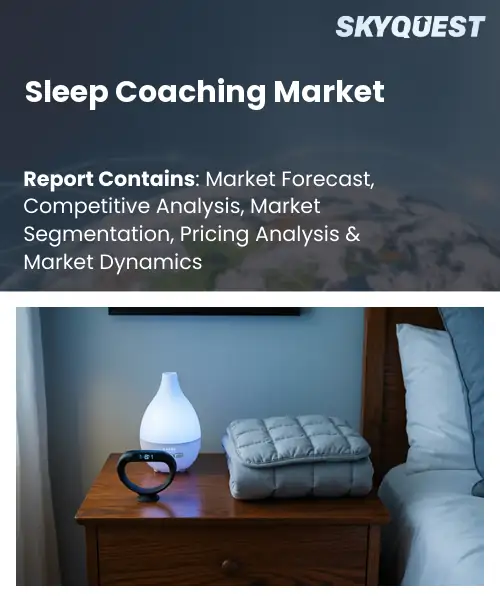
Sleep Coaching Market
Report ID: SQMIG25S2130
Report ID: SQMIG25S2130
[email protected]
USA +1 351-333-4748
Report ID:
SQMIG25S2130 |
Region:
Global |
Published Date: July, 2026
Pages:
157
|Tables:
173
|Figures:
79


Global Sleep Coaching Market size was valued at USD 487.3 Million in 2024 and is poised to grow from USD 525.31 Million in 2025 to USD 958.0 Million by 2033, growing at a CAGR of 7.8% during the forecast period (2026-2033).
The global sleep coaching market comprises professional services that guide individuals especially parents of young children toward healthier sleep patterns through personalized plans, virtual consultations, and data‑driven monitoring tools. Its importance stems from mounting evidence that insufficient sleep impairs cognitive development in children and productivity in adults, prompting governments and insurers to endorse preventive sleep health. The sector emerged in the early 2010s when pediatricians began recommending behavioral interventions, but accelerated after the COVID‑19 pandemic forced families to adopt tele‑coaching platforms such as Sleepwise and Nuna. This evolution reflects a broader shift toward digital therapeutic models that promise scalable, evidence‑based outcomes for public wellbeing. Demand for corporate wellness programs acts as a catalyst because employers recognize that sleep‑deprived staff generate higher error rates, absenteeism, and healthcare costs. Companies such as Google and Unilever have partnered with sleep‑coaching firms to embed nightly analytics into employee dashboards, leading to measurable reductions in turnover and a 12 % rise in reported productivity within six months. This success fuels venture capital inflows, prompting startups to integrate artificial‑intelligence sleep scoring and on‑demand video sessions that can be bundled with health‑benefit platforms. Consequently, the market expands beyond infant care into adult‑focused subscriptions, unlocking distribution channels and creating a loop that accelerates innovation and adoption.
How is AI-driven personalization reshaping the global sleep coaching market?
AI-driven personalization is turning sleep coaching into a data‑rich, highly tailored service. Algorithms analyze users’ habits, biometric signals and environmental factors to craft nightly routines that evolve with each individual’s progress. This shift moves coaches from generic advice to dynamic, real‑time guidance, improving engagement and outcomes. Platforms now blend virtual sessions with automated insights, allowing practitioners to focus on nuanced behavioral coaching while AI handles routine monitoring. The market is responding with new subscription models that bundle personalized content, wearables integration and continuous feedback loops, making sleep improvement more accessible and measurable for a broader audience.In April 2024, a leading sleep coaching platform introduced an AI‑driven personalization module that automatically adjusts coaching plans based on real‑time sleep data, boosting user adherence and supporting market growth through enhanced efficiency.
Market snapshot - (2026-2033)
Global Market Size
USD 487.3 Million
Largest Segment
Hardware Modules
Fastest Growth
Integrated Modules
Growth Rate
7.8% CAGR
To get more insights on this market click here to Request a Free Sample Report
Global sleep coaching market is segmented by component type, charging type, vehicle type, installation type, end user, sales channel and region. Based on component type, the market is segmented into Hardware Modules, Software Modules, Integrated Modules and Others. Based on charging type, the market is segmented into AC Charging Systems, DC Fast Charging Systems and Ultra-Fast Charging Systems. Based on vehicle type, the market is segmented into Passenger Electric Vehicles, Commercial Electric Vehicles, Electric Buses and Others. Based on installation type, the market is segmented into OEM Installed Modules and Retrofit Modules. Based on end user, the market is segmented into Automotive OEMs, Charging Point Operators, Fleet Operators and Others. Based on sales channel, the market is segmented into Direct Sales, System Integrators and Others. Based on region, the market is segmented into North America, Europe, Asia Pacific, Latin America and Middle East & Africa.
Software Modules segment leads because it provides scalable, data driven platforms that personalize sleep interventions in real time. Cloud based analytics combine biometric inputs with behavioral cues, enabling continuous coaching without hardware constraints. This flexibility encourages rapid onboarding of new users and seamless updates, fostering higher engagement and better outcomes. Consequently, providers prioritize software only solutions to differentiate their offerings and meet evolving consumer expectations for adaptive, evidence based guidance.
Meanwhile, Hardware Modules segment witnesses the strongest growth momentum as wearable sleep trackers become essential for collecting high resolution physiological data. Advances in sensor miniaturization and battery efficiency lower user friction, prompting broader adoption across wellness platforms. This surge fuels deeper insights, unlocking new coaching algorithms and expanding market reach through integrated device ecosystems.
Retrofit Modules segment stands out because it enables existing sleep environments to be upgraded with intelligent coaching layers without major renovation. By embedding sensors and actuators into current mattresses or bedroom lighting, providers tap into established user bases, reducing acquisition costs and accelerating deployment. This approach appeals to consumers seeking incremental improvement and to businesses leveraging legacy assets for new revenue streams.
Conversely, OEM Installed Modules segment is witnessing the fastest expansion as vehicle manufacturers embed sleep coaching interfaces directly into cabin systems. Integration during production ensures seamless user experience, aligns with ecosystems, and leverages connectivity. This early stage incorporation drives exposure, prompting adoption among tech savvy travelers and establishing a foundation for future in car wellness services.
To get detailed segments analysis, Request a Free Sample Report
North America holds a preeminent position in the sleep coaching ecosystem due to a confluence of advanced healthcare infrastructure, high consumer awareness of wellness, and a mature digital ecosystem that supports personalized coaching platforms. The region benefits from robust research institutions that continuously feed evidence‑based practices into commercial offerings, while insurers increasingly recognize sleep health as a preventative measure, expanding reimbursement pathways. A culture that values productivity and work‑life balance fuels demand for solutions that promise measurable performance gains, and the presence of leading technology firms accelerates innovation in data analytics, wearables, and virtual coaching interfaces. Furthermore, the regulatory environment encourages collaboration between public health agencies and private providers, streamlining product development cycles and facilitating rapid market entry.
United States Sleep Coaching Market
Sleep Coaching Market in the United States is shaped by a large pool of health‑conscious consumers who actively seek technology‑driven interventions to improve rest quality. The ecosystem features a dense network of startups, established wellness brands, and academic research centers that co‑develop evidence‑based programs. Insurance providers are progressively integrating sleep coaching into benefits packages, while corporate wellness initiatives amplify adoption across diverse employee populations and demonstrate measurable health benefits.
Canada Sleep Coaching Market
Sleep Coaching Market in Canada benefits from strong public health policies that prioritize mental and physical wellbeing, creating a receptive environment for sleep‑focused services. Collaborative frameworks between provincial health agencies and private providers foster tailored program delivery, while a growing interest in digital health solutions accelerates the adoption of mobile coaching applications. Employers increasingly recognize sleep health as a productivity lever, integrating coaching into broader wellness strategies for their workforces.
Europe experiences a rapid expansion of the sleep coaching market driven by heightened public awareness of sleep’s impact on chronic disease prevention and a strong policy emphasis on preventive health. Collaborative research across leading universities fuels innovative coaching methodologies that are rapidly translated into commercial services. The region’s mature insurance frameworks increasingly reimburse behavioral health interventions, encouraging consumers to adopt structured coaching programs. Cultural shifts toward work‑life balance, especially in urban centers, have amplified demand for personalized sleep solutions. Moreover, a thriving fintech and digital health sector provides scalable platforms for remote coaching, while regulatory harmonization across member states eases market entry for cross‑border providers. Consumer advocacy groups also play a pivotal role in disseminating evidence‑based sleep education, further reinforcing the market’s growth trajectory.
Germany Sleep Coaching Market
Sleep Coaching Market in Germany is anchored by scientific research that underpins evidence‑based interventions, positioning the country as a regional leader. Strong collaboration between healthcare providers and technology firms accelerates development of coaching platforms that blend biometric data with personalized guidance. Insurance schemes cover sleep coaching services, while corporate wellness programs embed them within employee health initiatives. Consumer confidence in clinically validated solutions sustains adoption across demographic segments nationwide and globally.
United Kingdom Sleep Coaching Market
Sleep Coaching Market in the United Kingdom is propelled by a vibrant digital health scene that rapidly adopts AI‑enhanced coaching solutions. Government initiatives encouraging preventive health have led to broader insurance coverage for behavioral sleep programs, while universities generate cutting‑edge research that feeds commercial offerings. Employers are embracing sleep coaching as a key component of talent retention strategies, and consumer appetite for accessible, evidence‑based apps drives swift market uptake across age groups.
France Sleep Coaching Market
Sleep Coaching Market in France is emerging as consumer interest in holistic wellbeing intersects with a growing ecosystem of health startups. National health guidelines increasingly reference sleep quality as a determinant of overall health, encouraging insurers to pilot reimbursement models for coaching services. Collaborative pilots between academic institutions and technology firms are fostering localized solutions that respect cultural preferences. Early adoption is evident among urban professionals seeking convenient, science‑backed approaches to improve nightly rest.
Asia Pacific is strengthening its position in the sleep coaching market through a combination of rapid technology adoption, rising health consciousness, and supportive governmental health agendas that emphasize preventive care. The region’s large, tech‑savvy populations are eager to integrate wearable devices and mobile applications into daily routines, providing fertile data environments for personalized coaching algorithms. Public‑private partnerships are emerging to address sleep disorders as a public health priority, unlocking funding for research and scalable program deployment. Cultural shifts toward stress reduction and mindfulness amplify interest in holistic sleep solutions, while multinational firms leverage regional manufacturing strengths to deliver cost‑effective devices at scale. This momentum is reshaping industry standards.
Japan Sleep Coaching Market
Sleep Coaching Market in Japan benefits from a deep respect for routine and a national emphasis on health optimization. Integration of sensor technology into consumer electronics provides data collection for tailored coaching programs. Government health campaigns increasingly highlight the burden of sleep deprivation, prompting insurers to include coaching services in preventive care packages. Employers adopt sleep wellness initiatives to boost employee performance, while a growing consumer base embraces mobile platforms that combine mindfulness practices with coaching methodologies.
South Korea Sleep Coaching Market
Sleep Coaching Market in South Korea is propelled by a consumer base and a government vision that frames sleep health as essential to national productivity. The proliferation of mobile networks enables delivery of AI‑driven coaching sessions through messaging platforms. Insurance providers are experimenting with reimbursement models that reward measurable improvements in sleep quality, while corporations embed coaching into wellness programs to attract and retain talent. Local startups innovate culturally attuned content that blends conventional wellness practices with behavioral science.
To know more about the market opportunities by region and country, click here to
Buy The Complete Report
Awareness Is Growing
Personalized Coaching Is Adopted
High Cost Is Barrier
Regulatory Uncertainty Is Deterring
Request Free Customization of this report to help us to meet your business objectives.
The global sleep coaching market is shaped by intense competition as firms leverage sizable funding rounds, strategic partnerships with wellness platforms, and rapid tech integration such as AI‑driven personalization. Recent large‑scale investments, like Eight Sleep’s $100 million raise, enable accelerated product development and potential acquisitions, while recognitions such as Fast Company’s Innovative Companies list amplify brand alliances and market visibility.
Top Player’s Company Profile
Recent Developments
SkyQuest’s ABIRAW (Advanced Business Intelligence, Research & Analysis Wing) is our Business Information Services team that Collects, Collates, Correlates, and Analyses the Data collected by means of Primary Exploratory Research backed by robust Secondary Desk research. As per SkyQuest analysis the global sleep coaching market is expanding rapidly, propelled by growing awareness of sleep’s impact on health and productivity, which fuels strong demand for professional coaching services. A second driver is the increasing adoption of personalized coaching enabled by AI‑driven platforms that tailor interventions to individual habits. The market is led by the software modules segment, which offers scalable cloud‑based solutions and drives higher user engagement. North America dominates the landscape thanks to advanced healthcare infrastructure, high consumer wellness awareness and robust tech ecosystems. However, high costs remain a restraint, limiting adoption among price‑sensitive groups and slowing broader penetration.
| Report Metric | Details |
|---|---|
| Market size value in 2024 | USD 487.3 Million |
| Market size value in 2033 | USD 958.0 Million |
| Growth Rate | 7.8% |
| Base year | 2024 |
| Forecast period | (2026-2033) |
| Forecast Unit (Value) | USD Million |
| Segments covered |
|
| Regions covered | North America (US, Canada), Europe (Germany, France, United Kingdom, Italy, Spain, Rest of Europe), Asia Pacific (China, India, Japan, Rest of Asia-Pacific), Latin America (Brazil, Rest of Latin America), Middle East & Africa (South Africa, GCC Countries, Rest of MEA) |
| Companies covered |
|
| Customization scope | Free report customization with purchase. Customization includes:-
|
To get a free trial access to our platform which is a one stop solution for all your data requirements for quicker decision making. This platform allows you to compare markets, competitors who are prominent in the market, and mega trends that are influencing the dynamics in the market. Also, get access to detailed SkyQuest exclusive matrix.
Table Of Content
Executive Summary
Market overview
Parent Market Analysis
Market overview
Market size
KEY MARKET INSIGHTS
COVID IMPACT
MARKET DYNAMICS & OUTLOOK
Market Size by Region
KEY COMPANY PROFILES
Methodology
For the Sleep Coaching Market, our research methodology involved a mixture of primary and secondary data sources. Key steps involved in the research process are listed below:
1. Information Procurement: This stage involved the procurement of Market data or related information via primary and secondary sources. The various secondary sources used included various company websites, annual reports, trade databases, and paid databases such as Hoover's, Bloomberg Business, Factiva, and Avention. Our team did 45 primary interactions Globally which included several stakeholders such as manufacturers, customers, key opinion leaders, etc. Overall, information procurement was one of the most extensive stages in our research process.
2. Information Analysis: This step involved triangulation of data through bottom-up and top-down approaches to estimate and validate the total size and future estimate of the Sleep Coaching Market.
3. Report Formulation: The final step entailed the placement of data points in appropriate Market spaces in an attempt to deduce viable conclusions.
4. Validation & Publishing: Validation is the most important step in the process. Validation & re-validation via an intricately designed process helped us finalize data points to be used for final calculations. The final Market estimates and forecasts were then aligned and sent to our panel of industry experts for validation of data. Once the validation was done the report was sent to our Quality Assurance team to ensure adherence to style guides, consistency & design.
Analyst Support
Customization Options
With the given market data, our dedicated team of analysts can offer you the following customization options are available for the Sleep Coaching Market:
Product Analysis: Product matrix, which offers a detailed comparison of the product portfolio of companies.
Regional Analysis: Further analysis of the Sleep Coaching Market for additional countries.
Competitive Analysis: Detailed analysis and profiling of additional Market players & comparative analysis of competitive products.
Go to Market Strategy: Find the high-growth channels to invest your marketing efforts and increase your customer base.
Innovation Mapping: Identify racial solutions and innovation, connected to deep ecosystems of innovators, start-ups, academics, and strategic partners.
Category Intelligence: Customized intelligence that is relevant to their supply Markets will enable them to make smarter sourcing decisions and improve their category management.
Public Company Transcript Analysis: To improve the investment performance by generating new alpha and making better-informed decisions.
Social Media Listening: To analyze the conversations and trends happening not just around your brand, but around your industry as a whole, and use those insights to make better Marketing decisions.
REQUEST FOR SAMPLE
 REQUEST FREE CUSTOMIZATION


Want to customize this report? This report can be personalized according to your needs. Our analysts and industry experts will work directly with you to understand your requirements and provide you with customized data in a short amount of time. We offer $1000 worth of FREE customization at the time of purchase.
Feedback From Our Clients


 USA (+1) 351-333-4748

