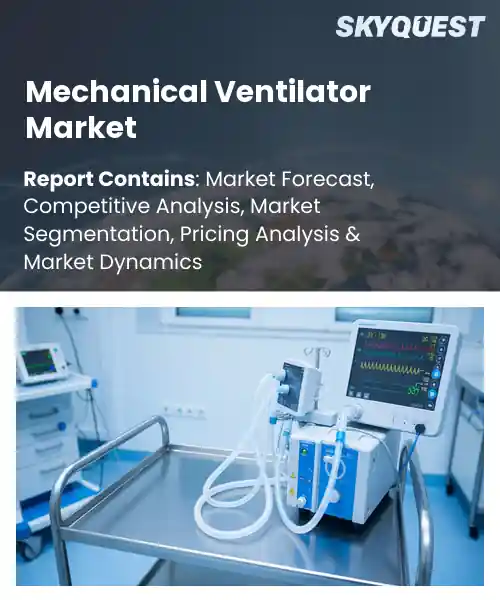
Mechanical Ventilator Market
Report ID: SQMIG35A3950
Report ID: SQMIG35A3950
[email protected]
USA +1 351-333-4748
Report ID:
SQMIG35A3950 |
Region:
Global |
Published Date: June, 2026
Pages:
157
|Tables:
180
|Figures:
79


Global Mechanical Ventilator Market size was valued at USD 5.2 Billion in 2024 and is poised to grow from USD 5.47 Billion in 2025 to USD 8.14 Billion by 2033, growing at a CAGR of 5.1% during the forecast period (2026-2033).
Mechanical ventilators are life-saving devices that help or replace spontaneous breathing. They are a specialized segment of critical care equipment that saw a surge in demand during the COVID-19 pandemic and remain critical for managing respiratory diseases, anesthesia, and emergency preparedness. [ The key market drivers are increasing prevalence of chronic respiratory diseases, acute respiratory failure and rising ICU admissions due to aging population. Technological advances, such as portable and noninvasive ventilators, broadened the application settings beyond tertiary hospitals to include ambulatory and home care. Historically incremental innovation, regulatory approvals and pandemic-driven procurement have transformed supply chains with competition increasing among multinational and niche manufacturers.
Strong procurement and facility upgrades are driving ventilator installations and service agreements Investment in healthcare infrastructure and supply chain resilience leveraging demographic and technological momentum is a key driver of growth. Governments and hospitals are expanding their ICU capacity, and manufacturers are increasing production and creating modular, lower-maintenance designs that lower the cost of ownership and help accelerate adoption in emerging markets. Real-world applications include fast-tracked transport and portable ventilators for pandemic field hospitals, home-ventilation programs for COPD patients that will translate into demand for compact noninvasive devices, and tele-ICU adoption that will create commercial opportunities for connected ventilator platforms and remote-monitoring services and training programs.
How is AI improving patient outcomes in the mechanical ventilator market?
The mechanical ventilators market uses artificial intelligence to improve patient outcomes through continuous physiologic monitoring, predictive analytics, closed loop control, and decision support. This enables ventilators to tailor settings for each patient, minimise harmful patterns of ventilation and detect deterioration earlier. This means less manual adjustments by clinicians, more uniform lung protective strategies and more seamless weaning pathways. “Patient acuity and staffing pressures are higher, so hospitals are more willing to buy smart systems that reduce workload and standardize care. They include closed loop modes that automatically titrate oxygen and pressure and algorithms that emphasize lung protection.
In October 2025, CorVent Medical launched AI driven CorVision platform, that applies predictive intelligence to ventilation management and integrates with hospital systems. This is driving market growth through improved clinical efficiencies and enabling scalable respiratory care in resource-constrained settings.
Market snapshot - (2026-2033)
Global Market Size
USD 5.2 Billion
Largest Segment
Intensive Care Ventilators
Fastest Growth
Portable Ventilators
Growth Rate
5.1% CAGR
To get more insights on this market click here to Request a Free Sample Report
Global mechanical ventilator market is segmented by product type, mode type, application, end user, patient type, interface type and region. Based on product type, the market is segmented into Intensive Care Ventilators, Portable Ventilators, Transport Ventilators, Neonatal Ventilators, Homecare Ventilators, Non-invasive Ventilators and Invasive Ventilators. Based on mode type, the market is segmented into Volume-controlled Ventilation, Pressure-controlled Ventilation, Combined Mode Ventilation and Others. Based on application, the market is segmented into Critical Care, Emergency Care, Chronic Respiratory Disease Management, Neonatal Care, Anesthesia Support and Others. Based on end user, the market is segmented into Hospitals, Ambulatory Surgical Centers, Homecare Settings, Specialty Clinics and Others. Based on patient type, the market is segmented into Adult, Pediatric and Neonatal. Based on interface type, the market is segmented into Invasive Ventilation Interfaces and Non-invasive Ventilation Interfaces. Based on region, the market is segmented into North America, Europe, Asia Pacific, Latin America and Middle East & Africa.
The Intensive Care Ventilators segment is the industry leader as it meets the most serious respiratory needs and is an essential part of hospital critical care workflows. It’s the choice of choice for critically ill patients with advanced ventilation modes, integration with hospital IT, as well as sophisticated monitoring. Strong clinician dependence, high procurement priority and the need for durable, multi-parameter devices reinforce its leadership position in the mechanical ventilator market and long-term serviceability, driving continued investment and product development.
However, portable ventilators are the fastest growing segment propelled by demand for mobility, simplified interfaces and increased use outside of the intensive care setting. Design innovation and adoption are being driven by battery operation, small form factors and connectivity for remote monitoring in emergency, transport and homecare settings, providing significant opportunities for new product entrants and service models.
The Volume-controlled Ventilation segment is dominating the market with its ability to deliver consistent tidal volumes and predictable gas exchange for a broad range of patients, making it easier for clinicians to manage patients in acute care settings. This mode is preferred because of the existing clinical protocols, monitoring systems and experience of respiratory teams. Its clinical trust, strong evidence base and ease of integration into critical care workflows drive continued investment and sustain its leadership position in the mechanical ventilator market.
Meanwhile, Combined Mode Ventilation is experiencing the highest growth momentum as clinicians resort to hybrid approaches to tailor support to evolving patient needs. Advances in algorithmic control, adaptive ventilation strategies and regulatory acceptance of smarter modes are driving adoption. This flexibility enables new clinical uses and vendor differentiation, driving future product innovation and market growth.
To get detailed segments analysis, Request a Free Sample Report
North America dominates the global mechanical ventilator market owing to its well-developed advanced healthcare infrastructure, strong clinical research ecosystems, and strong ties between the manufacturers and large hospital systems. A strong medical device regulatory environment and well-developed reimbursement pathways allow new technologies and service models for ventilator use to be rapidly accepted. The large device manufacturers have integrated supply chains and extensive aftermarket support that add reliability and clinician confidence. Through strategic partnerships with technology companies, academic centers and clinical networks, we accelerate the development and real-world validation of products. Public procurement practices and joint emergency preparedness planning strengthen resilient supply chains and prioritized allocation during surges. Domestic manufacturing capability decreases reliance on foreign sources . The regional solutions are a benchmark for clinical efficiency and remote care support, through the use of digital monitoring and connectivity capabilities and telemedicine interfaces.
The United States Mechanical Ventilator Market is propelled by the dense network of hospitals, leading device manufacturers and intensive clinical activity that informs product refinement. Good clinician–engineer relationships enable iterative design improvements and patient-centric features. An advanced ecosystem of procurement, training and technical support drives clinical adoption and after market services. Interoperability and data-driven ventilator management are also a differentiator of offerings and enabler of integration into critical care pathways.
Canada Mechanical Ventilator Market has a synchronized public health infrastructure and cooperative procurement mechanisms that give precedence to clinical needs across the regions. Canada Mechanical Ventilator Market @12 Collaborations with local manufacturers and strong clinical networks enable tailor-made configurations of ventilators for various levels of care. Device uptime and clinician confidence are increased through training, remote clinical support and long term maintenance programs. Regulatory alignment with global standards allows for innovation with strong safety oversight and ongoing post market surveillance.
The growth in Europe is being fuelled by the harmonisation of health policy frameworks, investment in hospital modernisation and close collaboration between medical device companies and clinical research centres. A push is on for manufacturers to supply modular, user-friendly systems with integrated monitoring and connectivity to support a range of care pathways, so flexible ventilator platforms are necessary. Cross border procurement organisations and joint purchasing strategies are increasing access while stimulating local supply chain development. The emphasis on clinician training, harmonization of standards and generation of post market clinical evidence supports sustained uptake. Greater emphasis on resilient manufacturing capabilities and partnerships with technology providers accelerates the diffusion of innovation across national health systems and private care networks. Regulatory harmonisation among member states removes barriers to market entry and encourages pan regional strategies. Collaborations between traditional manufacturers and agile tech startups foster faster prototyping and adaptation to different clinical workflows, and boost regional competitiveness and supply resilience.
Mechanical Ventilator Market United Kingdom witnesses rapid adoption of innovative ventilator technologies backed by private investment, flexible procurement and strong digital health integration. The manufacturer is focusing on connectivity, driven by clinical demand for flexible systems and remote monitoring. “Startups and established companies collaborate to rapidly prototype and launch. It emphasizes workforce training and adaptable service models that foster clinician confidence and expand use of ventilators in acute and step-down care settings.
Mechanical Ventilator Market in France Thanks to focused national programs to upgrade respiratory care and strengthen domestic manufacturers, the Mechanical Ventilator Market is gaining momentum. Flexible ventilator designs for various care settings are driving product development. Robust clinical networks and alliances with technology vendors promote use of user-centric features and integrated surveillance. Increased investment in training programs and localized service delivery enhances device uptime and clinician confidence in advanced ventilator platforms.
Asia Pacific is taking a multi-pronged approach, including investments in domestic manufacturing, increased collaborations for clinical research, and a heightened focus on affordable and scalable ventilator solutions tailored to regional care models. Governments and private actors are building local supply chains and alliances that accelerate technology transfer and manufacturing capacity. Serviceability, cost effective designs and training programs are emphasized to meet a spectrum of healthcare infrastructure requirements. Interoperability is ensured through the inclusion of connectivity features that enable remote monitoring and collaboration with global suppliers. The growing expertise in medical device engineering in the region and the improved workforce development strategy have resulted in increased competitiveness and ability to supply the domestic and export markets. Regional harmonization efforts provide for faster market access of compliant devices, and the navigability of regulatory pathways is improving. Better post sales support models and training programs help build clinician trust and sustain long term use across hospital and community care settings.
Mechanical Ventilator Market Japan depends on precision engineering, proven medical device OEMs and clinical validation pathways that generate reliable ventilator platforms. Products focus on intensive care and respiratory programs with an emphasis on automation, compact design and advanced monitoring. Strong after sales service networks , maintenance programs and clinician training initiatives support continued device performance . Industry and academic hospital partnerships accelerate product iterations and promote adoption in acute and home care settings.
South Korea Mechanical Ventilator Market South Korea’s strengths in electronics integration, agile manufacturing and a vibrant startup ecosystem match well with established medical device companies. Our focus on cost effective, feature rich ventilator designs supports broad clinical use from intensive care to step down units Close industry-academic hospital relationships accelerate validation and iterative improvement. Investments in telemedicine interfaces, service networks and connectivity improves usability of devices and clinician adoption.
To know more about the market opportunities by region and country, click here to
Buy The Complete Report
Rising Prevalence Of Respiratory Disorders
Technological Advancements In Ventilator Design
High Cost Of Advanced Devices
Limited Skilled Respiratory Workforce
Request Free Customization of this report to help us to meet your business objectives.
Competitive landscape is defined by incumbent medtech firms consolidating respiratory portfolios through acquisitions and by agile entrants pursuing rapid manufacturing or AI differentiation; competition is driven by the need to scale production quickly and secure regulatory clearance. Recent activity shows large-scale M&A to broaden respiratory and connected-care offerings and emergency manufacturing partnerships to surge output, while startups advance AI controls and low-cost emergency ventilators.
Top Player’s Company Profile
Recent Developments
SkyQuest’s ABIRAW (Advanced Business Intelligence, Research & Analysis Wing) is our Business Information Services team that Collects, Collates, Correlates, and Analyses the Data collected by means of Primary Exploratory Research backed by robust Secondary Desk research. As per SkyQuest analysis, the global mechanical ventilator market is being propelled by rising prevalence of respiratory disorders while high device costs remain a key restraint. North America continues to dominate the market supported by advanced healthcare infrastructure and strong clinical research networks, and Intensive Care Ventilators represent the leading segment due to high acuity demand and hospital procurement priorities. A second driver is rapid technological advancement, including AI-enabled and portable systems that expand use into ambulatory and homecare settings. Manufacturers that balance innovation, affordability and after-sales service are best positioned to capture growth as health systems upgrade capacity and pursue resilient supply chains.
| Report Metric | Details |
|---|---|
| Market size value in 2024 | USD 5.2 Billion |
| Market size value in 2033 | USD 8.14 Billion |
| Growth Rate | 5.1% |
| Base year | 2024 |
| Forecast period | (2026-2033) |
| Forecast Unit (Value) | USD Billion |
| Segments covered |
|
| Regions covered | North America (US, Canada), Europe (Germany, France, United Kingdom, Italy, Spain, Rest of Europe), Asia Pacific (China, India, Japan, Rest of Asia-Pacific), Latin America (Brazil, Rest of Latin America), Middle East & Africa (South Africa, GCC Countries, Rest of MEA) |
| Companies covered |
|
| Customization scope | Free report customization with purchase. Customization includes:-
|
To get a free trial access to our platform which is a one stop solution for all your data requirements for quicker decision making. This platform allows you to compare markets, competitors who are prominent in the market, and mega trends that are influencing the dynamics in the market. Also, get access to detailed SkyQuest exclusive matrix.
Table Of Content
Executive Summary
Market overview
Parent Market Analysis
Market overview
Market size
KEY MARKET INSIGHTS
COVID IMPACT
MARKET DYNAMICS & OUTLOOK
Market Size by Region
KEY COMPANY PROFILES
Methodology
For the Mechanical Ventilator Market, our research methodology involved a mixture of primary and secondary data sources. Key steps involved in the research process are listed below:
1. Information Procurement: This stage involved the procurement of Market data or related information via primary and secondary sources. The various secondary sources used included various company websites, annual reports, trade databases, and paid databases such as Hoover's, Bloomberg Business, Factiva, and Avention. Our team did 45 primary interactions Globally which included several stakeholders such as manufacturers, customers, key opinion leaders, etc. Overall, information procurement was one of the most extensive stages in our research process.
2. Information Analysis: This step involved triangulation of data through bottom-up and top-down approaches to estimate and validate the total size and future estimate of the Mechanical Ventilator Market.
3. Report Formulation: The final step entailed the placement of data points in appropriate Market spaces in an attempt to deduce viable conclusions.
4. Validation & Publishing: Validation is the most important step in the process. Validation & re-validation via an intricately designed process helped us finalize data points to be used for final calculations. The final Market estimates and forecasts were then aligned and sent to our panel of industry experts for validation of data. Once the validation was done the report was sent to our Quality Assurance team to ensure adherence to style guides, consistency & design.
Analyst Support
Customization Options
With the given market data, our dedicated team of analysts can offer you the following customization options are available for the Mechanical Ventilator Market:
Product Analysis: Product matrix, which offers a detailed comparison of the product portfolio of companies.
Regional Analysis: Further analysis of the Mechanical Ventilator Market for additional countries.
Competitive Analysis: Detailed analysis and profiling of additional Market players & comparative analysis of competitive products.
Go to Market Strategy: Find the high-growth channels to invest your marketing efforts and increase your customer base.
Innovation Mapping: Identify racial solutions and innovation, connected to deep ecosystems of innovators, start-ups, academics, and strategic partners.
Category Intelligence: Customized intelligence that is relevant to their supply Markets will enable them to make smarter sourcing decisions and improve their category management.
Public Company Transcript Analysis: To improve the investment performance by generating new alpha and making better-informed decisions.
Social Media Listening: To analyze the conversations and trends happening not just around your brand, but around your industry as a whole, and use those insights to make better Marketing decisions.
REQUEST FOR SAMPLE
 REQUEST FREE CUSTOMIZATION
Global Mechanical Ventilator Market size was valued at USD 5.2 Billion in 2024 and is poised to grow from USD 5.47 Billion in 2025 to USD 8.14 Billion by 2033, growing at a CAGR of 5.1% during the forecast period (2026-2033).
Competitive landscape is defined by incumbent medtech firms consolidating respiratory portfolios through acquisitions and by agile entrants pursuing rapid manufacturing or AI differentiation; competition is driven by the need to scale production quickly and secure regulatory clearance. Recent activity shows large-scale M&A to broaden respiratory and connected-care offerings and emergency manufacturing partnerships to surge output, while startups advance AI controls and low-cost emergency ventilators. 'Medtronic', 'Philips Healthcare', 'GE HealthCare', 'Drägerwerk', 'ResMed', 'Hamilton Medical', 'Getinge', 'Vyaire Medical', 'Mindray Medical International', 'Fisher & Paykel Healthcare', 'Nihon Kohden', 'Zoll Medical', 'Air Liquide Medical Systems', 'Smiths Medical', 'Becton Dickinson', 'Schiller', 'Lowenstein Medical', 'Aeonmed', 'Siare Engineering International Group', 'Heyer Medical'
There is an increasing clinical demand for mechanical ventilators due to the growing burden of acute and chronic respiratory illnesses, which compels healthcare providers to expand critical care capacity and upgrade supportive care infrastructure. Hospitals and care facilities prioritize acquisition of reliable ventilation equipment to manage severe respiratory episodes and prolonged ventilatory support needs, prompting procurement cycles and strategic investments. This persistent clinical need encourages manufacturers to innovate and scale production, broadening product portfolios and distribution networks to meet diversified clinical settings and patient profiles.
𝗔𝗜 𝗗𝗥𝗜𝗩𝗘𝗡 𝗩𝗘𝗡𝗧𝗜𝗟𝗔𝗧𝗜𝗢𝗡: AI-driven ventilation leverages advanced algorithms and continuous physiologic monitoring to personalize ventilator support in real time, enabling adaptive breath delivery and earlier detection of deterioration. Integration with clinical information systems and remote monitoring platforms streamlines workflows and supports telecritical care models, reducing clinician burden while prompting new service models. Emphasis on software validation, interoperability standards, and data governance is shaping vendor strategies, encouraging partnerships between medical device manufacturers and healthcare IT firms to deliver outcome-focused solutions across care settings broadly.
Why does North America Dominate the Global Mechanical Ventilator Market? |@12


Want to customize this report? This report can be personalized according to your needs. Our analysts and industry experts will work directly with you to understand your requirements and provide you with customized data in a short amount of time. We offer $1000 worth of FREE customization at the time of purchase.
Feedback From Our Clients


 USA (+1) 351-333-4748

