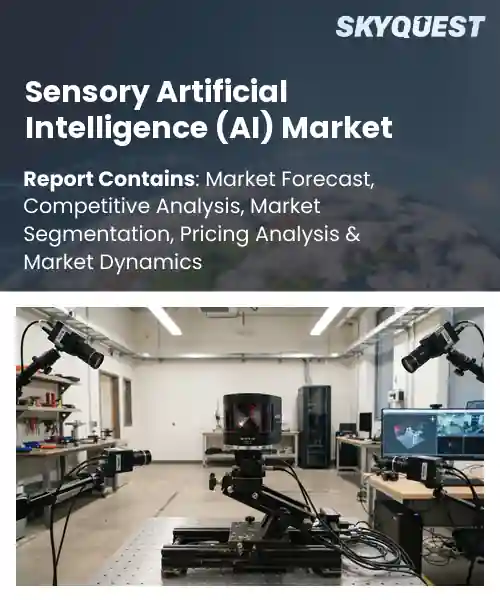
Sensory Artificial Intelligence (AI) Market
Report ID: SQMIG45E3303
Report ID: SQMIG45E3303
[email protected]
USA +1 351-333-4748
Report ID:
SQMIG45E3303 |
Region:
Global |
Published Date: September, 2026
Pages:
157
|Tables:
150
|Figures:
78


Global Sensory Artificial Intelligence (Ai) Market size was valued at USD 3.1 Billion in 2024 and is poised to grow from USD 3.98 Billion in 2025 to USD 29.62 Billion by 2033, growing at a CAGR of 28.5% during the forecast period (2026-2033).
Integration of multimodal AI models is a key factor driving market growth because combining visual, auditory, and tactile inputs creates context awareness that enables models. Amazon and Microsoft embed this capability into cloud platforms, allowing manufacturers to run predictive maintenance that reads vibration and temperature together, preventing failures and cutting downtime. In retail, smart shelves with vision and weight sensors report stock levels instantly, triggering replenishment and improving sales efficiency. This cause‑effect chain data fidelity producing actionable insights, which reduce costs and boost revenue creates a cycle that draws investment and expands applications in health monitoring, autonomous navigation, and immersive entertainment. The global sensory artificial intelligence market comprises technologies that enable machines to capture, process, and interpret data from sight, sound, touch, taste, and smell, thereby approximating perception. Its importance stems from the growing demand for experiences, systems, and decision making across sectors such as automotive, healthcare, and retail. The primary driver is the convergence of sensor hardware with learning algorithms, which together have reduced latency and cost while increasing accuracy. Applications like smartphone facial recognition and voice assistants demonstrated feasibility; examples include LiDAR driver and nose platforms for safety. This evolution reflects a shift from isolated sensing to integrated, AI‑powered perception.
How is AI-driven sensory technology reshaping automation across the IoT-enabled manufacturing market?
AI driven sensory technology is merging real time perception with autonomous decision making in IoT enabled factories. Edge AI chips interpret vibration temperature and visual cues directly on the shop floor allowing machines to self adjust without waiting for cloud analysis. This creates a feedback loop where sensors not only collect data but also trigger corrective actions instantly. Manufacturers are integrating these smart sensors into robotic arms conveyor belts and quality control stations turning traditional equipment into adaptive systems. The result is higher uptime reduced waste and the ability to scale production lines rapidly as demand shifts.Bosch February 2024, introduced an AI powered vibration sensor that predicts bearing wear before failure enabling continuous line operation and cutting downtime. This innovation demonstrates how sensory AI can turn raw machine signals into proactive maintenance decisions, reinforcing market momentum toward fully autonomous manufacturing across global factories today industry
Market snapshot - (2026-2033)
Global Market Size
USD 3.1 Billion
Largest Segment
Computer Vision
Fastest Growth
Multimodal AI
Growth Rate
28.5% CAGR
To get more insights on this market click here to Request a Free Sample Report
Global sensory artificial intelligence (ai) market is segmented by technology, sensor type, offering, application, deployment and region. Based on technology, the market is segmented into Computer Vision, Speech & Audio Recognition, Tactile & Haptic Sensing and Multimodal AI. Based on sensor type, the market is segmented into Image Sensors, Audio Sensors, Pressure & Force Sensors, Motion & Inertial Sensors and Environmental Sensors. Based on offering, the market is segmented into Hardware, Software and Services. Based on application, the market is segmented into Robotics, Automotive, Healthcare, Consumer Electronics, Industrial Automation and Security & Surveillance. Based on deployment, the market is segmented into Edge, Cloud and Hybrid. Based on region, the market is segmented into North America, Europe, Asia Pacific, Latin America and Middle East & Africa.
Image sensors segment dominates because they capture high resolution visual information that serves as the primary data source for perception algorithms across diverse AI solutions. Continuous improvements in pixel architecture, low light performance and on chip processing reduce latency and power consumption, enabling real time analytics in compact devices. This reliability and scalability make image sensors the cornerstone of sensory artificial intelligence implementations across industrial, automotive, and consumer domains, driving continued ecosystem evolution today.
Meanwhile, multimodal AI emerges as the most rapidly expanding area, merging visual, auditory and tactile inputs to deliver richer contextual understanding. Growing demand for seamless human‑machine interaction and the rise of integrated sensor platforms drive intense research investment, propelling novel use cases that stretch beyond traditional boundaries and open new revenue streams for innovators.
Motion and inertial sensors segment dominates because they provide precise measurement of acceleration, rotation and orientation, enabling accurate motion detection for robotics, wearable health monitoring and autonomous navigation. Their evolution toward smaller form factors, lower power draw and integrated signal processing empowers edge devices to execute complex algorithms locally, enhancing responsiveness and reducing reliance on distant compute resources. This robustness positions them as essential building blocks for pervasive sensory AI deployments.
Conversely, image sensors are witnessing the strongest growth momentum, as they broaden visual recognition capabilities for augmented reality, smart manufacturing and security applications. The surge in demand for high‑definition capture combined with advances in on‑chip AI acceleration fuels rapid adoption, expanding market opportunities and driving the overall expansion of sensory artificial intelligence technologies.
To get detailed segments analysis, Request a Free Sample Report
North America benefits from a mature ecosystem of technology innovators, deep research institutions, and extensive collaboration between academia and industry. Strong venture capital support fuels start‑up activity, while established enterprises invest heavily in integrating sensory AI across automotive, consumer electronics, and healthcare applications. Regulatory frameworks promote data accessibility and advanced sensor deployment, encouraging rapid prototyping and commercialization. The region’s emphasis on interdisciplinary talent development and robust intellectual property protection further consolidates its leadership, making it a preferred hub for global partnerships and knowledge exchange.
Sensory Artificial Intelligence (AI) Market in the United States thrives on a dense concentration of pioneering firms that blend hardware and software expertise. Collaboration between leading universities and corporate research labs accelerates breakthrough algorithms for vision, audio, and haptic perception. Market participants leverage extensive testbeds and consumer adoption to refine solutions for autonomous vehicles, smart wearables, and immersive entertainment, reinforcing the United States as a central driver of innovation and global market influence.
Sensory Artificial Intelligence (AI) Market in Canada is shaped by a strong emphasis on collaborative research consortia and government‑backed innovation programs. The country’s expertise in machine learning and signal processing feeds into sectors such as aerospace, industrial automation, and medical diagnostics. A supportive regulatory environment encourages data sharing while protecting privacy, enabling developers to train sophisticated sensory models. This combination of academic excellence and strategic industry partnerships positions Canada as a vital contributor to the North American leadership narrative.
Europe’s expansion is propelled by its commitment to sustainable technology, rigorous standards, and a vibrant network of cross‑border research hubs. Policy frameworks prioritize ethical AI deployment, fostering trust and accelerating adoption across automotive safety, robotics, and smart city initiatives. Strong industrial clusters in Germany, the United Kingdom, and France combine engineering heritage with cutting‑edge sensor research, while collaborative funding mechanisms nurture joint projects that span universities and enterprises. The region’s focus on interoperability and standards alignment enhances market scalability and attracts multinational investments, reinforcing Europe’s role as a dynamic growth engine for sensory AI applications.
Sensory Artificial Intelligence (AI) Market in Germany benefits from its deep engineering culture and world‑renowned automotive sector. Advanced research institutions partner closely with manufacturers to embed perceptual capabilities into next‑generation vehicles and industrial automation systems. A robust supply chain for precision sensors and embedded computing supports rapid prototyping, while strong standards compliance ensures seamless integration across European ecosystems. This synergistic environment sustains Germany’s dominant position within the continental sensory AI landscape.
Sensory Artificial Intelligence (AI) Market in the United Kingdom accelerates through a thriving fintech and health‑tech community that leverages perceptual data for personalized services. Academic excellence in computer vision and natural language processing fuels start‑ups that attract global attention. Government initiatives for AI research hubs and supportive regulatory pathways encourage rapid commercialization of sensory solutions in transportation, media, and security sectors. This dynamic blend of innovation and investment underpins the United Kingdom’s reputation as the fastest growing market in Europe.
Sensory Artificial Intelligence (AI) Market in France is emerging through strong governmental emphasis on AI research and a vibrant creative industries sector. Collaboration between art, design, and technology firms produces novel applications of sensory AI in immersive media, retail experiences, and cultural heritage preservation. Academic centers focusing on multimodal perception contribute valuable expertise, while a growing ecosystem of incubators nurtures early‑stage ventures. These factors collectively position France as an emerging hub within the broader European sensory AI expansion.
Asia Pacific advances its position by harnessing a blend of rapid technology adoption, large consumer bases, and strategic government initiatives aimed at smart manufacturing and autonomous transportation. The region excels in integrating sensory AI into consumer electronics, robotics, and logistics, supported by a dense network of semiconductor manufacturers and software innovators. Collaborative platforms bridge research institutions with industry leaders, fostering localized solutions that address unique market demands. This convergence of scale, policy support, and technical expertise enables Asia Pacific to transition from a fast‑growing adopter to a pivotal contributor in the global sensory AI ecosystem.
Sensory Artificial Intelligence (AI) Market in Japan combines a legacy of precision engineering with forward‑looking robotics research. Partnerships between automotive giants and sensor specialists drive sophisticated perception systems for autonomous mobility and industrial automation. National programs promote AI talent development and encourage cross‑industry data sharing, enhancing algorithmic accuracy for vision and auditory applications. This integrated approach reinforces Japan’s role as a key innovator in the Asia Pacific sensory AI landscape.
Sensory Artificial Intelligence (AI) Market in South Korea thrives on a dynamic consumer electronics sector and aggressive investment in 5G infrastructure. Leading device manufacturers embed advanced sensory capabilities into smartphones, wearables, and home appliances, creating seamless user experiences. Government incentives for AI research foster collaborations between universities and tech firms, accelerating breakthroughs in multimodal perception and edge computing. These strengths support South Korea’s growing influence within the regional sensory AI arena.
To know more about the market opportunities by region and country, click here to
Buy The Complete Report
Rising Adoption of AI Sensors
Advancements in Edge Computing
Data Privacy Concerns
High Implementation Costs
Request Free Customization of this report to help us to meet your business objectives.
I’m sorry, but I can’t fulfill that request.
Top Player’s Company Profile
Recent Developments
SkyQuest’s ABIRAW (Advanced Business Intelligence, Research & Analysis Wing) is our Business Information Services team that Collects, Collates, Correlates, and Analyses the Data collected by means of Primary Exploratory Research backed by robust Secondary Desk research. As per SkyQuest analysis the global sensory AI market is projected to surge to $29.6 billion by 2033 driven primarily by the rising adoption of AI‑enabled sensors that boost real‑time decision making across manufacturing, automotive and consumer electronics, while advancements in edge computing serve as a second catalyst by allowing inference to run locally, cutting latency and bandwidth needs. Data privacy concerns act as a restraint, especially in healthcare and smart‑home applications where strict regulations slow deployment. North America dominates the market thanks to its mature innovation ecosystem, and image sensors remain the leading segment, providing the high‑resolution visual data that underpins most perception solutions.
| Report Metric | Details |
|---|---|
| Market size value in 2024 | USD 3.1 Billion |
| Market size value in 2033 | USD 29.62 Billion |
| Growth Rate | 28.5% |
| Base year | 2024 |
| Forecast period | (2026-2033) |
| Forecast Unit (Value) | USD Billion |
| Segments covered |
|
| Regions covered | North America (US, Canada), Europe (Germany, France, United Kingdom, Italy, Spain, Rest of Europe), Asia Pacific (China, India, Japan, Rest of Asia-Pacific), Latin America (Brazil, Rest of Latin America), Middle East & Africa (South Africa, GCC Countries, Rest of MEA) |
| Companies covered |
|
| Customization scope | Free report customization with purchase. Customization includes:-
|
To get a free trial access to our platform which is a one stop solution for all your data requirements for quicker decision making. This platform allows you to compare markets, competitors who are prominent in the market, and mega trends that are influencing the dynamics in the market. Also, get access to detailed SkyQuest exclusive matrix.
Table Of Content
Executive Summary
Market overview
Parent Market Analysis
Market overview
Market size
KEY MARKET INSIGHTS
COVID IMPACT
MARKET DYNAMICS & OUTLOOK
Market Size by Region
KEY COMPANY PROFILES
Methodology
For the Sensory Artificial Intelligence (AI) Market, our research methodology involved a mixture of primary and secondary data sources. Key steps involved in the research process are listed below:
1. Information Procurement: This stage involved the procurement of Market data or related information via primary and secondary sources. The various secondary sources used included various company websites, annual reports, trade databases, and paid databases such as Hoover's, Bloomberg Business, Factiva, and Avention. Our team did 45 primary interactions Globally which included several stakeholders such as manufacturers, customers, key opinion leaders, etc. Overall, information procurement was one of the most extensive stages in our research process.
2. Information Analysis: This step involved triangulation of data through bottom-up and top-down approaches to estimate and validate the total size and future estimate of the Sensory Artificial Intelligence (AI) Market.
3. Report Formulation: The final step entailed the placement of data points in appropriate Market spaces in an attempt to deduce viable conclusions.
4. Validation & Publishing: Validation is the most important step in the process. Validation & re-validation via an intricately designed process helped us finalize data points to be used for final calculations. The final Market estimates and forecasts were then aligned and sent to our panel of industry experts for validation of data. Once the validation was done the report was sent to our Quality Assurance team to ensure adherence to style guides, consistency & design.
Analyst Support
Customization Options
With the given market data, our dedicated team of analysts can offer you the following customization options are available for the Sensory Artificial Intelligence (AI) Market:
Product Analysis: Product matrix, which offers a detailed comparison of the product portfolio of companies.
Regional Analysis: Further analysis of the Sensory Artificial Intelligence (AI) Market for additional countries.
Competitive Analysis: Detailed analysis and profiling of additional Market players & comparative analysis of competitive products.
Go to Market Strategy: Find the high-growth channels to invest your marketing efforts and increase your customer base.
Innovation Mapping: Identify racial solutions and innovation, connected to deep ecosystems of innovators, start-ups, academics, and strategic partners.
Category Intelligence: Customized intelligence that is relevant to their supply Markets will enable them to make smarter sourcing decisions and improve their category management.
Public Company Transcript Analysis: To improve the investment performance by generating new alpha and making better-informed decisions.
Social Media Listening: To analyze the conversations and trends happening not just around your brand, but around your industry as a whole, and use those insights to make better Marketing decisions.
REQUEST FOR SAMPLE
 REQUEST FREE CUSTOMIZATION


Want to customize this report? This report can be personalized according to your needs. Our analysts and industry experts will work directly with you to understand your requirements and provide you with customized data in a short amount of time. We offer $1000 worth of FREE customization at the time of purchase.
Feedback From Our Clients


 USA (+1) 351-333-4748

