Global Artificial Intelligence (AI) in Retail Market
Artificial Intelligence (AI) in Retail Market

Report ID: SQMIG45D2166

sales@skyquestt.com
USA +1 351-333-4748

Artificial Intelligence (AI) in Retail Market Size, Share, and Growth Analysis

Global Artificial Intelligence (AI) in Retail Market

Artificial Intelligence (AI) in Retail Market By Component (Solution, Service), By Technology (Machine Learning, Natural Language Processing, Chatbots, Image & Video Analytics, Swarm Intelligence), By Sales Channel, By Application, By Region -Industry Forecast 2026-2033


Report ID: SQMIG45D2166 | Region: Global | Published Date: August, 2025
Pages: 193 |Tables: 122 |Figures: 70

Format - word format excel data power point presentation

Artificial Intelligence (AI) in Retail Market Insights

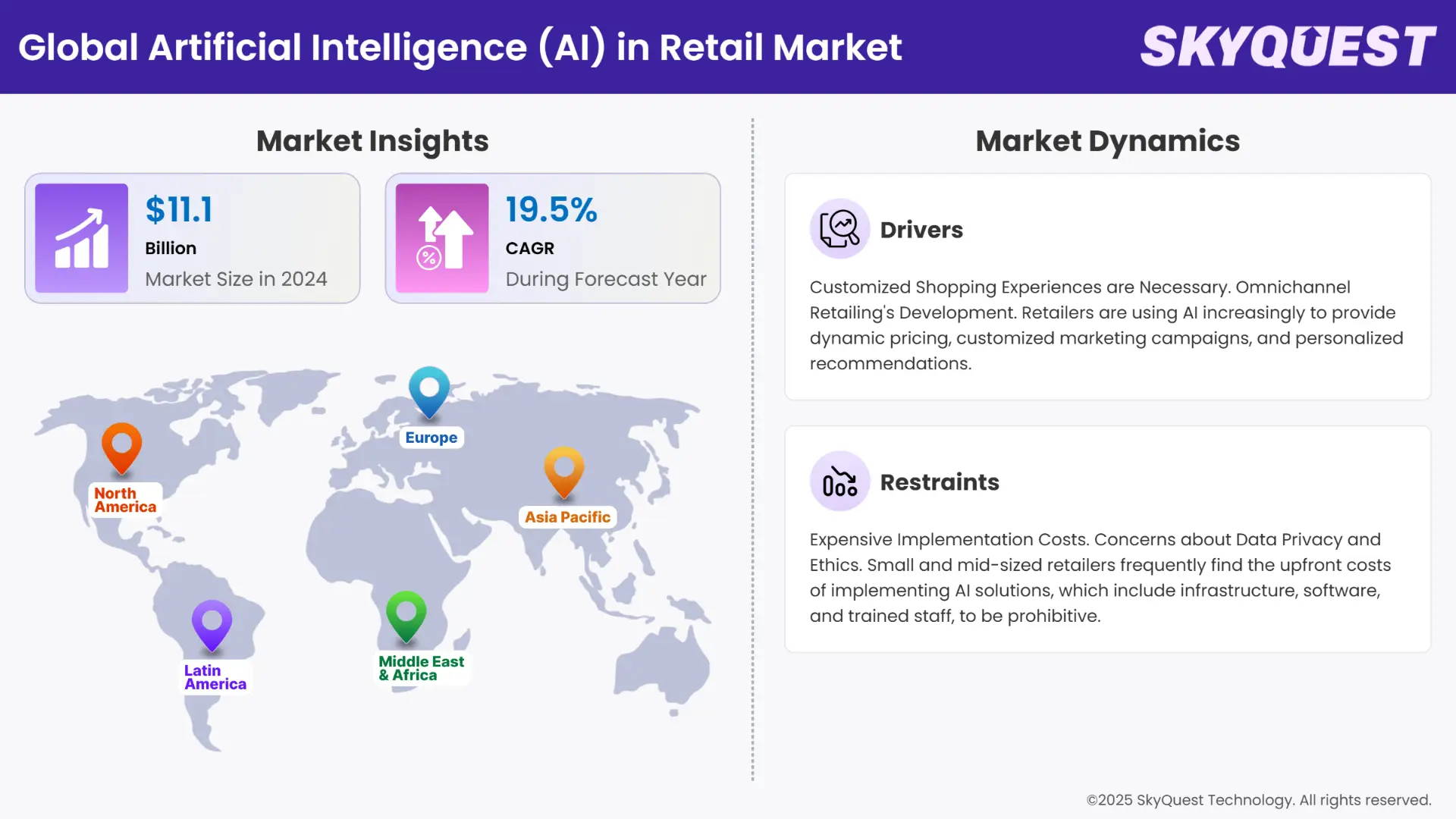
Global Artificial Intelligence (AI) in Retail Market size was valued at USD 11.1 Billion in 2024 and is poised to grow from USD 13.26 Billion in 2025 to USD 55.16 Billion by 2033, growing at a CAGR of 19.5% during the forecast period (2026–2033).

Key Takeaways: Market Trends & Insights

  • North America dominated the Artificial Intelligence (AI) in Retail market with a largest market share in 2025.
  • U.S. Artificial Intelligence (AI) in Retail market is expected to grow significantly over the forecast period.
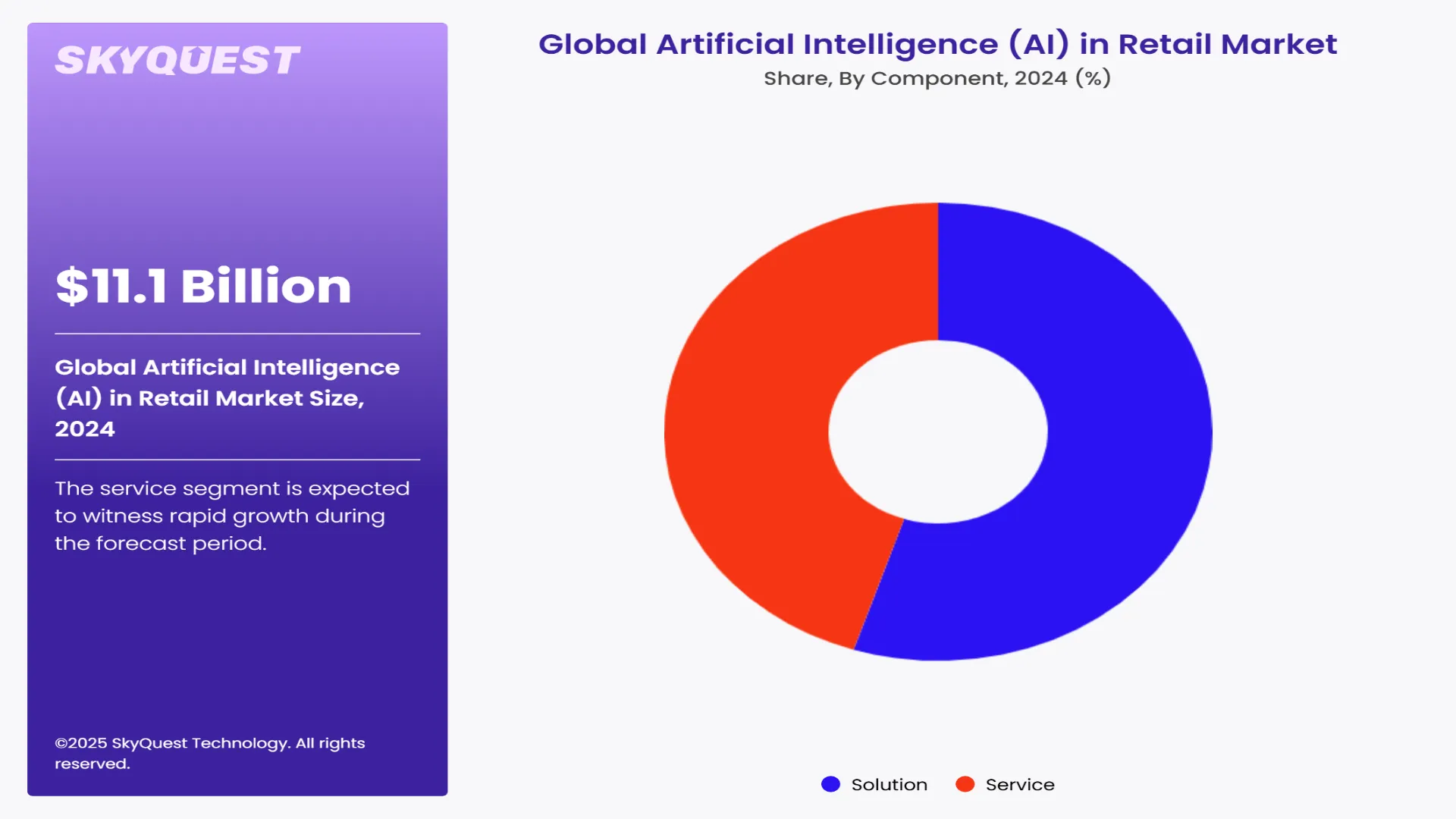
  • By Component, the Solution segment held the largest Artificial Intelligence (AI) in Retail market share in 2024.
  • The Service segment held the highest growing market over the forecast period.
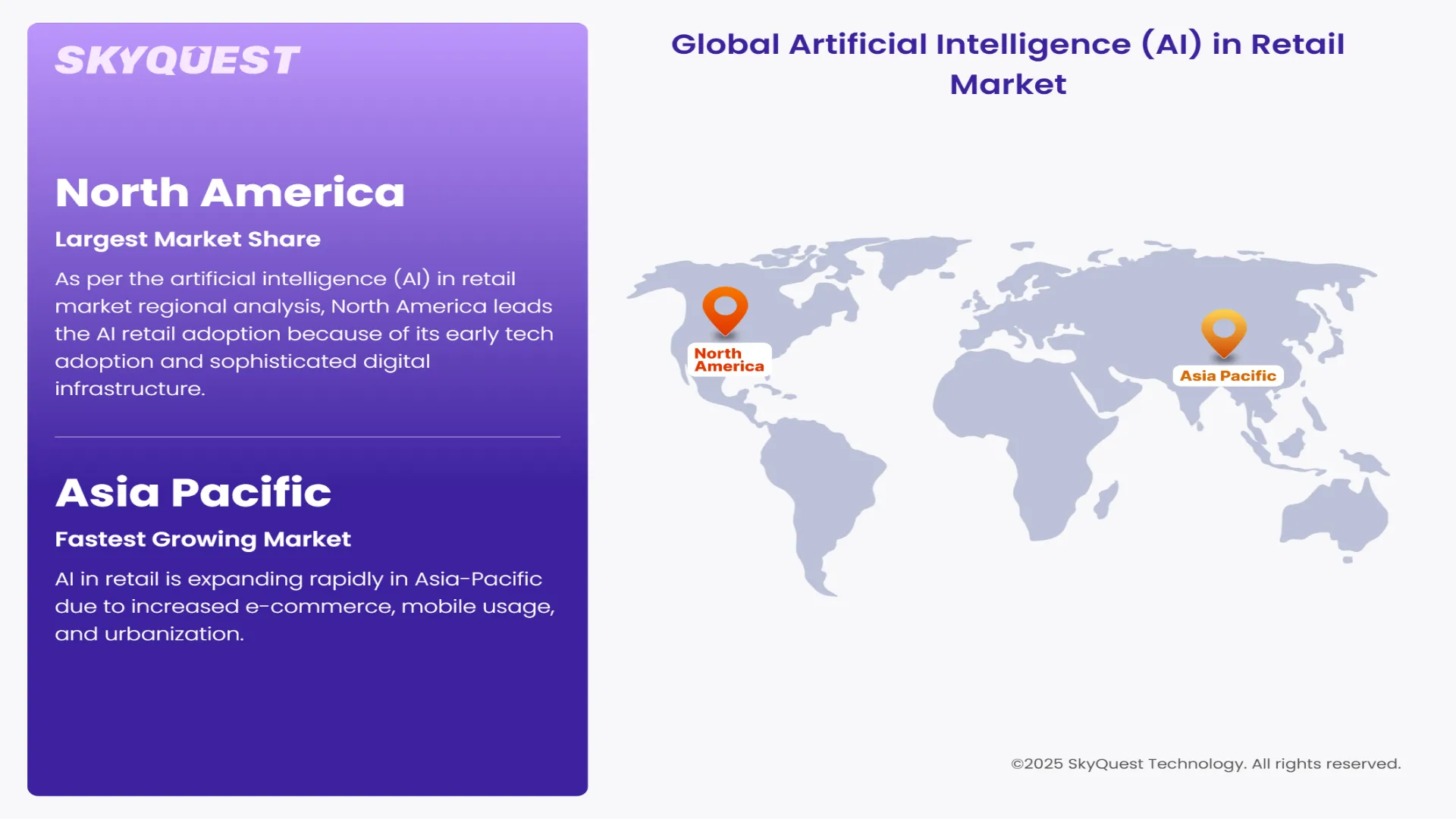
  • North America: Largest Market in 2025
  • Asia-Pacific: Fastest Growing Market
  • 2025 Market Size: USD 13.26 Billion
  • 2026 Projected Market Size: USD 15.85 Billion
  • 2033 Projected Market Size: USD 55.16 Billion
  • CAGR (2026-2033): 19.5%

The need for surveillance and monitoring in physical stores, the rise in internet users and smart devices, and government digitization initiatives are some of the factors driving the global artificial intelligence (AI) in retail market growth.

By bridging the gap between operational execution and customer insights, artificial intelligence in retail is revolutionizing decision-making. To make quicker and more precise decisions about product management and sales tactics, retailers are utilizing AI for real-time demand forecasting, personalized marketing, dynamic pricing, and inventory optimization.

  • Walmart extended its AI-powered retail intelligence platform, created in collaboration with SymphonyAI Retail CPG, to more than 1,200 locations nationwide in February 2025. AI is used by the system to analyze customer behavior, optimize shelf space, and make real-time inventory adjustments. Walmart achieved a 25% increase in promotional response and an 18% reduction in the time from insight to execution in marketing and merchandising.

Why are Big Data and AI Critical to Modern Retail Success?

The global artificial intelligence (AI) in retail market outlook is shaped by how companies have operated for decades. AI and big data and analytics have the potential to reinvigorate everything from how firms and businesses operate to customer service. It is core to digital business. In retail, big data and artificial intelligence are both ubiquitous and integral by various means, including the expansion of IoT, machine learning services, increasing apps and smart devices, and technological advances.
  • In April 2024, one of Europe's biggest retailers, Carrefour, teamed up with Google Cloud to introduce an AI-powered platform that leverages big data and machine learning to improve customer engagement, optimize inventory, and customize promotions. As evidence of how big data and artificial intelligence are revolutionizing customer satisfaction and operational efficiency, Carrefour reported a 30% reduction in food waste and a 12% increase in basket size across participating stores by the end of 2024.
Artificial Intelligence (AI) in Retail Market Insights

To get more insights on this market click here to Request a Free Sample Report

Artificial Intelligence (AI) in Retail Market Segments Analysis

The global artificial intelligence (AI) in retail market is segmented into component, technology, sales channel, application, and region. By component, the market is bifurcated into solution and service. Depending on technology, it is divided into machine learning, natural language processing, chatbots, image & video analytics, and swarm intelligence. According to sales channel, the market is classified into omnichannel, brick & mortar, and pure-play online retailers. As per the application, it is categorized into customer relationship management (CRM), supply chain & logistics, inventory management, product optimization, in-store navigation, payment & pricing analytics, and virtual assistant. Regionally, it is analyzed across North America, Europe, Asia-Pacific, Latin America, and the Middle East and Africa.

What Makes AI Solutions So Dominant in the Retail Industry?

As per the 2024 artificial intelligence (AI) in retail market analysis, the solution segment led the market with a revenue share of more than 62%. It is asserted that the increasing challenges of managing several retail operations are facilitated by innovative and new automated technologies in the retail sector. Retailers benefit from AI-powered solutions for supply chain management, logistics, warehouse management, and improving the customer experience. With the advent of products like IBM Watson, Salesforce Einstein, Google Machine Learning AI Platform, and Content DNA Platform, the artificial intelligence in retail market share has grown.

The service segment is expected to witness rapid growth during the forecast period. Artificial intelligence in retail is expected to grow significantly based on the high demand for managed services to drive accuracy, efficiency and productivity for optimal business operations. Increased demand for services is occurring because of the rapid adoption of AI solutions, which build intelligent capabilities, enhance customer experience, strengthen revenue growth potential, create fast innovation, and reduce human error.

How is AI-Powered CRM Transforming Customer Retention in Retail?

As per the 2024 artificial intelligence (AI) in retail market forecast, the customer relationship management (CRM) segment is the largest in the market. The CRM category will grow in popularity because of the overwhelming desire to improve customer service and retention. AI-supported search engines, chatbots, virtual assistance, and other technologies enable retail vendors to build lasting relationships and foster customer loyalty. CRM software can also help retail organizations with social media integration, data collection, and communication efficiency.

  • In January of 2025 H&M expanded its CRM implementations using Salesforce AI across Europe to tailor customer journeys. Using the platform's automated segmentation to index customers; chatbot capabilities that allowed customers to engage in real-time with personal support; AI suggestions for product targeting; the organization tallied a 15% increase in consumer engagement and an unprecedented 20% conversion for loyalty program members in the first quarter.

The virtual assistant segment is expected to expand at the fastest CAGR between 2025 and 2032 as a result of the extensive use of smartphones and other cutting-edge tools. The retail sector has investigated virtual assistant technologies to optimize the supply chain, including inventory ordering, bookkeeping, and invoicing. Thus, driving the segment growth.
Global Artificial Intelligence (AI) in Retail Market By Component 2026-2033
Artificial Intelligence (AI) in Retail Market Segment By Component

To get detailed segments analysis, Request a Free Sample Report

Artificial Intelligence (AI) in Retail Market Regional Insights

Is North America Setting the Global Standard for AI in Customer Experience?

As per the artificial intelligence (AI) in retail market regional analysis, North America leads the AI retail adoption because of its early tech adoption and sophisticated digital infrastructure. Amazon used computer vision and edge AI to open checkout-free stores in Chicago in March 2025. Due to the need for labor efficiency and personalization in the face of growing operating costs, retailers in the US and Canada are investing in predictive analytics and customer experience solutions.

Artificial Intelligence (AI) in Retail Market in the US

The US currently leads the artificial intelligence (AI) in retail industry due to large investments in AI-driven e-commerce, CRM, and logistics. Walmart installed AI-powered shelf scanners in 1,500 locations in April 2024 to enable real-time inventory management. With AI spending in the retail sector expected to reach USD 9.2 billion by the end of 2025, retailers are using machine learning to enhance supply chain operations and personalize marketing.

Artificial Intelligence (AI) in Retail Market in Canada

The Canada artificial intelligence (AI) in retail industry is expanding on the momentum of smart store initiatives and programs promoting digital transformation. Loblaws used voice assistants and behavioral data to deliver AI-based customer experience products in July 2024. Canadian retail AI research will continue to grow with programs like the AI Supercluster Program from the government, and with rapid growth expected in the areas of omnichannel customization, loyalty programs, and demand forecasting.

What Impact are EU Regulations Having on Ethical AI in Retail?

AI is the future of retail in Europe, and it is being used through automation, multichannel strategies, and personalized marketing. In May 2025, Carrefour implemented AI-based supply chain analytics, and reduced stockouts by 18% across France and Spain. The push for transparent and privacy-preserving AI tools is stemming from GDPR-compliance. Retailers in the UK, France and Germany are focusing on using real-time data to drive customer satisfaction and operational efficiency.

Artificial Intelligence (AI) in Retail Market in UK

The UK is setting the standard for the retail sector's adoption of AI with its state-of-the-art e-commerce and technologically sophisticated supermarkets. Tesco witnessed an increase in profit margins and a reduction in food waste when it implemented an AI-based dynamic pricing system in February 2025 in over 400 stores. The combination of the embedded fintech-retail space in the UK and a focus on sustainable shopping is prompting the need for predictive and automated thinking in physical and online retail workflows.

Artificial Intelligence (AI) in Retail Market in France

Smart customer relationship management (CRM) and store automation in France had been emerging and accelerated the growth of the AI in retail sector in the country. Monoprix implemented conversational AI across all its customer support channels in June 2024, with a reported 35% improvement in response times. Supported by France 2030 and Euro 1.5 billion for AI innovation, French retail chains are now planning both data driven personalized engagement and AI led customer engagement through both online and instore channels.

Artificial Intelligence (AI) in Retail Market in Germany

Germany's strong focus on automation and industrial AI, in addition to a growing increase in AI, is linked with the growth of the AI in retail in the country. In October 2024, Aldi Nord launched AI-based inventory forecasting and reduced food waste in 700 locations by 25%. Retail leaders have quickly embraced and implemented AI as part of their digital strategy for supply chain optimization, warehouse automation, and personalized or customized products as part of Germany's Digital Strategy 2025.

Is Asia-Pacific Outpacing the West in AI-Powered Retail Innovation?

AI in retail is expanding rapidly in Asia-Pacific due to increased e-commerce, mobile usage, and urbanization. Regional companies like Rakuten, JD.com, and Reliance Retail debuted AI-powered personalization features in 2024. AI is being quickly incorporated into payment, inventory, and customer engagement systems due to the region's investments in smart retail infrastructure and government-backed AI initiatives, particularly in China and India.

Artificial Intelligence (AI) in Retail Market in China

With its implementation of self-driving stores and facial recognition technology, China is leading the world in applying AI to retail. In August 2024, Alibaba rolled out a new AI-powered customer journey initiative that increased upselling rates and customer loyalty at many Freshippo locations. The use of AI in retail is also further encouraged through complementary local chipset manufacturing as well as government programs like the New Infrastructure Plan, which supports physical and online use.

Artificial Intelligence (AI) in Retail Market in India

The rapid adoption of UPI, the expansion of digital commerce, and a mobile-first consumer base can propel AI in retail in India. For example, in January 2025 Reliance Retail adopted AI chatbots to help JioMart provide customer service in multiple languages while also helping to manage dynamic pricing. Investments in AI for voice commerce, hyperlocal inventory management and personalized marketing are also being spun up by the Indian government with its Digital India program and through adoption of cloud computing in Tier 1 and Tier 2 cities.
Global Artificial Intelligence (AI) in Retail Market By Geography, 2026-2033
Artificial Intelligence (AI) in Retail Market Regional Analysis

To know more about the market opportunities by region and country, click here to
Buy The Complete Report

Artificial Intelligence (AI) in Retail Market Dynamics

Artificial Intelligence (AI) in Retail Market Drivers

Customized Shopping Experiences are Necessary

  • Retailers are using AI increasingly to provide dynamic pricing, customized marketing campaigns, and personalized recommendations. To provide individualized, real-time experiences, AI systems examine user profiles, browsing history, and purchase trends. Since companies like Amazon and Sephora use AI to boost customer interaction, conversion rates, and customer loyalty, personalization plays a significant role in the adoption of AI in e-commerce and physical retail. Thus, enhancing the global artificial intelligence (AI) in retail market penetration.

Omnichannel Retailing's Development

  • AI makes it possible for online, mobile, and in-store retail platforms to integrate seamlessly, increasing customer satisfaction and operational efficiency. Demand forecasting, supply chain automation, and inventory management are all supported. Walmart, for example, uses AI to forecast product demand and handle omnichannel logistics. Artificial intelligence (AI) is a key enabler of connected retail ecosystems as retailers aim for real-time visibility and consistency across channels.

Artificial Intelligence (AI) in Retail Market Restraints

Expensive Implementation Costs

  • Small and mid-sized retailers frequently find the upfront costs of implementing AI solutions, which include infrastructure, software, and trained staff, to be prohibitive. Furthermore, a substantial amount of processing and storage power is needed for AI models. The adoption of AI is hampered by these financial barriers, especially in developing countries where retail margins are narrow and the long-term or uncertain return on digital investments is uncertain.

Concerns about Data Privacy and Ethics

  • AI in retail typically necessitates gathering a large amount of data, including behavioral and personal data. This brings up issues with data privacy, misuse, and eavesdropping. Retailers face compliance challenges because of stricter laws like the CCPA and GDPR. The widespread use of AI-based customization and analytics technologies is constrained by the potential for harm to one's reputation, legal ramifications, and a decline in consumer trust that can result from improper handling of customer data.


Request Free Customization of this report to help us to meet your business objectives.

Artificial Intelligence (AI) in Retail Market Competitive Landscape

IT companies and retail executives who use AI for automation, personalization, and customer support control the AI in the retail market. Alibaba incorporates AI into its supply chain and marketing, while Amazon uses its own AI for recommendation engines and logistics. AI retail platforms are offered by Google and Microsoft through cloud services. Key tactics to improve data capabilities and operational agility include strategic alliances, acquisitions, and in-house AI technologies.

  • Established in 2016, Vue.ai provides AI-powered solutions for the retail fashion industry. With headquarters in the United States and India, Vue.ai can automate visual merchandising, product tagging, personalized styling and cataloging using computer vision and machine learning. Retailers such as Diesel and Macy's use Vue.ai to boost user engagement and conversions by automating processes which reduces manual labor and provides personalized online shopping experiences.
  • Founded in 2015, Focal Systems is a Silicon Valley-based company focused on inventory control and shelf monitoring in real retail environments using computer vision and deep learning. Focal Systems employs shelf cameras and AI algorithms to assess stockouts, lost items, and pricing issues in real time. Focal Systems partners with retailers including Walmart and Loblaw to provide increased inventory, decrease manual labor, and improve customer in-store experiences.

Top Player’s Company Profile

  • Amazon Web Services (AWS)
  • IBM Corporation
  • Google LLC (Alphabet Inc.)
  • Microsoft Corporation
  • Oracle Corporation
  • SAP SE
  • Salesforce, Inc.
  • Intel Corporation
  • Nvidia Corporation
  • Alibaba Group
  • Walmart Inc.
  • Zebra Technologies
  • Cognizant Technology Solutions

Recent Developments in Artificial Intelligence (AI) in Retail Market

  • In May 2025, Amazon announced that it would spend USD 100 billion over the next few months on capital projects for AWS and AI infrastructure. A substantial investment was made in a massive project to support an estimated 1,000 generative AI use cases, which are highly desired by industries such as entertainment, retail, healthcare, and logistics.
  • In October 2024, NVIDIA and Accenture extended their partnership, and Accenture created a new NVIDIA Business Group to help multinational companies accelerate their AI adoption. Through Accenture's AI Refinery, the new team will assist clients in laying the foundation for agentic AI capabilities, advancing domains like process transformation, AI-driven simulation, and sovereign AI, by utilizing the entire NVIDIA AI stack, which consists of NVIDIA AI Enterprise, NVIDIA AI Foundry, and NVIDIA Omniverse.
  • In October 2024, Microsoft Corp. and Rezolve AI, a leader in AI-powered commerce solutions, announced a strategic partnership aimed at providing retailers with improved digital engagement tools. As a result of this collaboration, Rezolve AI's Brain Suite, which consists of Brain Commerce, Brain Checkout, and Brain Assistant, powered by Microsoft Azure will be made available throughout the world through co-sell channels and the Azure Marketplace.

Artificial Intelligence (AI) in Retail Key Market Trends

Artificial Intelligence (AI) in Retail Market SkyQuest Analysis

SkyQuest’s ABIRAW (Advanced Business Intelligence, Research & Analysis Wing) is our Business Information Services team that Collects, Collates, Correlates, and Analyses the Data collected by means of Primary Exploratory Research backed by robust Secondary Desk research.

As per SkyQuest analysis, the rapid evolution of artificial intelligence (AI) in retail market is fueled by growing pressures for more tailored experiences and efficiencies in omnichannel retail settings. Retailers across the physical and digital spectrum are reporting vast uses of AI across customer engagement, dynamic pricing, visual search, and inventory optimization respectively. Adopting innovation, while benefiting from expected cost savings, still faces prohibitive hurdles including the engineering of high costs for implementation and regulatory obstacles. Nonetheless, AI adaptation is thriving on the back of new innovations and investments in AI-enabled automation, predictive analytics and autonomous retail in the current digital economy that needs change in order for retail to survive in a transformative market where AI will help retailers maintain competitive differentials, quickly achieve loyalty and sustainable growth in a constant flux.

Report Metric Details
Market size value in Retail USD 11.1 Billion
Market size value in 2033 USD 55.16 Billion
Growth Rate 19.5%
Base year 2024
Forecast period 2026-2033
Forecast Unit (Value) USD Billion
Segments covered
  • Component
    • Solution, Service
  • Technology
    • Machine Learning, Natural Language Processing, Chatbots, Image & Video Analytics, Swarm Intelligence
  • Sales Channel
    • Omnichannel, Brick & Mortar, Pure-Play Online Retailers
  • Application
    • Customer Relationship Management (CRM), Supply Chain & Logistics, Inventory Management, Product Optimization, In-Store Navigation, Payment & Pricing Analytics, Virtual Assistant
Regions covered North America (US, Canada), Europe (Germany, France, United Kingdom, Italy, Spain, Rest of Europe), Asia Pacific (China, India, Japan, Rest of Asia-Pacific), Latin America (Brazil, Rest of Latin America), Middle East & Africa (South Africa, GCC Countries, Rest of MEA)
Companies covered
  • Amazon Web Services (AWS)
  • IBM Corporation
  • Google LLC (Alphabet Inc.)
  • Microsoft Corporation
  • Oracle Corporation
  • SAP SE
  • Salesforce, Inc.
  • Intel Corporation
  • Nvidia Corporation
  • Alibaba Group
  • Walmart Inc.
  • Zebra Technologies
  • Cognizant Technology Solutions
Customization scope

Free report customization with purchase. Customization includes:-

  • Segments by type, application, etc
  • Company profile
  • Market dynamics & outlook
  • Region

To get a free trial access to our platform which is a one stop solution for all your data requirements for quicker decision making. This platform allows you to compare markets, competitors who are prominent in the market, and mega trends that are influencing the dynamics in the market. Also, get access to detailed SkyQuest exclusive matrix.

Table Of Content

Executive Summary

Market overview

  • Exhibit: Executive Summary – Chart on Market Overview
  • Exhibit: Executive Summary – Data Table on Market Overview
  • Exhibit: Executive Summary – Chart on Artificial Intelligence (AI) in Retail Market Characteristics
  • Exhibit: Executive Summary – Chart on Market by Geography
  • Exhibit: Executive Summary – Chart on Market Segmentation
  • Exhibit: Executive Summary – Chart on Incremental Growth
  • Exhibit: Executive Summary – Data Table on Incremental Growth
  • Exhibit: Executive Summary – Chart on Vendor Market Positioning

Parent Market Analysis

Market overview

Market size

  • Market Dynamics
    • Exhibit: Impact analysis of DROC, 2021
      • Drivers
      • Opportunities
      • Restraints
      • Challenges
  • SWOT Analysis

KEY MARKET INSIGHTS

  • Technology Analysis
    • (Exhibit: Data Table: Name of technology and details)
  • Pricing Analysis
    • (Exhibit: Data Table: Name of technology and pricing details)
  • Supply Chain Analysis
    • (Exhibit: Detailed Supply Chain Presentation)
  • Value Chain Analysis
    • (Exhibit: Detailed Value Chain Presentation)
  • Ecosystem Of the Market
    • Exhibit: Parent Market Ecosystem Market Analysis
    • Exhibit: Market Characteristics of Parent Market
  • IP Analysis
    • (Exhibit: Data Table: Name of product/technology, patents filed, inventor/company name, acquiring firm)
  • Trade Analysis
    • (Exhibit: Data Table: Import and Export data details)
  • Startup Analysis
    • (Exhibit: Data Table: Emerging startups details)
  • Raw Material Analysis
    • (Exhibit: Data Table: Mapping of key raw materials)
  • Innovation Matrix
    • (Exhibit: Positioning Matrix: Mapping of new and existing technologies)
  • Pipeline product Analysis
    • (Exhibit: Data Table: Name of companies and pipeline products, regional mapping)
  • Macroeconomic Indicators

COVID IMPACT

  • Introduction
  • Impact On Economy—scenario Assessment
    • Exhibit: Data on GDP - Year-over-year growth 2016-2022 (%)
  • Revised Market Size
    • Exhibit: Data Table on Artificial Intelligence (AI) in Retail Market size and forecast 2021-2027 ($ million)
  • Impact Of COVID On Key Segments
    • Exhibit: Data Table on Segment Market size and forecast 2021-2027 ($ million)
  • COVID Strategies By Company
    • Exhibit: Analysis on key strategies adopted by companies

MARKET DYNAMICS & OUTLOOK

  • Market Dynamics
    • Exhibit: Impact analysis of DROC, 2021
      • Drivers
      • Opportunities
      • Restraints
      • Challenges
  • Regulatory Landscape
    • Exhibit: Data Table on regulation from different region
  • SWOT Analysis
  • Porters Analysis
    • Competitive rivalry
      • Exhibit: Competitive rivalry Impact of key factors, 2021
    • Threat of substitute products
      • Exhibit: Threat of Substitute Products Impact of key factors, 2021
    • Bargaining power of buyers
      • Exhibit: buyers bargaining power Impact of key factors, 2021
    • Threat of new entrants
      • Exhibit: Threat of new entrants Impact of key factors, 2021
    • Bargaining power of suppliers
      • Exhibit: Threat of suppliers bargaining power Impact of key factors, 2021
  • Skyquest special insights on future disruptions
    • Political Impact
    • Economic impact
    • Social Impact
    • Technical Impact
    • Environmental Impact
    • Legal Impact

Market Size by Region

  • Chart on Market share by geography 2021-2027 (%)
  • Data Table on Market share by geography 2021-2027(%)
  • North America
    • Chart on Market share by country 2021-2027 (%)
    • Data Table on Market share by country 2021-2027(%)
    • USA
      • Exhibit: Chart on Market share 2021-2027 (%)
      • Exhibit: Market size and forecast 2021-2027 ($ million)
    • Canada
      • Exhibit: Chart on Market share 2021-2027 (%)
      • Exhibit: Market size and forecast 2021-2027 ($ million)
  • Europe
    • Chart on Market share by country 2021-2027 (%)
    • Data Table on Market share by country 2021-2027(%)
    • Germany
      • Exhibit: Chart on Market share 2021-2027 (%)
      • Exhibit: Market size and forecast 2021-2027 ($ million)
    • Spain
      • Exhibit: Chart on Market share 2021-2027 (%)
      • Exhibit: Market size and forecast 2021-2027 ($ million)
    • France
      • Exhibit: Chart on Market share 2021-2027 (%)
      • Exhibit: Market size and forecast 2021-2027 ($ million)
    • UK
      • Exhibit: Chart on Market share 2021-2027 (%)
      • Exhibit: Market size and forecast 2021-2027 ($ million)
    • Rest of Europe
      • Exhibit: Chart on Market share 2021-2027 (%)
      • Exhibit: Market size and forecast 2021-2027 ($ million)
  • Asia Pacific
    • Chart on Market share by country 2021-2027 (%)
    • Data Table on Market share by country 2021-2027(%)
    • China
      • Exhibit: Chart on Market share 2021-2027 (%)
      • Exhibit: Market size and forecast 2021-2027 ($ million)
    • India
      • Exhibit: Chart on Market share 2021-2027 (%)
      • Exhibit: Market size and forecast 2021-2027 ($ million)
    • Japan
      • Exhibit: Chart on Market share 2021-2027 (%)
      • Exhibit: Market size and forecast 2021-2027 ($ million)
    • South Korea
      • Exhibit: Chart on Market share 2021-2027 (%)
      • Exhibit: Market size and forecast 2021-2027 ($ million)
    • Rest of Asia Pacific
      • Exhibit: Chart on Market share 2021-2027 (%)
      • Exhibit: Market size and forecast 2021-2027 ($ million)
  • Latin America
    • Chart on Market share by country 2021-2027 (%)
    • Data Table on Market share by country 2021-2027(%)
    • Brazil
      • Exhibit: Chart on Market share 2021-2027 (%)
      • Exhibit: Market size and forecast 2021-2027 ($ million)
    • Rest of South America
      • Exhibit: Chart on Market share 2021-2027 (%)
      • Exhibit: Market size and forecast 2021-2027 ($ million)
  • Middle East & Africa (MEA)
    • Chart on Market share by country 2021-2027 (%)
    • Data Table on Market share by country 2021-2027(%)
    • GCC Countries
      • Exhibit: Chart on Market share 2021-2027 (%)
      • Exhibit: Market size and forecast 2021-2027 ($ million)
    • South Africa
      • Exhibit: Chart on Market share 2021-2027 (%)
      • Exhibit: Market size and forecast 2021-2027 ($ million)
    • Rest of MEA
      • Exhibit: Chart on Market share 2021-2027 (%)
      • Exhibit: Market size and forecast 2021-2027 ($ million)

KEY COMPANY PROFILES

  • Competitive Landscape
    • Total number of companies covered
      • Exhibit: companies covered in the report, 2021
    • Top companies market positioning
      • Exhibit: company positioning matrix, 2021
    • Top companies market Share
      • Exhibit: Pie chart analysis on company market share, 2021(%)

Methodology

For the Artificial Intelligence (AI) in Retail Market, our research methodology involved a mixture of primary and secondary data sources. Key steps involved in the research process are listed below:

1. Information Procurement: This stage involved the procurement of Market data or related information via primary and secondary sources. The various secondary sources used included various company websites, annual reports, trade databases, and paid databases such as Hoover's, Bloomberg Business, Factiva, and Avention. Our team did 45 primary interactions Globally which included several stakeholders such as manufacturers, customers, key opinion leaders, etc. Overall, information procurement was one of the most extensive stages in our research process.

2. Information Analysis: This step involved triangulation of data through bottom-up and top-down approaches to estimate and validate the total size and future estimate of the Artificial Intelligence (AI) in Retail Market.

3. Report Formulation: The final step entailed the placement of data points in appropriate Market spaces in an attempt to deduce viable conclusions.

4. Validation & Publishing: Validation is the most important step in the process. Validation & re-validation via an intricately designed process helped us finalize data points to be used for final calculations. The final Market estimates and forecasts were then aligned and sent to our panel of industry experts for validation of data. Once the validation was done the report was sent to our Quality Assurance team to ensure adherence to style guides, consistency & design.

Analyst Support

Customization Options

With the given market data, our dedicated team of analysts can offer you the following customization options are available for the Artificial Intelligence (AI) in Retail Market:

Product Analysis: Product matrix, which offers a detailed comparison of the product portfolio of companies.

Regional Analysis: Further analysis of the Artificial Intelligence (AI) in Retail Market for additional countries.

Competitive Analysis: Detailed analysis and profiling of additional Market players & comparative analysis of competitive products.

Go to Market Strategy: Find the high-growth channels to invest your marketing efforts and increase your customer base.

Innovation Mapping: Identify racial solutions and innovation, connected to deep ecosystems of innovators, start-ups, academics, and strategic partners.

Category Intelligence: Customized intelligence that is relevant to their supply Markets will enable them to make smarter sourcing decisions and improve their category management.

Public Company Transcript Analysis: To improve the investment performance by generating new alpha and making better-informed decisions.

Social Media Listening: To analyze the conversations and trends happening not just around your brand, but around your industry as a whole, and use those insights to make better Marketing decisions.

$5,300

REQUEST FOR SAMPLE

Please verify that you're not a robot to proceed!
Want to customize this report? REQUEST FREE CUSTOMIZATION

FAQs

Global Artificial Intelligence (AI) in Retail Market size was valued at USD 11.1 Billion in 2024 and is poised to grow from USD 13.26 Billion in 2025 to USD 55.16 Billion by 2033, growing at a CAGR of 19.5% during the forecast period (2026–2033).

IT companies and retail executives who use AI for automation, personalization, and customer support control the AI in the retail market. Alibaba incorporates AI into its supply chain and marketing, while Amazon uses its own AI for recommendation engines and logistics. AI retail platforms are offered by Google and Microsoft through cloud services. Key tactics to improve data capabilities and operational agility include strategic alliances, acquisitions, and in-house AI technologies. 'Amazon Web Services (AWS)', 'IBM Corporation', 'Google LLC (Alphabet Inc.)', 'Microsoft Corporation', 'Oracle Corporation', 'SAP SE', 'Salesforce, Inc.', 'Intel Corporation', 'Nvidia Corporation', 'Alibaba Group', 'Walmart Inc.', 'Zebra Technologies', 'Cognizant Technology Solutions'

Retailers are using AI increasingly to provide dynamic pricing, customized marketing campaigns, and personalized recommendations. To provide individualized, real-time experiences, AI systems examine user profiles, browsing history, and purchase trends. Since companies like Amazon and Sephora use AI to boost customer interaction, conversion rates, and customer loyalty, personalization plays a significant role in the adoption of AI in e-commerce and physical retail. Thus, enhancing the global artificial intelligence (AI) in retail market penetration.

AI-Powered Visual Search and Virtual Try-On: Retailers are using AI-powered visual search and AR-based virtual try-on tools to improve consumer engagement. For example, Zara and IKEA have image recognition for product discovery, and L'Oréal and Warby Parker use AI and AR for virtual try-ons. Overall, the use of AI and AR will improve online shopping's engagement and accuracy, while improve customer satisfaction and reduce product returns.

Is North America Setting the Global Standard for AI in Customer Experience?
AGC3x.webp
Aisin3x.webp
ASKA P Co. LTD3x.webp
BD3x.webp
BILL & MELIDA3x.webp
BOSCH3x.webp
CHUNGHWA TELECOM3x.webp
DAIKIN3x.webp
DEPARTMENT OF SCIENCE & TECHNOLOGY3x.webp
ETRI3x.webp
Fiti Testing3x.webp
GERRESHEIMER3x.webp
HENKEL3x.webp
HITACHI3x.webp
HOLISTIC MEDICAL CENTRE3x.webp
Institute for information industry3x.webp
JAXA3x.webp
JTI3x.webp
Khidi3x.webp
METHOD.3x.webp
Missul E&S3x.webp
MITSUBISHI3x.webp
MIZUHO3x.webp
NEC3x.webp
Nippon steel3x.webp
NOVARTIS3x.webp
Nttdata3x.webp
OSSTEM3x.webp
PALL3x.webp
Panasonic3x.webp
RECKITT3x.webp
Rohm3x.webp
RR KABEL3x.webp
SAMSUNG ELECTRONICS3x.webp
SEKISUI3x.webp
Sensata3x.webp
SENSEAIR3x.webp
Soft Bank Group3x.webp
SYSMEX3x.webp
TERUMO3x.webp
TOYOTA3x.webp
UNDP3x.webp
Unilever3x.webp
YAMAHA3x.webp
Yokogawa3x.webp

Want to customize this report? This report can be personalized according to your needs. Our analysts and industry experts will work directly with you to understand your requirements and provide you with customized data in a short amount of time. We offer $1000 worth of FREE customization at the time of purchase.

Feedback From Our Clients


