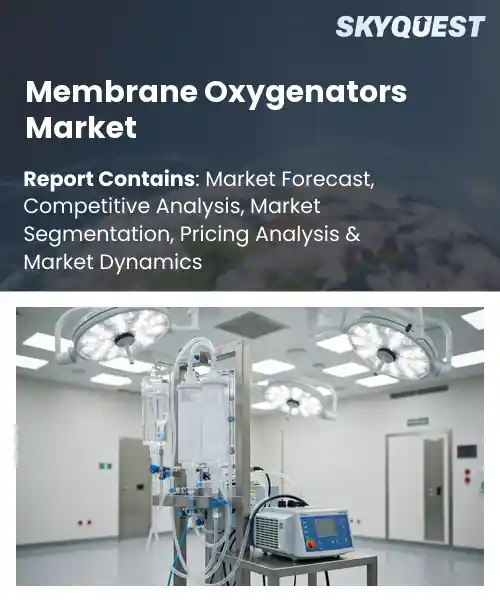
Membrane Oxygenators Market
Report ID: SQMIG35A3529
Report ID: SQMIG35A3529
[email protected]
USA +1 351-333-4748
Report ID:
SQMIG35A3529 |
Region:
Global |
Published Date: May, 2026
Pages:
157
|Tables:
117
|Figures:
77


Global Membrane Oxygenators Market size was valued at USD 1.45 Billion in 2024 and is poised to grow from USD 1.55 Billion in 2025 to USD 2.64 Billion by 2033, growing at a CAGR of 6.9% during the forecast period (2026-2033).
The primary driver of the membrane oxygenators market's growth is the increasing demand for extracorporeal life support and cardiopulmonary bypass, especially as cardiac procedures continue to rise and respiratory failures become more common worldwide. Membrane oxygenators are designed to deliver oxygen to the blood and remove carbon dioxide during complex care, such as open-heart surgery and ECMO.
Over time, the technology moved away from older bubble oxygenators toward hollow fiber membranes, which give better gas exchange and improved biocompatibility. Then companies started rolling out heparin coated membrane layers, and polymethylpentene-based designs, aimed at lowering thrombosis and hemolysis, so patients could survive longer in real world clinical pathways. Building on all of that progress, one growth factor keeps showing up: better membrane performance. When oxygen transfer works more efficiently and complications drop, hospitals feel more confident expanding use. And when membranes deliver stronger gas exchange and less thrombogenic behavior, clinicians can push ECMO longer, including as a bridge to lung transplant, or for extended respiratory assistance. Hospitals then invest in ECMO programs, dedicated teams, and operational routines that match those prolonged applications. At the same time, regulatory clearances and reimbursement conditions improve market access, letting manufacturers ramp up production. Higher volume tends to bring down unit cost, which helps penetration into newer regional markets. So, research collaborations and point of care ECMO systems have become the practical, visible opportunities for ongoing membrane oxygenators market penetration.
AI is improving membrane oxygenator performance in critical care largely by supporting continuous monitoring and more “smart” regulation of extracorporeal support in a data driven way. One central angle is real time assessment of how well gas exchange is happening, and analysis of pressure gradients and signals tied to blood trauma markers, so clotting or performance slippage can be caught earlier. In the current stage, many AI efforts are centered on decision support, like prognostic guidance, and researchers are also testing adaptive control methods that adjust blood flow and sweep gas based on patient physiology. The broader market context pushes hospitals toward more integrated intelligent ECLS systems because they want fewer unplanned exchanges and less friction in clinician workflows. Some examples people point to include prognostic deep learning models, reinforcement learning based flow adjustments and digital twin-style controllers.
Market snapshot - (2026-2033)
Global Market Size
USD 1.45 Billion
Largest Segment
Polymethylpentene (PMP) Hollow Fiber
Fastest Growth
Polymethylpentene (PMP) Hollow Fiber
Growth Rate
6.9% CAGR
To get more insights on this market click here to Request a Free Sample Report
The global membrane oxygenators market is segmented by material type, application form, patient component size, end-user, and region. Based on material type, the market is segmented into Polypropylene Hollow Fiber, Polymethylpentene (PMP) Hollow Fiber, Silicone Membrane, and Others. Based on the application form, the market is segmented into Extracorporeal Membrane Oxygenation (ECMO), Cardiopulmonary Bypass (CPB) Surgery, and Others. Based on patient component size, the market is segmented into Adult Membrane Oxygenators and Pediatric and Neonatal Oxygenators. Based on end-user, the market is segmented into Hospitals and Intensive Care Units, Specialized Cardiac Centers, and Ambulatory Surgical Centers. Based on region, the market is segmented into North America, Europe, Asia Pacific, Latin America, and the Middle East & Africa.
As per the membrane oxygenators market analysis, the Polymethylpentene (PMP) Hollow Fiber segment dominates, since its low plasma leakage and high gas transfer efficiency tend to keep oxygenation stable over longer support lifespans, which in turn cuts down device swaps and some clinical troubles. Also the material, robustness, and proven biocompatibility, helps build clinician trust and makes procurement feel more like the default choice. At the same time compatibility with more advanced cartridge designs improves how it slots into critical care routines, so you get a clearer cause and effect chain between performance benefits and sustained market leadership.
However, the polypropylene hollow fiber category is showing up as the fastest growing material, because newer coating technologies and manufacturing efficiencies lower thrombotic risk while also pressing costs downward. This makes it more suitable for short term procedures, and even for disposable use cases. With adoption increasing inside routine cardiopulmonary bypass settings, and design tweaks that are more targeted, procurement moves faster. So it looks like near term commercialization chances are opening, and market expansion gets a fuel boost.
According to the membrane oxygenators market forecast, the Adult Membrane Oxygenators segment dominates too, mostly because the designs answer wide clinical needs: high flow volumes and durable performance across lots of surgical, and critical care environments. This pushes procurement standardization, and inventory planning becomes easier. Mature clinical evidence and clinician familiarity also reduce adoption friction, while production scale, and compatibility with existing extracorporeal circuits, help reduce per unit costs. All of that reinforces purchasing preference and supports longer supply agreements, which basically locks in its market position.
However, the pediatric and neonatal oxygenators category is predicted to have the largest membrane oxygenators market share, because smaller, miniaturized layouts bring ultra low priming volumes together with added safety features. That combination supports safer neonatal ECMO and congenital cardiac interventions. Then, focused regulatory approvals, specialized clinician training, and targeted product innovation keep expanding use, creating additional procurement routes. For manufacturers, these shifts translate into attractive opportunities to catch the incoming demand wave.
To get detailed segments analysis, Request a Free Sample Report
As per the membrane oxygenators market regional forecast, North America shows dominance mostly because there is convergence of advanced clinical infrastructure, a lot of concentrated know-how in cardiopulmonary care, and ongoing investment into medical device innovation. Because there are well-established hospital networks and dedicated specialized centers, they often help push early adoption of new membrane oxygenator technologies and refined clinical protocols. Also, a strong presence of major manufacturers, together with an enabling regulatory environment, tends to support faster product development and commercialization. When clinicians, researchers and industry people collaborate, they can speed up those small iterative upgrades to device performance and safety,even if it’s not perfect on the first go. And with solid supply chain capabilities, and access to skilled clinical personnel, institutions can roll out these devices consistently across difficult procedures, while post market support keeps getting reinforced, which slowly builds institutional trust over time.
United States Membrane Oxygenators Market
In the United States, the Membrane Oxygenators Market is shaped by deep clinical capability in extracorporeal support, and a dense web of specialized cardiac and critical care centers that actively pull adoption forward. There is close day-to-day interaction between device makers and clinical opinion leaders, which supports rapid iteration and validation of new technologies. Procurement teams often lean toward performance that has already proven itself, and that keeps service continuity, so suppliers feel pressure to keep quality high and also offer extensive training. The market also benefits from distribution networks that already work, so availability is more timely, and support can reach many institutions without major delays.
Canada Membrane Oxygenators Market
In Canada, the Membrane Oxygenators Market is supported by a fairly cohesive healthcare system, with emphasis on evidence based adoption and more even access to advanced therapies. Regional centers of excellence function like focal points for education, training, and clinical research, helping teams do careful assessments of new membrane oxygenator technologies. Procurement tends to revolve around clinical outcomes and long-term value, so suppliers have to show durability and service follow through. Collaboration between clinicians, hospital administrators, and manufacturers helps align solutions to regional care pathways, and also to different resource environments,so the process doesn’t feel one size fits all.
What is Driving the Rapid Expansion of Membrane Oxygenators Market in Europe?
Europe is currently seeing fast expansion, and it is pulled along by a mix of strong clinical networks, established medical technology manufacturing, and coordinated healthcare delivery systems. Cross border exchange of know how among major cardiac centers helps spread best practices, and it makes adoption of advanced membrane oxygenator designs easier. Regulatory alignment and active involvement from reimbursement bodies push investment in technologies that can clearly show clinical benefit. Both domestic manufacturers and multinational companies add momentum to competition, which can accelerate improvements in materials and design choices. Public and private hospital systems also stress outcome oriented procurement, and that encourages suppliers to include training, lifecycle support, and localized service models, so they can meet the different national requirements.
Germany Membrane Oxygenators Market
In Germany, the Membrane Oxygenators sector is grounded in a strong medical device industry and a network of highly specialized cardiac centers that often seek technologically advanced options. Clinical research activity is noticeable, and there are solid links between industry and academia, which support continual improvements and stronger evidence generation. Procurement practices tend to focus on long term performance, clinical results, and after sales support that is comprehensive. Having local manufacturing and service resources also improves responsiveness to hospital needs, and that builds confidence among clinicians and administrators when they consider adopting new oxygenator technologies.
United Kingdom Membrane Oxygenators Market
In the United Kingdom, the Membrane Oxygenators industry is defined by quick uptake, driven by concentrated centers of excellence and proactive clinical networks that help spread best practices fast. Hospitals and specialist teams often prioritize technologies that improve procedural safety, while also making workflow more efficient. That leads to frequent engagement with suppliers for customized training and practical support. Policy attention on integrated care pathways, and an openness to technology adoption create a more favorable space for innovation. Collaborative studies, along with clinician led evaluations, help build confidence, and they also broaden usage across tertiary care environments.
France Membrane Oxygenators Market
In France, the Membrane Oxygenators Market is starting to expand more visibly, through strengthened clinical capabilities and targeted investments in cardiac and critical care infrastructure. National networks of specialist centers and research groups are increasingly involved in assessing novel oxygenator designs, while also creating standardized protocols. Procurement strategies try to balance clinical efficacy with cost concerns, so suppliers need to explain value clearly and offer tailored training. There is also growing collaboration between hospitals and manufacturers, which helps expansion happen gradually, as institutions look for reliable, well-supported membrane oxygenator solutions that can be maintained over time.
Asia Pacific is consolidating its position by expanding clinical infrastructure, strengthening local manufacturing abilities, and setting up strategic partnerships with global innovators. Regional investment in specialized cardiac and intensive care facilities boosts demand for reliable membrane oxygenators, while domestic producers lean toward cost-effective manufacturing and regulatory alignment to improve market access. In addition, knowledge transfer and joint ventures with well-established international firms help speed up technology adoption and also support localized product development. Beyond that, improved clinician training programs and regional centers of excellence back up better procedural outcomes, and they build confidence among healthcare providers, so uptake can keep growing across different healthcare systems, even when the systems vary a lot.
Japan Membrane Oxygenators Market
The membrane oxygenators market in Japan is benefiting from a mature healthcare ecosystem, with a strong focus on quality, precision, and continuous improvement. Close collaboration between device manufacturers and clinical researchers supports innovation in device design and material science in the same breath. Hospitals tend to prioritize high reliability and a smooth fit with the existing clinical workflows, so suppliers are encouraged to provide end-to-end training, and long-term technical support. Overall, the market blends careful clinical evaluation with a willingness to adopt advanced solutions that enhance procedural safety, and also patient outcomes.
South Korea Membrane Oxygenators Market
The membrane oxygenators market in South Korea is moving ahead through a mix of rapid clinical capability build-up and a lively medical technology sector, which leans toward agile product development. Strong ties between industry, academic institutions, and clinical centers allow iterative validation and adaptation of membrane oxygenator technologies. Hospitals emphasize efficiency and procurement that is outcome-driven, so suppliers get pushed to provide solid training and service networks. Strategic collaborations with international partners further accelerate technology transfer and help local manufacturing scale up, which strengthens regional competitiveness.
To know more about the market opportunities by region and country, click here to
Buy The Complete Report
Innovations In Membrane Materials
Rising Demand For Cardiac Support
High Cost Of Advanced Devices
Complex Regulatory Approval Processes
Request Free Customization of this report to help us to meet your business objectives.
Competitive pressure in membrane oxygenators is pushing incumbents to go after acquisitions and licensing, to lock in portable and low-resistance technologies, like Abiomed grabbing Breathe and MicroPort buying Hemovent. At the same time, startups are nudging product invention forward, with modular perfusion, add-in sensors, and ultrasound-enhanced oxygenation, and then strategic partnerships, along with focused M&A, help speed up regulatory translation, and also manufacturing scale.
Top Player’s Company Profile
Recent Developments in the Membrane Oxygenators Market
SkyQuest’s ABIRAW (Advanced Business Intelligence, Research & Analysis Wing) is our Business Information Services team that Collects, Collates, Correlates, and Analyses the Data collected by means of Primary Exploratory Research backed by robust Secondary Desk research.
As per SkyQuest analysis, the global membrane oxygenators market is being driven mostly by rising demand for extracorporeal life support and cardiopulmonary bypass procedures, and it’s further backed by innovations in membrane materials that boost gas transfer efficiency while improving biocompatibility. Growth is concentrated in North America, where advanced clinical infrastructure and a strong manufacturer presence keep adoption moving, and adult membrane oxygenators stay the leading segment, because they’re broadly applicable and have established procurement pathways. Still, expansion is held back by the high cost of advanced devices and lifecycle expenses, which can slow uptake in resource-constrained hospitals. Going forward, continued material innovation and better system integration look like clear chances for wider penetration and improved patient outcomes.
| Report Metric | Details |
|---|---|
| Market size value in 2024 | USD 1.45 Billion |
| Market size value in 2033 | USD 2.64 Billion |
| Growth Rate | 6.9% |
| Base year | 2024 |
| Forecast period | (2026-2033) |
| Forecast Unit (Value) | USD Billion |
| Segments covered |
|
| Regions covered | North America (US, Canada), Europe (Germany, France, United Kingdom, Italy, Spain, Rest of Europe), Asia Pacific (China, India, Japan, Rest of Asia-Pacific), Latin America (Brazil, Rest of Latin America), Middle East & Africa (South Africa, GCC Countries, Rest of MEA) |
| Companies covered |
|
| Customization scope | Free report customization with purchase. Customization includes:-
|
To get a free trial access to our platform which is a one stop solution for all your data requirements for quicker decision making. This platform allows you to compare markets, competitors who are prominent in the market, and mega trends that are influencing the dynamics in the market. Also, get access to detailed SkyQuest exclusive matrix.
Table Of Content
Executive Summary
Market overview
Parent Market Analysis
Market overview
Market size
KEY MARKET INSIGHTS
COVID IMPACT
MARKET DYNAMICS & OUTLOOK
Market Size by Region
KEY COMPANY PROFILES
Methodology
For the Membrane Oxygenators Market, our research methodology involved a mixture of primary and secondary data sources. Key steps involved in the research process are listed below:
1. Information Procurement: This stage involved the procurement of Market data or related information via primary and secondary sources. The various secondary sources used included various company websites, annual reports, trade databases, and paid databases such as Hoover's, Bloomberg Business, Factiva, and Avention. Our team did 45 primary interactions Globally which included several stakeholders such as manufacturers, customers, key opinion leaders, etc. Overall, information procurement was one of the most extensive stages in our research process.
2. Information Analysis: This step involved triangulation of data through bottom-up and top-down approaches to estimate and validate the total size and future estimate of the Membrane Oxygenators Market.
3. Report Formulation: The final step entailed the placement of data points in appropriate Market spaces in an attempt to deduce viable conclusions.
4. Validation & Publishing: Validation is the most important step in the process. Validation & re-validation via an intricately designed process helped us finalize data points to be used for final calculations. The final Market estimates and forecasts were then aligned and sent to our panel of industry experts for validation of data. Once the validation was done the report was sent to our Quality Assurance team to ensure adherence to style guides, consistency & design.
Analyst Support
Customization Options
With the given market data, our dedicated team of analysts can offer you the following customization options are available for the Membrane Oxygenators Market:
Product Analysis: Product matrix, which offers a detailed comparison of the product portfolio of companies.
Regional Analysis: Further analysis of the Membrane Oxygenators Market for additional countries.
Competitive Analysis: Detailed analysis and profiling of additional Market players & comparative analysis of competitive products.
Go to Market Strategy: Find the high-growth channels to invest your marketing efforts and increase your customer base.
Innovation Mapping: Identify racial solutions and innovation, connected to deep ecosystems of innovators, start-ups, academics, and strategic partners.
Category Intelligence: Customized intelligence that is relevant to their supply Markets will enable them to make smarter sourcing decisions and improve their category management.
Public Company Transcript Analysis: To improve the investment performance by generating new alpha and making better-informed decisions.
Social Media Listening: To analyze the conversations and trends happening not just around your brand, but around your industry as a whole, and use those insights to make better Marketing decisions.
REQUEST FOR SAMPLE
 REQUEST FREE CUSTOMIZATION
Global Membrane Oxygenators Market size was valued at USD 1.45 Billion in 2024 and is poised to grow from USD 1.55 Billion in 2025 to USD 2.64 Billion by 2033, growing at a CAGR of 6.9% during the forecast period (2026-2033).
Competitive pressure in membrane oxygenators is driving incumbents to pursue acquisitions and licensing to secure portable and low resistance technologies, exemplified by Abiomed's acquisition of Breethe and MicroPort's purchase of Hemovent. Startups are forcing product innovation with modular perfusion, integrated sensors and ultrasound enhanced oxygenation, while strategic partnerships and targeted M&A accelerate regulatory translation and manufacturing scale. 'Medtronic', 'Fresenius SE', 'Getinge', 'Terumo Corporation', 'MicroPort Scientific', 'Nipro Corporation', 'Kewei Medical', 'Braile Biomedica', 'LivaNova', 'Chalice Medical', 'Abbott Laboratories', 'AbbVie', 'Inspira Technologies', 'Sorin', 'Maquet', 'Spectrum Medical', 'Xenios AG', 'Eurosets', 'Medos Medizintechnik', 'Novalung'
Advances in membrane materials have improved gas transfer efficiency, durability, and biocompatibility, enabling clinicians to rely on membrane oxygenators for longer and more complex procedures. Novel polymers and surface treatments reduce thrombogenicity and protein deposition, which lowers complication risk and enhances patient outcomes. Manufacturing refinements also enable thinner, more permeable membranes that maintain structural integrity, facilitating broader clinical acceptance. These material innovations support wider adoption by addressing previous performance limitations and increasing confidence among healthcare providers, thereby driving demand for modern membrane oxygenator systems.
Integration With Ecmo Systems: Manufacturers are prioritizing seamless integration of membrane oxygenators within extracorporeal life support platforms to enhance clinical workflow and device compatibility. This trend emphasizes modular designs, standardized connectors, and interoperable monitoring interfaces that allow rapid deployment in high-acuity settings. Clinicians favor solutions that reduce setup complexity and facilitate team coordination during critical procedures. Additionally, supplier collaborations with hospital procurement groups are promoting bundled offerings that align product development with user needs, driving deeper adoption across specialized cardiac and critical care units.
Why does North America Dominate the Global Membrane Oxygenators Market? |@12


Want to customize this report? This report can be personalized according to your needs. Our analysts and industry experts will work directly with you to understand your requirements and provide you with customized data in a short amount of time. We offer $1000 worth of FREE customization at the time of purchase.
Feedback From Our Clients


 USA (+1) 351-333-4748

