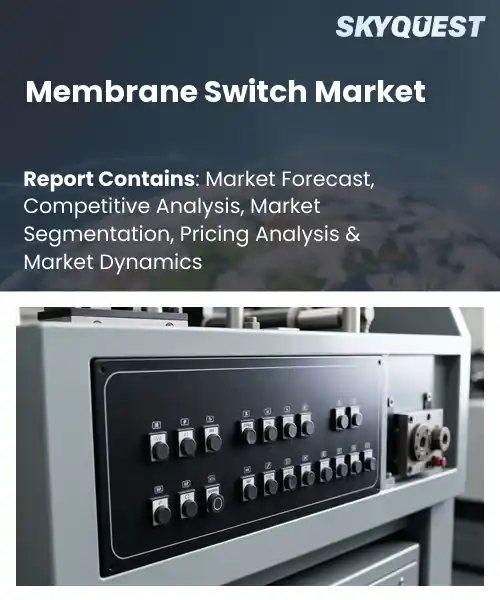
Membrane Switch Market
Report ID: SQMIG45J2490
Report ID: SQMIG45J2490
[email protected]
USA +1 351-333-4748
Report ID:
SQMIG45J2490 |
Region:
Global |
Published Date: June, 2026
Pages:
157
|Tables:
159
|Figures:
78


Global Membrane Switch Market size was valued at USD 5.7 Billion in 2024 and is poised to grow from USD 6.21 Billion in 2025 to USD 12.26 Billion by 2033, growing at a CAGR of 8.88% during the forecast period (2026-2033).
As the primary driver of the membrane switch market, demand for compact, durable, and cost-effective human-machine interfaces has reshaped product design across industries. Membrane switches are thin printed assemblies that replace mechanical keys to create sealed low-profile control panels used in medical devices, consumer appliances, and industrial equipment. Their importance lies in hygiene, reliability, and customizability, which reduce maintenance and enhance branding through integrated backlighting and tactile feedback. Over time the market progressed from basic rubber overlays to layered constructions with domes and illumination, enabling adoption in infusion pumps, commercial ovens, and factory controls as printing and materials technologies matured.
A key factor accelerating global membrane switch market growth is technological integration, where printed electronics, capacitive sensing, and advanced backlighting convert basic panels into smart interfaces, so product designers can embed diagnostics and connectivity while preserving thin form factors. As a result manufacturers of medical infusion pumps integrate sealed, backlit controls to meet sterilization standards and improve clinician efficiency, which increases procurement. Similarly appliance makers adopt tactile, illuminated overlays to improve user experience and reduce assembly costs, driving larger production runs that lower unit prices and open opportunities in emerging markets where cost sensitivity and regulatory hygiene demands align globally.
How is AI driving innovation in the membrane switch market?
Membrane switches are thin flexible human interface panels used in medical devices industrial controls and appliances. Artificial Intelligence is expediting innovation by automating overlay and circuit layout design via the analysis of usage patterns and the modeling of haptic input. Machine learning enhances material selection and quality assurance, whereas edge AI facilitates touch classification and adaptive reactions in smart panels. The market is transitioning towards integrated sensor fusion and predictive maintenance systems that combine membrane overlays with sensing electronics and algorithms. Companies are integrating innovative tactile sensing methodologies with AI to enhance interface reliability, contextual awareness, and development speed.
In April 2026, Molex finalized its acquisition of Smiths Interconnect to enhance its connectivity and interface portfolio, facilitating the adoption of AI-driven design tools, advanced HMI components, and improved production and testing efficiencies throughout the membrane switch supply chain.
Market snapshot - (2026-2033)
Global Market Size
USD 5.7 Billion
Largest Segment
Tactile Membrane Switch
Fastest Growth
Capacitive Membrane Switch
Growth Rate
8.88% CAGR
To get more insights on this market click here to Request a Free Sample Report
Global membrane switch market is segmented by type, component, technology, application, end use industry and region. Based on type, the market is segmented into Tactile Membrane Switch, Non-Tactile Membrane Switch, Capacitive Membrane Switch and Others. Based on component, the market is segmented into Polycarbonate, Polyester, Adhesives, Circuit Layer (Silver Flex, Copper Flex), Connectors & LEDs and Others. Based on technology, the market is segmented into Flat Membrane Switch, Embossed Membrane Switch, LED Integrated Membrane Switch, Backlit Membrane Switch and Others. Based on application, the market is segmented into Keypads & Keyboards, Control Panels, Touch Interfaces, Industrial Control Systems, Medical Devices Interfaces, Consumer Electronics and Others. Based on end use industry, the market is segmented into Industrial Equipment, Healthcare & Medical Devices, Automotive & Transportation, Aerospace & Defense, Consumer Electronics, Telecommunication and Others. Based on region, the market is segmented into North America, Europe, Asia Pacific, Latin America and Middle East & Africa.
Tactile membrane switch segment dominates with large membrane switch market share because designers and end users prioritize physical feedback for confirmation, enabling clearer human machine interaction in noisy or glove wearing environments. Its established manufacturing processes, proven reliability under repeated actuation, and ease of customization for force and travel create strong OEM preference. As a result, tactile switches reduce operator error and enhance perceived quality, driving widespread adoption across industrial and medical control interfaces where tactile assurance is critical.
As per membrane switch market outlook, capacitive membrane switch is the most rapidly expanding segment as demand for sleek, responsive touch grows in consumer electronics and modern instrumentation. Advances in sensing materials and integration with touch sensors enable multi touch and gesture input, unlocking new applications. This innovation driven growth creates fresh OEM opportunities and higher value design wins.
As per membrane switch market forecast, polyester segment dominates because its combination of low material cost, excellent printability, and dimensional stability makes it the preferred facestock for membrane switch overlays and graphic layers. Its chemical resistance and compatibility with common adhesives and screen printing inks enable consistent legend reproduction and durable tactile performance. Manufacturers favor polyester for scalable production runs, simple bonding processes, and reliable long term appearance retention, which collectively drive strong OEM adoption across consumer and industrial applications.
As per membrane switch market analysis, circuit layer (silver flex, copper flex) is the most rapidly expanding segment as demand for finer routing and higher conductivity rises in advanced membrane assemblies. Improved deposition and flexible conductor formulations enhance signal integrity and allow integrated LEDs and sensors, enabling new functional layouts. This material driven innovation is opening OEM opportunities for higher value system integration.
To get detailed segments analysis, Request a Free Sample Report
The Asia Pacific region dominates the membrane switch market because to its concentrated manufacturing capabilities, extensive electronics supply chains, and proximity to significant consumer electronics and automotive original equipment manufacturers (OEMs). Regional suppliers gain advantages from established component ecosystems, proficient engineering expertise, and a culture that facilitates swift design-to-production cycles, hence supporting tailored membrane switch solutions. Strategic investments in new materials and surface technologies improve product differentiation, while partnerships between manufacturers and major brand owners expedite qualification and uptake. Cost competitiveness and adaptable contract manufacturing enhance global sourcing appeal. The robust demand for mobile devices, household appliances, industrial controls, and automobile interiors establishes a wide foundation for innovation and scalability, solidifying the region as the principal production and technological center for membrane switch products.
As per membrane switch market regional outlook, Japan benefits from advanced materials research, precision manufacturing, and integration with sophisticated consumer and industrial electronics production. Local suppliers emphasize high quality, tight tolerances, and long product life cycles suitable for demanding applications. Close collaboration between designers and component producers yields refined tactile responses and durable finishes. Brand reputation for reliability encourages adoption in medical devices, automotive interiors, and instrumentation, supporting a pipeline of advanced membrane switch solutions.
As per membrane switch market regional forecast, South Korea is driven by strong OEM relationships, agile electronics contract manufacturers, and focus on miniaturized interfaces for consumer devices. Suppliers prioritize high fidelity printing, responsive tactile membranes, and integration with flexible electronics. Collaborative product development with startups and established brands accelerates innovative form factors. Emphasis on rapid prototyping and quality control supports deployment across mobile peripherals, home electronics, and industrial control panels, enhancing local capability.
As per membrane switch industry analysis, the swift growth in North America signifies a synthesis of sophisticated device design, robust end market demand for dependable human-machine interfaces, and an expanding network of specialist suppliers and contract manufacturers. Advancements in user experience and regulatory focus on safety and durability propel adoption in the medical, industrial, and automotive industries. Intimate cooperation between system integrators and membrane switch designers facilitates customized solutions for durable and sanitary applications. Investments in automation and quality management enhance manufacturing consistency, while closeness to significant technology buyers enables iterative development cycles. Academic collaborations enhance material testing, while robust aftermarket support and modular design methodologies augment product reliability and customer retention.
United States benefits from proximity to technology integrators, an emphasis on regulatory compliance for safety critical applications, and deep expertise in human machine interface design. Suppliers focus on ruggedization, hygienic sealing, and lifecycle testing to meet stringent industry requirements. Collaboration with medical and industrial OEMs yields tailored solutions and design iterations. Emphasis on service, aftermarket support, and integration capabilities sustains demand for membrane switch products.
Canada is characterized by collaborative manufacturing, emphasis on quality assurance, and partnerships with technology firms for customized interface solutions. Suppliers focus on sectors requiring hygienic, durable controls such as healthcare and food processing. Local manufacturers leverage proximity to North American customers for design and qualification. Focus on sustainability in materials selection and end-of-life planning enhances appeal to environmentally conscious OEMs while supporting reliable membrane switch offerings.
Europe is enhancing its position in the membrane switch industry by emphasizing engineering proficiency, adherence to regulations, and specialized applications requiring superior durability and aesthetic appeal. Manufacturers prioritize sophisticated printing methods, durable coatings, and user-focused design for high-end appliances, industrial automation, and medical devices. Cross-border supplier networks facilitate specialized material procurement and verification, while strong engagement with design consultancies improves ergonomics and brand integration. Sustainability approaches, such as material recyclability and minimized solvent operations, appeal to discerning OEMs. Investments in certification services and process standardization enable suppliers to fulfill intricate client demands, while centers of excellence across many nations facilitate customized small batch production and sophisticated assembly methods.
Germany leverages precision engineering, quality systems, and ties to industrial automation and automotive suppliers. Manufacturers focus on robust membranes, high reliability, and integration with complex control systems for factory and vehicle environments. Emphasis on engineering validation and certification supports applications in sectors. Collaborative development with OEMs yields tailored tactile feedback and durable finishes. A reputation for technical excellence and discipline positions suppliers to address high-specification projects.
United Kingdom prioritizes design innovation, branding integration, and user environment factors for high-end consumer products. Suppliers focus on sophisticated aesthetics, illumination alternatives, and tactile personalization to enhance brand distinction. Collaborative clusters connect design firms with manufacturers, facilitating swift concept validation. The focus on certification for safety and hygiene promotes adoption in healthcare and commercial industries. Robust service networks and specialized assembly competencies facilitate small batch production.
France combines industrial design expertise with refined surface finishing and premium materials to serve luxury consumer goods and professional equipment. Suppliers emphasize tactile innovation, aesthetic customization, and integration with branded interfaces. Collaboration between design studios and boutique manufacturers enables unique finishes and limited runs. A focus on material traceability and environmentally considerate processes aligns with buyer expectations. This supports demand for high-end, differentiated membrane switch solutions.
To know more about the market opportunities by region and country, click here to
Buy The Complete Report
Increasing Demand For Portable Electronics
Growing Demand From Medical Devices
Limited Tactile Perception Compared To Alternatives
Durability Concerns In Harsh Environments
Request Free Customization of this report to help us to meet your business objectives.
Competitive landscape in the global membrane switch industry is driven by integration of flexible printed circuits, digital graphic overlays and LED backlighting, pushing suppliers toward consolidation, targeted acquisitions and technical partnerships. For example JN White has grown through acquisitions. Hall Company developed strategic supply relationships with GE Healthcare, and several vendors adopted LED backlight and digital printing process upgrades to differentiate offerings.
SkyQuest’s ABIRAW (Advanced Business Intelligence, Research & Analysis Wing) is our Business Information Services team that Collects, Collates, Correlates, and Analyses the Data collected by means of Primary Exploratory Research backed by robust Secondary Desk research.
As per SkyQuest analysis, the global membrane switch market growth is propelled primarily by growing demand for compact, durable and cost-effective human-machine interfaces that support sealed, low-profile control panels, while technological integration including printed electronics, capacitive sensing and AI-driven smart interfaces serves as a second strong driver enabling connected, backlit and diagnostic-capable overlays. A notable restraint remains perceptions of limited tactile feedback and durability concerns versus alternative switch technologies in harsh environments, which can slow adoption in some applications. Asia Pacific leads the market due to concentrated manufacturing and supply chains, and tactile membrane switches remain the dominant segment because designers prioritize physical feedback and proven reliability.
| Report Metric | Details |
|---|---|
| Market size value in 2024 | USD 5.7 Billion |
| Market size value in 2033 | USD 12.26 Billion |
| Growth Rate | 8.88% |
| Base year | 2024 |
| Forecast period | (2026-2033) |
| Forecast Unit (Value) | USD Billion |
| Segments covered |
|
| Regions covered | North America (US, Canada), Europe (Germany, France, United Kingdom, Italy, Spain, Rest of Europe), Asia Pacific (China, India, Japan, Rest of Asia-Pacific), Latin America (Brazil, Rest of Latin America), Middle East & Africa (South Africa, GCC Countries, Rest of MEA) |
| Companies covered |
|
| Customization scope | Free report customization with purchase. Customization includes:-
|
To get a free trial access to our platform which is a one stop solution for all your data requirements for quicker decision making. This platform allows you to compare markets, competitors who are prominent in the market, and mega trends that are influencing the dynamics in the market. Also, get access to detailed SkyQuest exclusive matrix.
Table Of Content
Executive Summary
Market overview
Parent Market Analysis
Market overview
Market size
KEY MARKET INSIGHTS
COVID IMPACT
MARKET DYNAMICS & OUTLOOK
Market Size by Region
KEY COMPANY PROFILES
Methodology
For the Membrane Switch Market, our research methodology involved a mixture of primary and secondary data sources. Key steps involved in the research process are listed below:
1. Information Procurement: This stage involved the procurement of Market data or related information via primary and secondary sources. The various secondary sources used included various company websites, annual reports, trade databases, and paid databases such as Hoover's, Bloomberg Business, Factiva, and Avention. Our team did 45 primary interactions Globally which included several stakeholders such as manufacturers, customers, key opinion leaders, etc. Overall, information procurement was one of the most extensive stages in our research process.
2. Information Analysis: This step involved triangulation of data through bottom-up and top-down approaches to estimate and validate the total size and future estimate of the Membrane Switch Market.
3. Report Formulation: The final step entailed the placement of data points in appropriate Market spaces in an attempt to deduce viable conclusions.
4. Validation & Publishing: Validation is the most important step in the process. Validation & re-validation via an intricately designed process helped us finalize data points to be used for final calculations. The final Market estimates and forecasts were then aligned and sent to our panel of industry experts for validation of data. Once the validation was done the report was sent to our Quality Assurance team to ensure adherence to style guides, consistency & design.
Analyst Support
Customization Options
With the given market data, our dedicated team of analysts can offer you the following customization options are available for the Membrane Switch Market:
Product Analysis: Product matrix, which offers a detailed comparison of the product portfolio of companies.
Regional Analysis: Further analysis of the Membrane Switch Market for additional countries.
Competitive Analysis: Detailed analysis and profiling of additional Market players & comparative analysis of competitive products.
Go to Market Strategy: Find the high-growth channels to invest your marketing efforts and increase your customer base.
Innovation Mapping: Identify racial solutions and innovation, connected to deep ecosystems of innovators, start-ups, academics, and strategic partners.
Category Intelligence: Customized intelligence that is relevant to their supply Markets will enable them to make smarter sourcing decisions and improve their category management.
Public Company Transcript Analysis: To improve the investment performance by generating new alpha and making better-informed decisions.
Social Media Listening: To analyze the conversations and trends happening not just around your brand, but around your industry as a whole, and use those insights to make better Marketing decisions.
REQUEST FOR SAMPLE
 REQUEST FREE CUSTOMIZATION
Global Membrane Switch Market size was valued at USD 5.7 Billion in 2024 and is poised to grow from USD 6.21 Billion in 2025 to USD 12.26 Billion by 2033, growing at a CAGR of 8.88% during the forecast period (2026-2033).
Competitive landscape in the global membrane switch market is driven by integration of flexible printed circuits, digital graphic overlays and LED backlighting, pushing suppliers toward consolidation, targeted acquisitions and technical partnerships. For example JN White has grown through acquisitions. Hall Company developed strategic supply relationships with GE Healthcare, and several vendors adopted LED backlight and digital printing process upgrades to differentiate offerings. '3M Company', 'Eaton Corporation plc', 'TE Connectivity Ltd.', 'NKK Switches Co., Ltd.', 'Molex LLC', 'Schneider Electric SE', 'ABB Ltd.', 'Honeywell International Inc.', 'General Electric Company', 'Panasonic Holdings Corporation', 'Siemens AG', 'Omron Corporation', 'Flex Ltd.', 'Celestica Inc.', 'Jabil Inc.', 'Sanmina Corporation', 'Benchmark Electronics, Inc.', 'TT Electronics plc', 'Sensata Technologies Holding plc', 'CTS Corporation'
The widespread adoption of portable electronic devices has elevated demand for compact, reliable user interface components. Membrane switches enable slim profiles, tactile feedback, and resistance to dust and moisture, aligning with manufacturers' design priorities. Their compatibility with low-profile assemblies and ease of integration reduce design complexity and support rapid product development cycles. As product designers prioritize durability and sleek form factors, membrane switches become a preferred solution, stimulating increased incorporation across consumer electronics, medical instruments, and industrial handheld devices.
Sustainable Material Innovation: The membrane switch market is shifting toward eco-conscious polymers and recyclable components that reduce lifecycle environmental footprint while maintaining tactile performance and visual customization. Manufacturers collaborate with material scientists to replace legacy plastics with bio-based, low-emission alternatives and design for disassembly. This trend enhances brand sustainability credentials, supports regulatory compliance, and appeals to end users prioritizing circularity. Suppliers who can balance cost, manufacturability, and durable aesthetics are positioned to capture growing demand for greener human-machine interface solutions and supply chains.
Why does Asia Pacific Dominate the Global Membrane Switch Market? |@12


Want to customize this report? This report can be personalized according to your needs. Our analysts and industry experts will work directly with you to understand your requirements and provide you with customized data in a short amount of time. We offer $1000 worth of FREE customization at the time of purchase.
Feedback From Our Clients


 USA (+1) 351-333-4748

