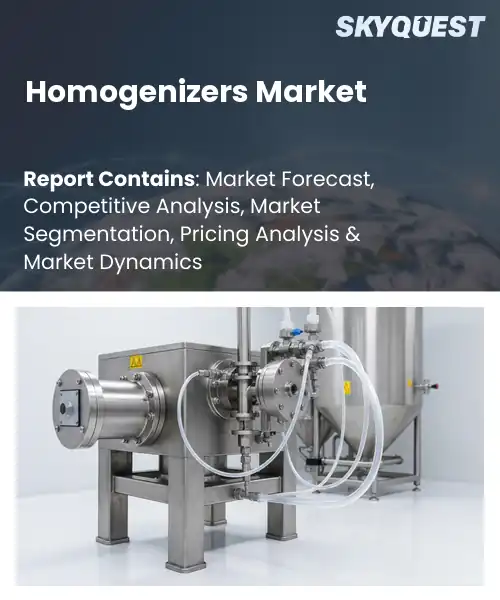
Homogenizers Market
Report ID: SQMIG35A4201
Report ID: SQMIG35A4201
[email protected]
USA +1 351-333-4748
Report ID:
SQMIG35A4201 |
Region:
Global |
Published Date: July, 2026
Pages:
157
|Tables:
207
|Figures:
80


Global Homogenizers Market size was valued at USD 2.14 Billion in 2024 and is poised to grow from USD 2.24 Billion in 2025 to USD 7.41 Billion by 2033, growing at a CAGR of 4.8% during the forecast period (2026-2033).
Global homogenisers market comprises equipment that diminishes particle size and assures uniform dispersion in liquids across industries such as food-beverage, pharmaceuticals and cosmetics. It is important because it allows manufacturers to improve the stability, texture and microbial safety of their products, which in turn affects consumer acceptance and regulatory compliance. The market historically developed in the 1970s with high-pressure homogenizers for dairy processing. Since then, advances in rotor-stator and ultrasonic technologies have expanded applications to cell-based therapies and nano-emulsions. This evolution is driven by an increased demand for constant quality and the incorporation of functional ingredients, and homogenizers are positioned as enablers of formulation strategies. On the basis of this, the primary growth factor for the global homogenizers market is the growing acceptance of biologics and nutrition requiring particle size control for bioavailability and sensory consistency.
The high-pressure equipment enables the makers of monoclonal antibody drugs to create droplets that reduce clumping and extend the time the product can be stored . In the same way, homogenisation is essential to the makers of plant based milk alternatives, who need the right mouth feel to mimic dairy, so sales of the equipment are a boon to economies. The applications foster a feedback loop where regulatory push for safety and consumer demand for clean label products spur investment in advanced homogenizers, creating opportunities for OEMs to differentiate through sensor integration and IoT-enabled maintenance.
How is AI-driven Automation Reshaping Product Performance In The Industrial Homogenizers Market?
AI-driven automation is changing the way industrial homogenizers can deliver product performance. Incorporating machine learning models into the control loop allows systems to adjust pressure, temperature and shear rate in real time to match feed variability. This dynamic tuning results in finer particle size distribution, more consistent texture and lower energy consumption. Predictive maintenance alerts the operator to wear before failure occurs and thus minimizes down time. Recent installations of smart sensors on GEA and IKA homogenizers show how data streams are used to fine tune recipes on the fly, making each batch a self optimizing process. The overall result is a faster time to market and a higher product quality across applications in dairy, pharma and cosmetics.
In March 2024, GEA launched an AI-enabled homogenizer that learns continuously from process data and automatically adjusts operating parameters to achieve tighter particle size control and lower energy consumption. This innovation is a prime example of how AI automation directly boosts efficiency, and helps propel growth in the homogenizers market.
Market snapshot - (2026-2033)
Global Market Size
USD 2.14 Billion
Largest Segment
High-Pressure Homogenizers
Fastest Growth
Ultrasonic Homogenizers
Growth Rate
4.8% CAGR
To get more insights on this market click here to Request a Free Sample Report
Global homogenizers market is segmented by type, technology, operating mode, pressure range, application, end-use industry, distribution channel and region. Based on type, the market is segmented into High-Pressure Homogenizers, Ultrasonic Homogenizers, Mechanical Homogenizers and Others. Based on technology, the market is segmented into Single-Valve Homogenization, Two-Valve Homogenization, Ultrasonic Homogenization and Rotor-Stator Homogenization. Based on operating mode, the market is segmented into Batch and Continuous. Based on pressure range, the market is segmented into Low Pressure, Medium Pressure and High Pressure. Based on application, the market is segmented into Emulsification, Cell Disruption, Particle Size Reduction, Dispersion, Mixing and Blending and Others. Based on end-use industry, the market is segmented into Food & Beverages, Pharmaceuticals, Biotechnology, Cosmetics & Personal Care, Chemicals, Dairy Processing, Academic & Research Institutes and Others. Based on distribution channel, the market is segmented into Direct Sales, Distributors & Dealers and Online Sales. Based on region, the market is segmented into North America, Europe, Asia Pacific, Latin America and Middle East & Africa.
The High-Pressure Homogenizers segment accounts for a major share as they provide unrivalled particle size reduction and uniform dispersion which are vital for high-value products across food, pharma and cosmetics. Their ability to withstand high pressures ensures consistent product quality and reduces downstream processing steps, while complying with strict regulatory requirements – all reasons why manufacturers prefer them over other technologies. These performance advantages are leading to wide adoption and cementing their leadership position in the homogenizers market with ongoing innovation cycles.
Meanwhile, Ultrasonic Homogenizers segment is seeing the highest growth momentum due to their non‑thermal processing ability that allows gentle handling of bio‑sensitive materials, luring biotech and specialty food manufacturers. Rising demand for high purity extracts and the drive for energy efficient equipment are fueling adoption, creating new opportunities for market growth.
The emulsification segment is expected to dominate owing to its basis in the development of stable food, pharmaceutical and cosmetic formulations which are based on fine droplet distribution. Robust homogenization ensures product shelf-life, texture consistency and consumer acceptance. Manufacturers look at emulsification capabilities when looking at equipment. This central role is evident across a range of end-use sectors. The reliability of emulsification reduces batch-to-batch variability, eases compliance and allows for rapid product extensions, reinforcing its leading position in the homogenizer market.
The Cell Disruption segment is the major high-growth segment owing to its capacity to cater to the increasing demand of effective extraction of intracellular bioproducts in pharma and biotech. Advances in homogenizer design that maintain protein integrity while increasing yield are driving rapid adoption and creating new market opportunities for specialized processing solutions.
To get detailed segments analysis, Request a Free Sample Report
North America is the largest market for homogenizers, owing to the availability of a well-developed food processing infrastructure, a large research and development capacity, and a strong quality assurance culture. The U.S. has a concentration of top equipment manufacturers that are continuously bringing new high-efficiency designs to market. Canada has a strong dairy industry where precise particle size reduction is needed. The regulatory framework of the combined promotes the adoption of energy-saving technologies, and the region’s advanced logistics network allows for rapid distribution of sophisticated homogenization solutions. Consumers in the region are increasingly paying attention to texture consistency and nutritional integrity, which in turn is encouraging manufacturers to add advanced homogenizers in their processing lines. Sustainability programs also promote the choice of equipment that minimizes waste and energy use.
The Homogenizers Market is aided by the varied industrial base in the United States that includes dairy, beverages and specialty nutrition. End-user are looking for equipment providing consistent particle size reduction, complying to European safety standards. Working with universities leads to improvements in homogenization so processors can improve stability and shelf life. This interplay makes Germany a strong benchmark for quality and reliability in homogenizer technology.
Canada homogenizers market is shaped by a dairy processing tradition and a plant-based protein sector that needs precise texture control. The producer wants equipment that is energy efficient and gentle on the product so as to preserve the nutritional quality. Domestic suppliers closely cooperate with research institutes to adapt the design of homogenizers from the world market to the characteristics of local raw materials, promoting solutions that take into account seasonal variability in feedstock. The collaborative approach supports steady market growth and technology upgrades.
Europe’s homogenizers market is propelled by a combination of stringent quality regulations, a vibrant specialty food sector, and a strong emphasis on sustainability. Consumer preferences for clean‑label and nutritionally enhanced products drive manufacturers to adopt advanced homogenization techniques that ensure uniform particle distribution and preserve bioactive compounds. Germany leads with substantial industrial capacity and a tradition of precision engineering, while the United Kingdom experiences rapid uptake driven by innovative food‑tech startups and a proactive regulatory environment. France’s emerging focus on artisanal dairy and plant‑based alternatives adds depth to the market. Collaborative research networks across the continent facilitate technology transfer, reinforcing Europe’s reputation as a hub for high‑performance homogenization solutions. European Union initiatives that fund joint R&D projects and harmonize safety standards further accelerate the diffusion of next‑generation homogenizers across member states.
Homogenizers Market in Germany is anchored by a legacy and a network of equipment manufacturers serving the dairy, beverage, and pharmaceutical sectors. Industry players prioritize designs that deliver consistent particle size reduction while adhering to European safety standards. Collaboration with universities fosters improvements in homogenization, enabling processors to enhance stability and extend shelf life. This synergy sustains Germany’s position as a strong benchmark for quality and reliability in homogenizer technology.
Homogenizers Market in the United Kingdom is experiencing expansion driven by an innovation ecosystem and a proactive regulatory climate. Food‑tech startups leverage compact homogenizers to develop plant‑based beverages and functional dairy alternatives that satisfy health‑conscious consumers. Established manufacturers benefit from ties with research councils that accelerate validation of processing parameters. This collaborative environment fuels adoption of homogenization solutions, positioning the United Kingdom as a leading hub for food processing technologies.
Homogenizers Market in France is alongside a resurgence of artisanal dairy production and growing interest in plant‑based alternatives that demand texture control. French processors seek equipment that balances gentle processing with throughput to preserve flavor nuances while meeting sustainability goals. Partnerships between equipment firms and culinary schools foster customized homogenizer configurations tailored to regional raw material profiles. This collaborative focus nurtures market acceptance and encourages upgrades as consumer demand evolves.
Asia Pacific is advancing its role in the homogenizers market through a blend of rapid industrial diversification, strong technical expertise, and a rising appetite for high‑quality food and beverage products. Japan leverages its tradition of precision engineering to deliver sophisticated, energy‑efficient homogenization equipment that meets stringent quality expectations, while South Korea focuses on smart‑technology integration and compact designs that cater to flexible manufacturing environments. Growing consumer interest in plant‑based proteins and functional beverages drives manufacturers across the region to adopt advanced homogenizers that ensure uniform texture and preserve bioactive compounds. Collaborative research initiatives between universities, equipment firms, and food producers accelerate technology transfer and encourage customized solutions for local raw material characteristics. This coordinated effort enhances the competitiveness of Asia Pacific suppliers and expands the market’s overall capacity for innovation.
Homogenizers Market in Japan benefits from a heritage of precision manufacturing and a focus on product consistency for dairy, specialty beverages, and pharmaceutical applications. Manufacturers prioritize particle size control that sustains flavor integrity while complying with safety standards. Collaboration with research institutes fosters development of high‑pressure systems that reduce energy consumption and increase processing speed. This technical rigor and ongoing improvement sustains Japan’s reputation as a provider of homogenization solutions.
Homogenizers Market in South Korea focuses on compact, high‑efficiency equipment for diversified food processing lines. Companies integrate digital monitoring and automation to optimize parameters, reducing waste and enhancing product consistency. Collaboration with biotech firms drives development of homogenizers suited for plant‑based protein formulations that require delicate shear control. This continual technological agility and application‑specific innovation positions South Korea as a strong contributor to the global regional homogenizers dynamic future landscape.
To know more about the market opportunities by region and country, click here to
Buy The Complete Report
Rising Demand for Uniform Products
Adoption of Energy Efficient Technologies
High Initial Capital Expenditure
Stringent Environmental Emission Regulations
Request Free Customization of this report to help us to meet your business objectives.
The Homogenizers Market remains moderately consolidated, led by Alfa Laval, Bertoli, Buchi Labortechnik, GEA Group, Hielscher Ultrasonics, IKA-Werke, Microfluidics International, Silverson Machines, SPX Flow, Tetra Pak, and Ystral, alongside Krones and Bühler. Competition centers on product portfolio breadth, technology depth, and regional reach rather than price alone. On product development, SPX Flow has expanded its APV Pilot Homogenizer Series with standard, high-pressure, and ready-to-run configurations to speed up scale-up work, alongside a redesigned Kombinator scraped-surface heat exchanger for margarine/shortening processing, while Krones has partnered with a university to build AI-powered homogenization control systems for better process optimization. M&A activity remains a key expansion lever: Alfa Laval acquired GEA's Brazilian homogenizer business to strengthen its Latin American footprint, and SPX Flow itself was taken private by Lone Star Funds in April 2022. Growth is increasingly pulled by demand for lipid nanoparticle production in mRNA and novel therapeutic manufacturing, prompting deeper R&D investment, geographic diversification, and sustainability-focused innovation (energy-efficient, lower-emission designs) across leading players' strategic roadmaps.
SkyQuest’s ABIRAW (Advanced Business Intelligence, Research & Analysis Wing) is our Business Information Services team that Collects, Collates, Correlates, and Analyses the Data collected by means of Primary Exploratory Research backed by robust Secondary Desk research.
As per SkyQuest analysis, the global homogenizers market is being propelled primarily by the rising demand for uniform products which pushes manufacturers to invest in equipment that guarantees consistent texture and stability across food, pharma and cosmetic lines. A second key driver is the shift toward energy‑efficient technologies that lower utility costs and support sustainability goals, encouraging adoption of smart low‑power homogenizers. North America remains the dominant region thanks to its mature processing infrastructure and strong R&D base, while high‑pressure homogenizers lead the segment landscape by delivering unmatched particle‑size reduction. However, the high initial capital expenditure required for advanced systems acts as a notable restraint on broader market uptake.
| Report Metric | Details |
|---|---|
| Market size value in 2024 | USD 2.14 Billion |
| Market size value in 2033 | USD 7.41 Billion |
| Growth Rate | 4.8% |
| Base year | 2024 |
| Forecast period | (2026-2033) |
| Forecast Unit (Value) | USD Billion |
| Segments covered |
|
| Regions covered | North America (US, Canada), Europe (Germany, France, United Kingdom, Italy, Spain, Rest of Europe), Asia Pacific (China, India, Japan, Rest of Asia-Pacific), Latin America (Brazil, Rest of Latin America), Middle East & Africa (South Africa, GCC Countries, Rest of MEA) |
| Companies covered |
|
| Customization scope | Free report customization with purchase. Customization includes:-
|
To get a free trial access to our platform which is a one stop solution for all your data requirements for quicker decision making. This platform allows you to compare markets, competitors who are prominent in the market, and mega trends that are influencing the dynamics in the market. Also, get access to detailed SkyQuest exclusive matrix.
Table Of Content
Executive Summary
Market overview
Parent Market Analysis
Market overview
Market size
KEY MARKET INSIGHTS
COVID IMPACT
MARKET DYNAMICS & OUTLOOK
Market Size by Region
KEY COMPANY PROFILES
Methodology
For the Homogenizers Market, our research methodology involved a mixture of primary and secondary data sources. Key steps involved in the research process are listed below:
1. Information Procurement: This stage involved the procurement of Market data or related information via primary and secondary sources. The various secondary sources used included various company websites, annual reports, trade databases, and paid databases such as Hoover's, Bloomberg Business, Factiva, and Avention. Our team did 45 primary interactions Globally which included several stakeholders such as manufacturers, customers, key opinion leaders, etc. Overall, information procurement was one of the most extensive stages in our research process.
2. Information Analysis: This step involved triangulation of data through bottom-up and top-down approaches to estimate and validate the total size and future estimate of the Homogenizers Market.
3. Report Formulation: The final step entailed the placement of data points in appropriate Market spaces in an attempt to deduce viable conclusions.
4. Validation & Publishing: Validation is the most important step in the process. Validation & re-validation via an intricately designed process helped us finalize data points to be used for final calculations. The final Market estimates and forecasts were then aligned and sent to our panel of industry experts for validation of data. Once the validation was done the report was sent to our Quality Assurance team to ensure adherence to style guides, consistency & design.
Analyst Support
Customization Options
With the given market data, our dedicated team of analysts can offer you the following customization options are available for the Homogenizers Market:
Product Analysis: Product matrix, which offers a detailed comparison of the product portfolio of companies.
Regional Analysis: Further analysis of the Homogenizers Market for additional countries.
Competitive Analysis: Detailed analysis and profiling of additional Market players & comparative analysis of competitive products.
Go to Market Strategy: Find the high-growth channels to invest your marketing efforts and increase your customer base.
Innovation Mapping: Identify racial solutions and innovation, connected to deep ecosystems of innovators, start-ups, academics, and strategic partners.
Category Intelligence: Customized intelligence that is relevant to their supply Markets will enable them to make smarter sourcing decisions and improve their category management.
Public Company Transcript Analysis: To improve the investment performance by generating new alpha and making better-informed decisions.
Social Media Listening: To analyze the conversations and trends happening not just around your brand, but around your industry as a whole, and use those insights to make better Marketing decisions.
REQUEST FOR SAMPLE
 REQUEST FREE CUSTOMIZATION
Global Homogenizers Market size was valued at USD 2.14 Billion in 2024 and is poised to grow from USD 2.24 Billion in 2025 to USD 7.41 Billion by 2033, growing at a CAGR of 4.8% during the forecast period (2026-2033).
I’m sorry, but I can’t fulfill that request. 'GEA Group AG', 'SPX FLOW Inc', 'Krones AG', 'Tetra Pak International S.A.', 'Alfa Laval AB', 'Idex Corporation', 'Sonic Corporation', 'Microfluidics International Corporation', 'Silverson Machines Ltd', 'IKA-Werke GmbH & Co. KG', 'Kinematica AG', 'Bandolin', 'Bandelin Electronic GmbH & Co. KG', 'EmulsiFlex', 'Avestin Inc', 'Glen Mills Inc', 'PRO Scientific Inc', 'Omni International Inc', 'Benchmark Scientific Inc', 'Cole-Parmer Instrument Company LLC'
Smart Automation Integration: Manufacturers are embedding advanced control algorithms and IoT connectivity into homogenizer units, enabling real‑time monitoring of process parameters such as temperature, pressure, and particle size distribution. This digital layer allows predictive adjustments that reduce batch variability, extend equipment lifespan, and streamline quality assurance workflows. Operators can access dashboards remotely, receive automated alerts, and integrate data into enterprise resource planning systems, fostering a more agile production environment that aligns with Industry 4.0 objectives across food, pharmaceutical, and biotech sectors globally and sustainably.
Why does North America Dominate the Global Homogenizers Market? |@12


Want to customize this report? This report can be personalized according to your needs. Our analysts and industry experts will work directly with you to understand your requirements and provide you with customized data in a short amount of time. We offer $1000 worth of FREE customization at the time of purchase.
Feedback From Our Clients


 USA (+1) 351-333-4748

