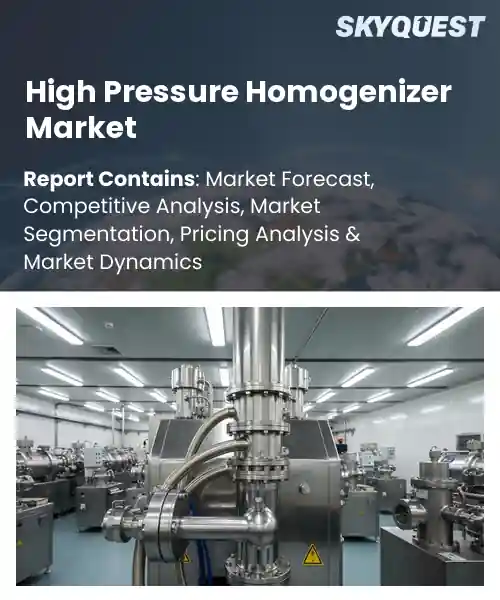
High Pressure Homogenizer Market
Report ID: SQMIG20I2654
Report ID: SQMIG20I2654
[email protected]
USA +1 351-333-4748
Report ID:
SQMIG20I2654 |
Region:
Global |
Published Date: February, 2026
Pages:
157
|Tables:
114
|Figures:
77


Global High Pressure Homogenizer Market size was valued at USD 1.2 Billion in 2024 and is poised to grow from USD 1.28 Billion in 2025 to USD 2.1 Billion by 2033, growing at a CAGR of 6.4% during the forecast period (2026-2033).
The high pressure homogenizer market is global and consists of machines designed to create a uniform size of all types of particle/droplets by forcing fluid product through small openings. This creates a stable/totally consistent textural and bioavailable product. The demand for processed foods with a long shelf life, for precision formulation of drugs, and for topically applied nanoemulsions has led to many new products that consumers want because they are safe and effective. The market has transformed from simple mechanical homogenizers used in milk production to very advanced piston and microfluidizer systems used to produce liposome medications that correspond to regulatory agency standards and technological innovation.
A key trend driving the global high pressure homogenizer sector demand from biopharmaceutical and specialty food sectors because tighter control over particle size and cellular disruption directly improves product performance and process yields, which in turn incentivizes investment in high pressure homogenizers. For example producing uniform lipid nanoparticles for mRNA vaccines compelled manufacturers to adopt microfluidization and strengthen validation protocols, driving demand for precision systems. Homogenisation is used by producers of plant-based dairy products to make their products seem creamier and more stable; this improves consumer acceptance and expands their share of the market. With increasing regulation, and R&D increasing drastically, the suppliers can capture growth around the world by providing energy efficient, scalable systems and validation services.
How is AI Enhancing Operational Efficiency in the High Pressure Homogenizer Market?
AI is improving operational efficiency in the high pressure homogenizer market by making key processes smarter and more predictable. Core aspects include real time monitoring of pressure and valve condition, predictive maintenance that anticipates wear, and AI driven recipe tuning that optimizes energy use and product stability. The current state shows manufacturers and processors adopting data driven controls and digital twin simulations to speed scale up and reduce trial runs. In practice AI helps operators maintain consistent particle size distributions, shorten downtime for valve servicing, and enable remote diagnostics that keep lines running reliably while improving product quality.
GEA in March 2025, announced an AI powered application to streamline engineer to order workflows for separation and flow equipment, which supports faster, more accurate configurating of homogenizer systems and reduces manual engineering effort, helping plants deploy units quicker and keep uptime higher through smarter digital tools.
Market snapshot - 2026-2033
Global Market Size
USD 1.2 Billion
Largest Segment
Industrial Homogenizers
Fastest Growth
Laboratory Homogenizers
Growth Rate
6.4% CAGR
To get more insights on this market click here to Request a Free Sample Report
Global high pressure homogenizer market is segmented by product type, operation mode, application, end user and region. Based on product type, the market is segmented into laboratory homogenizers and industrial homogenizers. Based on operation mode, the market is segmented into continuous mode and batch mode. Based on application, the market is segmented into food & beverage, pharmaceutical and cosmetics. Based on end user, the market is segmented into manufacturers and research institutions. Based on region, the market is segmented into North America, Europe, Asia Pacific, Latin America and Middle East & Africa.
Based on the global high pressure homogenizer market forecast, laboratory Homogenizers segment dominates because it serves as the innovation and validation hub where new formulations and processes are trialed under high pressure conditions. Their precise control over pressure, flow, and particle size enables developers to qualify formulations and troubleshoot instability early, which reduces downstream development risk. The driving force behind product design and validation from a technical standpoint can create a ‘funnel’ of investment and expertise within laboratories.
Industrial homogenizers are expected to be the fastest growing segment in the global high pressure homogenizer market due to rising large scale production in food, pharmaceutical, and biotechnology industries. Due to increased demands for uniformity in particle size reductions; product stability; implementation of automated systems; and growing production requirements by developing nations; this will result in more companies adapting to these new standards.
Continuous Mode segment leads because it enables sustained high throughput and consistent shear exposure that aligns with industrial manufacturing requirements. It can be integrated inline with both upstream and downstream processes which helps reduce the amount of handling and inconsistencies resulting in a much more efficient operation and a more consistent product. Continuous processing reduces processing complexity and supports automation, making it the preferred choice where steady production and tight quality control are critical.
Batch mode operation is projected to be the fastest growing segment in the global high pressure homogenizer market due to its flexibility in handling small to medium production volumes, precise control over processing parameters, and suitability for customized formulations. Growing demand from pharmaceutical, biotechnology, and specialty food industries further accelerates batch system adoption globally.
To get detailed segments analysis, Request a Free Sample Report
As per the global high pressure homogenizer market analysis, North America dominates the industry due to a strong confluence of industrial capability, concentrated end user demand, and a regulatory environment that emphasizes product safety and process control. The region has several major equipment makers along with contract manufacturers who help promote the initial use of cutting edge systems by having large service and aftermarket support facilities. Certain industries that involve high value such as biopharma, specialty foods and personal care products heavily depend on homogenization for their ability to stabilize the formulation and for rupturing cells; as a result there is continued investment in developing customized solutions for these industries. The close proximity of research and development activities and suppliers to each other allows manufacturers and end-users to quickly test and develop new technologies, allowing for the easy implementation of those technologies.
High pressure homogenizer market in United States benefits from concentrated biotech and pharmaceutical clusters, sophisticated process development capabilities, and extensive adoption across food and personal care manufacturing. When an original equipment manufacturer (OEM) has an established local presence with a corresponding strong service support network, it provides customers with customized assistance and rapid product validation. The requirement for high-throughput manufacturing and increasingly complex biologics, such as those developed through biopharmaceuticals, results in significant investments in more advanced homogenization technologies.
High pressure homogenizer market in Canada combines a diverse processing industry with strong service networks and emphasis on food safety and quality. Domestic processors and specialty manufacturers seek reliable homogenization for dairy, beverage and nutraceutical applications, encouraging demand for customizable systems and local maintenance. Proximity to North America supply chains facilitates access to parts and technical expertise. Collaboration between equipment providers and research centers supports adaptation of technologies to regional product requirements.
Rapid expansion of the high pressure homogenizer market in Europe is driven by regulatory expectations, targeted innovation across core industries and strong demand for premium processed goods. Food and beverage businesses are looking for ways to enhance the appearance and durability of their products; however, pharmaceutical and cosmetic companies are using homogenizers as an efficient means of formulating and delivering their products. Specialized equipment suppliers and engineering companies that focus exclusively on these industries create a highly connected, effective network that facilitates retrofitting and new installations of homogenizing equipment. Research collaborations and specialized technical services augment these networks. Manufacturers will continue to invest in training their employees and developing robust after-sales support systems to further encourage manufacturers’ ongoing use of homogenization equipment.
High pressure homogenizer market in Germany draws on strong engineering tradition and a concentrated process equipment sector. Strong cooperation amongst research institutions with industry users fuels continuous improvement of dependable systems used in the manufacturing of pharmaceuticals, food products and specialty chemicals. Precision and serviceability were heavily weighted features for end users when selecting systems from potential suppliers; therefore, suppliers are encouraged to provide modular products and consistent local product support to remain competitive.
High pressure homogenizer market in United Kingdom benefits from a vibrant innovation ecosystem and agile contract manufacturing that support rapid adoption of advanced homogenization equipment. Specialty food, nutraceutical, and cosmetic manufacturers demand systems that are flexible and compact to accommodate various sizes; there is currently an increased relationship between technology incubators, suppliers and service providers to assist with pilot testing and process optimization; the emphasis is to focus on quality and traceability while commercializing quickly is leading to an increase in the integration of homogenization and analytical workflows.
High pressure homogenizer market in France reflects growing preference for premium and artisanal processed goods that benefit from delicate emulsification and texture control. Demand for adaptable systems that gently yet efficiently homogenize are growing in volume due to small and medium sized producers of food, cosmetics, and specialty ingredients. The need for clean, label friendly formulations and sustainably processed ingredients are leading suppliers to develop energy saving and serviceable solutions to meet their client’s needs. By partnering with regional research organizations, application specific customizations and market maturation can occur more rapidly than through traditional means.
Asia Pacific is strengthening its position in the high pressure homogenizer market through development of local manufacturing capabilities, strategic partnerships with global suppliers and rising demand across food, beverage and biopharmaceutical sectors. Enhanced accessibility and responsiveness through competitive supply chains enable domestic process intensification and customized regional solutions as domestic OEMs and engineering firms take precedence in relation to these areas. The introduction of advanced designs and control techniques into regional sites occurs via technology transfer and joint development programs; and by expanding aftermarket support, barriers to adoption will be lowered. As a result, existing strengths in precision engineering and electronics integration, especially in the leading markets will promote rapid innovation and adaptation of homogenization technologies for a wide variety of applications across Asia Pacific region.
High pressure homogenizer market in Japan builds on a tradition of precision engineering and rigorous quality control to deliver highly reliable homogenization systems. To fulfill stringent standards providers of pharmaceutical goods and specialty food manufacturers develop durable products manufactured to strict tolerances and integrated with automated systems as well as analytics. They also have strong post-sale support and service capabilities to ensure long-term use, and cooperative engineering services to allow equipment to evolve with market demands and solve the many adaptation needs of these specialized/process-specific uses.
High pressure homogenizer market in South Korea benefits from rapid technology adoption, strong industrial engineering and a focus on compact, high performance systems suited to cosmetics, functional foods and bio applications. The incorporation of high-level control systems and digital measurement capabilities allows for greater reproducibility of the process itself and facilitates faster production with more flexibility than without. Additionally, regional opportunities for innovation and export readiness promote a strong regional advantage.
To know more about the market opportunities by region and country, click here to
Buy The Complete Report
Increasing Demand For Stable Emulsions
Manufacturers from the food, pharmaceutical, and personal care products industries increasingly rely on high pressure homogenizers to produce stable emulsions and suspensions through continual particle size reduction and consistent dispersion of the particles in order to achieve repeatable droplet size distributions, improved texture, and long-term product stability. This ongoing demand for reliable quality and extended shelf life will result in increased investment in new equipment and aftermarket services, as well as custom processing solutions, which will drive the global high pressure homogenizer market growth and lead to manufacturer and supplier capacity expansion and innovation efforts that contribute to the overall expansion of the market.
Technological Advancements In Homogenizer Design
Continuous improvements in pump technology, valve geometry, materials of construction, and control systems have enhanced the operational reliability and versatility of high pressure homogenizers, making them more attractive to a broader set of manufacturers. Improved energy efficiency, simplified sanitation, and greater automation reduce operational complexity and support integration into continuous production lines, encouraging procurement for both new facilities and retrofits. Producers can satisfy tightly regulated safety standards through these innovations while minimizing downtime and therefore encouraging broad adoption, diversifying suppliers from their competition, and increasingly growing the surrounding market ecosystem- an example of the benefits of these types of technological advancements.
High Operational And Maintenance Costs
High pressure homogenizers represent a large capital expenditure commitment for small or medium through various components such as purchase of equipment, need for special maintenance, and need for trained operators. With regard to ongoing costs, wear part of equipment; validation for sanitation; and regular periodic validation activities add to a greater overall cost perception; therefore, alternatives/contract producers look more attractive. This issue slows market penetration to manufacturers that are looking for lower price points, lessens their replacement cycles of high pressure homogenizers, and channels demand toward either lower-capacity options or contract production thus limiting the level of equipment sales and overall growth within the industry.
Energy Consumption and Operational Complexity
High pressure homogenizers consume substantial energy and require skilled operation to maintain performance and safety standards. Complex pressure controls, frequent wear-part replacements, and strict compliance requirements add operational burden. These factors increase total cost of ownership and discourage adoption among cost-sensitive industries, especially where simpler processing alternatives exist.
Request Free Customization of this report to help us to meet your business objectives.
The competitive landscape in the global high pressure homogenizer market outlook is shifting from volume competition to technology-led differentiation, driven by demand for aseptic nanoemulsions and inline process control in pharma and food. Vendors pursue targeted acquisitions and engineering partnerships to add emulsification, microencapsulation and PAT capabilities, for example SPX Flow’s 2021 acquisition of Philadelphia Mixing Solutions and recent collaborations involving Tetra Pak, Danone and GEA on next‑gen emulsification and lab equipment.
SkyQuest’s ABIRAW (Advanced Business Intelligence, Research & Analysis Wing) is our Business Information Services team that Collects, Collates, Correlates, and Analyses the Data collected by means of Primary Exploratory Research backed by robust Secondary Desk research.
As per SkyQuest analysis, the global high pressure homogenizer industry is driven primarily by increasing demand for stable emulsions that improve product texture, stability and shelf life, and by ongoing technological advancements in homogenizer design that boost energy efficiency and automation. However high operational and maintenance costs, including wear-prone components and validation requirements, constrain adoption among smaller processors. North America remains the dominating region due to concentrated biopharma and food processing clusters and strong aftermarket support, while laboratory homogenizers lead the product mix by enabling formulation development and scale-up validation. Providers that offer scalable, energy-efficient systems and digital services are best positioned to capture growth.
| Report Metric | Details |
|---|---|
| Market size value in 2024 | USD 1.2 Billion |
| Market size value in 2033 | USD 2.1 Billion |
| Growth Rate | 6.4% |
| Base year | 2024 |
| Forecast period | 2026-2033 |
| Forecast Unit (Value) | USD Billion |
| Segments covered |
|
| Regions covered | North America (US, Canada), Europe (Germany, France, United Kingdom, Italy, Spain, Rest of Europe), Asia Pacific (China, India, Japan, Rest of Asia-Pacific), Latin America (Brazil, Rest of Latin America), Middle East & Africa (South Africa, GCC Countries, Rest of MEA) |
| Companies covered |
|
| Customization scope | Free report customization with purchase. Customization includes:-
|
To get a free trial access to our platform which is a one stop solution for all your data requirements for quicker decision making. This platform allows you to compare markets, competitors who are prominent in the market, and mega trends that are influencing the dynamics in the market. Also, get access to detailed SkyQuest exclusive matrix.
Table Of Content
Executive Summary
Market overview
Parent Market Analysis
Market overview
Market size
KEY MARKET INSIGHTS
COVID IMPACT
MARKET DYNAMICS & OUTLOOK
Market Size by Region
KEY COMPANY PROFILES
Methodology
For the High Pressure Homogenizer Market, our research methodology involved a mixture of primary and secondary data sources. Key steps involved in the research process are listed below:
1. Information Procurement: This stage involved the procurement of Market data or related information via primary and secondary sources. The various secondary sources used included various company websites, annual reports, trade databases, and paid databases such as Hoover's, Bloomberg Business, Factiva, and Avention. Our team did 45 primary interactions Globally which included several stakeholders such as manufacturers, customers, key opinion leaders, etc. Overall, information procurement was one of the most extensive stages in our research process.
2. Information Analysis: This step involved triangulation of data through bottom-up and top-down approaches to estimate and validate the total size and future estimate of the High Pressure Homogenizer Market.
3. Report Formulation: The final step entailed the placement of data points in appropriate Market spaces in an attempt to deduce viable conclusions.
4. Validation & Publishing: Validation is the most important step in the process. Validation & re-validation via an intricately designed process helped us finalize data points to be used for final calculations. The final Market estimates and forecasts were then aligned and sent to our panel of industry experts for validation of data. Once the validation was done the report was sent to our Quality Assurance team to ensure adherence to style guides, consistency & design.
Analyst Support
Customization Options
With the given market data, our dedicated team of analysts can offer you the following customization options are available for the High Pressure Homogenizer Market:
Product Analysis: Product matrix, which offers a detailed comparison of the product portfolio of companies.
Regional Analysis: Further analysis of the High Pressure Homogenizer Market for additional countries.
Competitive Analysis: Detailed analysis and profiling of additional Market players & comparative analysis of competitive products.
Go to Market Strategy: Find the high-growth channels to invest your marketing efforts and increase your customer base.
Innovation Mapping: Identify racial solutions and innovation, connected to deep ecosystems of innovators, start-ups, academics, and strategic partners.
Category Intelligence: Customized intelligence that is relevant to their supply Markets will enable them to make smarter sourcing decisions and improve their category management.
Public Company Transcript Analysis: To improve the investment performance by generating new alpha and making better-informed decisions.
Social Media Listening: To analyze the conversations and trends happening not just around your brand, but around your industry as a whole, and use those insights to make better Marketing decisions.
REQUEST FOR SAMPLE
 REQUEST FREE CUSTOMIZATION
Global High Pressure Homogenizer Market size was valued at USD 1.2 Billion in 2024 and is poised to grow from USD 1.28 Billion in 2025 to USD 2.1 Billion by 2033, growing at a CAGR of 6.4% during the forecast period (2026-2033).
The competitive landscape in the global high pressure homogenizer market is shifting from volume competition to technology-led differentiation, driven by demand for aseptic nanoemulsions and inline process control in pharma and food. Vendors pursue targeted acquisitions and engineering partnerships to add emulsification, microencapsulation and PAT capabilities, for example SPX Flow’s 2021 acquisition of Philadelphia Mixing Solutions and recent collaborations involving Tetra Pak, Danone and GEA on next‑gen emulsification and lab equipment. 'GEA Group AG', 'APV Hemson', 'Scherzer GmbH', 'SPX FLOW, Inc.', 'XCX Technology Co., Ltd.', 'Alfa Laval', 'Tetra Pak International S.A.', 'Boston Scientific Corporation', 'Krones AG', 'Eisele Pneumatics GmbH & Co. KG', 'FBF Technologies', 'KHS GmbH', 'Systech Illinois', 'Hielscher Ultrasonics GmbH', 'IKA Werke GmbH & Co. KG', 'Eppendorf AG', 'Netzsch Grinding & Dispersing', 'Ystral GmbH', 'Silverson Machines', 'HEMO GmbH'
As manufacturers across food, pharmaceutical, and personal care sectors prioritize consistent particle size reduction and uniform dispersion, high pressure homogenizers become essential tools for producing stable emulsions and suspensions. Their ability to deliver reproducible droplet size distributions, enhanced texture, and improved product stability encourages adoption by formulators seeking reliable quality and extended shelf life. This sustained demand drives investment in new equipment, aftermarket services, and tailored processing solutions, prompting manufacturers and suppliers to expand capacity and innovate, which in turn reinforces overall market growth.
As per the global high pressure homogenizer market analysis, North America dominates the industry due to a strong confluence of industrial capability, concentrated end user demand, and a regulatory environment that emphasizes product safety and process control.


Want to customize this report? This report can be personalized according to your needs. Our analysts and industry experts will work directly with you to understand your requirements and provide you with customized data in a short amount of time. We offer $1000 worth of FREE customization at the time of purchase.
Feedback From Our Clients


 USA (+1) 351-333-4748

