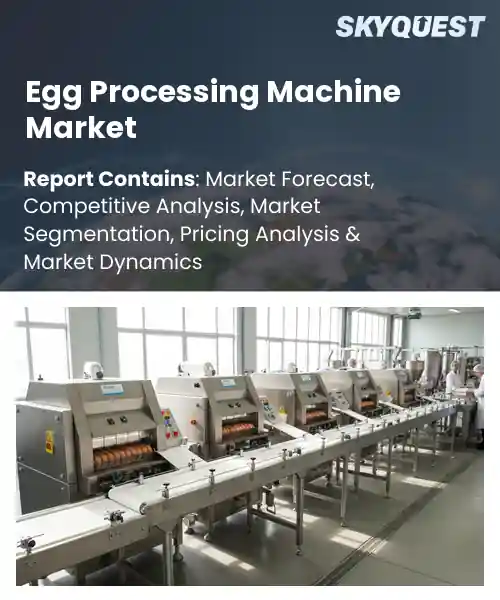
Egg Processing Machine Market
Report ID: SQMIG20I3060
Report ID: SQMIG20I3060
[email protected]
USA +1 351-333-4748
Report ID:
SQMIG20I3060 |
Region:
Global |
Published Date: June, 2026
Pages:
157
|Tables:
180
|Figures:
79


Global Egg Processing Machine Market size was valued at USD 31.2 Billion in 2024 and is poised to grow from USD 32.82 Billion in 2025 to USD 49.24 Billion by 2033, growing at a CAGR of 5.2% during the forecast period (2026-2033).
The primary driver of the egg processing machine industry is a surge in demand for safe, convenience focused egg products coupled with tightening food safety regulations and rising labor costs. The market comprises equipment for washing, candling, grading, breaking, pasteurizing and packaging of shell eggs and processed derivatives, and this market is significant because manufacturers depend on these systems to meet volume, quality and compliance targets. Over decades the sector moved from manual, small scale handling to automated continuous flow lines as industrial baking, liquid eggs and large scale food production expanded, bakeries adopted high capacity breakers to secure consistent batter yields.
As food safety rules tighten, processors buy pasteurizers and digital traceability systems, which lowers recall risk and enables longer term supply agreements with large foodservice customers. Concurrently, labor shortages prompt adoption of automated breakers and graders, cutting wage exposure and improving yield; for example bakeries deploying sensor guided breakers report lower shell contamination and more consistent costs. These cause and effect dynamics fuel opportunities for modular lines, retrofit projects, leasing models and service revenue.
How is automation improving efficiency in the egg processing machine market?
Automation is raising efficiency in the egg processing machine market by combining vision guided grading, robotic handling, and inline data capture to streamline tasks that were once manual. Key aspects include automated grading for consistent quality, gentle robotic transfer to lower breakage and contamination, and integrated software for traceability and predictive maintenance. The market is shifting to the modular systems that link graders, breakers and packers so lines run with fewer stops and smoother handoffs. Examples from recent trade shows highlight graders that communicate with coding printers and robotic packers, making operations more reliable and easier to staff and scale.
Moba in May 2026, introduced new Omnia ET and Omnia PX plus graders that pair advanced vision with digital traceability, showing how automation reduces labor needs while improving throughput and consistency. This innovation helps producers scale operations with fewer operators and better quality control, supporting market growth through increased reliability and data driven decision making.
Market snapshot - (2026-2033)
Global Market Size
USD 31.2 Billion
Largest Segment
Egg Grading Machines
Fastest Growth
Egg Pasteurization Machines
Growth Rate
5.2% CAGR
To get more insights on this market click here to Request a Free Sample Report
Global egg processing machine market is segmented by by product type, by operation type, by application, by end user, by capacity, by distribution channel and region. Based on by product type, the market is segmented into Egg Breaking Machines, Egg Separating Machines, Egg Washing Machines, Egg Grading Machines, Egg Pasteurization Machines, Egg Drying Machines, Egg Packaging Machines and Others. Based on by operation type, the market is segmented into Automatic Machines, Semi-automatic Machines and Manual Machines. Based on by application, the market is segmented into Liquid Egg Processing, Powdered Egg Processing, Frozen Egg Processing and Others. Based on by end user, the market is segmented into Egg Processing Plants, Poultry Farms, Food & Beverage Manufacturers, Bakeries & Confectioneries, Hotels & Restaurants and Others. Based on by capacity, the market is segmented into Small-scale Machines, Medium-scale Machines and Large-scale Machines. Based on by distribution channel, the market is segmented into Direct Sales, Distributors & Dealers and Online Sales. Based on region, the market is segmented into North America, Europe, Asia Pacific, Latin America and Middle East & Africa.
Egg grading machines segment dominates with large egg processing machine market share because grading is central to downstream handling and commercialization, enabling consistent sizing, weight classification and defect detection that directly influence packing decisions and product value. By eliminating the need for manual sorting of product, reducing waste and enforcing quality standards throughout the production process, their systems are critical to producers that want to maximize throughput and provide uniform product.
As per egg processing machine market outlook, egg packaging machines are emerging as the most rapidly expanding area as demand for automated, flexible packing solutions grows. Advances in modular designs and quick changeovers lower packing costs while smarter labeling and tamper proofing boost retail readiness. These egg processing machine market trends drive investment by processors seeking faster fulfillment and reduced labor intensity.
As per egg processing machine market analysis, automatic machines segment dominates because fully automated systems deliver continuous high throughput while minimizing manual intervention, enabling processors to scale operations with predictable performance. Their advanced controls and sensor driven feedback improve consistency across breaking, washing and packing tasks, reduce contamination risk and simplify regulatory compliance. By consolidating multiple functions into integrated lines they cut cycle times, lower operating variability, and attract investment from operators prioritizing productivity and cost efficiencies.
As per egg processing machine market forecast, semi-automatic machines are witnessing the strongest growth momentum as mid sized processors seek balanced automation with lower capital outlay. Innovations in modular interfaces and simpler maintenance widen adoption among facilities upgrading from manual practices. This adaptability accelerates modernization, enabling incremental capacity expansion and creating opportunities for retrofit services.
To get detailed segments analysis, Request a Free Sample Report
As per global egg processing machine market outlook, Asia Pacific dominates the market owing to a combination of dense production clusters, strong manufacturing ecosystems and an emphasis on automation that suits regional productivity imperatives. Demand for diversified food processing spurs innovation from local machine makers for yield, hygiene and energy efficiency, while linked supply chains speed the commercialization of new equipment. Partnerships between technology providers and major processors allow for custom solutions, and food safety regulatory focus is driving the use of state-of-the-art inspection and packaging equipment. The proximity of component suppliers and flexible contract manufacturing is a time to market advantage that makes the region a hotbed for incremental improvements and innovative equipment designs for domestic and export-oriented companies.
As per global egg processing machine market forecast, Japan holds an advantage in the worldwide projections for the egg processing machine market due to its culture of precise engineering, strong OEM capabilities and close collaboration of food processors with machine producers. Reliability, cleanliness and compact automation suits crowded manufacturing sites and value added product lines. Suppliers are emphasizing modular solutions and maintenance services that meet high food safety standards and allow for replacement cycles and incremental upgrades that maintain throughput while reducing contamination risk while improving operational cost control.
As per global egg processing machine industry analysis, South Korea is being influenced by fast automation adoption, a strong consumer focus on food formats, and a tight link between electronics component providers and equipment makers, based on global egg processing machine industry analysis. The key drivers of innovation in the area of inline sorting and packaging lines are sanitary design and smart process controls. Local companies specialize in small machines and service networks that allow processors to scale variation while meeting strict food quality requirements.
North America is expected to witness a substantial growth in demand for egg processing machines, owing to a confluence of changing consumer tastes toward processed egg products, a strong base of industrial processors seeking efficiency improvements, and strong aftermarket service ecosystems reducing hurdles to adoption. Traceability, food safety requirements and speedy product rotation emphasize the need to invest in integrated lines with sorting, breaking, pasteurizing and packing capabilities designed for different product types. Machine manufacturers benefit from local engineering know-how and collaboration with food industries to offer scalable solutions and responsive maintenance. Channel structures that incorporate leasing, financing and local support further enable extensive modernization. Cross sector innovation in sensors and digital controls improves operational visibility and lowers downtime for large scale operations. Regional standards and joint pilot initiatives between equipment makers and processors also speed practical deployment and incremental improvement.
United States is characterized by demand from large scale processors seeking high throughput automation and integrated quality assurance systems. Emphasis on traceability and rigorous safety standards drives adoption of modular lines and advanced sensor based inspection. Domestic manufacturers and multinational suppliers compete on comprehensive solutions and aftermarket support, while processors prioritize energy efficient designs and remote monitoring capabilities that align with retailer requirements and scalability.
Canada reflects a balance between export oriented processors and domestic manufacturers seeking versatile equipment with strong hygiene credentials. Collaborative development and pilot testing help adapt overseas technologies to local supply chain needs. Suppliers prioritize flexible lines that support small and medium operations while offering service agreements and training. Regulatory alignment and emphasis on sustainable operation further encourage investment in energy efficient, easy to clean designs.
A combination of regulatory rigor, targeted innovation and excellent engineering capabilities, concentrated in key industrial clusters, is helping Europe expand its position in the egg processing machine market. Processors and equipment manufacturers collaborate to advance hygienic design, energy efficient operations and flexible designs that accommodate different production methods across the region. Focus on adherence to tight food safety guidelines is increasing the use of inspection, traceability and clean in place technologies. Investment in test facilities, collaborative research and cross border supply partnerships mean that product features can be iterated quickly, and a well established service infrastructure ensures that operators receive training and maintenance that maintains high uptime and consistent product quality for both domestic consumption and niche export markets. Manufacturers are also using digitization and the integration of sensors for predictive maintenance and process optimization. They are also differentiating themselves competitively with after sales value and engineering services tailored to the customer.
Germany market is supported by a strong legacy of precise engineering, tool capabilities and the close cooperation between manufacturers and processors. The companies focus on strong design, modular automation and high hygiene requirements, allowing customized solutions for different production volumes. Service networks and training provide consistent equipment performance. The places where sensors and control software are integrated to improve traceability and minimize variability in operations on processing lines are the innovation centers.
United Kingdom is shaped by a vibrant food technology scene and diverse processing models from artisanal to large firms. Demand emphasizes flexibility, hygienic design, and quick changeover to support varied product portfolios. Suppliers offer modular systems and services including operator training and remote diagnostics. Collaboration between equipment makers, contract packers, and research institutions fosters innovation that addresses traceability, waste reduction, and energy efficiency in operations.
France is influenced by strong culinary traditions and artisanal and industrial processors seeking equipment that preserves quality and texture. Manufacturers prioritize customizable breaking and portioning solutions with attention to sanitary design and gentle handling. Local suppliers provide after sales services and training to optimize process outcomes, while collaborative innovation focuses on reducing waste and energy use aligned with food manufacturing expectations and niche export potential.
To know more about the market opportunities by region and country, click here to
Buy The Complete Report
Rising Demand For Processed Eggs
Technological Advancements In Equipment
High Initial Capital Investment
Complex Regulatory Compliance Requirements
Request Free Customization of this report to help us to meet your business objectives.
Incumbents have consolidated through mergers and acquisitions, giving them the ability to differentiate on technology-driven innovations. These innovations are influencing procurement cycles and service contracts by using products driven by artificial intelligence and sensors, along with targeted partnerships. Examples from the competitive landscape illustrate how incumbents are leveraging partnerships and product innovations for two purposes increasing switching costs for end-users and securing large accounts with large processors, such as the example of Sanovo’s partnership with Ovotrack on breaker batch software or the rollout of Moba’s high-capacity Crono loaders.
SkyQuest’s ABIRAW (Advanced Business Intelligence, Research & Analysis Wing) is our Business Information Services team that Collects, Collates, Correlates, and Analyses the Data collected by means of Primary Exploratory Research backed by robust Secondary Desk research.
As per SkyQuest analysis, the global egg processing machine market growth is being propelled by rising consumer demand for processed, convenience-focused egg products and by technological advancements in automation and digital traceability, which together boost throughput and compliance. However high initial capital investment remains a key restraint limiting adoption among smaller processors. Asia Pacific leads the market due to dense production clusters and strong manufacturing ecosystems, while egg grading machines dominate by enabling consistent sizing, quality control and seamless integration with automated lines. Stricter food safety regulations also push processors toward pasteurization and inspection investments, reinforcing demand for integrated, low-risk equipment.
| Report Metric | Details |
|---|---|
| Market size value in 2024 | USD 31.2 Billion |
| Market size value in 2033 | USD 49.24 Billion |
| Growth Rate | 5.2% |
| Base year | 2024 |
| Forecast period | (2026-2033) |
| Forecast Unit (Value) | USD Billion |
| Segments covered |
|
| Regions covered | North America (US, Canada), Europe (Germany, France, United Kingdom, Italy, Spain, Rest of Europe), Asia Pacific (China, India, Japan, Rest of Asia-Pacific), Latin America (Brazil, Rest of Latin America), Middle East & Africa (South Africa, GCC Countries, Rest of MEA) |
| Companies covered |
|
| Customization scope | Free report customization with purchase. Customization includes:-
|
To get a free trial access to our platform which is a one stop solution for all your data requirements for quicker decision making. This platform allows you to compare markets, competitors who are prominent in the market, and mega trends that are influencing the dynamics in the market. Also, get access to detailed SkyQuest exclusive matrix.
Table Of Content
Executive Summary
Market overview
Parent Market Analysis
Market overview
Market size
KEY MARKET INSIGHTS
COVID IMPACT
MARKET DYNAMICS & OUTLOOK
Market Size by Region
KEY COMPANY PROFILES
Methodology
For the Egg Processing Machine Market, our research methodology involved a mixture of primary and secondary data sources. Key steps involved in the research process are listed below:
1. Information Procurement: This stage involved the procurement of Market data or related information via primary and secondary sources. The various secondary sources used included various company websites, annual reports, trade databases, and paid databases such as Hoover's, Bloomberg Business, Factiva, and Avention. Our team did 45 primary interactions Globally which included several stakeholders such as manufacturers, customers, key opinion leaders, etc. Overall, information procurement was one of the most extensive stages in our research process.
2. Information Analysis: This step involved triangulation of data through bottom-up and top-down approaches to estimate and validate the total size and future estimate of the Egg Processing Machine Market.
3. Report Formulation: The final step entailed the placement of data points in appropriate Market spaces in an attempt to deduce viable conclusions.
4. Validation & Publishing: Validation is the most important step in the process. Validation & re-validation via an intricately designed process helped us finalize data points to be used for final calculations. The final Market estimates and forecasts were then aligned and sent to our panel of industry experts for validation of data. Once the validation was done the report was sent to our Quality Assurance team to ensure adherence to style guides, consistency & design.
Analyst Support
Customization Options
With the given market data, our dedicated team of analysts can offer you the following customization options are available for the Egg Processing Machine Market:
Product Analysis: Product matrix, which offers a detailed comparison of the product portfolio of companies.
Regional Analysis: Further analysis of the Egg Processing Machine Market for additional countries.
Competitive Analysis: Detailed analysis and profiling of additional Market players & comparative analysis of competitive products.
Go to Market Strategy: Find the high-growth channels to invest your marketing efforts and increase your customer base.
Innovation Mapping: Identify racial solutions and innovation, connected to deep ecosystems of innovators, start-ups, academics, and strategic partners.
Category Intelligence: Customized intelligence that is relevant to their supply Markets will enable them to make smarter sourcing decisions and improve their category management.
Public Company Transcript Analysis: To improve the investment performance by generating new alpha and making better-informed decisions.
Social Media Listening: To analyze the conversations and trends happening not just around your brand, but around your industry as a whole, and use those insights to make better Marketing decisions.
REQUEST FOR SAMPLE
 REQUEST FREE CUSTOMIZATION
Global Egg Processing Machine Market size was valued at USD 31.2 Billion in 2024 and is poised to grow from USD 32.82 Billion in 2025 to USD 49.24 Billion by 2033, growing at a CAGR of 5.2% during the forecast period (2026-2033).
Competitive landscape is defined by incumbent consolidation and technology led differentiation, where strategic M&A, targeted partnerships, and AI and sensor driven product launches directly influence procurement cycles and service contracts. Examples include Sanovo’s cooperation with Ovotrack on breaker batch software and Moba’s rollout of higher capacity Crono loaders, showing incumbents using partnerships and product innovation to raise switching costs and secure large processor accounts. 'SANOVO TECHNOLOGY GROUP', 'Moba Group', 'Ovobel Foods', 'Actini Group', 'Pelbo', 'CracklessEgg', 'Kyowa Machinery', 'Nabel', 'Diamond Engineering', 'Sime-Tek', 'Taiwan Egg Machinery', 'Bühler Group', 'JBT Corporation', 'Soteco Engineering', 'Staalkat International', 'Ovotherm International', 'Big Dutchman', 'Vencomatic Group', 'Innovo Group', 'ZENYER Machinery'
Rising consumer preference for convenience and consistently processed egg products has expanded demand for industrial egg processing equipment. Manufacturers in foodservice and packaged goods seek reliable machinery to deliver uniform texture, extended shelf life, and simplified ingredient integration, prompting investment in automated separators, pasteurizers, and liquid egg systems. This sustained purchasing behavior encourages suppliers to innovate production capacity and service offerings, reinforcing market expansion through greater adoption of mechanized processing solutions across supply chains focused on scalability and product standardization.
Automation And Process Integration: Manufacturers are increasingly adopting automated, integrated processing lines to improve throughput, consistency, and hygiene across egg handling, grading, breaking, and packing stages. Modular systems enable flexible scaling and faster changeovers to accommodate diverse product formats, while robotics and sensor-driven controls reduce reliance on manual labor and minimize contamination risks. Integration with upstream suppliers and downstream packing allows smoother workflows and shortened lead times. Service agreements and predictive maintenance models complement automation by ensuring uptime and continuous process optimization across facilities.
Why does Asia Pacific Dominate the Global Egg Processing Machine Market? |@12


Want to customize this report? This report can be personalized according to your needs. Our analysts and industry experts will work directly with you to understand your requirements and provide you with customized data in a short amount of time. We offer $1000 worth of FREE customization at the time of purchase.
Feedback From Our Clients


 USA (+1) 351-333-4748

