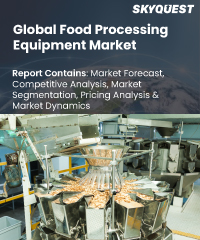
Food Processing Equipment Market
Report ID: SQMIG20I2445
Report ID: SQMIG20I2445
[email protected]
USA +1 351-333-4748
Report ID:
SQMIG20I2445 |
Region:
Global |
Published Date: August, 2025
Pages:
191
|Tables:
148
|Figures:
73


Global Food Processing Equipment Market size was valued at USD 134.34 Billion in 2024 and is poised to grow from USD 142 Billion in 2025 to USD 221.26 Billion by 2033, growing at a CAGR of 5.7% during the forecast period (2026–2033).
The food processing equipment market is undergoing steady expansion, driven by rising global demand for processed and packaged foods, shifting dietary habits, and the growth of ready-to-eat and convenience food segments.
Technological advancements, especially in automation, along with heightened awareness about food safety and hygiene standards, are also contributing to the expansion of the industry.
With rising demand for food products, businesses are increasingly turning to automation to increase production, cut costs, and improve safety and quality requirements. Human error and contamination are reduced with automatic solutions, ensuring food safety standards are met. They also allow enterprises to maintain consistency in manufacturing quality, reduce waste, and increase efficiency which contributes to revenue growth of this segment. The market share is expanding, driven by the rising preference for frozen food products and convenience snacks owing to busy lifestyles, along with the expansion of food delivery services that require reliable tools for maintaining quality and extended shelf life.
The expansion of e-commerce portals is offering a favorable India food processing equipment market outlook. As per industry reports, the Indian e-commerce sector was expected to attain a gross merchandise value (GMV) of USD 12 Billion during the October to December 2024 festival season, representing a 23% rise compared to 2023. E-commerce sites offer the convenience of ordering food items easily from the comfort of homes. Online grocery platforms and food delivery services require consistent quality, extended shelf life, and efficient packaging, which encourages companies to adopt better machinery for sorting and preserving food products. As e-commerce platforms are broadening their reach, small and large food brands are upgrading their production lines to keep up with bulk orders. Faster processing and automation have become essential to maintain supply chain efficiency and ensure fresh items reach customers quickly. The need for specialized equipment for dairy products is also increasing as online grocery sales surge. With more people adopting digital shopping, the demand for high-tech food processing equipment continues to grow across India.
How is AI Transforming the Food Processing Equipment Market?
Artificial Intelligence (AI) is playing a transformative role in the food processing equipment market by enhancing automation, improving quality control, and optimizing production efficiency. AI-powered systems are increasingly being used for predictive maintenance, real-time equipment diagnostics, and automated sorting and inspection of food products to ensure consistency, hygiene, and minimal waste.
Market snapshot - 2026-2033
Global Market Size
USD 127.1 Billion
Largest Segment
Processing
Fastest Growth
Pre-Processing
Growth Rate
5.7% CAGR
To get more insights on this market click here to Request a Free Sample Report
The global food processing equipment market is segmented into type, operation, application, end-product and region. Based on type, the market is segmented into pre-processing and processing. Based on equipment, the market is segmented into size reduction equipment, size enlargement equipment, homogenizers and mixers & blenders. Based on operation, the market is segmented into automatic, semi-automatic and manual. Based on application, the market is segmented into bakery & confectionery, meat & poultry, fish & seafood, dairy products, alcoholic beverages, non-alcoholic beverages and others. Based on end-product, the market is solid, liquid and semi-solid. Based on region, the market is segmented into North America, Europe, Asia-Pacific, Latin America, and the Middle East & Africa.
What Makes Processing Equipment the Core of Food Manufacturing?
As per the global food processing equipment market analysis, the processing segment continues to dominate the market. Its dominance stems from the central role it plays across all food categories, from meat and dairy to bakery and beverages. Additionally, the increasing demand for ready-to-eat meals, frozen products, and packaged snacks has intensified the need for high-capacity, automated processing lines. Manufacturers are heavily investing in smart processing machinery to meet high-volume demands while ensuring quality, consistency, and compliance with food safety regulations.
The pre-processing segment is witnessing faster growth due to the rising importance of ingredient handling, cleaning, sorting, and peeling in ensuring food quality and safety. With increasing consumer expectations for clean-label and traceable food, pre-processing systems now play a critical role in upstream quality control. Advancements in AI-powered inspection systems, optical sorters, and automated washing units are making pre-processing more efficient and precise, particularly in fruits, vegetables, and grains.
What Makes Mixers and Blenders Essential Across Food Categories?
As per the global food processing equipment forecast, mixers and blenders continue to dominate the market due to their wide application across all food categories, including bakery, dairy, sauces, beverages, confectionery, and meat processing. These machines are essential for achieving uniform texture, flavor distribution, and product consistency, making them indispensable in both small-scale and industrial food production. The rising demand for processed, ready-to-eat, and functional foods is driving the need for versatile and high-capacity mixing solutions.
Homogenizers are emerging as one of the fastest-growing equipment categories, particularly in the dairy, beverage, and plant-based product segments. Their role in improving texture, stability, and shelf life by creating uniform emulsions is crucial for modern food formulations. With rising consumer demand for clean-label, stable, and visually appealing products, homogenization is becoming increasingly essential.
To get detailed segments analysis, Request a Free Sample Report
How is the Food Processing Equipment Market Evolving in North America?
North America holds a significant market share in the global food processing equipment market, driven by strong industrialization, advanced automation infrastructure, and consumer demand for packaged, processed, and frozen foods. The region is witnessing rapid adoption of AI-integrated and energy-efficient machinery, particularly in meat, dairy, bakery, and snack processing sectors.
Food Processing Equipment Market in the U.S.
The U.S. leads the North America region due to its highly industrialized food sector and strong adoption of automation and AI-enabled systems. Manufacturers are heavily investing in smart equipment for meat, dairy, and bakery segments to improve efficiency and ensure regulatory compliance. Demand for hygienic, energy-efficient systems is also growing, driven by both safety standards and sustainability goals.
Food Processing Equipment Market in Canada
Canada’s region is shaped by a strong export-oriented food industry and increasing demand for packaged and frozen foods. Equipment suppliers are focusing on modular and customizable solutions, especially for the country’s thriving meat, seafood, and snack processing segments. Government support for food innovation and sustainability is further boosting the adoption of modern machinery.
What are the Growth Trends in the Asia-Pacific Food Processing Equipment Market?
Asia-Pacific is the fastest-growing region, supported by urbanization, rising disposable incomes, and growing demand for convenience and functional foods. Governments are promoting smart factory investments, and manufacturers are seeking affordable yet advanced equipment to meet volume and quality standards.
Food Processing Equipment Market in Japan
As per regional outlook, Japan’s region is characterized by high standards for food quality, precision, and hygiene. With an aging population and labor shortages, there’s a strong uptake of robotics and compact automation systems for seafood, confectionery, and convenience food manufacturing. Local players are also innovating in packaging and shelf-life extension technologies.
Food Processing Equipment Market in South Korea
South Korea is witnessing rising demand for automated and smart food processing equipment, especially in ready-to-eat meals and export-friendly food categories. The country is adopting smart factory models to reduce costs and align with global standards. Government initiatives to boost smart manufacturing and food exports are accelerating market growth.
How is Europe Driving Innovation in the Food Processing Equipment Market?
Europe plays a major role in advancing food processing machinery technology. The region is known for its engineering excellence, regulatory rigor, and sustainability leadership. Growth is fueled by demand for premium, organic, and plant-based foods, supported by high R&D investment.
Food Processing Equipment Market in Germany
As per regional forecast, Germany is a technology leader in the food machinery sector, known for precision engineering and industrial automation. The country exports a significant volume of food processing equipment and continues to drive innovation in dairy, baked goods, and meat processing technologies. Sustainability and energy efficiency remain top priorities.
Food Processing Equipment Market in the UK
The UK region is influenced by growing demand for packaged, plant-based, and health-conscious foods. Post-Brexit trade pressures have pushed manufacturers to modernize facilities with flexible, scalable processing lines. AI and data-driven technologies are also gaining momentum to meet quality and traceability demands.
Food Processing Equipment Market in Italy
Italy’s food processing equipment market is fueled by its globally recognized pasta, bakery, and cheese industries. Local manufacturers offer both traditional and high-tech solutions, and there’s increasing adoption of automated dough handling, cutting, and filling machines. Export demand and EU hygiene compliance regulations support continued investment in modern equipment.
To know more about the market opportunities by region and country, click here to
Buy The Complete Report
Food Processing Equipment Market Drivers
Growing Global Demand for Processed Seafood
Developments in Processing Automation Technology
Food Processing Equipment Market Restraints
Substantial Initial Outlay of Funds
Difficulties with Regulatory and Hygiene Compliance
Request Free Customization of this report to help us to meet your business objectives.
The competitive landscape of the food processing equipment industry is characterized by a mix of global conglomerates and specialized regional players, all focusing on innovation, automation, and customization to stay ahead. Leading companies like GEA Group, Bühler AG, and Tetra Pak dominate the market with extensive product portfolios spanning mixing, refrigeration, thermal processing, and packaging systems. These players continue to invest in smart manufacturing technologies, including AI, IoT, and energy-efficient systems to enhance performance and meet evolving industry demands.
As per market strategies, in 2024, for example, Fortifi Food Processing Solutions partnered with Völur, a Norwegian AI firm, to embed real-time optimization capabilities into meat processing lines—enabling better yield management and reduced waste.
Several startups are reshaping the food processing equipment market by introducing cutting-edge technologies that prioritize automation, sustainability, and AI-driven efficiency. Companies like Chef Robotics are pioneering the use of generative AI and robotic arms to automate labor-intensive tasks such as portioning and packaging, helping food manufacturers address workforce shortages and increase throughput.
SkyQuest’s ABIRAW (Advanced Business Intelligence, Research & Analysis Wing) is our Business Information Services team that Collects, Collates, Correlates, and Analyses the Data collected by means of Primary Exploratory Research backed by robust Secondary Desk research.
As per SkyQuest analysis, with rising demand for food products, businesses are increasingly turning to automation to increase production, cut costs, and improve safety and quality requirements. Human error and contamination are reduced with automatic solutions, ensuring food safety standards are met. They also allow enterprises to maintain consistency in manufacturing quality, reduce waste, and increase efficiency which contributes to revenue growth of this segment. Furthermore, automatic technology helps firms to cut labor expenses. One of the primary restraints in the food processing equipment market is the significant upfront investment required for purchasing advanced machinery.
| Report Metric | Details |
|---|---|
| Market size value in 2024 | USD 134.34 Billion |
| Market size value in 2033 | USD 221.26 Billion |
| Growth Rate | 5.7% |
| Base year | 2024 |
| Forecast period | 2026-2033 |
| Forecast Unit (Value) | USD Billion |
| Segments covered |
|
| Regions covered | North America (US, Canada), Europe (Germany, France, United Kingdom, Italy, Spain, Rest of Europe), Asia Pacific (China, India, Japan, Rest of Asia-Pacific), Latin America (Brazil, Rest of Latin America), Middle East & Africa (South Africa, GCC Countries, Rest of MEA) |
| Companies covered |
|
| Customization scope | Free report customization with purchase. Customization includes:-
|
To get a free trial access to our platform which is a one stop solution for all your data requirements for quicker decision making. This platform allows you to compare markets, competitors who are prominent in the market, and mega trends that are influencing the dynamics in the market. Also, get access to detailed SkyQuest exclusive matrix.
Table Of Content
Executive Summary
Market overview
Parent Market Analysis
Market overview
Market size
KEY MARKET INSIGHTS
COVID IMPACT
MARKET DYNAMICS & OUTLOOK
Market Size by Region
KEY COMPANY PROFILES
Methodology
For the Food Processing Equipment Market, our research methodology involved a mixture of primary and secondary data sources. Key steps involved in the research process are listed below:
1. Information Procurement: This stage involved the procurement of Market data or related information via primary and secondary sources. The various secondary sources used included various company websites, annual reports, trade databases, and paid databases such as Hoover's, Bloomberg Business, Factiva, and Avention. Our team did 45 primary interactions Globally which included several stakeholders such as manufacturers, customers, key opinion leaders, etc. Overall, information procurement was one of the most extensive stages in our research process.
2. Information Analysis: This step involved triangulation of data through bottom-up and top-down approaches to estimate and validate the total size and future estimate of the Food Processing Equipment Market.
3. Report Formulation: The final step entailed the placement of data points in appropriate Market spaces in an attempt to deduce viable conclusions.
4. Validation & Publishing: Validation is the most important step in the process. Validation & re-validation via an intricately designed process helped us finalize data points to be used for final calculations. The final Market estimates and forecasts were then aligned and sent to our panel of industry experts for validation of data. Once the validation was done the report was sent to our Quality Assurance team to ensure adherence to style guides, consistency & design.
Analyst Support
Customization Options
With the given market data, our dedicated team of analysts can offer you the following customization options are available for the Food Processing Equipment Market:
Product Analysis: Product matrix, which offers a detailed comparison of the product portfolio of companies.
Regional Analysis: Further analysis of the Food Processing Equipment Market for additional countries.
Competitive Analysis: Detailed analysis and profiling of additional Market players & comparative analysis of competitive products.
Go to Market Strategy: Find the high-growth channels to invest your marketing efforts and increase your customer base.
Innovation Mapping: Identify racial solutions and innovation, connected to deep ecosystems of innovators, start-ups, academics, and strategic partners.
Category Intelligence: Customized intelligence that is relevant to their supply Markets will enable them to make smarter sourcing decisions and improve their category management.
Public Company Transcript Analysis: To improve the investment performance by generating new alpha and making better-informed decisions.
Social Media Listening: To analyze the conversations and trends happening not just around your brand, but around your industry as a whole, and use those insights to make better Marketing decisions.
REQUEST FOR SAMPLE
 REQUEST FREE CUSTOMIZATION
Global Food Processing Equipment Market size was valued at USD 134.34 Billion in 2024 and is poised to grow from USD 142 Billion in 2025 to USD 221.26 Billion by 2033, growing at a CAGR of 5.7% during the forecast period (2026–2033).
The competitive landscape of the food processing equipment industry is characterized by a mix of global conglomerates and specialized regional players, all focusing on innovation, automation, and customization to stay ahead. Leading companies like GEA Group, Bühler AG, and Tetra Pak dominate the market with extensive product portfolios spanning mixing, refrigeration, thermal processing, and packaging systems. These players continue to invest in smart manufacturing technologies, including AI, IoT, and energy-efficient systems to enhance performance and meet evolving industry demands. 'Fortifi Food Processing Solutions', 'Chef Robotics', 'Oxipital AI', 'GEA Group AG', 'Bühler AG', 'Marel hf.', 'JBT Corporation', 'Tetra Pak International S.A.', 'SPX FLOW, Inc.', 'Middleby Corporation', 'Alfa Laval AB', 'Baker Perkins Ltd.', 'FENCO Food Machinery S.r.l.', 'Heat and Control, Inc.', 'FMC Technologies, Inc.'
The need for sophisticated seafood processing equipment is being driven by the rising demand for frozen and ready-to-eat seafood. With seafood exports expected to reach over USD 160 billion by 2025, processors are using automated technology to scale their operations efficiently. In North America, Europe, and Asia-Pacific, the demand for industrial processing equipment to guarantee volume, safety, and hygienic compliance is rising dramatically because of dietary changes and urbanization.
Adoption of Industry 4.0 and Smart Manufacturing Technologies: A growing number of food processing companies are embracing smart equipment solutions that incorporate IoT, AI, and real-time analytics. These technologies enable predictive maintenance (reducing unplanned downtime), optimize batch quality, and enhance traceability from raw material intake to packaging. For instance, AI-powered vision systems can detect product defects instantly, while IoT sensors monitor energy use and production speed. This market trend is reshaping food factories into connected, data-driven environments, boosting productivity and product consistency.
How is the Food Processing Equipment Market Evolving in North America?


Want to customize this report? This report can be personalized according to your needs. Our analysts and industry experts will work directly with you to understand your requirements and provide you with customized data in a short amount of time. We offer $1000 worth of FREE customization at the time of purchase.
Feedback From Our Clients


 USA (+1) 351-333-4748

