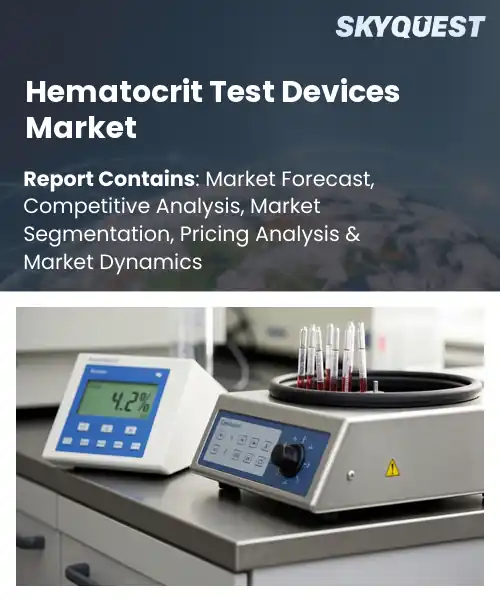
Hematocrit Test Devices Market
Report ID: SQMIG35A3760
Report ID: SQMIG35A3760
[email protected]
USA +1 351-333-4748
Report ID:
SQMIG35A3760 |
Region:
Global |
Published Date: June, 2026
Pages:
157
|Tables:
115
|Figures:
77


Global Hematocrit Test Devices Market size was valued at USD 5.32 Billion in 2024 and is poised to grow from USD 5.64 Billion in 2025 to USD 9.02 Billion by 2033, growing at a CAGR of 6.04% during the forecast period (2026-2033).
The growing demand for rapid point of care blood diagnostics to aid in clinical decision making, especially in emergency and remote care settings, is driving the demand for hematocrit test devices market trends. Hematocrit devices measure the proportion of red blood cells and are essential in hospitals, ambulances and community clinics to inform transfusion, dehydration and anemia management. In the last decade the market has moved away from laboratory centrifuge-based assays to small, disposable cartridges and handheld analyzers, providing results in minutes, with manufacturers integrating microfluidics and optical sensors to increase precision. Technological change drove uptake in low-resource regions, highlighting real-world impact on patient triage.
Decentralization of care toward point-of-care diagnostics is another key driver of global hematocrit test devices market growth, building on improved patient triage, as clinicians need immediate, actionable data to manage anemia, bleeding and transfusion needs outside of central laboratories. With care shifting to ambulances, community clinics and home health, device makers see demand for portable analyzers that cut time-to-treatment and avoid unnecessary hospital admissions. This opens up opportunities for recurring revenue from cartridges and connectivity services, partnerships with NGOs to increase access in low-income regions, and integration with telehealth platforms where specialists can interpret results remotely and optimize patient pathways.
How is AI Improving Diagnostic Accuracy in the Hematocrit Test Devices Market?
AI enhances the accuracy of the diagnosis in hematocrit test devices market share by automating image analysis and pattern recognition, minimizing operator variability, and identifying sample quality issues such as hemolysis or poor mixing. Machine learning models trained on large sets of cell images lead to more consistent red blood cell classification and calibration across instruments. Vendors are deploying these algorithms with optical sensors and point of care workflows to reduce retests and speed up result turnaround. The market today favors devices that couple AI with strong validation and usability, making hematocrit assessment more reliable for clinicians and enabling use beyond centralized labs.
Zoetis announced expansion of Vetscan OptiCell capabilities using AI to analyze cell populations more precisely, offering hematocrit related metrics at the point of care, April 2026. This innovation builds clinician confidence and operational efficiency by reducing repeat testing and speeding decision making.
Market snapshot - (2026-2033)
Global Market Size
USD 5.32 Billion
Largest Segment
Fastest Growth
Growth Rate
6.04% CAGR
To get more insights on this market click here to Request a Free Sample Report
Global hematocrit test devices market is segmented by product portfolio segment, test methodology, end-user, distribution channel and region. Based on product portfolio segment, the market is segmented into hematocrit analyzers & instruments and consumables, reagents & assay kits. Based on test methodology, the market is segmented into centrifugation micro-hematocrit and electronic impedance detection. Based on end-user, the market is segmented into hospitals & pathology clinics, diagnostic laboratories and blood banks & donation centers. Based on distribution channel, the market is segmented into direct and indirect. Based on region, the market is segmented into North America, Europe, Asia Pacific, Latin America and Middle East & Africa.
Consumables, reagents & assay kits segment has the maximum share as these supplies generate recurring revenues and are vital to test validity thus, prompting clinical users to procure them on a continuous basis. Their role in assay performance and regulatory validation forces device manufacturers to include proprietary kits, creating customer dependence and aftermarket sales. Quality controlled reagents and replacement consumables continue to be in demand, which drives manufacturer margins and influences vendor strategy . Supply chain entrenchment and certification pathways provide market leadership .
However, hematocrit analyzers & instruments is the fastest growing segment as miniaturization and automation of technology allow point of care deployment and faster integration in the workflow. Compact analyzers with innovation, improved connectivity and modular system upgrades drive adoption across clinical settings unlocking new procurement models, service contracts and long term opportunities for manufacturers and end users.
The electronic impedance detection segment is a leader due to its automated, high throughput hematocrit measurement which is compatible with integrated hematology platforms and laboratory workflows. Its high throughput with minimum operator intervention and easy interfacing with data is attractive to large diagnostic labs and manufacturers with an emphasis on efficiency. Further sensor refinement and instrument integration increase reliability and regulatory acceptance, strengthening procurement preference and investment in impedance based systems across diagnostic networks.
In the meantime, centrifugation micro-hematocrit is gaining momentum, with portable centrifuge innovations and simplified capillary methods making it attractive for point of care and resource limited environments. Renewed focus on rapid, low cost hematocrit estimation and device ruggedization drives adoption in decentralized testing, creating new application niches and supplier opportunities in small, low complexity testing solutions
To get detailed segments analysis, Request a Free Sample Report
North America is leading the way due to the confluence of advanced healthcare infrastructure, broad industry expertise and a culture that fosters innovation and rapid commercialization. The area is covered by a dense network of hospitals, clinical laboratories and point of care settings that need reliable availability of hematocrit solution. Ongoing product refinement is being driven by strong research institutions and established medtech manufacturers, and a broad market reach is facilitated by an integrated supply chain and experienced distributors. Adoption of newer devices is encouraged by supportive regulatory pathways and reimbursement frameworks. Vendors will seek to maintain global leadership and influence on standards and product development priorities through strategic partnerships with healthcare providers and significant investment in training clinicians and integrating with health technology.
Hematocrit test devices market forecast in the United States is characterized by a rapid adoption of advanced diagnostics and a strong commercial infrastructure. The country is home to major manufacturers and innovation hubs that make it easier to develop and clinically validate the products. Demand for a variety of devices is driven by large hospital systems and private laboratories, with reimbursement clarity and procurement sophistication allowing for widespread deployment. Collaborations across industry and academic centers speed up evidence generation and clinician acceptance across care environments.
Hematocrit test devices market outlook in Canada, public health system, with its centralized purchasing and emphasis on value and access, affects the market for hematocrit test devices. Reliable and cost effective solutions for all communities, urban to the most remote, are prioritized by regional health authorities and clinical laboratories. Vendors work with provincial decision makers and clinical stakeholders to show operational benefits and ease of integration. Robust public health laboratory networks and collaborations with academic institutions underpin evidence based adoption and localized service models.
Europe is seeing a growth spurt powered by a potent mix of manufacturing might, policy focus on diagnostic modernization and collaborative health networks that emphasize timely clinical decision-making. National health systems and private providers are increasingly investing in point of care and decentralized testing to support care delivery across a broad range of settings. Established medtech clusters and cross border regulatory alignment enable faster market access for innovative devices. A focus on clinical quality, interoperability with health IT systems and procurement frameworks rewarding proven cost effectiveness will incentivize manufacturers to tailor offerings to European needs. Strategic alliances between industry, hospitals and research centres also speed up the adoption and regional diffusion of new hematocrit technologies.
Hematocrit test devices market penetartion in Germany is characterized by a strong medtech manufacturing base and a sophisticated hospital infrastructure that values high quality diagnostics. Procurement practices favor established clinical evidence and technical performance, and domestic manufacturers foster innovation and export orientation. Clinical researchers with strong industry ties are better able to ensure rigorous validation and engagement with clinicians. The concentration of specialized care centers and the focus on standardization are driving steady demand for advanced hematocrit devices in clinical and laboratory settings.
Hematocrit test devices market regional outlook in the United Kingdom is defined by dynamic adoption pathways, driven by health system modernization and digital health initiatives. Point of care testing is available in primary care networks and community services to increase access and reduce pressure on secondary care. Procurement and guideline bodies demand clinical effectiveness and integration with health records, driving vendors to demonstrate interoperability and real world benefits. Active engagement between innovators, clinical champions and procurement authorities facilitates fast piloting and wider roll-out.
Hematocrit test devices market regional forecast in France is emerging from a mix of demand from public hospitals and support for domestic medtech development. Centralised purchasing and clinical networks help to drive uptake of solutions aligned to national care pathways and quality standards. Local manufacturers and research institutions work together to adapt devices to the workflow in hospitals and the requirements of laboratories. Clinical validation and cost-conscious procurement are emphasized, encouraging careful selection, and pilot programs and regional health initiatives encourage gradual expansion to wider care settings.
The Asia Pacific is reinforcing its position with targeted investments in health care infrastructure, expansion of local manufacturing capabilities, and innovation and technology transfer-friendly policies. Governments and private health systems are expanding diagnostic services to reach community and remote populations beyond traditional hospital hubs, driving demand for portable and user-friendly hematocrit solutions. Local firms are partnering with global players to enhance product design, regulatory compliance and distribution capabilities. Emphasis is laid on affordability and scalability, encouraging development of regionally specific variants. With clinicians becoming increasingly comfortable with point of care diagnostics and clinical research capabilities growing, the region continues to be an ever more important market and source of competitive product offerings.
Hematocrit test devices industry in Japan is driven by a strong demand for quality and precision, with hospitals and diagnostic centers preferring established technologies that can be easily incorporated into clinical workflows. Refined engineering and rigorous validation are emphasized by domestic manufacturers and research institutions. Providers want devices that meet stringent regulatory and quality standards. There is great interest in solutions that support precision diagnostics and data integration with hospital systems. Collaborative trials and local product adaptation support clinician confidence and uptake.
Hematocrit test devices industry trends in South Korea benefits from a vibrant medtech ecosystem and quick adoption of technologies across care settings. Strong electronics and manufacturing background to develop compact and innovative diagnostic platforms. The close collaboration with startups, established companies and clinical institutions accelerates product development and commercialisation. Government initiatives and export orientation are promoting competitive offerings and hospitals and laboratories are actively assessing technologies that enhance workflow efficiency and provide reliable point of care results.
To know more about the market opportunities by region and country, click here to
Buy The Complete Report
Rising Prevalence Of Blood Disorders
Advances In Point Of Care Devices
Regulatory Approval and Compliance
Limited Reimbursement and Low Adoption
Request Free Customization of this report to help us to meet your business objectives.
Competitive landscape in the global hematocrit test devices market is shaped by consolidation and rapid tech differentiation, with established medtech acquiring niche innovators to add monitoring capabilities and startups forming clinical partnerships and winning grants to validate wearable and algorithmic approaches; examples include Haemonetics completing the Attune Medical acquisition and startups securing NIH and CAPCaT support to advance noninvasive hematocrit wearables.
Top Player’s Company Profile
Recent Developments
SkyQuest’s ABIRAW (Advanced Business Intelligence, Research & Analysis Wing) is our Business Information Services team that Collects, Collates, Correlates, and Analyses the Data collected by means of Primary Exploratory Research backed by robust Secondary Desk research. As per SkyQuest analysis, the global hematocrit test devices market is propelled primarily by rising demand for rapid point of care blood diagnostics that enable immediate clinical decisions, complemented by the decentralization of care toward ambulatory and remote settings which increases uptake of portable analyzers. Growth is anchored by recurring sales in the consumables, reagents and assay kits segment, while North America remains the dominant region due to advanced infrastructure and strong commercialization pathways. Market expansion faces a notable restraint from complex regulatory approval and compliance requirements that extend time to market and raise development costs. Vendors focusing on connectivity, AI and validated workflows are best positioned to capture opportunities.
| Report Metric | Details |
|---|---|
| Market size value in 2024 | USD 5.32 Billion |
| Market size value in 2033 | USD 9.02 Billion |
| Growth Rate | 6.04% |
| Base year | 2024 |
| Forecast period | (2026-2033) |
| Forecast Unit (Value) | USD Billion |
| Segments covered |
|
| Regions covered | North America (US, Canada), Europe (Germany, France, United Kingdom, Italy, Spain, Rest of Europe), Asia Pacific (China, India, Japan, Rest of Asia-Pacific), Latin America (Brazil, Rest of Latin America), Middle East & Africa (South Africa, GCC Countries, Rest of MEA) |
| Companies covered |
|
| Customization scope | Free report customization with purchase. Customization includes:-
|
To get a free trial access to our platform which is a one stop solution for all your data requirements for quicker decision making. This platform allows you to compare markets, competitors who are prominent in the market, and mega trends that are influencing the dynamics in the market. Also, get access to detailed SkyQuest exclusive matrix.
Table Of Content
Executive Summary
Market overview
Parent Market Analysis
Market overview
Market size
KEY MARKET INSIGHTS
COVID IMPACT
MARKET DYNAMICS & OUTLOOK
Market Size by Region
KEY COMPANY PROFILES
Methodology
For the Hematocrit Test Devices Market, our research methodology involved a mixture of primary and secondary data sources. Key steps involved in the research process are listed below:
1. Information Procurement: This stage involved the procurement of Market data or related information via primary and secondary sources. The various secondary sources used included various company websites, annual reports, trade databases, and paid databases such as Hoover's, Bloomberg Business, Factiva, and Avention. Our team did 45 primary interactions Globally which included several stakeholders such as manufacturers, customers, key opinion leaders, etc. Overall, information procurement was one of the most extensive stages in our research process.
2. Information Analysis: This step involved triangulation of data through bottom-up and top-down approaches to estimate and validate the total size and future estimate of the Hematocrit Test Devices Market.
3. Report Formulation: The final step entailed the placement of data points in appropriate Market spaces in an attempt to deduce viable conclusions.
4. Validation & Publishing: Validation is the most important step in the process. Validation & re-validation via an intricately designed process helped us finalize data points to be used for final calculations. The final Market estimates and forecasts were then aligned and sent to our panel of industry experts for validation of data. Once the validation was done the report was sent to our Quality Assurance team to ensure adherence to style guides, consistency & design.
Analyst Support
Customization Options
With the given market data, our dedicated team of analysts can offer you the following customization options are available for the Hematocrit Test Devices Market:
Product Analysis: Product matrix, which offers a detailed comparison of the product portfolio of companies.
Regional Analysis: Further analysis of the Hematocrit Test Devices Market for additional countries.
Competitive Analysis: Detailed analysis and profiling of additional Market players & comparative analysis of competitive products.
Go to Market Strategy: Find the high-growth channels to invest your marketing efforts and increase your customer base.
Innovation Mapping: Identify racial solutions and innovation, connected to deep ecosystems of innovators, start-ups, academics, and strategic partners.
Category Intelligence: Customized intelligence that is relevant to their supply Markets will enable them to make smarter sourcing decisions and improve their category management.
Public Company Transcript Analysis: To improve the investment performance by generating new alpha and making better-informed decisions.
Social Media Listening: To analyze the conversations and trends happening not just around your brand, but around your industry as a whole, and use those insights to make better Marketing decisions.
REQUEST FOR SAMPLE
 REQUEST FREE CUSTOMIZATION
Global Hematocrit Test Devices Market size was valued at USD 5.32 Billion in 2024 and is poised to grow from USD 5.64 Billion in 2025 to USD 9.02 Billion by 2033, growing at a CAGR of 6.04% during the forecast period (2026-2033).
Competitive landscape in the global hematocrit test devices market is shaped by consolidation and rapid tech differentiation, with established medtech acquiring niche innovators to add monitoring capabilities and startups forming clinical partnerships and winning grants to validate wearable and algorithmic approaches; examples include Haemonetics completing the Attune Medical acquisition and startups securing NIH and CAPCaT support to advance noninvasive hematocrit wearables. 'Abbott Laboratories', 'Siemens Healthineers', 'F. Hoffmann-La Roche', 'Danaher Corporation', 'Sysmex Corporation', 'Becton Dickinson', 'Nova Biomedical', 'Instrumentation Laboratory', 'Werfen Life', 'Horiba', 'Nihon Kohden Corporation', 'Boule Diagnostics', 'Mindray Medical International', 'Bio-Rad Laboratories', 'Agilent Technologies', 'PerkinElmer', 'Thermo Fisher Scientific', 'Merck KGaA', 'Sysmex Corporation', 'Arkray'
The increasing incidence of anemia and other hematologic conditions expands clinical demand for hematocrit testing, as clinicians require accurate assessment of red blood cell volume to diagnose, monitor, and manage treatment. Greater patient numbers prompt healthcare providers to integrate hematocrit devices into routine workflows, increasing procurement and usage. This sustained clinical necessity supports investment in device availability, training, and supply chains, encouraging manufacturers to scale production and innovation to meet evolving diagnostic needs across hospitals, clinics, and point-of-care settings.
Point Of Care Accessibility: Point of care hematocrit devices are increasingly adopted as healthcare providers prioritize decentralized testing that shortens turnaround and supports clinical decisions. Focus on portability, simplified user interfaces and minimal maintenance enables deployment in outpatient clinics, emergency departments, mobile units and remote facilities. Vendors prioritize durable designs and streamlined consumable workflows to suit care settings while training and models evolve to support nonlaboratory personnel. This trend fosters clinician patient interaction, faster triage and broader access to hematology information outside traditional labs.
Why does North America Dominate the Global Hematocrit Test Devices Market? |@12


Want to customize this report? This report can be personalized according to your needs. Our analysts and industry experts will work directly with you to understand your requirements and provide you with customized data in a short amount of time. We offer $1000 worth of FREE customization at the time of purchase.
Feedback From Our Clients


 USA (+1) 351-333-4748

