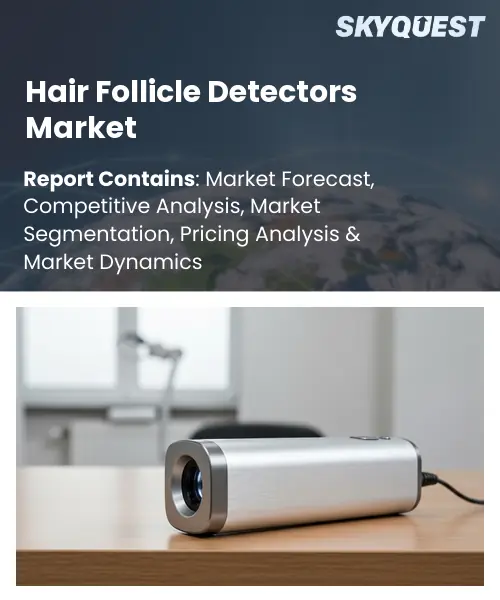
Hair Follicle Detectors Market
Report ID: SQMIG35A4250
Report ID: SQMIG35A4250
[email protected]
USA +1 351-333-4748
Report ID:
SQMIG35A4250 |
Region:
Global |
Published Date: July, 2026
Pages:
157
|Tables:
117
|Figures:
77


Global Hair Follicle Detectors Market size was valued at USD 312.6 Million in 2024 and is poised to grow from USD 340.42 Million in 2025 to USD 673.35 Million by 2033, growing at a CAGR of 8.9% during the forecast period (2026-2033).
The primary driver of the hair follicle detectors market is the escalating demand for non‑invasive diagnosis of hair‑loss disorders and related dermatological conditions. This market comprises optical and electrical sensor systems that map follicular density, growth phase, and vitality, enabling clinicians to personalize treatment plans. Historically, diagnosis relied on inspection and scalp biopsy, which were subjective and painful; the introduction of laser‑based imaging in the early 2010s reduced latency and improved accuracy. As consumer awareness of genetic predisposition and lifestyle impact grew, clinics adopted these detectors to differentiate androgenic alopecia from telogen effluvium, fostering a shift toward precision data‑driven care. Beyond early diagnosis, the integration of artificial intelligence with hair follicle detectors drives the next significant growth engine because AI converts imaging data into prognostic scores that guide therapy selection. This capability has prompted dermatology chains to embed detector units in routine check‑ups, where clinicians instantly compare a patient’s follicular index with benchmarks and recommend minoxidil, platelet‑rich plasma, or stem‑cell injections. Improved treatment success rates encourage insurers to reimburse these procedures, which fuels manufacturers to enhance sensor resolution and cloud analytics platforms. Consequently, emerging markets in Asia‑Pacific adopt price‑competitive models as consumer willingness to invest in preventive scalp health rises.
How is AI enhancing accuracy in the hair follicle detectors market?
AI is sharpening hair follicle detectors by embedding deep‑learning models that interpret microscopic images with far greater nuance than traditional algorithms. These models are trained on vast image libraries, allowing them to distinguish subtle variations in follicle density, phase and health. Real‑time processing reduces manual review time, while adaptive learning updates criteria as new data arrive, keeping accuracy high across diverse skin tones. Integration with cloud‑based analytics lets clinicians compare results against population benchmarks, turning raw scans into actionable insights. The market’s rapid expansion is fueled by this blend of precision imaging and intelligent software, which together raise diagnostic confidence and support earlier intervention strategies.In August 2025, Wyss Institute, introduced an AI‑enhanced diagnostic platform that refines follicle detection, boosting accuracy and reinforcing market momentum.
Market snapshot - (2026-2033)
Global Market Size
USD 312.6 Million
Largest Segment
Optical Hair Follicle Detectors
Fastest Growth
AI-Based Hair Follicle Detectors
Growth Rate
8.9% CAGR
To get more insights on this market click here to Request a Free Sample Report
Global hair follicle detectors market is segmented by product type, technology, application, end user and region. Based on product type, the market is segmented into Optical Hair Follicle Detectors, AI-Based Hair Follicle Detectors and Digital Hair Follicle Analyzers. Based on technology, the market is segmented into Imaging-Based, Optical Sensor-Based and AI-Assisted Analysis. Based on application, the market is segmented into Hair Transplantation, Dermatology and Cosmetic Assessment. Based on end user, the market is segmented into Hair Transplant Clinics, Dermatology Clinics and Research Institutes. Based on region, the market is segmented into North America, Europe, Asia Pacific, Latin America and Middle East & Africa.
Optical Hair Follicle Detectors segment dominates because they provide direct visual confirmation of follicle viability, enabling clinicians to precisely map donor sites. Their reliance on established imaging optics offers high resolution without complex data processing, fostering widespread adoption in clinics focused on transplant efficiency. The clarity and immediacy of results drive confidence among surgeons, reinforcing their market leadership. Additionally, the low learning curve accelerates integration into existing workflows, further cementing its position.
Meanwhile, AI Based Hair Follicle Detectors are witnessing the strongest growth momentum because breakthroughs in machine learning enable automated follicle classification and predictive survival analysis. This intelligence reduces manual effort, expands use beyond transplant centers into cosmetic and research settings, and encourages investment in software platforms, propelling rapid market expansion and creating new revenue streams.
Imaging Based technology segment dominates because it delivers high resolution capture of follicular architecture, allowing dermatologists to assess scalp health with exceptional detail. The reliance on proven camera systems integrates seamlessly with existing clinical equipment, minimizing additional infrastructure costs. This reliability fosters trust among practitioners, establishing imaging as the preferred analytical method for accurate diagnosis and treatment planning. Consequently, clinics prioritize imaging solutions to streamline patient workflows, reinforcing its market leadership.
On the other hand, AI Assisted Analysis emerges as the key high growth area because it turns raw images into actionable insights through real time processing and predictive modeling. Clinics drawn to efficiency adopt it rapidly, and supportive regulatory attitudes accelerate uptake, broadening market reach and creating integration opportunities.
To get detailed segments analysis, Request a Free Sample Report
North America sustains its leadership through a convergence of sophisticated research ecosystems, extensive clinical networks, and a culture that embraces cutting‑edge diagnostic tools. Major universities and specialized biotech hubs collaborate closely with medical device manufacturers, accelerating product development and clinical validation. Healthcare providers across the United States and Canada prioritize early detection of dermatological conditions, driving consistent demand for precision instruments. A regulatory framework that balances rigorous safety standards with streamlined approval pathways further encourages innovation. In addition, strong financial markets and venture capital availability support rapid scaling of emerging technologies. These combined factors also attract multinational collaborations seeking to leverage the region’s expertise and market reach.
Hair Follicle Detectors Market in the United States benefits from an extensive network of academic research centers that specialize in dermatological imaging and a vibrant venture ecosystem that funds early‑stage innovators. Leading hospitals integrate these devices into routine skin examinations, while insurance providers increasingly recognize their diagnostic value. Collaboration between biotech firms and specialty clinics accelerates product refinement, positioning the United States as a benchmark for technology adoption and clinical integration.
Hair Follicle Detectors Market in Canada is supported by a strong public health system that emphasizes preventive dermatology and early diagnosis. Research institutions collaborate closely with device manufacturers to tailor solutions for diverse patient demographics. Provincial healthcare programs are increasingly incorporating these technologies into routine screenings, while reimbursement frameworks facilitate broader clinical use. The collaborative environment between academic labs, hospitals, and industry drives continuous improvement and positions Canada as a forward‑looking participant in the global landscape.
Europe’s rapid expansion is propelled by a tightly knit ecosystem of research institutions, dermatology specialists, and cosmetic innovators that collectively prioritize precision diagnostics. Strong public and private funding mechanisms nurture the development of sophisticated imaging solutions, while comprehensive health coverage schemes encourage adoption across clinical settings. The region’s emphasis on sustainability and ethical manufacturing aligns with emerging consumer expectations for environmentally responsible medical devices. Collaborative networks among Germany, the United Kingdom, and France facilitate knowledge exchange, accelerating product refinement and market penetration. Additionally, regulatory harmonization across the European Union streamlines approval processes, enabling manufacturers to bring innovations to market efficiently. This confluence of scientific rigor, supportive policy, and consumer consciousness sustains Europe’s position as a dynamic growth hub for hair follicle detection technologies.
Hair Follicle Detectors Market in Germany is anchored by world‑class engineering expertise and a strong tradition of medical device manufacturing. Collaborative initiatives between universities, research hospitals, and industrial firms drive the creation of highly accurate detection platforms. Reimbursement policies that recognize diagnostic value support widespread clinical integration, while export‑focused strategies extend German innovations to broader European markets. The combination of technical precision and regulatory confidence reinforces Germany leadership role within Europe’s ecosystem.
Hair Follicle Detectors Market in the United Kingdom accelerates through a vibrant startup culture and strong ties to cosmetic research entities. Government‑backed incubators and grant programs nurture early‑stage innovators, enabling rapid prototyping and clinical validation. National health services increasingly incorporate these tools into skin‑cancer screening pathways, reflecting growing confidence in their diagnostic accuracy. The emphasis on digital health integration in the United Kingdom fuels swift market uptake, positioning it as the continent’s fastest‑growing hub for hair follicle detection technologies.
Hair Follicle Detectors Market in France is emerging as research collaborations between dermatology clinics and technology startups gain momentum. Public research agencies provide targeted funding that encourages innovative sensor designs and AI‑driven analysis. Health insurance schemes are beginning to recognize the clinical benefits, allowing pilot programs within select hospitals. This supportive environment, combined with a growing consumer interest in preventative skin health, sets the stage for France to expand its footprint in the European hair follicle detection landscape.
Asia Pacific is strengthening its role by leveraging rapid digital health adoption, a burgeoning aesthetic medicine sector, and robust manufacturing capabilities. Nations such as Japan and South Korea invest heavily in research that fuses optical engineering with artificial intelligence, creating highly sensitive hair follicle detection solutions. Government initiatives that promote medical‑technology innovation, coupled with increasingly health‑conscious populations, drive demand for early‑stage diagnostic tools. The region’s supply chains provide cost‑effective production while maintaining stringent quality standards, allowing local firms to compete globally. Collaborative ecosystems that connect universities, biotech start‑ups, and established device manufacturers accelerate product cycles and facilitate rapid market entry. This combination of technological expertise, supportive policy, and consumer readiness positions Asia Pacific as a rising hub for advanced hair follicle detection technologies.
Hair Follicle Detectors Market in Japan benefits from a long‑standing culture of precision engineering and a strong emphasis on clinical research. Partnerships between university laboratories, leading hospitals, and electronics manufacturers drive the development of compact, high‑resolution detection devices. Government health programs that prioritize early diagnosis of skin conditions support broader clinical adoption, while insurance coverage increasingly accommodates these advanced tools. The integration of cutting‑edge sensor technology with data analytics positions Japan as a key innovator in the Asian hair follicle detection space.
Hair Follicle Detectors Market in South Korea is propelled by a dynamic biotech ecosystem and aggressive investment in smart medical devices. Collaborative ventures between cosmetic clinics, AI startups, and optical component manufacturers produce highly sensitive detection platforms tailored to consumer‑focused skin health services. National health initiatives encourage the incorporation of early‑diagnostic tools into routine dermatology practice, fostering practitioner acceptance. The country’s ability to rapidly iterate product designs and scale manufacturing underpins its growing influence in the regional and global hair follicle detection markets.
To know more about the market opportunities by region and country, click here to
Buy The Complete Report
Rising Demand For Early Detection
Advancements In Imaging Technologies
High Cost Of Equipment
Regulatory Hurdles and Approvals
Request Free Customization of this report to help us to meet your business objectives.
The competitive landscape of the global hair follicle detectors market is shaped by intense rivalry among technology‑focused firms leveraging artificial‑intelligence algorithms, strategic acquisitions of niche imaging startups, and partnerships with dermatology clinics to integrate detection platforms into routine care. Recent moves include AI‑driven product enhancements that improve diagnostic accuracy and collaborations that expand distribution channels, driving market momentum and differentiation.
Top Player’s Company Profile
Recent Developments
SkyQuest’s ABIRAW (Advanced Business Intelligence, Research & Analysis Wing) is our Business Information Services team that Collects, Collates, Correlates, and Analyses the Data collected by means of Primary Exploratory Research backed by robust Secondary Desk research. As per SkyQuest analysis, the global hair follicle detectors market is being propelled primarily by a rising demand for early detection of hair‑loss disorders, which encourages clinics to adopt precise, non‑invasive tools. A second strong catalyst is the rapid advancement of imaging technologies and AI‑driven analysis that boost diagnostic accuracy and speed. North America remains the dominant region thanks to its mature research ecosystem, robust funding and early‑adopter clinicians. Within the market, optical hair follicle detectors lead the segment share because they deliver high‑resolution visual confirmation with a low learning curve. However, the high cost of equipment poses a significant restraint, limiting uptake in smaller practices and emerging economies.
| Report Metric | Details |
|---|---|
| Market size value in 2024 | USD 312.6 Million |
| Market size value in 2033 | USD 673.35 Million |
| Growth Rate | 8.9% |
| Base year | 2024 |
| Forecast period | (2026-2033) |
| Forecast Unit (Value) | USD Million |
| Segments covered |
|
| Regions covered | North America (US, Canada), Europe (Germany, France, United Kingdom, Italy, Spain, Rest of Europe), Asia Pacific (China, India, Japan, Rest of Asia-Pacific), Latin America (Brazil, Rest of Latin America), Middle East & Africa (South Africa, GCC Countries, Rest of MEA) |
| Companies covered |
|
| Customization scope | Free report customization with purchase. Customization includes:-
|
To get a free trial access to our platform which is a one stop solution for all your data requirements for quicker decision making. This platform allows you to compare markets, competitors who are prominent in the market, and mega trends that are influencing the dynamics in the market. Also, get access to detailed SkyQuest exclusive matrix.
Table Of Content
Executive Summary
Market overview
Parent Market Analysis
Market overview
Market size
KEY MARKET INSIGHTS
COVID IMPACT
MARKET DYNAMICS & OUTLOOK
Market Size by Region
KEY COMPANY PROFILES
Methodology
For the Hair Follicle Detectors Market, our research methodology involved a mixture of primary and secondary data sources. Key steps involved in the research process are listed below:
1. Information Procurement: This stage involved the procurement of Market data or related information via primary and secondary sources. The various secondary sources used included various company websites, annual reports, trade databases, and paid databases such as Hoover's, Bloomberg Business, Factiva, and Avention. Our team did 45 primary interactions Globally which included several stakeholders such as manufacturers, customers, key opinion leaders, etc. Overall, information procurement was one of the most extensive stages in our research process.
2. Information Analysis: This step involved triangulation of data through bottom-up and top-down approaches to estimate and validate the total size and future estimate of the Hair Follicle Detectors Market.
3. Report Formulation: The final step entailed the placement of data points in appropriate Market spaces in an attempt to deduce viable conclusions.
4. Validation & Publishing: Validation is the most important step in the process. Validation & re-validation via an intricately designed process helped us finalize data points to be used for final calculations. The final Market estimates and forecasts were then aligned and sent to our panel of industry experts for validation of data. Once the validation was done the report was sent to our Quality Assurance team to ensure adherence to style guides, consistency & design.
Analyst Support
Customization Options
With the given market data, our dedicated team of analysts can offer you the following customization options are available for the Hair Follicle Detectors Market:
Product Analysis: Product matrix, which offers a detailed comparison of the product portfolio of companies.
Regional Analysis: Further analysis of the Hair Follicle Detectors Market for additional countries.
Competitive Analysis: Detailed analysis and profiling of additional Market players & comparative analysis of competitive products.
Go to Market Strategy: Find the high-growth channels to invest your marketing efforts and increase your customer base.
Innovation Mapping: Identify racial solutions and innovation, connected to deep ecosystems of innovators, start-ups, academics, and strategic partners.
Category Intelligence: Customized intelligence that is relevant to their supply Markets will enable them to make smarter sourcing decisions and improve their category management.
Public Company Transcript Analysis: To improve the investment performance by generating new alpha and making better-informed decisions.
Social Media Listening: To analyze the conversations and trends happening not just around your brand, but around your industry as a whole, and use those insights to make better Marketing decisions.
REQUEST FOR SAMPLE
 REQUEST FREE CUSTOMIZATION


Want to customize this report? This report can be personalized according to your needs. Our analysts and industry experts will work directly with you to understand your requirements and provide you with customized data in a short amount of time. We offer $1000 worth of FREE customization at the time of purchase.
Feedback From Our Clients


 USA (+1) 351-333-4748

