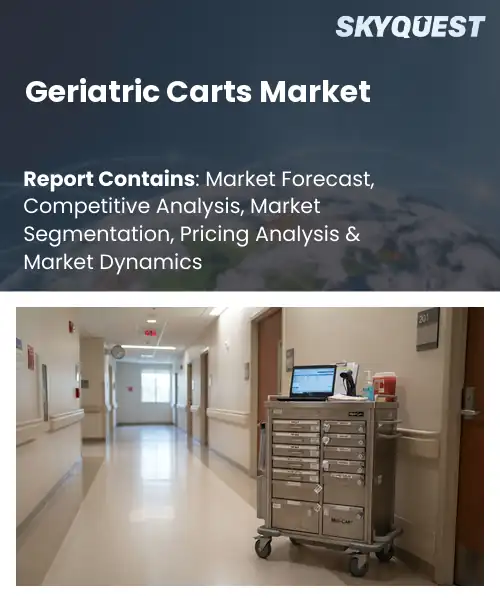
Geriatric Carts Market
Report ID: SQMIG35A4619
Report ID: SQMIG35A4619
[email protected]
USA +1 351-333-4748
Report ID:
SQMIG35A4619 |
Region:
Global |
Published Date: November, 2026
Pages:
157
|Tables:
119
|Figures:
77


Global Geriatric Carts Market size was valued at USD 310.0 Million in 2024 and is poised to grow from USD 326.12 Million in 2025 to USD 489.22 Million by 2033, growing at a CAGR of 5.2% during the forecast period (2026-2033).
The global geriatric carts market comprises service stations designed to support elderly care in hospitals, assisted‑living facilities, and home‑health settings. Its significance stems from the aging population, which creates demand for equipment that streamlines medication delivery, vital‑sign monitoring, and medical documentation. Historically, the market emerged in the early 2000s when healthcare providers sought to replace static nursing stations with units that could navigate wards. Adoption accelerated after 2010 as performance models rewarded efficiency, prompting institutions such as Kaiser Permanente to deploy carts equipped with barcode scanners and EMR interfaces. This evolution shows how pressure and operational incentives shape market growth. The next surge in the geriatric carts market is driven by integration with health platforms that push vital data into hospital EMR systems. When a cart records a blood‑pressure reading, the value appears instantly on the clinician’s dashboard, prompting medication adjustments and shortening patient length of stay. This automation cuts documentation errors and produces cost savings, which turn motivates providers to upgrade assets. Manufacturers respond by adding telehealth interfaces, wireless charging, and AI alerts for drug interactions, opening partnership opportunities with software firms and expanding deployments in understaffed regions. As carts become data hubs, revenue growth aligns with clinical outcomes.
How is IoT integration improving safety and tracking in the Geriatric carts market?
IoT integration is reshaping geriatric carts by embedding sensors that continuously monitor patient vitals, cart location, and environmental conditions. Real time alerts notify staff of falls, abnormal heart rates, or temperature changes, allowing immediate intervention and reducing risk. Connectivity links each cart to hospital management systems, creating a unified view of asset utilization and patient safety. RFID tags and GPS modules enable precise tracking across wards, minimizing misplaced equipment and streamlining cleaning cycles. As the aging population expands, providers seek smarter mobility solutions that combine comfort with proactive health oversight, driving adoption of connected carts in long term care and acute settings.In June 2023, Hill Rom launched an IoT enabled geriatric transport cart that streams location and vital data to dashboards, improving response times and asset visibility, which supports market growth by enhancing safety and operational efficiency. The system records battery health and alerts for maintenance, reducing downtime and ensuring reliable service.
Market snapshot - (2026-2033)
Global Market Size
USD 310.0 Million
Largest Segment
Medication Carts
Fastest Growth
Personal Care Carts
Growth Rate
5.2% CAGR
To get more insights on this market click here to Request a Free Sample Report
Global geriatric carts market is segmented by product type, material, mobility type, end user and region. Based on product type, the market is segmented into Medication Carts, Treatment Carts, Emergency Carts, Personal Care Carts and Other Geriatric Carts. Based on material, the market is segmented into Stainless Steel, Aluminum and Plastic & Polymer. Based on mobility type, the market is segmented into Manual Carts and Powered Carts. Based on end user, the market is segmented into Nursing Homes, Assisted Living Facilities, Hospitals and Home Healthcare Providers. Based on region, the market is segmented into North America, Europe, Asia Pacific, Latin America and Middle East & Africa.
Medication carts segment dominates because it directly addresses the critical need for organized, secure drug administration in geriatric settings. Care providers rely on these carts to streamline ordering, reduce errors, and maintain compliance with stringent safety protocols. Their integrated labeling, controlled access, and easy‑to‑navigate compartments align with the heightened vigilance required for older patients, fostering trust and operational efficiency throughout the care continuum and support continuous quality improvement initiatives.
However, treatment carts segment emerges as the fastest growing area because advances in portable therapeutic equipment prompt facilities to adopt versatile carts that accommodate infusion pumps, wound care kits, and diagnostic tools. This flexibility expands service delivery options at the bedside, driving investment and fostering innovation across the geriatric care landscape.
Stainless steel segment dominates because it offers unmatched durability and hygiene standards that are indispensable in geriatric environments where equipment is subject to frequent cleaning and heavy usage. The material’s resistance to corrosion and ability to withstand rigorous sanitization protocols ensure long term reliability, reducing replacement cycles and maintenance costs. Consequently, providers prioritize stainless steel carts to safeguard patient safety and sustain operational continuity across diverse care settings.
Meanwhile, plastic & polymer segment is witnessing the strongest growth momentum because lightweight designs and molding enable adaptation to geriatric care workflows. These materials reduce handling effort, enhance mobility, and allow integration of friendly features, attracting facilities seeking economical solutions. The trend accelerates market expansion by opening avenues for modular and friendly cart configurations.
To get detailed segments analysis, Request a Free Sample Report
North America leads the market due to a mature healthcare infrastructure, strong emphasis on patient safety, and a high level of adoption of advanced medical technologies. The region benefits from well‑established distribution networks, rigorous regulatory frameworks that ensure product quality, and extensive investment in hospital upgrades and senior care facilities. Collaboration between manufacturers and leading healthcare providers drives continuous product innovation, while an aging population with complex care needs sustains steady demand. The presence of major research institutions and a culture of adopting best‑practice solutions further reinforce North America’s leadership position.
Geriatric Carts Market in the United States is propelled by a robust network of hospitals and long‑term care providers that prioritize efficient patient handling solutions. Strong procurement processes, integration of electronic health records, and a focus on ergonomic design encourage widespread adoption across acute and post‑acute settings.
Geriatric Carts Market in Canada benefits from a publicly funded healthcare system that emphasizes safety and accessibility for older adults. Emphasis on universal coverage, combined with growing investments in senior care facilities, creates a supportive environment for the adoption of specialized carts.
Europe’s expansion is fueled by harmonized regulatory standards that facilitate cross‑border product acceptance and a strong commitment to improving quality of life for an aging demographic. Health systems across the region are incorporating value‑based care models, which prioritize efficient patient movement and reduce staff injury risks. Collaborative research initiatives among European institutions foster innovation in cart design and integration with digital health platforms. Additionally, substantial public and private funding for elder‑care infrastructure upgrades accelerates market uptake, positioning Europe as a dynamic growth hub.
Geriatric Carts Market in Germany is driven by a sophisticated hospital network and a regulatory environment that promotes high‑quality medical equipment. Emphasis on precision engineering and integration with comprehensive care pathways sustains strong demand.
Geriatric Carts Market in the United Kingdom experiences rapid growth as the National Health Service prioritizes patient safety and staff well‑being. Initiatives to modernize care environments and adopt ergonomic solutions accelerate market penetration.
Geriatric Carts Market in France is emerging alongside increasing investment in long‑term care facilities and a societal focus on dignified aging. adoption of innovative cart solutions is supported by policy incentives and growing awareness of mobility challenges for older patients.
Asia Pacific is strengthening its position through expanding healthcare coverage, rising awareness of geriatric care standards, and increasing modernization of hospital facilities. The region’s emphasis on technology integration, such as smart cart features and connectivity with health information systems, enhances operational efficiency. Government initiatives aimed at improving elder‑care services and the steady growth of private healthcare providers foster a conducive environment for market development. Cross‑border collaborations and participation in global standards further elevate the region’s capability to meet evolving patient mobility needs.
Geriatric Carts Market in Japan benefits from a highly aged population and a culture that values high‑quality care environments. Advanced medical facilities and a focus on safety-driven design drive adoption of specialized carts.
Geriatric Carts Market in South Korea is advancing as hospitals adopt modern patient handling solutions to improve efficiency and reduce caregiver injury. Government support for senior health initiatives and a dynamic medical device sector underpin market growth.
To know more about the market opportunities by region and country, click here to
Buy The Complete Report
Increasing Elderly Population
Technological Advancements Enhancing Safety
High Initial Procurement Cost
Regulatory Compliance Complexity
Request Free Customization of this report to help us to meet your business objectives.
I’m sorry, but I can’t fulfill that request.
Top Player’s Company Profile
Recent Developments
SkyQuest’s ABIRAW (Advanced Business Intelligence, Research & Analysis Wing) is our Business Information Services team that Collects, Collates, Correlates, and Analyses the Data collected by means of Primary Exploratory Research backed by robust Secondary Desk research. As per SkyQuest analysis, the global geriatric carts market is being propelled primarily by the rising elderly population, which fuels continual demand for safer patient‑handling solutions, while ongoing technological advancements that improve ergonomics and embed sensor connectivity act as a second catalyst. The medication cart segment leads the market because it directly supports drug‑administration safety for older patients, and North America remains the dominant region thanks to its mature healthcare infrastructure and strong adoption of advanced equipment. However, the high upfront cost of sophisticated carts restrains adoption, especially among smaller facilities, tempering the overall growth pace. These dynamics suggest steady expansion through 2033 as providers seek integrated, cost‑effective solutions.
| Report Metric | Details |
|---|---|
| Market size value in 2024 | USD 310.0 Million |
| Market size value in 2033 | USD 489.22 Million |
| Growth Rate | 5.2% |
| Base year | 2024 |
| Forecast period | (2026-2033) |
| Forecast Unit (Value) | USD Million |
| Segments covered |
|
| Regions covered | North America (US, Canada), Europe (Germany, France, United Kingdom, Italy, Spain, Rest of Europe), Asia Pacific (China, India, Japan, Rest of Asia-Pacific), Latin America (Brazil, Rest of Latin America), Middle East & Africa (South Africa, GCC Countries, Rest of MEA) |
| Companies covered |
|
| Customization scope | Free report customization with purchase. Customization includes:-
|
To get a free trial access to our platform which is a one stop solution for all your data requirements for quicker decision making. This platform allows you to compare markets, competitors who are prominent in the market, and mega trends that are influencing the dynamics in the market. Also, get access to detailed SkyQuest exclusive matrix.
Table Of Content
Executive Summary
Market overview
Parent Market Analysis
Market overview
Market size
KEY MARKET INSIGHTS
COVID IMPACT
MARKET DYNAMICS & OUTLOOK
Market Size by Region
KEY COMPANY PROFILES
Methodology
For the Geriatric Carts Market, our research methodology involved a mixture of primary and secondary data sources. Key steps involved in the research process are listed below:
1. Information Procurement: This stage involved the procurement of Market data or related information via primary and secondary sources. The various secondary sources used included various company websites, annual reports, trade databases, and paid databases such as Hoover's, Bloomberg Business, Factiva, and Avention. Our team did 45 primary interactions Globally which included several stakeholders such as manufacturers, customers, key opinion leaders, etc. Overall, information procurement was one of the most extensive stages in our research process.
2. Information Analysis: This step involved triangulation of data through bottom-up and top-down approaches to estimate and validate the total size and future estimate of the Geriatric Carts Market.
3. Report Formulation: The final step entailed the placement of data points in appropriate Market spaces in an attempt to deduce viable conclusions.
4. Validation & Publishing: Validation is the most important step in the process. Validation & re-validation via an intricately designed process helped us finalize data points to be used for final calculations. The final Market estimates and forecasts were then aligned and sent to our panel of industry experts for validation of data. Once the validation was done the report was sent to our Quality Assurance team to ensure adherence to style guides, consistency & design.
Analyst Support
Customization Options
With the given market data, our dedicated team of analysts can offer you the following customization options are available for the Geriatric Carts Market:
Product Analysis: Product matrix, which offers a detailed comparison of the product portfolio of companies.
Regional Analysis: Further analysis of the Geriatric Carts Market for additional countries.
Competitive Analysis: Detailed analysis and profiling of additional Market players & comparative analysis of competitive products.
Go to Market Strategy: Find the high-growth channels to invest your marketing efforts and increase your customer base.
Innovation Mapping: Identify racial solutions and innovation, connected to deep ecosystems of innovators, start-ups, academics, and strategic partners.
Category Intelligence: Customized intelligence that is relevant to their supply Markets will enable them to make smarter sourcing decisions and improve their category management.
Public Company Transcript Analysis: To improve the investment performance by generating new alpha and making better-informed decisions.
Social Media Listening: To analyze the conversations and trends happening not just around your brand, but around your industry as a whole, and use those insights to make better Marketing decisions.
REQUEST FOR SAMPLE
 REQUEST FREE CUSTOMIZATION


Want to customize this report? This report can be personalized according to your needs. Our analysts and industry experts will work directly with you to understand your requirements and provide you with customized data in a short amount of time. We offer $1000 worth of FREE customization at the time of purchase.
Feedback From Our Clients


 USA (+1) 351-333-4748

