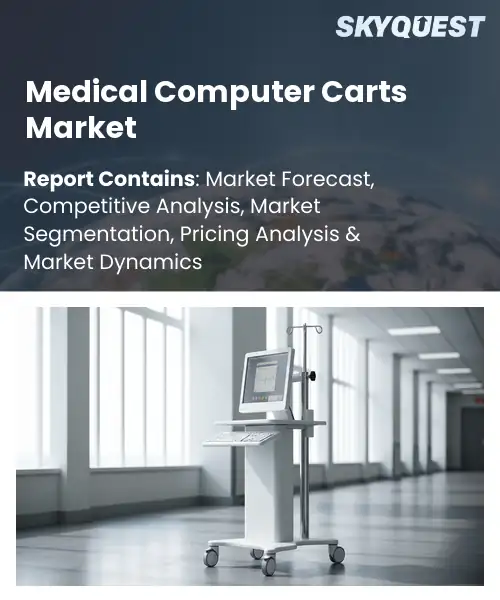
Medical Computer Carts Market
Report ID: SQMIG35A3656
Report ID: SQMIG35A3656
[email protected]
USA +1 351-333-4748
Report ID:
SQMIG35A3656 |
Region:
Global |
Published Date: May, 2026
Pages:
157
|Tables:
143
|Figures:
73


Global Medical Computer Carts Market size was valued at USD 1.22 Billion in 2024 and is poised to grow from USD 1.3 Billion in 2025 to USD 2.22 Billion by 2033, growing at a CAGR of 6.91% during the forecast period (2026-2033).
The medical computer carts market is driven by the increasing digitization of clinical workflows that transitioned static documentation to mobile bedside computing and increased the need for point-of-care solutions. Medical computer carts are mobile workstations that house computers, peripherals and power systems that enable clinicians to access electronic health records, administer medications and perform bedside charting. Why is market so important? These carts improve accuracy and reduce transcription delays. They help infection control as compared to paper charts.” Today they have evolved from the bulky cart-mounted terminals of the 1990s to lightweight ergonomic designs with barcode scanners and antimicrobial surfaces under EHR mandates and patient safety expectations.
Technology integration is one of the key growth drivers, with interoperability with EHRs, IoT devices and telemedicine platforms transforming carts into clinical hubs and driving efficiencies that impact purchasing decisions. The integration of carts with barcode medication administration systems and bedside monitors reduces medication errors and time on documentation resulting in a shorter length of stay and lower labor costs. Tele-ICU carts allow remote assessment and reduce transfers in practice, and modular vaccine carts enabled mass immunization during COVID-19. These cause-and-effect dynamics create vendor opportunities in software services, subscription models and specialty carts for long-term care and ambulatory settings. Aging populations increase demand for homecare.
How is IoT enhancing operational efficiency of medical computer carts?
Internet of Things improves operational efficiency of medical computer carts by integrating sensors software and networks into everyday clinical work. Key features include real time location tracking asset awareness battery and temperature monitoring and seamless integration with electronic health records Today, many health systems favor connected carts because they cut down on time spent finding equipment, speed documentation and support infection prevention efforts. Vendors that provide secure single sign on automated supply alerts and predictive maintenance are favored in the market trend so clinicians spend more time with patients and less time on device logistics.
Capsa Healthcare opened a new innovation center in March 2025, focused on tech-ready carts with embedded IoT capabilities for inventory monitoring, remote diagnostics, and cloud connectivity. This supports market growth by enabling faster replenishment, reduced downtime, and smoother EHR workflows.
Market snapshot - (2026-2033)
Global Market Size
USD 1.22 Billion
Largest Segment
Powered Medical Carts
Fastest Growth
Powered Medical Carts
Growth Rate
6.91% CAGR
To get more insights on this market click here to Request a Free Sample Report
Global medical computer carts market is segmented by type, mobility, application, end-user, material and region. Based on type, the market is segmented into Powered Medical Carts, Non-Powered Carts and Wall-Mount Workstations. Based on mobility, the market is segmented into Mobile Carts and Stationary. Based on application, the market is segmented into EMR/EHR Documentation, Medication Administration and Point-of-Care Testing. Based on end-user, the market is segmented into Hospitals, Clinics and Ambulatory Care Centers. Based on material, the market is segmented into Plastic, Stainless Steel and Aluminum. Based on region, the market is segmented into North America, Europe, Asia Pacific, Latin America and Middle East & Africa.
Powered Medical Carts segment leads the way because its integrated power systems ensure uninterrupted device operation and support high performance peripherals that clinicians rely on for bedside tasks. This helps accelerate rounds and documentation by reducing interruptions for battery changes and allowing continuous EMR access, medication scanning and diagnostic device support. The vendor’s emphasis on ergonomics and cable management helps to further accelerate adoption by reducing friction in workflow and enabling more seamless care delivery.
However, Wall-Mount Workstations are seeing the most growth momentum as facilities maximize space and fixed point of care access for charting and testing. They benefit from demand for compact, easily cleaned workstations that provide access to EMR without taking up floor space, and design innovations incorporating touchscreen and telehealth tools that open new deployment opportunities and steady demand from workflow redesign efforts.
The Stainless Steel segment is dominating due to its resistance to corrosion and compatibility with aggressive disinfectants that meet the stringent cleaning protocols required in clinical environments. The material’s durability supports procurement priorities around infection control and total cost of ownership by enabling multiple sanitation cycles and extended lifecycle performance. Specification in high acuity settings is probably associated with the perception that stainless steel is more hygienic and resilient under clinical use.
Aluminum is becoming the key high growth area for its lightweight nature and flexible fabrication that lends more mobile and ergonomic cart designs. Advances in aluminum finishes and structural profiles allow for slimmer, energy efficient platforms and easier handling, driving adoption in settings looking for portability, clinician comfort and rapid deployment while unlocking new product variations for suppliers.
To get detailed segments analysis, Request a Free Sample Report
North America has the lion’s share thanks to a convergence of advanced healthcare infrastructure, strong clinical need for mobility and point of care computing and a mature medical technology ecosystem. Providers’ focus on integration to electronic health records and infection control protocols is fueling demand for configurable, enterprise grade carts. Fast deployment and lifecycle support via robust distribution and service networks. Positive reimbursement structures and high levels of investment in health care information technology encourage vendor innovation and collaboration with hospitals. The large global manufacturers and competitive provider landscape further accelerates adoption of specialized features such as ergonomics, battery management and telemedicine enablement, further reinforcing leadership in product development and market penetration. Academic medical centers and integrated delivery networks are early adopters and reference sites to develop visible use cases. Strict regulatory requirements and the emphasis on patient safety also push purchasing toward solutions that are proven and backed by service, maintaining market depth and premium positioning.
The United States Medical Computer Carts Market is heavily used in acute care and outpatient settings, because they need easy access to electronic health records and infection control. Large hospital systems and clinical networks need solutions that are customizable, and have strong service and integration capabilities. Vendor innovation is driven by ergonomic design, battery performance and interoperability, and is supported by mature procurement channels and visible reference deployments that influence broader market uptake choices.
Medical Computer Carts Market in Canada Indicates Prioritization of Investment in Interoperability and Remote Care Enablement Across Provincial Health Systems Long term service partnerships and total cost of ownership are what procurement is generally looking for, with academic and regional hospitals being the early adopters. Vendors are developing solutions for smaller footprint facilities and rural access, integration with national and provincial electronic record initiatives, training programs and reliable maintenance networks to allow consistent clinical workflows.
Due to coordinated modernization in hospital systems, increasing focus on digital health initiatives and high focus on patient safety and clinical efficiency, Europe is growing very fast. The use of certified and interoperable solutions that align with regional standards is being promoted through regulatory harmonization and procurement frameworks. Government and private investment in outpatient and acute care infrastructure creates demand for configurable, mobile computing platforms. Local manufacturing capabilities and medtech-healthcare provider collaborations propel product customization for ergonomics, multilingual interfaces and infection control. Cross-border collaboration and visible pilot programs within leading health systems provide reference models that accelerate uptake across diverse markets and support a competitive vendor environment focused on service and compliance excellence. Validate clinical and economic benefits in academic centers and national procurement pilots to build confidence for hospital administrators and buyers.
Germany’s Medical Computer Carts Market is supported by a strong domestic medtech manufacturing base and engineering excellence to enable complex, durable solutions for hospital automation. High performance, service backed systems that meet rigorous safety and quality requirements are essential for large university hospitals and specialist clinics. Procurement often favours providers that can offer customisation, maintenance and integration with existing clinical IT landscapes, while local distribution and after sales capabilities reinforce vendor credibility.
Large scale digital health programs and active innovation ecosystem in research hospitals and startups are propelling the Medical Computer Carts market in UK. Visible pilot programs enable rapid evaluation and broader deployment of public health procurement efforts. Vendors compete on their integration with national electronic record platforms, user centric design and bundled support offerings. And the focus on efficiency in clinical workflows and service models is getting traction across hospital networks.
The France Medical Computer Carts Market is expected to grow owing to focused modernization of hospital infrastructure and increasing focus on clinical mobility solutions. Regional procurement authorities and hospital groups pilot ergonomic, infection resistant designs for acute and ambulatory needs. Clinical teams collaborate with local manufacturers and integrators to customize products to their language and workflow needs. Maintenance networks and scaling are oriented to sustain integration into national health care delivery.
Asia Pacific is consolidating its position with a mix of fast-growing healthcare infrastructure, rising local manufacturing capabilities and strategic partnerships with global medtech companies. Regional health systems are focusing on digital transformation and smart hospital initiatives, creating demand for compact, highly integrated mobile computing solutions tailored to space-constrained facilities. Domestic OEMs emphasize cost efficient designs and fast customization, while governments push for regulatory alignment and quality standards. Emphasis on after-sales support, training programs and local distribution networks greatly increases product acceptance and reliability. “When hospitals, technology companies and academic centers innovate together, they move faster to develop features like seamless integration of systems, enablement of telehealth and improved infection control that can work in different clinical settings. Increased investment in R&D and in pilot projects with leading urban hospitals provide important proof points, and localization of user interfaces and service models builds trust across diverse markets.
Japan Medical Computer Carts Market is driven by high expectations for precision engineering, compact form factors and seamless integration with sophisticated hospital IT systems. Domestic manufacturers are focusing on quality, durability and features suitable for the elderly care environment, while hospitals are trialling advanced mobility solutions that incorporate automation and telemetry. Strong regulatory oversight, culture of continuous improvement, supporting adoption of refined designs, supported by maintenance and training programs for clinician needs.
The market for medical computer carts in South Korea is characterized by rapid digital health adoption, integrated smart hospital projects, and strong collaboration between technology companies and clinical organizations. Local vendors offer small, connected carts to play well with national electronic health platforms. Startups and established manufacturers emphasize features that enhance workflow efficiency and clinician usability. Strong sales support, training and customization build confidence and drive implementation across medical centers.
To know more about the market opportunities by region and country, click here to
Buy The Complete Report
Increasing Adoption Of Electronic Health Records
Growing Focus On Patient Safety
High Initial Acquisition Costs
Complex Integration With Legacy Systems
Request Free Customization of this report to help us to meet your business objectives.
The competitive landscape is consolidating as incumbents make acquisitions and partnerships while startups accelerate product innovation. For example, a few well-known suppliers are adding niche cart makers and OEM partners as strategic deals and selective buyouts reshape the distribution and service channels. Technology differentiation is now driving procurement decisions, and wireless charging and EHR-ready workstation carts are two examples. Partnerships like the TAGCarts and Inpro initiative demonstrate that infrastructure alliances shift hospital buying priorities.
SkyQuest’s ABIRAW (Advanced Business Intelligence, Research & Analysis Wing) is our Business Information Services team that Collects, Collates, Correlates, and Analyses the Data collected by means of Primary Exploratory Research backed by robust Secondary Desk research.
As per SkyQuest analysis, the global medical computer carts market is driven primarily by accelerating digitization of clinical workflows that shift documentation to bedside computing and sustain demand for point of care solutions, while interoperable technologies including IoT and EHR integration further bolster value by reducing medication errors and improving operational efficiency. Growth is tempered by high initial acquisition costs that constrain purchases among smaller facilities and slow premium cart adoption. North America leads the market given advanced healthcare IT infrastructure and strong vendor ecosystems, and powered medical carts dominate due to integrated power systems enabling continuous operation and support for performance peripherals essential to clinician workflow.
| Report Metric | Details |
|---|---|
| Market size value in 2024 | USD 1.22 Billion |
| Market size value in 2033 | USD 2.22 Billion |
| Growth Rate | 6.91% |
| Base year | 2024 |
| Forecast period | (2026-2033) |
| Forecast Unit (Value) | USD Billion |
| Segments covered |
|
| Regions covered | North America (US, Canada), Europe (Germany, France, United Kingdom, Italy, Spain, Rest of Europe), Asia Pacific (China, India, Japan, Rest of Asia-Pacific), Latin America (Brazil, Rest of Latin America), Middle East & Africa (South Africa, GCC Countries, Rest of MEA) |
| Companies covered |
|
| Customization scope | Free report customization with purchase. Customization includes:-
|
To get a free trial access to our platform which is a one stop solution for all your data requirements for quicker decision making. This platform allows you to compare markets, competitors who are prominent in the market, and mega trends that are influencing the dynamics in the market. Also, get access to detailed SkyQuest exclusive matrix.
Table Of Content
Executive Summary
Market overview
Parent Market Analysis
Market overview
Market size
KEY MARKET INSIGHTS
COVID IMPACT
MARKET DYNAMICS & OUTLOOK
Market Size by Region
KEY COMPANY PROFILES
Methodology
For the Medical Computer Carts Market, our research methodology involved a mixture of primary and secondary data sources. Key steps involved in the research process are listed below:
1. Information Procurement: This stage involved the procurement of Market data or related information via primary and secondary sources. The various secondary sources used included various company websites, annual reports, trade databases, and paid databases such as Hoover's, Bloomberg Business, Factiva, and Avention. Our team did 45 primary interactions Globally which included several stakeholders such as manufacturers, customers, key opinion leaders, etc. Overall, information procurement was one of the most extensive stages in our research process.
2. Information Analysis: This step involved triangulation of data through bottom-up and top-down approaches to estimate and validate the total size and future estimate of the Medical Computer Carts Market.
3. Report Formulation: The final step entailed the placement of data points in appropriate Market spaces in an attempt to deduce viable conclusions.
4. Validation & Publishing: Validation is the most important step in the process. Validation & re-validation via an intricately designed process helped us finalize data points to be used for final calculations. The final Market estimates and forecasts were then aligned and sent to our panel of industry experts for validation of data. Once the validation was done the report was sent to our Quality Assurance team to ensure adherence to style guides, consistency & design.
Analyst Support
Customization Options
With the given market data, our dedicated team of analysts can offer you the following customization options are available for the Medical Computer Carts Market:
Product Analysis: Product matrix, which offers a detailed comparison of the product portfolio of companies.
Regional Analysis: Further analysis of the Medical Computer Carts Market for additional countries.
Competitive Analysis: Detailed analysis and profiling of additional Market players & comparative analysis of competitive products.
Go to Market Strategy: Find the high-growth channels to invest your marketing efforts and increase your customer base.
Innovation Mapping: Identify racial solutions and innovation, connected to deep ecosystems of innovators, start-ups, academics, and strategic partners.
Category Intelligence: Customized intelligence that is relevant to their supply Markets will enable them to make smarter sourcing decisions and improve their category management.
Public Company Transcript Analysis: To improve the investment performance by generating new alpha and making better-informed decisions.
Social Media Listening: To analyze the conversations and trends happening not just around your brand, but around your industry as a whole, and use those insights to make better Marketing decisions.
REQUEST FOR SAMPLE
 REQUEST FREE CUSTOMIZATION
Global Medical Computer Carts Market size was valued at USD 1.22 Billion in 2024 and is poised to grow from USD 1.3 Billion in 2025 to USD 2.22 Billion by 2033, growing at a CAGR of 6.91% during the forecast period (2026-2033).
Competitive landscape is consolidating as incumbents execute acquisitions and form partnerships while startups accelerate product innovation. Strategic deals and selective buyouts reshape distribution and service channels, for example established suppliers acquiring niche cart makers and OEM partners. Technology differentiation now drives procurement decisions, with wireless charging and EHR ready workstation carts emerging. Collaborations such as the TAGCarts and Inpro initiative show infrastructure alliances altering hospital purchasing priorities. 'Ergotron Inc.', 'Capsa Healthcare', 'Enovate Medical', 'Harloff Company', 'Advantech Co.', 'JACO Inc.', 'Stanley Healthcare', 'Lund Industries', 'AFC Industries', 'Cybernet Manufacturing', 'Newcastle Systems', 'Cura Carts', 'Altus Inc.', 'IntelliCarts', 'CompuCaddy'
Hospitals and clinics implementing electronic health records increasingly rely on medical computer carts to provide secure, point of care access to patient charts and clinical applications, improving workflow continuity and clinician efficiency. By enabling bedside documentation and medication verification, these carts reduce time spent retrieving information and support integrated care processes, which enhances perceived value among administrators and clinical leaders. The alignment between digital record adoption and the need for mobile, ergonomic computing platforms drives procurement decisions and supports steady demand for advanced cart solutions.
Workflow Automation And Connectivity: Medical computer carts are evolving into integrated workflow hubs that streamline clinician tasks, enable real-time information exchange, and support point of care decision making. Enhanced connectivity with electronic health records, medical devices, and enterprise systems facilitates seamless documentation and care coordination while reducing manual handoffs. Modular interfaces and standardized communication protocols allow rapid adaptation to changing clinical processes. Emphasis on intuitive user interfaces, single sign on and mobile accessibility improves staff adoption and operational efficiency across diverse care settings worldwide.
Why does North America Dominate the Global Medical Computer Carts Market? |@12


Want to customize this report? This report can be personalized according to your needs. Our analysts and industry experts will work directly with you to understand your requirements and provide you with customized data in a short amount of time. We offer $1000 worth of FREE customization at the time of purchase.
Feedback From Our Clients


 USA (+1) 351-333-4748

