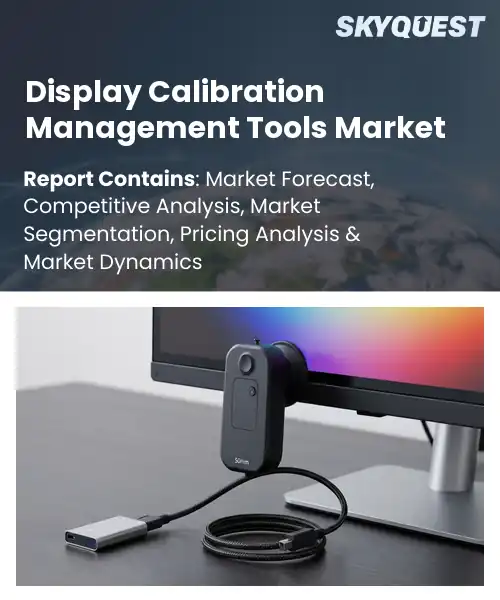
Display Calibration Management Tools Market
Report ID: SQMIG45E2919
Report ID: SQMIG45E2919
[email protected]
USA +1 351-333-4748
Report ID:
SQMIG45E2919 |
Region:
Global |
Published Date: June, 2026
Pages:
157
|Tables:
117
|Figures:
77


Global Display Calibration Management Tools Market size was valued at USD 382.5 Million in 2024 and is poised to grow from USD 408.2 Million in 2025 to USD 685.4 Million by 2033, growing at a CAGR of 6.72% during the forecast period (2026-2033).
The global display calibration management tools industry comprises software and hardware solutions that ensure color fidelity, luminance consistency, and geometric accuracy across a range of screens from consumer TVs to industrial monitors. Its significance drives from the growing reliance on visual precision in sectors such as digital advertising, medical imaging, and e‑sports, where even minor deviations can impair decision‑making or audience experience.
One of the compelling growth catalysts for the display calibration management tools market is the rapid adoption of 4K and 8K displays across professional and consumer environments, which raises calibration complexity and creates demand for automated solutions. As broadcasters migrate to high‑definition content, mismatched color gamuts lead to re‑work, prompting studios to invest in cloud‑based calibration suites that synchronize settings across production sites. Similarly, automotive OEMs integrating displays require precise luminance control to meet safety regulations, driving partnerships with calibration software vendors. These use cases illustrate how resolution standards translate directly into larger significant software contracts and global ecosystem expansion.
How is AI-driven automation reshaping the display calibration management tools market?
AI-driven automation is redefining display calibration management tools by embedding intelligent algorithms that continuously monitor color accuracy, luminance and geometry across devices. These systems reduce manual adjustments, accelerate setup times and maintain consistency in dynamic environments such as broadcast studios and digital signage networks. Vendors are integrating machine‑learning models that predict drift patterns, enabling proactive recalibration before visual degradation occurs. The shift toward cloud‑based platforms also allows remote oversight, data aggregation and real‑time analytics, fostering collaborative workflows among technicians and content creators. As regulatory standards tighten and content quality expectations rise, the market is gravitating toward solutions that combine precision with scalable, self‑optimizing capabilities.
In June 2026, an AI‑driven automation feature was introduced into calibration software, streamlining workflows and enhancing efficiency across the display ecosystem.
Market snapshot - (2026-2033)
Global Market Size
USD 382.5 Million
Largest Segment
Hardware Calibrators
Fastest Growth
Combined Hardware-Software Solutions
Growth Rate
6.72% CAGR
To get more insights on this market click here to Request a Free Sample Report
Global display calibration management tools market is segmented by tool type, application, end-user, distribution and region. Based on tool type, the market is segmented into Hardware Calibrators, Software-Based Calibration and Combined Hardware-Software Solutions. Based on application, the market is segmented into Photography & Design, Medical Imaging, Video Post-Production and Print Production. Based on end-user, the market is segmented into Creative Professionals, Healthcare and Print & Publishing. Based on distribution, the market is segmented into Online and Specialty Electronics. Based on region, the market is segmented into North America, Europe, Asia Pacific, Latin America and Middle East & Africa.
Hardware calibrators segment dominates with large display calibration management tools market share because they deliver tangible, repeatable accuracy that is essential for enterprises requiring strict color fidelity across large display fleets. Physical reference devices are trusted to eliminate drift, and manufacturers embed them into workflows, reinforcing their indispensability. This trust translates into sustained procurement cycles, while the tactile nature of the tools simplifies training and maintenance, cementing their leading position in the market for color‑critical output across industries.
As per display calibration management tools market outlook, software based calibration emerges as the most rapidly expanding area because cloud enabled platforms allow remote updates, scalable licensing, and integration with AI driven profiling. This flexibility meets the surge in distributed workforces and subscription models, driving adoption and opening new revenue streams for vendors in the market.
As per display calibration management tools market forecast, medical imaging segment dominates because clinicians depend on precise luminance and chromatic consistency to interpret diagnostic visuals accurately. Calibration tools are embedded in imaging suites to meet strict regulatory standards, and the high cost of misdiagnosis motivates continuous investment. Consequently, healthcare institutions prioritize these solutions, fostering long term contracts and specialized service ecosystems that reinforce the segment’s leading status across hospitals, imaging centers, and research labs, ensuring a pervasive demand for calibrated displays.
Meanwhile, video post production emerges as the key high growth segment because sophisticated visual effects workflows need frame accurate color matching across multiple monitors. Cloud based collaboration tools and higher resolution content push studios to adopt automated calibration solutions. This surge expands market opportunity, attracting developers and creating ancillary services that accelerate overall market expansion.
To get detailed segments analysis, Request a Free Sample Report
North America leads due to a mature ecosystem of advanced display manufacturers, extensive research institutions, and high adoption of precision imaging workflows across media, entertainment, and defense sectors. The region benefits from strong collaboration between hardware producers and software developers, fostering integrated calibration solutions that meet stringent quality standards. Robust investment in innovation encourages continuous feature enhancements, while the presence of major enterprise customers drives demand for scalable management platforms. Furthermore, regulatory frameworks emphasize accuracy and consistency, prompting organizations to prioritize calibrated displays. This combination of technical expertise, market demand, and supportive policy creates a self‑reinforcing cycle that sustains North America’s leadership in the display calibration management space.
As per display calibration management tools market regional outlook, United States thrives on a dense concentration of leading display manufacturers and a vibrant ecosystem of creative studios that demand exacting color fidelity. Advanced research labs partner with software vendors to embed calibration capabilities directly into production pipelines, accelerating adoption across broadcasting, gaming, and virtual reality sectors. Enterprise procurement policies often mandate comprehensive management tools, reinforcing market depth and encouraging the development of sophisticated, user‑centric solutions.
As per display calibration management tools market regional forecast, Canada is shaped by a strong emphasis on visual media education and a growing number of post‑production facilities that rely on calibrated displays for high‑quality output. Collaborative initiatives between academic institutions and technology firms foster talent skilled in color science, while government incentives promote adoption of precision tools in research and healthcare imaging. This supportive environment nurtures a steady expansion of calibrated workflow solutions across the Canadian market.
Europe’s expansion is propelled by rigorous industry standards, a highly regulated environment, and a deep commitment to visual excellence across sectors such as automotive design, digital signage, and broadcast media. Cross‑border collaboration among leading display manufacturers, software innovators, and standards bodies creates a harmonized framework that accelerates tool integration. The region’s focus on sustainability and energy efficiency also encourages the use of calibrated displays to reduce waste and improve operational consistency. Strong funding for research in color science and immersive technologies further fuels demand, while a discerning customer base seeks integrated management platforms that deliver precision, compliance, and seamless workflow orchestration across diverse European markets.
As per display calibration management tools industry analysis, Germany benefits from a robust industrial base that incorporates calibrated displays into automotive design, precision engineering, and high‑end photography. Close cooperation between hardware producers and software developers results in highly tailored solutions that meet exacting German quality standards. Academic research centers advance color science, feeding innovative features into commercial tools and reinforcing Germany’s leading position in the European landscape.
United Kingdom experiences swift growth driven by a dynamic creative sector, including advertising, film, and gaming studios that demand meticulous color accuracy. The UK’s strong emphasis on digital innovation encourages rapid adoption of cloud‑based management platforms, facilitating collaborative workflows across dispersed teams. Partnerships between universities and technology firms nurture expertise in calibration techniques, supporting the market’s accelerated expansion.
France is emerging as visual media and fashion industries increasingly rely on color‑precise displays for product development and marketing. Government initiatives that support creative tech adoption, combined with a vibrant start‑up ecosystem, stimulate interest in integrated calibration solutions. Academic programs focused on visual arts and engineering contribute a growing talent pool that drives market awareness and uptake.
Asia Pacific advances its position through rapid digital transformation, expanding content production capabilities, and heightened consumer expectations for visual fidelity. The region’s leading display manufacturers invest heavily in research, embedding calibration features directly into next‑generation panels, while software firms tailor management tools to local workflow preferences. Growing demand for high‑resolution entertainment, e‑sports, and immersive experiences fuels the need for accurate color reproduction across devices. Collaborative ecosystems linking hardware, software, and content creators promote rapid innovation cycles, and increasing awareness of quality standards encourages enterprises to implement comprehensive calibration management strategies, solidifying the region’s competitive edge.
Japan is driven by a longstanding culture of precision engineering and a thriving consumer electronics sector that prioritizes high‑definition visual experiences. Partnerships between leading display makers and software developers embed calibration functionality into premium devices, while content creators in animation and gaming seek exacting color control. Academic research institutions contribute cutting‑edge color science, reinforcing Japan’s reputation for meticulous visual quality.
South Korea benefits from the nation’s leadership in advanced display technologies and a vibrant multimedia industry. Major manufacturers integrate sophisticated calibration modules into flagship smartphones, televisions, and professional monitors, prompting content producers to adopt robust management platforms. Government support for technology innovation and a skilled workforce further accelerate the development and deployment of precise calibration solutions across the South Korean market.
To know more about the market opportunities by region and country, click here to
Buy The Complete Report
Increasing Adoption of AI
Expanding Use of Remote Management
High Initial Investment Costs
Complex Integration with Legacy Systems
Request Free Customization of this report to help us to meet your business objectives.
The market is dominated by established firms such as LG Electronics, Datacolor, EIZO Corporation, NEC Display Solutions and Portrait Displays, each leveraging technology innovation and strategic collaborations to strengthen their positions; for example, Datacolor has expanded its calibration software suite, while LG Electronics integrates advanced display calibration features into its monitor lines, intensifying competition and driving market differentiation.
SkyQuest’s ABIRAW (Advanced Business Intelligence, Research & Analysis Wing) is our Business Information Services team that Collects, Collates, Correlates, and Analyses the Data collected by means of Primary Exploratory Research backed by robust Secondary Desk research.
As per SkyQuest analysis, the display calibration management tools market growth is being propelled primarily by the rapid integration of AI which automates color accuracy and predictive maintenance, while a second growth engine stems from expanding remote‑management platforms that let technicians calibrate displays over networks, reducing downtime. These display calibration management tools market trends also push vendors toward subscription‑based, AI‑enhanced software offerings that can lower entry barriers. The hardware calibrators segment remains the largest, delivering tangible precision that enterprises rely on, and North America leads the market due to its mature ecosystem of display manufacturers and media firms. However, high upfront investment costs pose a notable restraint, especially for smaller players, slowing broader adoption of advanced calibration solutions.
| Report Metric | Details |
|---|---|
| Market size value in 2024 | USD 382.5 Million |
| Market size value in 2033 | USD 685.4 Million |
| Growth Rate | 6.72% |
| Base year | 2024 |
| Forecast period | (2026-2033) |
| Forecast Unit (Value) | USD Million |
| Segments covered |
|
| Regions covered | North America (US, Canada), Europe (Germany, France, United Kingdom, Italy, Spain, Rest of Europe), Asia Pacific (China, India, Japan, Rest of Asia-Pacific), Latin America (Brazil, Rest of Latin America), Middle East & Africa (South Africa, GCC Countries, Rest of MEA) |
| Companies covered |
|
| Customization scope | Free report customization with purchase. Customization includes:-
|
To get a free trial access to our platform which is a one stop solution for all your data requirements for quicker decision making. This platform allows you to compare markets, competitors who are prominent in the market, and mega trends that are influencing the dynamics in the market. Also, get access to detailed SkyQuest exclusive matrix.
Table Of Content
Executive Summary
Market overview
Parent Market Analysis
Market overview
Market size
KEY MARKET INSIGHTS
COVID IMPACT
MARKET DYNAMICS & OUTLOOK
Market Size by Region
KEY COMPANY PROFILES
Methodology
For the Display Calibration Management Tools Market, our research methodology involved a mixture of primary and secondary data sources. Key steps involved in the research process are listed below:
1. Information Procurement: This stage involved the procurement of Market data or related information via primary and secondary sources. The various secondary sources used included various company websites, annual reports, trade databases, and paid databases such as Hoover's, Bloomberg Business, Factiva, and Avention. Our team did 45 primary interactions Globally which included several stakeholders such as manufacturers, customers, key opinion leaders, etc. Overall, information procurement was one of the most extensive stages in our research process.
2. Information Analysis: This step involved triangulation of data through bottom-up and top-down approaches to estimate and validate the total size and future estimate of the Display Calibration Management Tools Market.
3. Report Formulation: The final step entailed the placement of data points in appropriate Market spaces in an attempt to deduce viable conclusions.
4. Validation & Publishing: Validation is the most important step in the process. Validation & re-validation via an intricately designed process helped us finalize data points to be used for final calculations. The final Market estimates and forecasts were then aligned and sent to our panel of industry experts for validation of data. Once the validation was done the report was sent to our Quality Assurance team to ensure adherence to style guides, consistency & design.
Analyst Support
Customization Options
With the given market data, our dedicated team of analysts can offer you the following customization options are available for the Display Calibration Management Tools Market:
Product Analysis: Product matrix, which offers a detailed comparison of the product portfolio of companies.
Regional Analysis: Further analysis of the Display Calibration Management Tools Market for additional countries.
Competitive Analysis: Detailed analysis and profiling of additional Market players & comparative analysis of competitive products.
Go to Market Strategy: Find the high-growth channels to invest your marketing efforts and increase your customer base.
Innovation Mapping: Identify racial solutions and innovation, connected to deep ecosystems of innovators, start-ups, academics, and strategic partners.
Category Intelligence: Customized intelligence that is relevant to their supply Markets will enable them to make smarter sourcing decisions and improve their category management.
Public Company Transcript Analysis: To improve the investment performance by generating new alpha and making better-informed decisions.
Social Media Listening: To analyze the conversations and trends happening not just around your brand, but around your industry as a whole, and use those insights to make better Marketing decisions.
REQUEST FOR SAMPLE
 REQUEST FREE CUSTOMIZATION
Global Display Calibration Management Tools Market size was valued at USD 382.5 Million in 2024 and is poised to grow from USD 408.2 Million in 2025 to USD 685.4 Million by 2033, growing at a CAGR of 6.72% during the forecast period (2026-2033).
The United States market is dominated by established firms such as LG Electronics, Datacolor, EIZO Corporation, NEC Display Solutions and Portrait Displays, each leveraging technology innovation and strategic collaborations to strengthen their positions; for example, Datacolor has expanded its calibration software suite, while LG Electronics integrates advanced display calibration features into its monitor lines, intensifying competition and driving market differentiation. 'X-Rite (Calibrite)', 'Datacolor Inc.', 'Calibrite', 'BasICColor GmbH', 'SpectraCal (Portrait Displays)', 'Eizo Corporation', 'NEC Display Solutions', 'Barco NV', 'Image Science (Color Confidence)', 'Portrait Displays Inc.', 'Pantone LLC (X-Rite)', 'Light Illusion', 'ChromaPure', 'Klein Instruments', 'Murideo (AVPro)', 'Calman (Portrait Displays)', 'Color Manager (Calibrite)', 'i1Profiler (X-Rite)', 'ColorEdge (EIZO)', 'Photo Research (Konica Minolta)'
The rapid integration of artificial intelligence into display calibration workflows streamlines color accuracy verification, reduces manual intervention, and enables predictive maintenance. By automating complex adjustment algorithms, manufacturers achieve faster time‑to‑market for new devices while maintaining consistent visual quality. This capability also supports the development of adaptive calibration solutions that respond to varying ambient conditions, enhancing user experience across diverse applications. Consequently, demand for sophisticated calibration management tools grows as OEMs and service providers seek to leverage AI‑driven efficiencies and competitive differentiation.
Ai‑Driven Automated Calibration: Manufacturers are increasingly embedding artificial intelligence into calibration software to automatically adjust display parameters in real time, reducing reliance on manual tuning. Machine‑learning models analyze sensor inputs, ambient lighting conditions, and content characteristics to fine‑tune color accuracy, luminance uniformity, and contrast. This shift accelerates production cycles, enhances consistency across diverse device portfolios, and enables manufacturers to meet stringent quality standards without expanding specialist staffing, positioning AI as a core differentiator in competitive display markets globally and effectively through continuous innovation.
Why does North America Dominate the Global Display Calibration Management Tools Market? |@12


Want to customize this report? This report can be personalized according to your needs. Our analysts and industry experts will work directly with you to understand your requirements and provide you with customized data in a short amount of time. We offer $1000 worth of FREE customization at the time of purchase.
Feedback From Our Clients


 USA (+1) 351-333-4748

