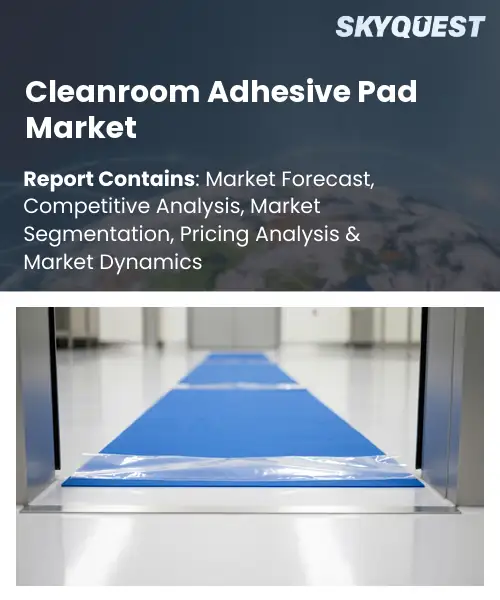
Cleanroom Adhesive Pad Market
Report ID: SQMIG20B2139
Report ID: SQMIG20B2139
[email protected]
USA +1 351-333-4748
Report ID:
SQMIG20B2139 |
Region:
Global |
Published Date: March, 2026
Pages:
157
|Tables:
118
|Figures:
77


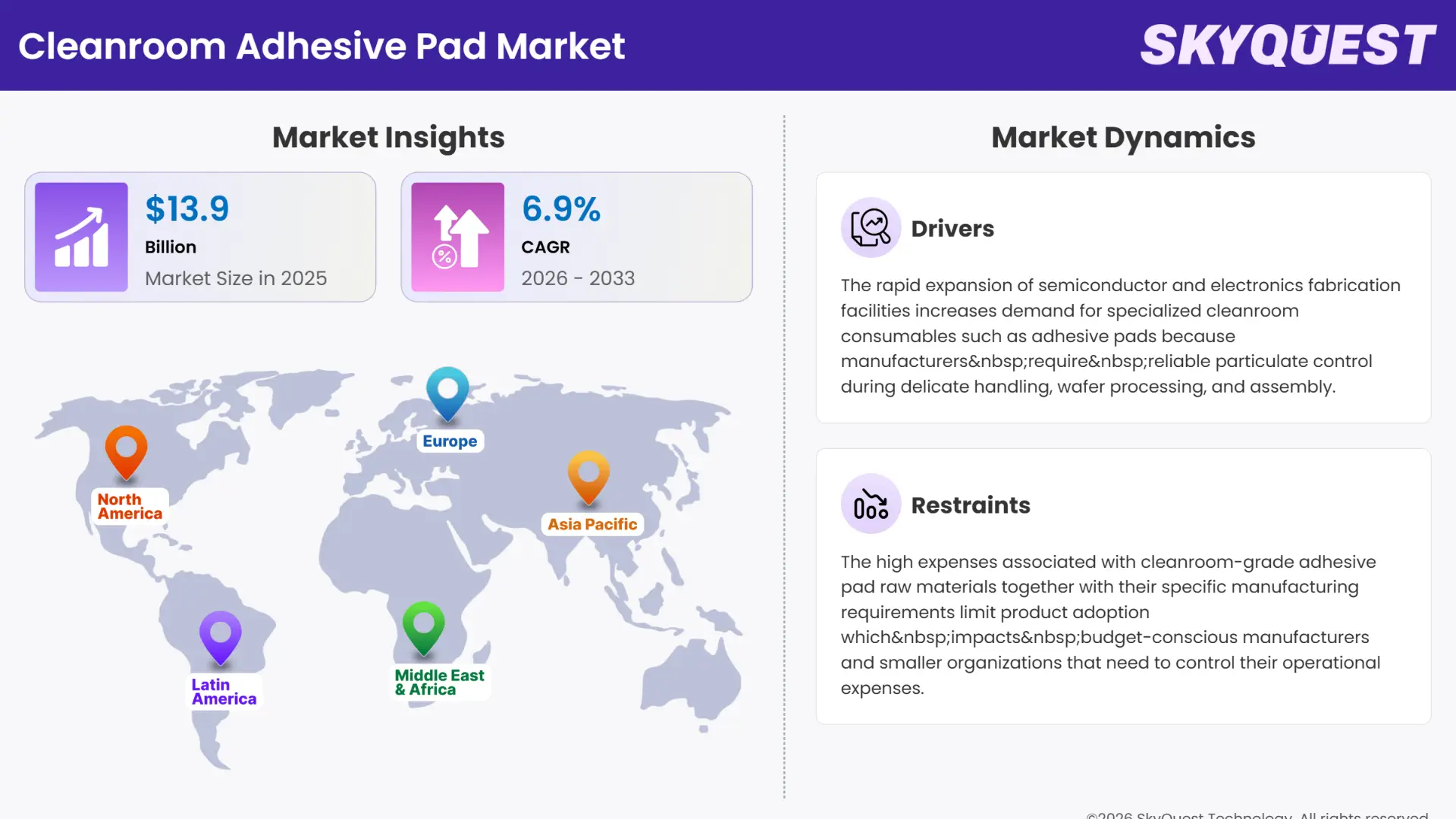
Global Cleanroom Adhesive Pad Market size was valued at USD 13.0 Billion in 2024 and is poised to grow from USD 13.9 Billion in 2025 to USD 23.7 Billion by 2033, growing at a CAGR of 6.9% during the forecast period (2026-2033).
Key Takeaways: Market Trends & Insights
• North America dominated the Cleanroom Adhesive Pad market with the largest market share in 2025.
• The U.S. Cleanroom Adhesive Pad market is expected to grow significantly over the forecast period.
• By Product Type, the Disposable Adhesive Pads segment held the largest market share in 2024.
• The Multi-Layer Adhesive Pads segment is expected to be the fastest-growing segment over the forecast period.
• North America: Largest Market in 2025.
• Asia Pacific: Fastest Growing Market.
• 2025 Market Size: USD 13.90 Billion.
• 2026 Projected Market Size: USD 14.86 Billion.
• 2033 Projected Market Size: USD 23.70 Billion.
• CAGR (2026-2033): 6.9%.
The global cleanroom adhesive pad market growth is driven because industries that need precise control of contamination are increasing their requirements for contamination management which drives changes in how facilities control dust movement between areas. Cleanroom adhesive pads are specialized tacky mats or pads used at entry points and workstations to remove particulates from shoes, wheels, and equipment, and they matter because even microscopic contaminants can compromise semiconductor yields or pharmaceutical sterility. The market transitioned from basic sticky mats to engineered low-particle formulations and electrostatic-dissipative constructions.
Moreover, the global cleanroom adhesive pad market outlook progressed from sticky floor rolls in electronics fabs to peel-away adhesive tiles used in aseptic drug filling lines. Higher-performance cleanroom adhesive pad adoption occurs because multiple regulatory standards and device miniaturization develop from historical market trends. As regulations force lower acceptable particle counts, manufacturers adopt low-shedding substrates and adhesive chemistries that retain particulates without leaving residue, which reduces defect rates in semiconductor wafer processing and prevents contamination during vaccine fill-finish operations. The cause-and-effect relationship enables suppliers to build business through certified materials and recyclable pad solutions and custom designs for automated material handling while achieving cost savings from reduced product rejections and optimized cleaning operations.
How is AI Improving Quality Control in the Cleanroom Adhesive Pad Market?
AI uses machine learning with high resolution vision technology to detect contamination and application defects during the manufacturing process. The system implements three primary components which include inline inspection and adaptive process control and data-driven traceability. The current state is moving away from intermittent sampling toward continuous monitoring that shortens problem diagnosis and supports consistent batch quality. The system eliminates rework and audit risk for semiconductor and biopharma production operations which operate under strict regulatory requirements. 3D laser mapping of adhesive beads and AI models that flag anomalous coating patterns function as practical examples which allow operators to correct issues before defects spread through the production process.
To get more insights on this market click here to Request a Free Sample Report
The global cleanroom adhesive pad market is segmented based on material base, adhesive type, product design, end-use industry, and region. By material base, the market is categorized into polyethylene (PE) sheets, polyurethane (PU) reusable pads, and PVC-based pads. In terms of adhesive type, it includes acrylic-based adhesives, silicone-based adhesives, and water-based eco-adhesives. Based on product design, the market is segmented into peel-off tacky mats, permanent or washable adhesive pads, and frame-mounted versus direct floor-mounted solutions. By end-use industry, it serves semiconductor and electronics manufacturing, pharmaceutical and biotech laboratories, medical device production, as well as aerospace and precision engineering. Geographically, the market is analyzed across North America, Europe, Asia Pacific, Latin America, and the Middle East & Africa.
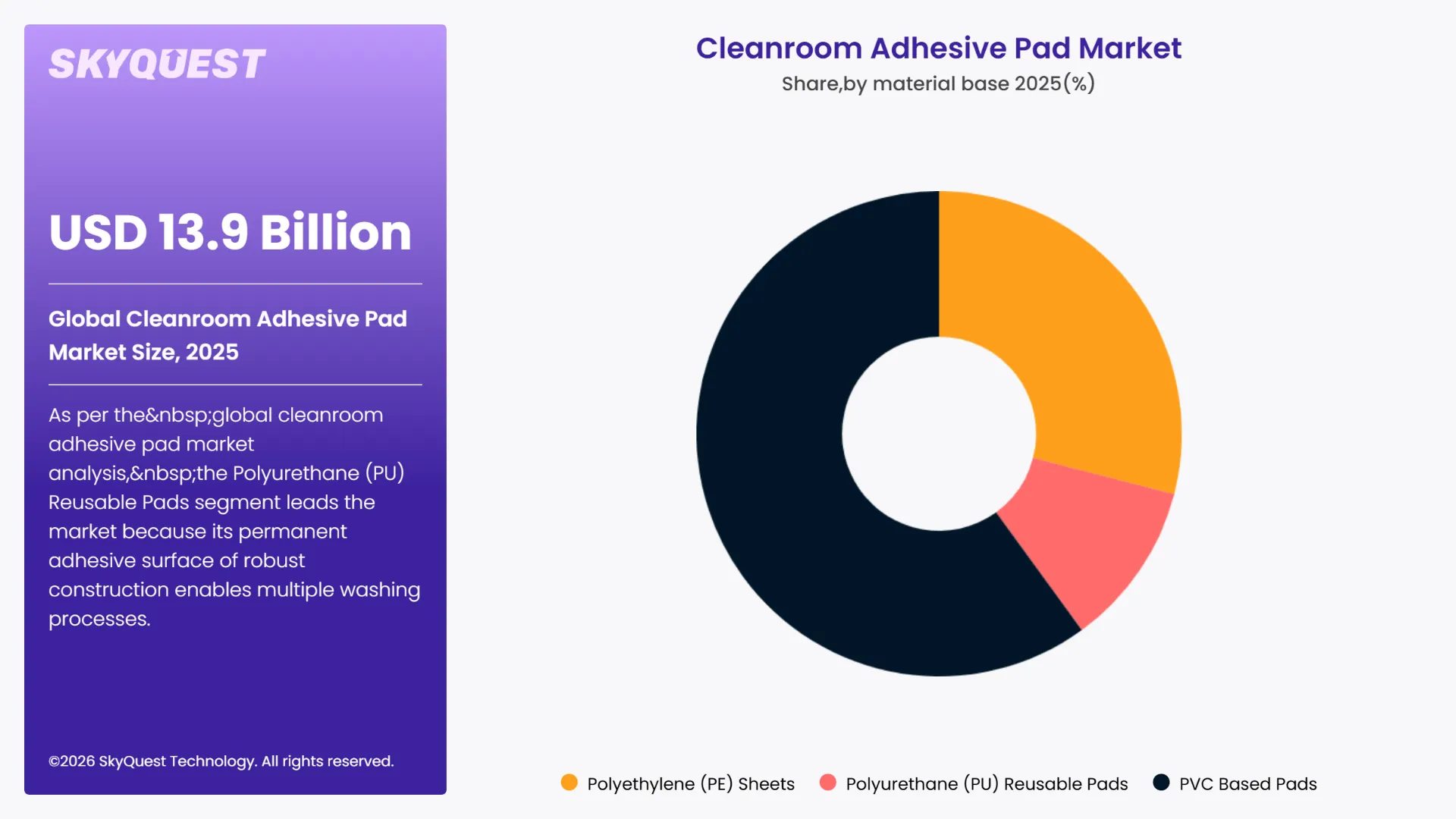
As per the global cleanroom adhesive pad market analysis, the Polyurethane (PU) Reusable Pads segment leads the market because its permanent adhesive surface of robust construction enables multiple washing processes. The product's ability to handle continuous usage leads to fewer replacement needs which results in less operational contamination throughout its lifetime. The product's design which supports various cleanroom standards and its ability to withstand solvent cleaning procedures results in a purchasing path that organizations use to establish their procurement rules.
However, the Polyethylene (PE) Sheets segment experiences its highest market growth because customers want affordable single-use products that control contamination. The combination of lightweight disposability and easy tack level customization and educational waste management procedures makes laboratories more operationally flexible through rapid procurement and volume-driven opportunities within various cleanroom sectors.
According to the global cleanroom adhesive pad market forecast, the Silicone-based Adhesive segment leads because its chemical inertness and stable tack across temperature variations ensures minimal outgassing and particle shedding under stringent cleanroom conditions. The product specification process depends on contamination risk reduction which occurs because it matches delicate substrate requirements while eliminating residues in sensitive manufacturing areas. People choose the material because it shows predictable adhesion during sterilization and thermal cycles which builds trust in its use for neutral material and essential process stability.
Whereas the Water-based Eco-adhesives segment is predicted to achieve the largest cleanroom adhesive pad market share because people prefer low toxicity products that contain no VOCs while regulations require these products. The development of tack performance improvements and cleanroom compatibility solutions and easier disposal profiles expands the product range to pharmaceutical and biotech users while establishing new procurement frameworks through sustainable contamination control practices.
To get detailed segments analysis, Request a Free Sample Report
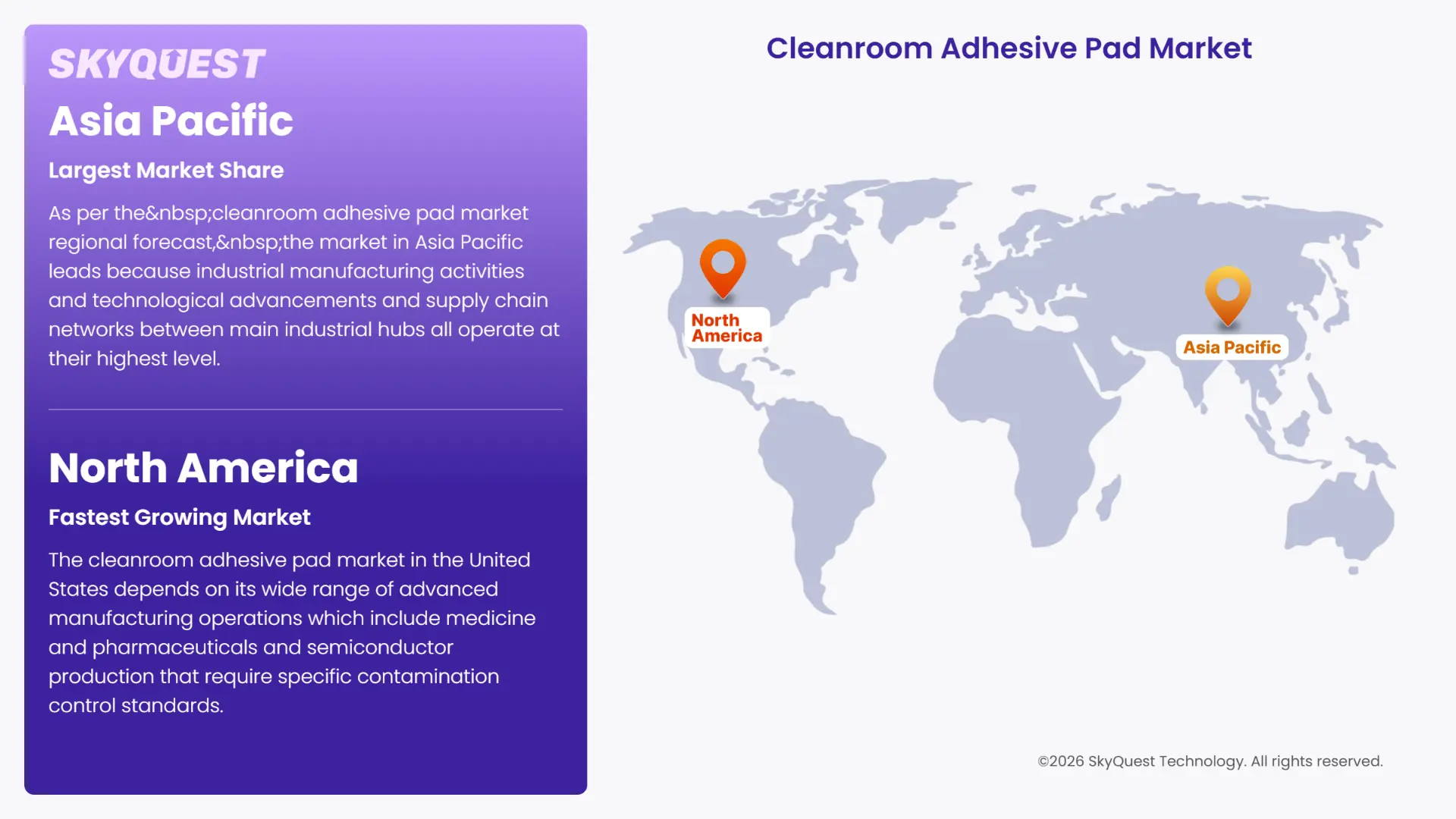
As per the cleanroom adhesive pad market regional forecast, the market in Asia Pacific leads because industrial manufacturing activities and technological advancements and supply chain networks between main industrial hubs all operate at their highest level. Contamination control consumables experience strong demand within electronics and semiconductor manufacturing ecosystems because domestic suppliers and contract manufacturers produce advanced adhesive media. National industrial strategies emphasize precision manufacturing and quality assurance, which creates quick demand for specialized consumables. Close location to original equipment manufacturers and tiered supplier networks allows companies to develop products and customize them according to cleanroom classification needs. The combination of cost-efficient operations and broad technical expertise enables business growth, while international research partnerships and knowledge exchange speed up the creation and testing of new adhesive pad products for advanced contamination control procedures.
The cleanroom adhesive pad sector in Japan exists because precise manufacturing operations and advanced semiconductor production systems require strict contamination management. Local manufacturers and research institutions collaborate to adapt adhesive formulations and pad designs for ultra-low particulate environments. The two parties establish tight relationships through their shared commitment to quality systems and supplier qualification processes. The cultural focus on continuous improvement and reliability drives adhesive pad solution usage within the organization.
The cleanroom adhesive pad industry in South Korea establishes direct connections between consumer electronics producers and their specialized consumable suppliers, which enables both parties to create better product specifications for advanced semiconductor assembly and packaging needs. Contamination control products need to match complex manufacturing processes because companies require these products to support their miniaturization and yield improvement goals. The combination of solid engineering capabilities and shared validation systems permits producers to showcase adhesive pad performance during demanding tests, which facilitates product use in controlled manufacturing and assembly environments.
The North American cleanroom adhesive pad market has grown rapidly because multiple advanced manufacturing facilities need high standards of contamination control. The establishment of specialized medical and pharmaceutical and microelectronic manufacturing facilities which must adhere to strict regulatory and quality standards drives the rising demand for specialized consumables. Local suppliers and service providers focus on creating personalized products for customers who need validation support and comprehensive product maintenance throughout their entire operational period. Cross-sector partnerships between industry and research institutions promote faster development of new materials through testing methods and procurement systems which prioritize supply security and technical assistance lead to stronger ties with domestic manufacturers. The need for adhesive pad solutions exists because these solutions make it easier to maintain production facilities while preventing contamination problems in complex production environments.
The cleanroom adhesive pad market in the United States depends on its wide range of advanced manufacturing operations which include medicine and pharmaceuticals and semiconductor production that require specific contamination control standards. Domestic suppliers deliver customized solutions together with validation services and technical support that meets strict regulatory requirements. Research and industry integration between both parties impacts demand for prototyping and lifecycle services. The need for secure local supply and expert support drives adoption throughout critical operations.
The cleanroom adhesive pad market in Canada exists because biotechnology and pharmaceutical companies work closely together with research organizations and their suppliers to create commercial partnerships. Domestic manufacturers and contract facilities conduct their procurement activities according to three primary requirements: product validation, cleanroom certification, and sustainable material options. The two parties work together to create solutions that meet all cleanliness requirements while customizing their product needs. The regional distribution networks along with the technical support systems deliver dependable critical production environment services through their fast operational capabilities.
The European cleanroom adhesive pad market achieves growth through its combination of strict regulations and environmental sustainability initiatives, together with its specialized knowledge of essential industrial production domains. The established pharmaceutical and medtech sectors together with precision engineering clusters require approved consumables and standard operating procedures, which leads suppliers to prioritize materials with low outgassing properties and recyclability and verified performance data. Regional markets achieve broader access to established technologies through standardized regulations, while testing laboratories and joint research investments create new material possibilities. Suppliers develop validation services which enable them to fulfill distribution requirements across international borders and deliver complete logistic solutions. Manufacturers and academic research institutions create strategic partnerships to help bring new adhesive technologies from research into certified products, which helps companies compete in both domestic and international markets for procurement needs.
The Cleanroom Adhesive Pad Market in Germany receives support from its strong pharmaceutical and precision engineering industries, which require businesses to implement strict contamination control measures and utilize verified consumable products. Local suppliers work together with manufacturers and quality teams to create low outgassing adhesives and durable pad designs, which they use in applications that depend on reliable performance. The manufacturing focuses on both operational excellence and documented product performance together with recyclability of certified products leading to higher adoption rates. The advanced testing capabilities together with dedicated technical assistance allow businesses to implement their systems into modern production environments.
The Cleanroom Adhesive Pad Market in United Kingdom receives its main support from the pharmaceutical and biotech clusters, which need verified contamination control systems together with materials that have documented performance metrics. The suppliers of this market develop custom adhesive products and pad designs to meet the unique needs of research laboratories and production facilities. The product validation process obtains faster results through the partnership between research centers and certification bodies. Organizations use quality management systems together with end user training to ensure that production facilities continue using adhesive pad solutions throughout their entire operational life.
The Cleanroom Adhesive Pad Market in France depends on the pharmaceutical sector and aerospace industry and medical device manufacturers, who need proven contamination control methods and dependable consumable products. The local suppliers work with testing facilities to achieve certification of low contamination performance while developing adhesive chemistry for specialized application needs. Organizations use environmental compliance together with product traceability to determine their procurement paths. The technical service offerings together with distribution channels enable manufacturing and research facilities to quickly establish and implement adhesive pad solutions in their sensitive areas.
To know more about the market opportunities by region and country, click here to
Buy The Complete Report
Expansion of Semiconductor Manufacturing
The rapid expansion of semiconductor and electronics fabrication facilities increases demand for specialized cleanroom consumables such as adhesive pads because manufacturers require reliable particulate control during delicate handling, wafer processing, and assembly. The adhesive pads have two functions which enable surface cleaning work while enabling static electricity discharge and secure component positioning which results in reliable equipment operation and decreased contamination risks. The major manufacturing companies regard adhesive pads as essential materials because they enable production processes to continue running while helping to maintain the required cleanliness standards of their current fabrication systems.
Adoption of Stringent Cleanroom Standards
Organizations have to upgrade their contamination control systems because existing stricter regulatory standards and improved industry quality benchmarks require them to do so. This leads to more organizations using adhesive pads in cleanroom environments because these products help track particles which need to be captured and help complete specific surface cleaning tasks. Manufacturing operations use adhesive pads which enable manufacturers to achieve mandatory cleanliness standards by preventing particle movement during equipment operations and storage of parts. The organization needs adhesive pads as a solution because they establish validated procedures which enhance certification processes and decrease non-compliance risk.
High Cost of Specialty Materials
The high expenses associated with cleanroom-grade adhesive pad raw materials together with their specific manufacturing requirements limit product adoption which impacts budget-conscious manufacturers and smaller organizations that need to control their operational expenses. Premium-priced certified adhesive products lead procurement teams to either purchaselower-cost alternatives or postpone acquisition until existing supplies deplete their value thresholds. Budget constraints force businesses to decrease their purchasing activities, which results in a slower adoption rate of products that offer technical benefits in markets that maintain strict control over capital and operational expenses.
Supply Chain Complexity and Delays
Request Free Customization of this report to help us to meet your business objectives.
The global cleanroom adhesive pad market competition relies on two main factors which are product differentiation and market consolidation. The market shows growth through distributor buy and build operations along with private equity firms acquiringstrategic assets and companies establishing partnerships with suppliers. Recent acquisitions extended regional distribution platforms while major suppliers created engineered adhesive mat variants for semiconductor and pharma entry points to establishlong-term contracts.
Stricter Contamination Control Standards: The growing need for sterile environments according to industry standards and governmental regulations is fueling the use of adhesive pads which deliver effective particle collection and residue-free product removal and maintain their operational capabilities through multiple manufacturing stages. The manufacturers first need to prove that their products work with high-priority cleaning procedures before they can market their products, which contain materials that do not release gases or chemical compounds that would jeopardize product quality. The pharmaceutical and biotechnology and advanced electronics sectors need pharmaceutical suppliers to establish their contamination control processes through proper product traceability and standard testing and certification programs which help users make purchasing decisions while reducing potential risks.
Sustainable Low Residue Materials: Environmental responsibility and operator safety have become more important which leads cleanroom operators to select adhesive pads made from recyclable materials and chemical formulas that produce minimal residue on delicate surfaces. The research and development efforts of suppliers focus on creating bio-based backing materials and developing solvent-free adhesive solutions and building systems which enable recycling and reuse in controlled environments. The market response requires complete lifecycle assessment together with lower pollution levels and simplified disposal processes which must still provide strong adhesion and compatibility with both cleaning methods and sterilization processes used in regulated sectors.
SkyQuest’s ABIRAW (Advanced Business Intelligence, Research & Analysis Wing) is our Business Information Services team that Collects, Collates, Correlates, and Analyses the Data collected by means of Primary Exploratory Research backed by robust Secondary Desk research.
As per SkyQuest analysis, the global cleanroom adhesive pad market experiences its main growth through rising contamination control needs which high-precision industries such as semiconductors create while strict regulatory requirements and smaller device sizes create additional demand for particle control solutions. The growth of the market gets hindered because facilities with budget constraints cannot afford specialty materials which have high expenses. Asia Pacific leads the market because it contains numerous electronic and semiconductor production centers which operatecomplete supply chain systems. Polyurethane reusable pads dominate the product market because their durable construction enables high-quality operations to perform repeated cleaning work which requires low material shedding. The suppliers of certified recyclable products with low residual waste have the highest market potential to acquireconsumer demand.
| Report Metric | Details |
|---|---|
| Market size value in 2024 | USD 13.0 Billion |
| Market size value in 2033 | USD 23.7 Billion |
| Growth Rate | 6.9% |
| Base year | 2024 |
| Forecast period | 2026-2033 |
| Forecast Unit (Value) | USD Billion |
| Segments covered |
|
| Regions covered | North America (US, Canada), Europe (Germany, France, United Kingdom, Italy, Spain, Rest of Europe), Asia Pacific (China, India, Japan, Rest of Asia-Pacific), Latin America (Brazil, Rest of Latin America), Middle East & Africa (South Africa, GCC Countries, Rest of MEA) |
| Companies covered |
|
| Customization scope | Free report customization with purchase. Customization includes:-
|
To get a free trial access to our platform which is a one stop solution for all your data requirements for quicker decision making. This platform allows you to compare markets, competitors who are prominent in the market, and mega trends that are influencing the dynamics in the market. Also, get access to detailed SkyQuest exclusive matrix.
Table Of Content
Executive Summary
Market overview
Parent Market Analysis
Market overview
Market size
KEY MARKET INSIGHTS
COVID IMPACT
MARKET DYNAMICS & OUTLOOK
Market Size by Region
KEY COMPANY PROFILES
Methodology
For the Cleanroom Adhesive Pad Market, our research methodology involved a mixture of primary and secondary data sources. Key steps involved in the research process are listed below:
1. Information Procurement: This stage involved the procurement of Market data or related information via primary and secondary sources. The various secondary sources used included various company websites, annual reports, trade databases, and paid databases such as Hoover's, Bloomberg Business, Factiva, and Avention. Our team did 45 primary interactions Globally which included several stakeholders such as manufacturers, customers, key opinion leaders, etc. Overall, information procurement was one of the most extensive stages in our research process.
2. Information Analysis: This step involved triangulation of data through bottom-up and top-down approaches to estimate and validate the total size and future estimate of the Cleanroom Adhesive Pad Market.
3. Report Formulation: The final step entailed the placement of data points in appropriate Market spaces in an attempt to deduce viable conclusions.
4. Validation & Publishing: Validation is the most important step in the process. Validation & re-validation via an intricately designed process helped us finalize data points to be used for final calculations. The final Market estimates and forecasts were then aligned and sent to our panel of industry experts for validation of data. Once the validation was done the report was sent to our Quality Assurance team to ensure adherence to style guides, consistency & design.
Analyst Support
Customization Options
With the given market data, our dedicated team of analysts can offer you the following customization options are available for the Cleanroom Adhesive Pad Market:
Product Analysis: Product matrix, which offers a detailed comparison of the product portfolio of companies.
Regional Analysis: Further analysis of the Cleanroom Adhesive Pad Market for additional countries.
Competitive Analysis: Detailed analysis and profiling of additional Market players & comparative analysis of competitive products.
Go to Market Strategy: Find the high-growth channels to invest your marketing efforts and increase your customer base.
Innovation Mapping: Identify racial solutions and innovation, connected to deep ecosystems of innovators, start-ups, academics, and strategic partners.
Category Intelligence: Customized intelligence that is relevant to their supply Markets will enable them to make smarter sourcing decisions and improve their category management.
Public Company Transcript Analysis: To improve the investment performance by generating new alpha and making better-informed decisions.
Social Media Listening: To analyze the conversations and trends happening not just around your brand, but around your industry as a whole, and use those insights to make better Marketing decisions.
REQUEST FOR SAMPLE
 REQUEST FREE CUSTOMIZATION
Global Cleanroom Adhesive Pad Market size was valued at USD 13.0 Billion in 2024 and is poised to grow from USD 13.9 Billion in 2025 to USD 23.7 Billion by 2033, growing at a CAGR of 6.9% during the forecast period (2026-2033).
Consolidation and product differentiation define the competitive landscape in the global cleanroom adhesive pad market, where distributor buy and build activity, strategic private equity add ons, and supplier partnerships are driving scale and service integration. Examples include recent acquisitions that expanded regional distribution platforms and major suppliers introducing engineered adhesive mat variants for semiconductor and pharma entry points to secure long term contracts. 'Berkshire Corporation', 'Kimberly-Clark Professional', 'Contec, Inc.', 'DuPont', 'Ansell Ltd.', 'Illinois Tool Works (ITW)', 'Thermo Fisher Scientific', 'Valutek Inc.', 'Steris', 'Avantor', 'KM Purely', 'PB Statclean', 'Azbil Corporation', 'Nitritex Ltd.', 'Micronova Manufacturing', 'Texwipe', 'Purus International', 'Dycem', 'Sticky Mat', 'Statico'
The rapid expansion of semiconductor and electronics fabrication facilities increases demand for specialized cleanroom consumables such as adhesive pads because manufacturers require reliable particulate control during delicate handling, wafer processing, and assembly. Adhesive pads support surface cleanliness, static dissipation, and component stabilization, enabling consistent process yields and reduced contamination risks. Their adoption within upgraded production lines directly supports operational integrity and quality assurance efforts, making adhesive pads an essential consumable that manufacturers prioritize to maintain uptime and to comply with stringent cleanliness protocols across modern fabrication environments.
Stricter Contamination Control Standards: Increasing regulatory and industry expectations for aseptic environments are driving adoption of adhesive pads that offer reliable particle capture, residue free removal, and consistent performance across production cycles. Manufacturers are prioritizing products validated for compatibility with critical cleaning protocols and resistant to outgassing or migration that could compromise product integrity. As pharmaceuticals, biotech and advanced electronics demand tighter control of particulate and molecular contamination, suppliers are focusing on traceability, standardized testing, and certifications to support procurement and risk reduction.
Asia Pacific Dominate the Global Cleanroom Adhesive Pad Market?
Cleanroom adhesive pads are designed to capture dust, dirt, and particulate contaminants from footwear before personnel enter controlled environments, helping maintain cleanroom integrity.
These products are extensively used in pharmaceutical manufacturing, biotechnology facilities, semiconductor production, healthcare environments, and electronics manufacturing cleanrooms.


Want to customize this report? This report can be personalized according to your needs. Our analysts and industry experts will work directly with you to understand your requirements and provide you with customized data in a short amount of time. We offer $1000 worth of FREE customization at the time of purchase.
Feedback From Our Clients


 USA (+1) 351-333-4748

