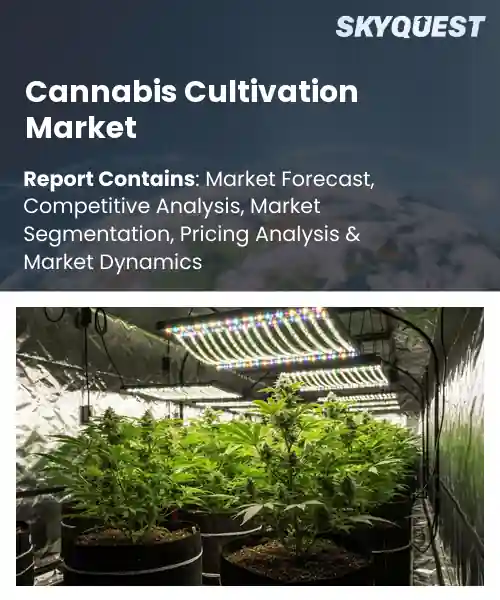
Cannabis Cultivation Market
Report ID: SQMIG30H2413
Report ID: SQMIG30H2413
[email protected]
USA +1 351-333-4748
Report ID:
SQMIG30H2413 |
Region:
Global |
Published Date: June, 2026
Pages:
157
|Tables:
186
|Figures:
79


Global Cannabis Cultivation Market size was valued at USD 554.4 Billion in 2024 and is poised to grow from USD 647.54 Billion in 2025 to USD 2242.89 Billion by 2033, growing at a CAGR of 16.8% during the forecast period (2026-2033).
The cannabis cultivation market as the collection of producers supplying plant biomass and derivatives for medical, recreational and industrial uses; its primary driver has been legalization which transformed an illicit trade into regulated supply chains. This market matters because legal cultivation supports consistent product quality, generates tax revenue and expands patient access, thereby influencing health outcomes and public finance.
The sector evolved from informal outdoor grows toward sophisticated indoor and greenhouse farms using environmental controls and automation, a trajectory illustrated by Canada's legalization and the emergence of cultivation in U.S. states such as Colorado.Building on legalization-driven formalization, the key factor shaping the global cannabis cultivation market is capital and technology deployment because regulatory certainty attracts investment which enables growers to adopt advanced lighting, climate control and breeding programs that raise yields and consistency. As a result, firms such as Canopy Growth and U.S. operators scaled greenhouse and indoor operations to service dispensaries and pharmaceutical clients, while manufacturers pursuing FDA-grade products prompted growers to implement GMP-compliant cultivation for medicines like Epidiolex. Increased productivity lowered unit costs and created opportunities in export, derivative manufacturing, and industrial hemp applications, thereby incentivizing further consolidation, research sustainable practices.
How is AI improving yield prediction in commercial cannabis cultivation?
AI improves yield prediction in commercial cannabis cultivation by linking continuous sensor and imaging data with machine learning models that learn cultivar and facility specific growth patterns. Key aspects are plant level monitoring, environmental trend analysis and model retraining on local outcomes.
The current state sees growers using these tools for earlier harvest forecasting, risk detection and scheduling which reduces surprises and smooths supply. Market context shows operators adopting AI driven systems to tighten quality control and stabilize output. Examples include greenhouse applications that combine climate control data and plant imaging to predict harvest windows and final potency with greater confidence.Tilray October 2025, the company reported implementing AI driven horticulture automation across cultivation which supports more reliable yield forecasting and consistent potency outcomes and helps licensed producers scale operations with improved planning and resource efficiency.
Market snapshot - (2026-2033)
Global Market Size
USD 554.4 Billion
Largest Segment
Indoor Cultivation
Fastest Growth
Vertical Farming Cultivation
Growth Rate
16.8% CAGR
To get more insights on this market click here to Request a Free Sample Report
Global cannabis cultivation market is segmented by cultivation type, product type, cultivation method, application, end user, component and region. Based on cultivation type, the market is segmented into Indoor Cultivation, Greenhouse Cultivation, Outdoor Cultivation, Vertical Farming Cultivation, Hydroponic Cultivation and Aeroponic Cultivation. Based on product type, the market is segmented into Medical Cannabis, Recreational Cannabis, Industrial Hemp, CBD-rich Cannabis and THC-rich Cannabis. Based on cultivation method, the market is segmented into Organic Cultivation, Conventional Cultivation and Precision Agriculture-based Cultivation. Based on application, the market is segmented into Medical & Pharmaceutical, Recreational Use, Food & Beverage, Cosmetics & Personal Care, Industrial Applications, Nutraceuticals and Others. Based on end user, the market is segmented into Pharmaceutical Companies, Cannabis Dispensaries, Research Institutes, Industrial Hemp Processors, Individual Consumers and Others. Based on component, the market is segmented into Seeds, Nutrients & Fertilizers, Lighting Systems, HVAC Systems, Irrigation Systems and Others. Based on region, the market is segmented into North America, Europe, Asia Pacific, Latin America and Middle East & Africa.
Indoor Cultivation segment dominates because its controlled environment systems allow cultivators to precisely manage light cycles, temperature, humidity, and nutrient delivery, producing consistent cannabinoid and terpene profiles that meet stringent buyer and regulatory expectations. Integration of advanced HVAC, lighting, and irrigation technologies reduces biological variability and crop losses, which attracts professional operators and investment, enabling stable supply chains for premium and medical-grade products.
However, Vertical Farming Cultivation is emerging as the fastest growing area due to space efficient stacked production, high automation potential, and fit for urban specialty markets. Advances in lighting and aeration increase per area throughput, drawing investment and enabling new business models that expand premium product lines and accelerate time to market.
Precision Agriculture-based Cultivation segment dominates because its networked sensors, analytics, and automation enable data driven adjustments to irrigation, fertilization, and microclimate controls, ensuring predictable plant development and consistent potency. Continuous monitoring improves resource efficiency and traceability, mitigating crop risk and supporting compliance requirements, which in turn attracts commercial scale operators and supports contracts for consistent, high-quality botanical inputs.
On the other hand, Organic Cultivation is emerging as the fastest growing approach driven by consumer preference for natural, pesticide free cannabis and growing demand in therapeutic markets. Certification and sustainability narratives unlock premium pricing and specialty distribution, prompting investment in certified operations and product lines that broaden market access for wellness and medical applications.
To get detailed segments analysis, Request a Free Sample Report
North America leads the global cannabis cultivation market due to a mature regulatory environment, abundant cultivation expertise, and established commercial infrastructure. Strong private investment and vertically integrated operators support large scale production, while advanced research institutions and breeding programs drive product quality improvements. A developed supply chain for indoor and controlled environment agriculture enables consistent yields and sophisticated extraction and processing capabilities. Regulatory frameworks that allow medical and adult use in multiple jurisdictions promote scale and market sophistication, attracting professional management and technology adoption. Market consolidation by experienced firms and deep capital markets further strengthen competitiveness, enabling rapid deployment of innovation in cultivation methods, genetics, and controlled environment systems. Well developed ancillary sectors including technology suppliers, skilled labor pools, and professional services support scalability and regulatory compliance, reinforcing North America position as a global production leader.
Cannabis Cultivation Market in United States is characterized by diversified production models, spanning boutique craft operations to large commercial facilities under controlled environments. Sophisticated supply chain infrastructure, strong private investment, and a deep pool of cultivation expertise foster innovation in genetics, lighting, and climate control. Regulatory complexity leads to regional variation in operational practices, while established distribution networks and research collaboration support product quality, traceability, and continuous improvement across segments.
Cannabis Cultivation Market in Canada emphasizes regulated large scale production, controlled environment agriculture, and integration between cultivation and processing. A framework supporting licensed producers encourages standardized cultivation protocols, quality assurance, and product diversification. Industry focus on research partnerships and technological adoption advances strain development, energy efficient systems, and post harvest handling. Strategic emphasis on compliance and export readiness cultivates operators adept at meeting diverse regulatory requirements and market expectations effectively.
Europe is experiencing rapid expansion in cannabis cultivation driven by shifting regulatory attitudes, growing medical demand, and increasing public and private investment in controlled environment agriculture. Harmonization efforts and pilot programs in several countries lower barriers to research and commercial cultivation, while producers focus on medicinal quality, compliance, and export potential. Investment in greenhouse technology, tissue culture, and precision climate control supports scale and consistency. Strategic partnerships among cultivators, contract manufacturers, and research institutions accelerate knowledge transfer, while consumer interest in standardized, traceable products encourages professionalization across the value chain. Emerging clusters of specialized cultivation hubs and service providers enhance operational efficiency, while emphasis on quality management systems and traceability helps meet stringent market entry requirements in multiple jurisdictions.
Cannabis Cultivation Market in Germany benefits from a strong pharmaceutical and medical research ecosystem that prioritizes high quality standards and regulatory compliance. Established greenhouse and controlled environment operations focus on medicinal grade cultivation with rigorous quality assurance and traceability practices. German producers emphasize strain standardization, sterile propagation methods, and collaboration with clinical researchers. Demand for consistent, compliant supply encourages investment in automated systems, analytics, and cultivation teams meeting market requirements.
Cannabis Cultivation Market in United Kingdom is characterized by dynamic regulatory reform, growing clinical research activity, and network of innovative cultivators prioritizing medicinal quality and product traceability. Investment in indoor and hybrid greenhouse facilities, along with partnerships between industry and academic institutions, accelerates development of optimized genetics and cultivation protocols. Emphasis on compliance, product standardization, and supply chain transparency positions operators to scale production and meet expanding clinical demand needs.
Cannabis Cultivation Market in France is emerging with growing interest in medicinal applications, cultivation programs, and research collaborations. Developments in greenhouse technologies and controlled environment systems support early stage producers focused on quality, traceability, and regulatory compliance. Collaborative initiatives among growers, research centers, and manufacturers foster knowledge exchange in genetics and propagation. Emerging supply chain capabilities and professionalization of cultivation practices indicate a trajectory toward standardized production and market readiness.
Asia Pacific is strengthening its position through cautious regulatory change, targeted research initiatives, and selective commercialization focused on medicinal and industrial applications. Governments and private actors are investing in pilot cultivation programs, tissue culture capabilities, and controlled environment technologies adapted to local climates. Emphasis on domestic research and partnerships with international firms supports transfer of cultivation know how, genetics, and quality management practices. Regional manufacturing clusters and supply chain improvements enhance capacity for processing and standardized output. While regulatory approaches vary across markets, strategic focus on clinical evidence, export readiness, and technology enabled cultivation elevates the region contribution to global supply of specialized medicinal and wellness oriented cannabis products. Training initiatives, academic programs, and emergence of certification bodies build a skilled workforce and credible quality frameworks that support cross border collaboration and export potential.
Cannabis Cultivation Market in Japan is advancing through research oriented approaches, cautious regulatory adjustments, and investment in precision controlled environment systems. Academic institutions and industry participants collaborate on cultivation science, tissue culture, and strain development tailored to medicinal applications. Focus on stringent quality assurance, traceability, and compliance encourages adoption of automation and analytics. Emerging projects and partnerships with international technology providers help build capabilities that align production with clinical requirements.
Cannabis Cultivation Market in South Korea emphasizes research driven cultivation and regulatory oversight that prioritize medicinal quality and patient safety. Government supported initiatives and collaborations with biotech firms foster development of propagation techniques, controlled environment practices, and analytical quality control. Industry focus on pharmaceutical grade production motivates investment in automation, propagation, and laboratory cultivation environments. Focus on clinical trials and partnerships enhances credibility and readiness for domestic and international supply.
To know more about the market opportunities by region and country, click here to
Buy The Complete Report
Increasing Medical Acceptance
Expansion Of Recreational Markets
Regulatory Uncertainty and Compliance Costs
Supply Chain and Quality Challenges
Request Free Customization of this report to help us to meet your business objectives.
Competition in the global cannabis cultivation market is driven by rapid consolidation for platform control, exclusive genetics access, and operational efficiency; firms pursue M&A to secure compliance and cultivation tech, for example Akerna’s acquisitions of Trellis and 365 Cannabis, while genetics and breeding startups and tissue culture providers attract investment and partnerships to differentiate product pipelines.
Top Player’s Company Profile
Recent Developments
SkyQuest’s ABIRAW (Advanced Business Intelligence, Research & Analysis Wing) is our Business Information Services team that Collects, Collates, Correlates, and Analyses the Data collected by means of Primary Exploratory Research backed by robust Secondary Desk research. As per SkyQuest analysis, the global cannabis cultivation market is set for robust growth driven primarily by legalization and the resulting influx of capital and technology that enables controlled environments, higher yields and product standardization. Regulatory uncertainty and rising compliance costs are a key restraint, increasing operational complexity and squeezing margins for many growers. North America continues to dominate the market, with indoor cultivation the leading segment thanks to precise climate and lighting control suited to medical and premium recreational supply. A second driver is expansion of recreational markets, which broadens consumer demand and accelerates investment in scale, branding and diversified product portfolios.
| Report Metric | Details |
|---|---|
| Market size value in 2024 | USD 554.4 Billion |
| Market size value in 2033 | USD 2242.89 Billion |
| Growth Rate | 16.8% |
| Base year | 2024 |
| Forecast period | (2026-2033) |
| Forecast Unit (Value) | USD Billion |
| Segments covered |
|
| Regions covered | North America (US, Canada), Europe (Germany, France, United Kingdom, Italy, Spain, Rest of Europe), Asia Pacific (China, India, Japan, Rest of Asia-Pacific), Latin America (Brazil, Rest of Latin America), Middle East & Africa (South Africa, GCC Countries, Rest of MEA) |
| Companies covered |
|
| Customization scope | Free report customization with purchase. Customization includes:-
|
To get a free trial access to our platform which is a one stop solution for all your data requirements for quicker decision making. This platform allows you to compare markets, competitors who are prominent in the market, and mega trends that are influencing the dynamics in the market. Also, get access to detailed SkyQuest exclusive matrix.
Table Of Content
Executive Summary
Market overview
Parent Market Analysis
Market overview
Market size
KEY MARKET INSIGHTS
COVID IMPACT
MARKET DYNAMICS & OUTLOOK
Market Size by Region
KEY COMPANY PROFILES
Methodology
For the Cannabis Cultivation Market, our research methodology involved a mixture of primary and secondary data sources. Key steps involved in the research process are listed below:
1. Information Procurement: This stage involved the procurement of Market data or related information via primary and secondary sources. The various secondary sources used included various company websites, annual reports, trade databases, and paid databases such as Hoover's, Bloomberg Business, Factiva, and Avention. Our team did 45 primary interactions Globally which included several stakeholders such as manufacturers, customers, key opinion leaders, etc. Overall, information procurement was one of the most extensive stages in our research process.
2. Information Analysis: This step involved triangulation of data through bottom-up and top-down approaches to estimate and validate the total size and future estimate of the Cannabis Cultivation Market.
3. Report Formulation: The final step entailed the placement of data points in appropriate Market spaces in an attempt to deduce viable conclusions.
4. Validation & Publishing: Validation is the most important step in the process. Validation & re-validation via an intricately designed process helped us finalize data points to be used for final calculations. The final Market estimates and forecasts were then aligned and sent to our panel of industry experts for validation of data. Once the validation was done the report was sent to our Quality Assurance team to ensure adherence to style guides, consistency & design.
Analyst Support
Customization Options
With the given market data, our dedicated team of analysts can offer you the following customization options are available for the Cannabis Cultivation Market:
Product Analysis: Product matrix, which offers a detailed comparison of the product portfolio of companies.
Regional Analysis: Further analysis of the Cannabis Cultivation Market for additional countries.
Competitive Analysis: Detailed analysis and profiling of additional Market players & comparative analysis of competitive products.
Go to Market Strategy: Find the high-growth channels to invest your marketing efforts and increase your customer base.
Innovation Mapping: Identify racial solutions and innovation, connected to deep ecosystems of innovators, start-ups, academics, and strategic partners.
Category Intelligence: Customized intelligence that is relevant to their supply Markets will enable them to make smarter sourcing decisions and improve their category management.
Public Company Transcript Analysis: To improve the investment performance by generating new alpha and making better-informed decisions.
Social Media Listening: To analyze the conversations and trends happening not just around your brand, but around your industry as a whole, and use those insights to make better Marketing decisions.
REQUEST FOR SAMPLE
 REQUEST FREE CUSTOMIZATION
Global Cannabis Cultivation Market size was valued at USD 554.4 Billion in 2024 and is poised to grow from USD 647.54 Billion in 2025 to USD 2242.89 Billion by 2033, growing at a CAGR of 16.8% during the forecast period (2026-2033).
Competition in the global cannabis cultivation market is driven by rapid consolidation for platform control, exclusive genetics access, and operational efficiency; firms pursue M&A to secure compliance and cultivation tech, for example Akerna’s acquisitions of Trellis and 365 Cannabis, while genetics and breeding startups and tissue culture providers attract investment and partnerships to differentiate product pipelines. 'Canopy Growth Corporation', 'Tilray Brands', 'Aurora Cannabis', 'Cronos Group', 'Curaleaf Holdings', 'Trulieve Cannabis', 'Green Thumb Industries', 'Cresco Labs', 'TerrAscend', 'Hexo Corporation', 'Organigram Holdings', 'Village Farms International', 'The Scotts Miracle-Gro Company', 'Aphria', 'MedMen Enterprises', 'Columbia Care', 'Sundial Growers', 'Jazz Pharmaceuticals', 'Charlotte's Web Holdings', 'Ecofibre'
Increasing medical acceptance drives demand from patients and healthcare providers, creating sustained need for reliable, quality controlled cannabis supply. As clinical recognition broadens, licensed cultivators gain clearer pathways to meet therapeutic requirements, prompting investment in specialized facilities and professional cultivation practices. This dynamic encourages development of standardized strains, traceability systems, and partnerships across research and industry, improving product consistency and safety. The resulting institutional interest and clearer market signals reduce uncertainty for producers, fostering capacity expansion and innovation that support long term market growth.
Technology-Driven Production: Advanced cultivation technologies are reshaping grow operations, enabling controlled environments, automation and precision agriculture practices that improve consistency and reduce labor intensity. Growers increasingly adopt climate control systems, LED lighting strategies and sensor-driven nutrient delivery to optimize plant health and uniformity across cycles. These innovations support scalable indoor and greenhouse models, facilitate standardization for medical and recreational markets, and create opportunities for differentiated product profiles while lowering variability and enabling more predictable yields and quality outcomes for brands and partners.
Why does North America Dominate the Global Cannabis Cultivation Market? |@12


Want to customize this report? This report can be personalized according to your needs. Our analysts and industry experts will work directly with you to understand your requirements and provide you with customized data in a short amount of time. We offer $1000 worth of FREE customization at the time of purchase.
Feedback From Our Clients


 USA (+1) 351-333-4748

