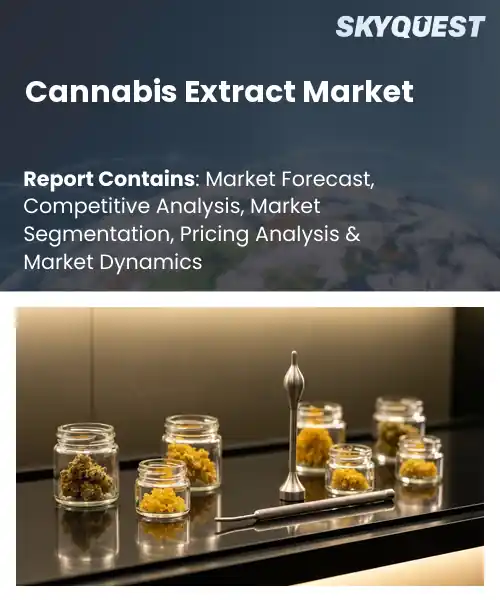
Cannabis Extract Market
Report ID: SQMIG35H2485
Report ID: SQMIG35H2485
[email protected]
USA +1 351-333-4748
Report ID:
SQMIG35H2485 |
Region:
Global |
Published Date: May, 2026
Pages:
157
|Tables:
208
|Figures:
80


Global Cannabis Extract Market size was valued at USD 3.7 Billion in 2024 and is poised to grow from USD 4.31 Billion in 2025 to USD 14.6 Billion by 2033, growing at a CAGR of 16.48% during the forecast period (2026-2033).
The legalisation of cannabis on a state-by-state basis has transformed the cannabis extract market by taking the formerly illicit supply chain and creating a legitimate market for its production and distribution through regulatory liberalisation and increased medical recognition. The cannabis extract market comprises products that have concentrated cannabinoids (also known as cannabinoids) in various forms including tinctures, edibles, and topical creams with their importance derived from their ability to provide accurate dosing, alternative means of Administration/Delivery and positive therapeutic effects.
Over the past ten years, production of cannabis extracts has moved away from artisanal production methods that used solvents towards industrially scalable methods such as supercritical carbon dioxide extraction and distillation, with the waves of legalisation occurring throughout North America and the FDA's approval of Epidiolex providing financial opportunities for manufacturing of cannabis extracts, creating higher-quality manufacturing standards and eventually enabling global distribution of cannabis extracts. The regulatory clarity provided by government by providing licensing requirements and quality assurance creates an environment where investors will commit their money to manufacturers of cannabis extracts through GMP compliant processing facilities which results in a chain of effects for the entire commercial spectrum of cannabis extracts.
Commercial investments in cannabis extract manufacturing create funds for scientific research and development of cannabis products as well as enable more extensive scale manufacturing that lowers manufacturing costs, requires more stringent safety tests for consumers and allows pharmaceutical companies and consumer companies manufacturing cannabis extract products to compete as products for additional sleep therapeutic, topical analgesics and drug formulations. The result is expanded retail presence, more R&D collaboration and growing export flows from established producers toward emerging markets, which significantly reduces prices for consumers globally.
How is Blockchain Improving Traceability In The Cannabis Extract Market?
In the cannabis extract industry, Blockchain technology can help create an unalterable record of each component associated with the final product back to the plant. The key components are an unalterable record of harvesting activities, each batch’s time stamped history, and programmable procedures to connect lab certificates to lot releases. With a supply chain that is growing in complexity and rising levels of expectations for quality and compliance reporting, the ability for producers and retailers to connect their extracts to verifiable origins and testing data will enable them to quickly identify areas of contamination and resolve disputes. Real world usage examples and integrating blockchain with lab tagging and product passports support retail recall processes and validate brands’ claims.
BioTrace announced an unalterable blockchain of custody for sensitive biological materials in January 2026 as an example of how innovation will help cannabis extract manufacturers document origins to relevant authorities when selling through regulatory systems, thereby improving the trust of the cannabis extract marketplace.
Market snapshot - (2026-2033)
Global Market Size
USD 3.7 Billion
Largest Segment
CBD Extracts
Fastest Growth
Minor Cannabinoid Extracts
Growth Rate
16.48% CAGR
To get more insights on this market click here to Request a Free Sample Report
Global cannabis extract market is segmented by extract type, product type, source, extraction method, application, distribution channel, end user and region. Based on extract type, the market is segmented into CBD Extracts, THC Extracts, Balanced THC/CBD Extracts and Minor Cannabinoid Extracts. Based on product type, the market is segmented into Oils & Tinctures, Concentrates, Isolates, Distillates, Capsules & Softgels, Topicals and Edibles & Beverages. Based on source, the market is segmented into Hemp-Derived Extracts and Marijuana-Derived Extracts. Based on extraction method, the market is segmented into CO2 Extraction, Ethanol Extraction, Hydrocarbon Extraction and Solventless Extraction. Based on application, the market is segmented into Medical Use, Recreational Use, Wellness & Nutraceuticals, Cosmetics & Personal Care, Pharmaceutical Applications and Food & Beverage Applications. Based on distribution channel, the market is segmented into Dispensaries, Retail Pharmacies, Specialty Stores and Online Channels. Based on end user, the market is segmented into Individual Consumers, Pharmaceutical Companies, Food & Beverage Manufacturers and Cosmetics & Personal Care Companies. Based on region, the market is segmented into North America, Europe, Asia Pacific, Latin America and Middle East & Africa.
As per cannabis extract market analysis, the CBD Extracts Segment is the leading category in light of strong interest from a wide variety of consumers for non-intoxicating products, resulting in CBD's widespread inclusion within an array of oil and topical products, edibles, and nutraceuticals. Furthermore, having predictable regulatory pathways for hemp-derived CBD is encouraging manufacturers to invest in extraction, formulation, and branding. As a result of these investments, manufacturers are creating highly efficient supply chains and common dosage formats. This competitive majority is further supported by a great deal of research on wellness claims leading to retail acceptance and marketing success.
As per cannabis extract market forecast, Minor Cannabinoids are the least developed market, but they are quickly gaining traction as consumer interest in cannabinoids such as CBG and CBN increases and consumers want to see a different benefit from the cannabinoids they purchase. New methods of selective extraction allow for targeted formulations and premium pricing, resulting in increased investment in research collaboration and product innovation to develop new medical uses and commercial opportunities.
As per cannabis extract market outlook, the CO2 Extraction segment leads the industry due to its ability to provide a solvent-free, tunable extraction method producing superior ability to produce high-quality extracts while only using CO2. CO2 extraction provides manufacturers with an increased opportunity to standardize their CO2 extraction processes across all of their products while providing a high level of compliance to all regulations, which creates a more standardized supply chain. This is made possible through consistency in product development processes and increased efficiency in downstream processing (i.e. distillates, isolates, and finished products), which reinforces further usage throughout the industry and greater integration within the supply chain.
Alternatively, users of Solventless Extraction continue to see rapid growth within the industry because craft brands and consumers are increasingly demanding less-processed, minimally processed or raw/full spectrum extracts (e.g. Rosin). Advances in press machines and temperature controls have led to higher-quality outputs that do not use solvents and have significantly lower costs than their solvent-based counterparts, creating opportunities for premium pricing structures, higher profit margins and larger product sales, ultimately creating a greater opportunity for niche markets to continue developing and growth.
To get detailed segments analysis, Request a Free Sample Report
As per cannabis extract market regional analysis, due to the convergence of a mature regulatory environment, comprehensive research conducted clinically and with diverse commercialization ecosystems, large-scale cannabis extraction innovation, North America has a dominant position in the worldwide cannabis extraction industry. Diverse product portfolios; extensive supply chains; leading edge extraction methods are made possible by access to so many markets (states/provinces). The dominant companies within this industry have congruent capabilities for growing/cultivating, processing and distributing, and sophisticated quality assurance/input testing capabilities (including accreditations). The was the ability of the industry to develop new products through strong investment and capital markets as well as to form overseas partnerships to create an international presence. Rapid adoption of these new products is supported by consumers' familiarity with the regulations governing both medical and recreational use of cannabis products. The combination of clearly defined rule sets/regulatory structures, expertise to create/implement technical systems, access to capital and matured marketplaces creates the framework necessary for North America to funnel the product's standardization, pricing and international trading routes to where they will ultimately be delivered through cannabis products extracting systems within the industry.
The U.S. cannabis extract market is expanding due to a wide variety of consumption methods, retail outlets, and advancements in extraction research. Producers strive for standardization via strict quality and testing standards, as well as formulation efforts to satisfy increasingly diversifying tastes. In addition to the wide range of products supported by a well-developed supplier base and investment interest, regulatory fragmentation among jurisdictions also offers companies opportunities to try out various methods while their institutional experience in scaling operations supports resiliency in their supply chains and assurance of product quality.
In Canada, the cannabis extracts market is benefitting from a standardized regulatory framework that promotes innovation through new extraction methods and product designs. Established supply chains, properly licensed production facilities, and a strong emphasis on laboratory certifications, combined with their regulatory environment, support the credibility of cannabis extracts, both medicinally and recreationally. Manufacturers typically focus on product diversity and international certifications to enhance their product positioning. Manufacturers are also collaborating with research institutions to assist with transferring knowledge and furthering their marketing successes on a global scale.
As per cannabis extract market regional forecast, the growth of the industry throughout Europe can be attributed to a combination of regulatory reforms, medical acceptance, and investment made by established pharmaceutical companies and consumer health brands. Many prominent markets and regulators are working together to develop a framework for medical programs, which will lead to the opening of distribution channels and facilitate clinical research for adult use. By demonstrating product safety through the standardization of product testing and product surveillance, companies will have greater confidence in their ability to establish credibility with potential institutional partners. Many European manufacturers are also investing in developing good manufacturing practices for product extraction, product formulation, and supply chain compliance to be in line with the conservative expectations set forth by European regulators. Collaborative efforts between research institutions and industry will continue to foster the cross-border cooperation, patient advocacy, and collaboration required to rapidly commercialize differentiated clinically oriented cannabis extracts and will position Europe as a highly desirable market for those products. Evidence generation and engagement between market participants and healthcare professionals is being prioritized in an effort to facilitate reimbursement discussions and create clinical trust. The integration of sustainable agriculture and ethics-based sourcing into product offerings is becoming increasingly attractive to consumers.
The German cannabis extracts market has a strong focus on pharmaceuticals, strict regulatory oversight, and an emphasis on clinical proof. Manufacturers focus on the Good Manufacturing Practice (GMP) and are able to produce Cannabis extracts using standardised manufacturing techniques with high-quality testing to be able to meet the expectations for quality in the industry. Involvement of healthcare professionals and well-established medical channels help to build credibility for products. As a reference market for other European countries, Germany is able to establish cross-border partnerships and support the ability of local companies to influence European regulations and medical pathways.
In the UK cannabis extracts market, products are being developed and marketed due to thedevelopment of regulatory pathways as well as increased clinician awareness. Start-Ups are developing clinically-proven products and companies are collaborating with universities to develop clinical evidence and build credibility. The increase in private clinics and distributors is providing patients with access while product differentiation through formulation and quality credentials is gaining traction. The interest from investors in products that provide a therapeutic benefit will support the commercialisation of cannabis extracts in the UK and establish it as a vibrant cannabis market within Europe.
In France, there are restrictions on the cannabis extract market because of regulatory caution and a growing interest in medical applications for these products. As a result, stakeholders in the market are focusing on getting professional acceptance for cannabis extracts through good clinical evidence, proper quality control systems, and compliance with Good Manufacturing Practices (GMP). Local manufactuers and research centers are actively working together to find new more efficent methods of extraction. Furthermore, they will be adjusting their products to try to adhere to the more conservative expectations of the French Market. As there is some liberalization in France with respect to the sale and use of cannabis, opportunities for product diversification and manufacturing for export will likely increase.
The Asia-Pacific region has developed a foundation of regulatory reform through selective regulatory reform, targeted clinical research efforts, and the creation of specialized processing capacity across its countries. Government and research institutions are exploring various therapeutic use options for regulated cannabis while businesses focus on complying with regulations through extensive testing and by conforming to the international regulatory compliance standards in order to facilitate trade. Cross-border partnerships and licensing agreements provide for the transfer of knowledge and the adaptation of products for particular patient populations. The increasing number of companies interested in creating wellness products, together with the interest of large pharmaceutical companies in commercializing these products, has led to rapid growth in the development of innovative formulations and in the new ways of bringing products to market. By investing in new cultivation methods and establishing extraction plant hubs, the cannabis industry has developed production capabilities that support growth and quality production of regulated cannabis according to the regulatory requirements of each market. Educational programs and discourse among stakeholders are providing a better understanding of clinical applications and are creating pathways for the responsible development of a cannabis market throughout Asia Pacific.
Japan cannabis extract market is highly regulated, with a strong focus on pharmaceutical-grade production and the use of clinical evidence to support any approved cannabis product. To gain acceptance in the healthcare sector, domestic stakeholders emphasize the importance of rigorous testing, traceability and compliance with established medical frameworks. Research institutions are collaborating with industry to investigate the various therapeutic indications for cannabis and to develop newand technically advanced processes for extracting Cannabis. Manufacturers are producing high-purity cannabis extracts using compliant production processes, and the patient advocacy and professional collaboration will provide pathways for developing specific medical and wellness applications.
The cannabis extract market in South Korea operates under strict regulations and has a central focus on clinical evidence and safety. Public and private investment in clinical research related to cannabis is taking place through collaboration between government and private companies for the purpose of developing improved therapeutic cannabinoids and developing advanced methods of extracting cannabis. Therapeutic programs run by hospitals, clinics, and physicians provide opportunities for patients to access cannabis and for manufacturers to develop compliant, high-purity products that meet or exceed medical standards. Efforts to link companies through collaborative agreements to build capabilities and develop industry professionals will continue to be supported by government initiatives and international development efforts.
To know more about the market opportunities by region and country, click here to
Buy The Complete Report
Rising Medical Acceptance
Healthcare professionals and patients alike are more aware of the therapeutic benefits of different cannabis extract products, which has resulted in an increasing demand for cannabis-based products that are standardized. The greater acceptance of cannabis products has led manufacturers and researchers to make product development a priority and make investments in the development of quality control measures and use clinical evidence to improve formulation quality. As a result, companies in the cannabis industry are becoming more willing to work with regulators and medical organizations to establish safety and efficacy standards for cannabis products, which increases consumer confidence in the products and helps to increase the number of consumers purchasing cannabis products.
Expansion Of Consumer Product Portfolios
Regulatory Complexity Across Regions
Supply Chain and Sourcing Challenges
Request Free Customization of this report to help us to meet your business objectives.
Ingredient purity, supply chain integration/distribution channels, formulation capabilities, and in-country distribution capabilities all will influence competition across the global cannabis extract sector. Companies engage with mergers/consolidation activities (e.g., Curaleaf acquiring Select; Organigram investing in Open Book Extracts) to gain access to raw materials/logistics or to develop/implement joint strategic investments through collaboration on supplier/distributor development/use/collateral development, etc. The ability of brands/manufacturers to use biotech fermentation techniques or advanced isolation technology will also continue to differentiate between suppliers/brands.
SkyQuest’s ABIRAW (Advanced Business Intelligence, Research & Analysis Wing) is our Business Information Services team that Collects, Collates, Correlates, and Analyses the Data collected by means of Primary Exploratory Research backed by robust Secondary Desk research.
As per SkyQuest analysis, the key driver is regulatory liberalization and growing medical acceptance that have formalized production, spurred investment and improved quality standards, while a second driver is the rapid expansion of consumer product portfolios driving formulation innovation and retail adoption. Regulatory complexity across regions remains a primary restraint, increasing compliance costs and slowing market entry for smaller firms. North America continues to dominate the market due to mature frameworks, deep commercialization ecosystems and advanced extraction infrastructure. CBD extracts are the leading segment as demand for nonintoxicating, wellness-oriented formulations fuels mainstream adoption and supports scalable supply chains. This combination positions established producers to set quality and trade standards globally.
| Report Metric | Details |
|---|---|
| Market size value in 2024 | USD 3.7 Billion |
| Market size value in 2033 | USD 14.6 Billion |
| Growth Rate | 16.48% |
| Base year | 2024 |
| Forecast period | (2026-2033) |
| Forecast Unit (Value) | USD Billion |
| Segments covered |
|
| Regions covered | North America (US, Canada), Europe (Germany, France, United Kingdom, Italy, Spain, Rest of Europe), Asia Pacific (China, India, Japan, Rest of Asia-Pacific), Latin America (Brazil, Rest of Latin America), Middle East & Africa (South Africa, GCC Countries, Rest of MEA) |
| Companies covered |
|
| Customization scope | Free report customization with purchase. Customization includes:-
|
To get a free trial access to our platform which is a one stop solution for all your data requirements for quicker decision making. This platform allows you to compare markets, competitors who are prominent in the market, and mega trends that are influencing the dynamics in the market. Also, get access to detailed SkyQuest exclusive matrix.
Table Of Content
Executive Summary
Market overview
Parent Market Analysis
Market overview
Market size
KEY MARKET INSIGHTS
COVID IMPACT
MARKET DYNAMICS & OUTLOOK
Market Size by Region
KEY COMPANY PROFILES
Methodology
For the Cannabis Extract Market, our research methodology involved a mixture of primary and secondary data sources. Key steps involved in the research process are listed below:
1. Information Procurement: This stage involved the procurement of Market data or related information via primary and secondary sources. The various secondary sources used included various company websites, annual reports, trade databases, and paid databases such as Hoover's, Bloomberg Business, Factiva, and Avention. Our team did 45 primary interactions Globally which included several stakeholders such as manufacturers, customers, key opinion leaders, etc. Overall, information procurement was one of the most extensive stages in our research process.
2. Information Analysis: This step involved triangulation of data through bottom-up and top-down approaches to estimate and validate the total size and future estimate of the Cannabis Extract Market.
3. Report Formulation: The final step entailed the placement of data points in appropriate Market spaces in an attempt to deduce viable conclusions.
4. Validation & Publishing: Validation is the most important step in the process. Validation & re-validation via an intricately designed process helped us finalize data points to be used for final calculations. The final Market estimates and forecasts were then aligned and sent to our panel of industry experts for validation of data. Once the validation was done the report was sent to our Quality Assurance team to ensure adherence to style guides, consistency & design.
Analyst Support
Customization Options
With the given market data, our dedicated team of analysts can offer you the following customization options are available for the Cannabis Extract Market:
Product Analysis: Product matrix, which offers a detailed comparison of the product portfolio of companies.
Regional Analysis: Further analysis of the Cannabis Extract Market for additional countries.
Competitive Analysis: Detailed analysis and profiling of additional Market players & comparative analysis of competitive products.
Go to Market Strategy: Find the high-growth channels to invest your marketing efforts and increase your customer base.
Innovation Mapping: Identify racial solutions and innovation, connected to deep ecosystems of innovators, start-ups, academics, and strategic partners.
Category Intelligence: Customized intelligence that is relevant to their supply Markets will enable them to make smarter sourcing decisions and improve their category management.
Public Company Transcript Analysis: To improve the investment performance by generating new alpha and making better-informed decisions.
Social Media Listening: To analyze the conversations and trends happening not just around your brand, but around your industry as a whole, and use those insights to make better Marketing decisions.
REQUEST FOR SAMPLE
 REQUEST FREE CUSTOMIZATION
Global Cannabis Extract Market size was valued at USD 3.7 Billion in 2024 and is poised to grow from USD 4.31 Billion in 2025 to USD 14.6 Billion by 2033, growing at a CAGR of 16.48% during the forecast period (2026-2033).
Competition in the global cannabis extract market is driven by ingredient purity, supply chain integration, formulation capability and international distribution. Companies execute M and A, strategic investments and partnerships to secure raw material and market access, for example Curaleaf's acquisition of Select and Organigram’s investment in Open Book Extracts. Biotech fermentation and advanced isolation technologies are key differentiators for brands and manufacturers. 'Canopy Growth Corporation', 'Aurora Cannabis Inc.', 'Tilray Brands, Inc.', 'Cronos Group Inc.', 'Curaleaf Holdings, Inc.', 'Trulieve Cannabis Corp.', 'Green Thumb Industries Inc.', 'Verano Holdings Corp.', 'Cresco Labs Inc.', 'The Cannabist Company Holdings Inc.', 'Village Farms International, Inc.', 'Organigram Global Inc.', 'SNDL Inc.', 'TerrAscend Corp.', 'Hexo Corp.', 'MedReleaf Corp.', 'Charlotte's Web Holdings, Inc.', 'CV Sciences, Inc.', 'Medical Marijuana, Inc.', 'Kazmira LLC'
Growing recognition of therapeutic benefits among healthcare professionals and patients has increased demand for standardized, cannabis extract products. This acceptance encourages manufacturers and researchers to prioritize product development, invest in quality control, and apply clinical evidence to formulation improvements. As a result, industry stakeholders are more willing to collaborate with regulators and medical institutions to ensure safety and efficacy standards, which boosts consumer confidence and market adoption. Such professional validation supports expansion into new therapeutic segments and broadens use cases beyond recreational consumption.
Therapeutic Product Diversification: The market is shifting toward a broader range of clinical and wellness-oriented extracts, emphasizing tailored formulations and delivery systems to address specific indications. Companies are exploring minor cannabinoids, terpene profiles, and precise dosing strategies to improve efficacy and patient acceptance. Collaboration with medical professionals and investment in clinical validation are strengthening credibility, while differentiated formulations enable entry into specialized distribution channels. This trend supports product segmentation and creates opportunities for differentiated value propositions grounded in therapeutic outcomes and patient experience.
Why does North America Dominate the Global Cannabis Extract Market? |@12


Want to customize this report? This report can be personalized according to your needs. Our analysts and industry experts will work directly with you to understand your requirements and provide you with customized data in a short amount of time. We offer $1000 worth of FREE customization at the time of purchase.
Feedback From Our Clients


 USA (+1) 351-333-4748

