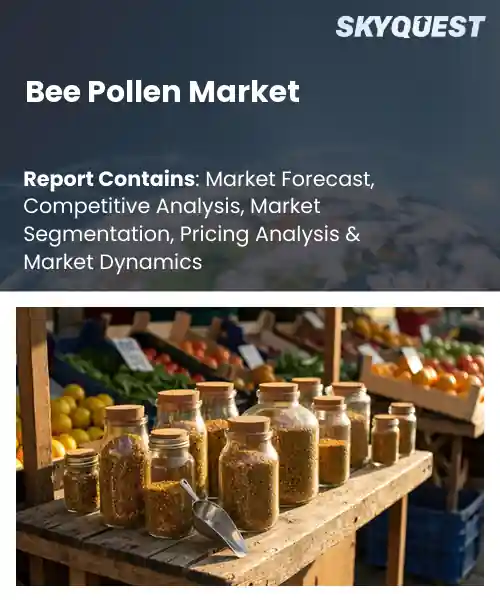
Bee Pollen Market
Report ID: SQMIG20I2890
Report ID: SQMIG20I2890
[email protected]
USA +1 351-333-4748
Report ID:
SQMIG20I2890 |
Region:
Global |
Published Date: April, 2026
Pages:
157
|Tables:
91
|Figures:
76


Global Bee Pollen Market size was valued at USD 642.5 Million in 2024 and is poised to grow from USD 679.12 Million in 2025 to USD 645.8 Million by 2033, growing at a CAGR of 5.7% during the forecast period (2026-2033).
The primary driver of the bee pollen market is rising consumer demand for natural, nutrient dense supplements, which has reshaped production and distribution globally. Bee pollen comprises flower pollen collected by honeybees and marketed as a source of protein, vitamins, and antioxidants, its perceived health benefits have elevated it from regional apiculture byproduct to ingredient. Over a decade, wellness trends and interest in functional foods have expanded retail channels from specialty health stores to mainstream supermarkets and ecommerce. Countries with strong apiculture traditions such as China, Brazil and parts of Europe show how local production scaled to meet export opportunities.Product quality and traceability drive the global bee pollen market because stricter food safety standards and consumer scrutiny compel producers to upgrade processing and certification, enabling access to larger institutional and retail buyers. When processors adopt standardized drying, contaminant testing and organic or origin labelling, retailers and exporters secure premium pricing and enter pharmaceutical, sports nutrition and cosmetic supply chains. For example, supplement brands use standardized bee pollen in immune support blends while natural cosmetics exploit pollen extracts for antioxidant positioning, illustrating how compliance driven improvements translate into scalable commercial applications and support rural beekeeper incomes and diversify local economies.
How is AI improving quality assurance in the bee pollen market?
AI is improving quality assurance in the bee pollen market by combining automated imaging, machine learning, and targeted chemical profiling. Key aspects include rapid pollen identification, contamination detection, and non destructive batch screening that replaces slow manual microscopy. The current state shows growing adoption among laboratories and specialty producers as demand for verified natural ingredients rises. In a market where authenticity concerns and premium positioning matter, AI tools such as hyperspectral imaging and image classifiers standardize results. Digital traceability and automated lab workflows make inspections more consistent and readable across supply chains.AI Technika, December 2025, launched an AI driven digital pollen analysis service that automates identification and supports faster, more consistent quality checks across supply chains. That innovation helps producers and certification bodies scale testing capacity and build trust in premium bee pollen products and reduces rework and returns.
Market snapshot - (2026-2033)
Global Market Size
USD 642.5 Million
Largest Segment
Cloud-based AI Developer Tools
Fastest Growth
Cloud-based AI Developer Tools
Growth Rate
5.7% CAGR
To get more insights on this market click here to Request a Free Sample Report
Global bee pollen market is segmented by toolkit component, deployment mode, end-use vertical (strategic drivers) and region. Based on toolkit component, the market is segmented into Software Libraries & Frameworks (TensorFlow, PyTorch), Cloud-based AI Developer Tools and Professional Managed Services. Based on deployment mode, the market is segmented into Cloud-based Toolkits (SaaS) and On-premise/Edge AI Toolkits. Based on end-use vertical (strategic drivers), the market is segmented into IT & Telecommunications, Healthcare & Life Sciences and Others (Retail, BFSI & Automotive). Based on region, the market is segmented into North America, Europe, Asia Pacific, Latin America and Middle East & Africa.
Cloud-based AI Developer Tools segment dominates because centralized analytics and model management create consistent quality control across diverse apiaries, enabling producers to standardize sorting thresholds and contamination detection. Integrated cloud platforms connect sensor data, imaging systems, and traceability ledgers which simplifies compliance and certification processes, while remote update capabilities accelerate deployment of improved classifiers, resulting in more reliable product grading and streamlined supply chain coordination that strengthens buyer confidence.
However, Software Libraries & Frameworks are emerging as the most rapidly expanding area in the bee pollen market by enabling bespoke models for varietal identification and contamination screening; open-source toolkits let researchers and small producers prototype classifiers and mobile inspection apps, driving niche automation that creates differentiated products and new quality assurance services.
On-premise/Edge AI Toolkits segment dominates because local deployment enables real-time imaging and sorting within processing lines where intermittent connectivity and tight latency constraints exist; running models on site secures proprietary pollen profiles and production data, while direct integration with conveyor systems and sorting hardware reduces spoilage and manual inspection needs, thereby improving batch consistency and operational resilience for producers who require immediate decisions during harvesting and processing cycles.
However, Cloud-based Toolkits (SaaS) are witnessing the strongest growth momentum in the bee pollen market because they lower adoption barriers for small-scale beekeepers, provide continuous model improvements, and enable centralized traceability services; subscription models and remote analytics expand access to quality grading and market linkages, catalyzing broader participation and new value-added services throughout the supply chain.
To get detailed segments analysis, Request a Free Sample Report
Asia Pacific dominance is rooted in a combination of cultural acceptance of apitherapy, sustained consumer interest in natural health solutions, and concentrated beekeeping expertise that yields diverse pollen varieties. Strong domestic demand supports premium positioning and continuous product innovation across forms suited to local consumption habits. Well developed distribution networks including specialty retailers and sophisticated e-commerce channels facilitate wide market reach. Emphasis on quality assurance, traceability and collaboration among producers and research bodies enhances credibility and export readiness. Regional actors tend to prioritize sustainable sourcing and varietal differentiation, allowing brands to command consumer trust while responding quickly to shifting preferences for clean label and functional attributes, thereby reinforcing leadership in both domestic and international markets.
Bee Pollen Market in Japan benefits from entrenched consumer familiarity with natural supplements and high expectations for product safety and provenance. Retail channels including specialty health stores and advanced online platforms support premium positioning and niche innovation. Close ties between apicultural producers and research institutions promote quality assurance and varietal development. Consumer willingness to adopt convenient formats encourages diversification of offerings, while emphasis on certification and transparent sourcing strengthens trust among discerning buyers and supports sustained market presence.
Bee Pollen Market in South Korea is driven by pronounced interest in wellness and beauty applications that favor high quality, cosmetically oriented formulations. Urban retail ecosystems and vibrant online marketplaces accelerate adoption and rapid trial of new brands and formats. Producers focus on purity, sourcing transparency and branding that aligns with appearance and health narratives. Collaboration between manufacturers and marketing specialists facilitates targeted launches, while consumer preference for efficacy and clean labeling sustains demand for premium, well certified products across mainstream and specialty channels.
Rapid expansion in North America is propelled by growing consumer preference for natural, functionally oriented ingredients and robust retail and digital channels that enable fast product discovery and scaling. Clean label positioning and transparent supply chain narratives resonate strongly with ingredient conscious buyers, while health professionals and wellness influencers elevate awareness and acceptance. Investment in standardized testing, third party verification and certification builds consumer confidence and supports entry into mainstream retail. Product innovation that tailors bee pollen into convenient formats for diverse applications enhances cross category penetration. Strategic collaborations between ingredient suppliers, formulators and distributors facilitate broader distribution and targeted marketing, reinforcing market growth and diversification across wellness, sports nutrition and beauty adjacent segments.
Bee Pollen Market in the United States benefits from extensive retail reach encompassing mainstream grocery, specialty health stores and sophisticated direct to consumer platforms. Consumer demand for natural, clean label supplements supports premium and value tier offerings, while investment in traceability and quality testing underpins retailer and consumer confidence. Partnerships between ingredient suppliers and product formulators enable integration into varied applications including sports nutrition and beauty oriented products. Marketing ecosystems and influencer networks further amplify awareness and support rapid product adoption across diverse consumer segments.
Bee Pollen Market in Canada is characterized by consumers who prioritize provenance, safety and environmentally responsible sourcing. Specialty retailers and health food channels cultivate demand for artisanal and certified products, while e-commerce expands access beyond urban centers. Producers emphasize transparent supply chains and certification to differentiate offerings and meet retailer expectations. Collaborative efforts between local producers and research institutions support quality improvements and help position products for expanded distribution within North American networks, enhancing credibility among discerning buyers.
Europe is strengthening its market position through emphasis on regulatory compliance, rigorous quality standards and growing consumer interest in natural and organic health products. Established beekeeping traditions and regional varietal diversity contribute to differentiated product offerings that appeal to premium and specialty segments. Focus on sustainability, traceability and certification enhances consumer trust and aligns with broader environmental concerns. Retail structures including pharmacies, health stores and specialty outlets provide trusted channels for distribution, while cross border trade and collaboration among producers support standardization and innovation. Investment in research, product formulation and targeted marketing is expanding functional uses and integrating bee pollen into wider wellness and food categories, reinforcing Europe role as a sophisticated, quality driven market.
Bee Pollen Market in Germany is supported by a strong culture of health oriented consumption and trust in scientifically backed claims. Channels such as pharmacies and specialized health retailers facilitate distribution of premium and certified products. Emphasis on stringent quality control and sustainability resonates with consumers seeking traceable sourcing. Collaboration between apicultural producers and scientific institutions advances product development and quality assurance, fostering confidence among both retailers and health conscious buyers and enabling sustained market maturation.
Bee Pollen Market in the United Kingdom benefits from a diverse retail mix that includes health shops, online specialists and mainstream retailers that embrace natural supplement categories. Consumer interest in functional wellness and beauty through nutrition drives experimentation with innovative formats. Producers emphasize provenance and testing to satisfy retailer requirements and consumer expectations. Marketing channels and influencer engagement support awareness building, while collaborative initiatives with research bodies encourage credibility and product refinement for discerning market segments.
Bee Pollen Market in France leverages a strong tradition of artisanal food culture and appreciation for provenance, supporting premium positioning of well sourced products. Specialty food and health retailers provide platforms for artisanal and certified offerings, and consumers often value traceability and sustainable practices. Close interaction between beekeepers, certification bodies and research entities promotes high quality standards and varietal differentiation. Branding that emphasizes natural heritage and wellness benefits helps integrate bee pollen into both culinary and supplement use cases, reinforcing market resilience and appeal.
To know more about the market opportunities by region and country, click here to
Buy The Complete Report
Rising Health Consciousness Among Consumers
Expansion Of Functional Food Applications
Supply Variability And Dependence
Regulatory And Quality Assurance Challenges
Request Free Customization of this report to help us to meet your business objectives.
Competitive landscape in the global bee pollen market centres on provenance and supply security, driving M&A, retailer partnerships and agtech adoption as differentiation strategies. For example, established manuka and honey groups have been targets of acquisition. Precision beekeeping platforms are partnering with seed companies and growers to certify pollination. Wellness brands are leveraging investment and retail collaborations to claim provenance and scientific validation.
Top Player’s Company Profile
Recent Developments
SkyQuest’s ABIRAW (Advanced Business Intelligence, Research & Analysis Wing) is our Business Information Services team that Collects, Collates, Correlates, and Analyses the Data collected by means of Primary Exploratory Research backed by robust Secondary Desk research. As per SkyQuest analysis, the global bee pollen market is being driven primarily by rising consumer demand for natural, nutrient-dense supplements and further propelled by expansion of functional food applications that broaden use cases. However supply variability due to seasonal and geographic dependence remains a major restraint, complicating standardization and large-scale procurement. Asia Pacific dominates the market, supported by deep apicultural traditions, strong domestic demand and robust e-commerce channels. Among solution segments, Cloud-based AI Developer Tools are dominating because centralized analytics and model management enable consistent quality assurance and traceability across dispersed apiaries. Continued premiumization and investment in traceability will sustain growth and export readiness.
| Report Metric | Details |
|---|---|
| Market size value in 2024 | USD 642.5 Million |
| Market size value in 2033 | USD 645.8 Million |
| Growth Rate | 5.7% |
| Base year | 2024 |
| Forecast period | (2026-2033) |
| Forecast Unit (Value) | USD Million |
| Segments covered |
|
| Regions covered | North America (US, Canada), Europe (Germany, France, United Kingdom, Italy, Spain, Rest of Europe), Asia Pacific (China, India, Japan, Rest of Asia-Pacific), Latin America (Brazil, Rest of Latin America), Middle East & Africa (South Africa, GCC Countries, Rest of MEA) |
| Companies covered |
|
| Customization scope | Free report customization with purchase. Customization includes:-
|
To get a free trial access to our platform which is a one stop solution for all your data requirements for quicker decision making. This platform allows you to compare markets, competitors who are prominent in the market, and mega trends that are influencing the dynamics in the market. Also, get access to detailed SkyQuest exclusive matrix.
Table Of Content
Executive Summary
Market overview
Parent Market Analysis
Market overview
Market size
KEY MARKET INSIGHTS
COVID IMPACT
MARKET DYNAMICS & OUTLOOK
Market Size by Region
KEY COMPANY PROFILES
Methodology
For the Bee Pollen Market, our research methodology involved a mixture of primary and secondary data sources. Key steps involved in the research process are listed below:
1. Information Procurement: This stage involved the procurement of Market data or related information via primary and secondary sources. The various secondary sources used included various company websites, annual reports, trade databases, and paid databases such as Hoover's, Bloomberg Business, Factiva, and Avention. Our team did 45 primary interactions Globally which included several stakeholders such as manufacturers, customers, key opinion leaders, etc. Overall, information procurement was one of the most extensive stages in our research process.
2. Information Analysis: This step involved triangulation of data through bottom-up and top-down approaches to estimate and validate the total size and future estimate of the Bee Pollen Market.
3. Report Formulation: The final step entailed the placement of data points in appropriate Market spaces in an attempt to deduce viable conclusions.
4. Validation & Publishing: Validation is the most important step in the process. Validation & re-validation via an intricately designed process helped us finalize data points to be used for final calculations. The final Market estimates and forecasts were then aligned and sent to our panel of industry experts for validation of data. Once the validation was done the report was sent to our Quality Assurance team to ensure adherence to style guides, consistency & design.
Analyst Support
Customization Options
With the given market data, our dedicated team of analysts can offer you the following customization options are available for the Bee Pollen Market:
Product Analysis: Product matrix, which offers a detailed comparison of the product portfolio of companies.
Regional Analysis: Further analysis of the Bee Pollen Market for additional countries.
Competitive Analysis: Detailed analysis and profiling of additional Market players & comparative analysis of competitive products.
Go to Market Strategy: Find the high-growth channels to invest your marketing efforts and increase your customer base.
Innovation Mapping: Identify racial solutions and innovation, connected to deep ecosystems of innovators, start-ups, academics, and strategic partners.
Category Intelligence: Customized intelligence that is relevant to their supply Markets will enable them to make smarter sourcing decisions and improve their category management.
Public Company Transcript Analysis: To improve the investment performance by generating new alpha and making better-informed decisions.
Social Media Listening: To analyze the conversations and trends happening not just around your brand, but around your industry as a whole, and use those insights to make better Marketing decisions.
REQUEST FOR SAMPLE
 REQUEST FREE CUSTOMIZATION


Want to customize this report? This report can be personalized according to your needs. Our analysts and industry experts will work directly with you to understand your requirements and provide you with customized data in a short amount of time. We offer $1000 worth of FREE customization at the time of purchase.
Feedback From Our Clients


 USA (+1) 351-333-4748

