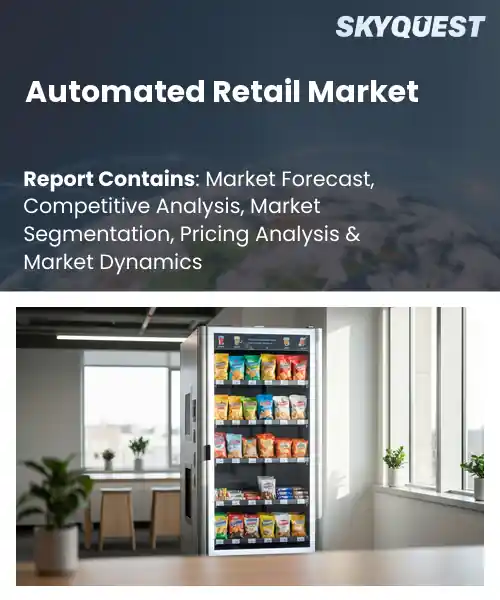
Automated Retail Market
Report ID: SQMIG45E2737
Report ID: SQMIG45E2737
[email protected]
USA +1 351-333-4748
Report ID:
SQMIG45E2737 |
Region:
Global |
Published Date: April, 2026
Pages:
157
|Tables:
119
|Figures:
77


Global Automated Retail Market size was valued at USD 15.4 Billion in 2024 and is poised to grow from USD 18.8 Billion in 2025 to USD 15.7 Billion by 2033, growing at a CAGR of 22.1% during the forecast period (2026-2033).
Automated retail refers to digitally enabled points of sale such as vending machines, lockers, and unmanned kiosks that deliver goods and services without storefront staff, and its primary driver is demand for convenience combined with advances in sensor, payment and connectivity technologies. The market matters because it reduces labor costs, extends service hours, and captures impulse purchases in high footfall locations, so retailers can optimize footprint and inventory. Over the last decade adoption expanded from simple snack vending to smart refrigerated machines and cashierless microstores, exemplified by companies deploying networked machines in transit hubs, campus environments and corporate campuses globally.Building on global deployment, a key factor driving the Global Automated Retail Market is data analytics capability that turns transaction and sensor inputs into actionable insights, which increases sales and reduces stockouts by enabling predictive replenishment. As retailers integrate cloud platforms and machine learning, they can tailor assortments to local demand and implement dynamic pricing, leading to higher revenue per machine and lower waste in perishable categories. Practical examples include logistics firms scheduling routes based on real time consumption and beverage brands rotating promotions through software updates, so investors and operators see clearer return on investment and faster rollouts profitably.
How is AI enhancing customer experience in the automated retail market?
AI is reshaping customer experience in the automated retail market by enabling seamless checkout, on the spot personalization and clearer inventory awareness. Key aspects include computer vision that recognizes items, conversational interfaces that assist shoppers and predictive models that tailor offers and staffing. The market is moving from experimental pilots to practical rollouts in places where convenience matters most. Retailers focus on reducing friction, delivering immediate receipts and creating contextual promotions that feel helpful rather than intrusive. These capabilities shorten perceived wait times and produce more consistent service, making automated retail more attractive to operators and easier for customers to adopt.AiFi April 2026, the company launched checkout free stores at Inter Miami's Nu Stadium, showing AI powered computer vision that speeds transactions and enables personalized offers at scale. This deployment improves customer flow and reduces operational complexity, which supports faster venue rollouts and more efficient automated retail operations.
Market snapshot - (2026-2033)
Global Market Size
USD 15.4 Billion
Largest Segment
Intelligent Vending Machines (Smart Kiosks)
Fastest Growth
Cashierless Stores (Just-Walk-Out Tech)
Growth Rate
22.1% CAGR
To get more insights on this market click here to Request a Free Sample Report
Global automated retail market is segmented by machine/retail format, technology component, product vertical, end-user location and region. Based on machine/retail format, the market is segmented into Intelligent Vending Machines (Smart Kiosks), Automated Micro-Markets, Cashierless Stores (Just-Walk-Out Tech) and Automated Parcel & Grocery Lockers. Based on technology component, the market is segmented into Computer Vision & Weight Sensors, Biometric & Mobile Payment Systems and Inventory Management & AI Analytics Software. Based on product vertical, the market is segmented into Food & Beverage (Fresh/Prepared Meals), Consumer Electronics & Luxury Goods, Pharmaceutical & Health Essentials and Apparel & Personal Care. Based on end-user location, the market is segmented into Airports & Transit Hubs, Corporate Offices & Business Parks and Retail Malls & Residential Complexes. Based on region, the market is segmented into North America, Europe, Asia Pacific, Latin America and Middle East & Africa.
Intelligent Vending Machines (Smart Kiosks) segment dominates because these machines combine compact footprint with flexible product assortments and continuous availability, enabling operators to deploy retail points quickly and cost effectively. Their integration with mobile payments and telemetry creates tighter inventory control and customer insights, which in turn reduce stockouts and shrinkage and support partnerships with brands seeking rapid market access, driving broad adoption across venues.
However, Automated Micro-Markets are the fastest growing area as they offer broader assortments and fresh prepared options that match evolving on-site demand. Their mini-store experience with integrated payments and remote inventory attracts workplace and venue operators, enabling higher basket values and creating opportunities for premium product and service partnerships.
Inventory Management & AI Analytics Software segment leads because it provides visibility across dispersed automated retail points, enabling predictive replenishment and dynamic assortment decisions that minimize downtime and lost sales. By translating telemetry into actionable insights, these systems drive automated ordering, shrinkage reduction and personalization, which lowers operational costs and strengthens vendor relationships, thereby making advanced software foundational to scaling automated retail deployments and supporting diverse product verticals.
Meanwhile, Computer Vision & Weight Sensors are the most rapidly expanding technology as they enable accurate item-level detection and frictionless checkout experiences critical to cashierless formats. By improving loss prevention and supporting richer analytics for shopper behavior, these capabilities accelerate deployment of cashierless stores and unlock new retail formats.
To get detailed segments analysis, Request a Free Sample Report
Asia Pacific dominates due to concentrated urban populations, rapid adoption of digital payment infrastructure, and strong technology manufacturing ecosystems that enable wide deployment of automated retail solutions. Regional consumer preferences favor convenience and contactless interactions, while high retail density creates favorable use cases for vending, kiosks, and automated stores. Local vendors and global providers collaborate with retailers and transit operators to integrate hardware, software, and logistics, driving tailored solutions for varied markets. Supportive policies and investment climates in key economies encourage pilot programs and scale ups. A mature electronics supply chain and advanced robotics capabilities reduce deployment complexity and cost, enabling faster iteration of business models. Combined, these factors create a reinforcing environment where demand, supply, and innovation accelerate the market profile across the region.
Automated Retail Market in Japan benefits from dense urban networks, high consumer comfort with technology, and a strong domestic robotics and electronics base that supports refined deployments. Retailers and transit operators pursue automated solutions to enhance convenience and efficiency, while local integrators focus on seamless payment and inventory systems. Cultural acceptance of vending and unmanned formats helps pilot innovative concepts, enabling refinement of service models and user experiences in centers.
Automated Retail Market in South Korea is propelled by advanced mobile payment habits, strong urban infrastructure, and active collaboration between technology providers and retailers to deliver quality automated formats. Focus on seamless user interfaces and fast replenishment models supports convenience retailing in dense commercial zones. Local innovation emphasizes data driven merchandising and integration with public transport networks, allowing pilots to expand into scalable concepts while maintaining alignment with consumer expectations.
North America exhibits rapid expansion driven by a combination of widespread retail digitization, high consumer expectations for convenience, and strong investment activity in automation technologies. Retail chains, workplace operators, and transport hubs pursue automated formats to reduce friction and tailor service hours, while technology vendors deliver integrated solutions combining hardware, software, and analytics. Emphasis on omnichannel retail and seamless payment ecosystems creates demand for pick up, kiosk, and unattended store concepts that complement traditional outlets. Collaborative pilots involving retailers, logistics providers, and solution integrators enable iterative refinement of user experience and operations. Regulatory clarity and an emphasis on labor efficiency further encourage experimentation, positioning the region as a test bed for commercially scalable automated retail models. Data driven insights from customer interactions and inventory telemetry support refined merchandising and service personalization, helping operators optimize formats for urban and suburban contexts.
Automated Retail Market in United States reflects diverse deployment across retail and transportation hubs, supported by strong vendor ecosystems and mature payment infrastructure. Operators prioritize integration with loyalty and omnichannel platforms to drive convenience and retention, while developers focus on reliable hardware, remote monitoring, and predictive replenishment. Pilot projects evolve into standard offerings when operational models prove resilient, and partnerships between national retailers and technology providers help scale solutions nationally.
Automated Retail Market in Canada reflects targeted adoption across urban corridors and venues, driven by collaboration between retailers and technology providers to address convenience and labor challenges. Emphasis on robust service support and local customization helps operators adapt hardware and software for regional preferences and interfaces. Trials often focus on integration with existing retail systems and logistics networks, enabling expansion into broader footprints when operational performance and customer acceptance align.
Europe is strengthening its position through coordinated efforts among technology innovators, retail groups, and logistics providers to adapt automated retail solutions to diverse market needs. Focus on interoperability, energy efficiency, and compliance with regional standards aids deployment in mixed urban and suburban contexts. Retailers emphasize omnichannel coordination and store automation to enhance convenience while controlling operating costs, and solution providers tailor hardware and software for varied languages and consumer behaviors. Cross border pilots and industry collaborations help validate models across different regulatory and cultural environments, while emphasis on customer privacy and secure payments builds trust. These factors support gradual translation of prototypes into commercially viable formats across a wide set of markets.
Automated Retail Market in Germany focuses on industrial grade hardware, robust maintenance frameworks, and energy conscious designs that align with operational expectations. Technology providers work closely with retail chains and property operators to integrate automated formats into existing store networks and mobility hubs. Pilots stress reliability, data security, and compliance with regional regulations, enabling solutions to move from experimental trials to established service offerings across commercial corridors and logistical nodes.
Automated Retail Market in United Kingdom combines urban convenience initiatives with strong retail innovation ecosystems, emphasizing user experience and payment flexibility. Retailers pilot unattended stores and kiosk concepts in transportation hubs, integrating loyalty programs and mobile ordering to create seamless journeys. Focus on accessibility and consumer trust drives careful selection of technology partners, while supply chain coordination and support underpin roll out when pilots demonstrate customer acceptance and operational resilience.
Automated Retail Market in France emphasizes engagement and integration with local retail formats to reflect varied urban lifestyles. Retailers and solution providers collaborate to create unattended formats that align with neighborhood shopping behaviors and transport nodes, with attention to interfaces and payment variety. Pilot programs concentrate on user centric experiences and reliable operations, supported by partnerships that address maintenance, logistics, and retail merchandising to enable scale up across metropolitan corridors.
To know more about the market opportunities by region and country, click here to
Buy The Complete Report
Rising Consumer Demand is Key
Advancements In Payment Technologies
High Initial Deployment Costs
Regulatory And Compliance Challenges
Request Free Customization of this report to help us to meet your business objectives.
Competition in the global automated retail market is driven by technology differentiation, strategic commercial pilots and partnership-led rollouts rather than pure price wars. Leading moves include platform integrations and regional rollups, with examples such as Amazon expanding Just Walk Out, Shopic pilots enabling smart trolleys at Waitrose, and European checkout free startups raising seed rounds to scale across petrol and convenience networks.
Top Player’s Company Profile
Recent Developments
SkyQuest’s ABIRAW (Advanced Business Intelligence, Research & Analysis Wing) is our Business Information Services team that Collects, Collates, Correlates, and Analyses the Data collected by means of Primary Exploratory Research backed by robust Secondary Desk research. As per SkyQuest analysis, the global automated retail market is propelled primarily by consumer demand for quick, contactless convenience enabled by advances in sensors, payment and connectivity, while adoption is tempered by high initial deployment costs for hardware and integration. Asia Pacific leads the market due to dense urbanization, strong digital payments and a mature electronics supply chain, and intelligent vending machines or smart kiosks remain the dominant format because of compact footprints and flexible assortments. A complementary driver is the rise of inventory management and AI analytics that enable predictive replenishment, dynamic assortments and higher per-machine revenues, helping operators achieve faster, profitable rollouts.
| Report Metric | Details |
|---|---|
| Market size value in 2024 | USD 15.4 Billion |
| Market size value in 2033 | USD 15.7 Billion |
| Growth Rate | 22.1% |
| Base year | 2024 |
| Forecast period | (2026-2033) |
| Forecast Unit (Value) | USD Billion |
| Segments covered |
|
| Regions covered | North America (US, Canada), Europe (Germany, France, United Kingdom, Italy, Spain, Rest of Europe), Asia Pacific (China, India, Japan, Rest of Asia-Pacific), Latin America (Brazil, Rest of Latin America), Middle East & Africa (South Africa, GCC Countries, Rest of MEA) |
| Companies covered |
|
| Customization scope | Free report customization with purchase. Customization includes:-
|
To get a free trial access to our platform which is a one stop solution for all your data requirements for quicker decision making. This platform allows you to compare markets, competitors who are prominent in the market, and mega trends that are influencing the dynamics in the market. Also, get access to detailed SkyQuest exclusive matrix.
Table Of Content
Executive Summary
Market overview
Parent Market Analysis
Market overview
Market size
KEY MARKET INSIGHTS
COVID IMPACT
MARKET DYNAMICS & OUTLOOK
Market Size by Region
KEY COMPANY PROFILES
Methodology
For the Automated Retail Market, our research methodology involved a mixture of primary and secondary data sources. Key steps involved in the research process are listed below:
1. Information Procurement: This stage involved the procurement of Market data or related information via primary and secondary sources. The various secondary sources used included various company websites, annual reports, trade databases, and paid databases such as Hoover's, Bloomberg Business, Factiva, and Avention. Our team did 45 primary interactions Globally which included several stakeholders such as manufacturers, customers, key opinion leaders, etc. Overall, information procurement was one of the most extensive stages in our research process.
2. Information Analysis: This step involved triangulation of data through bottom-up and top-down approaches to estimate and validate the total size and future estimate of the Automated Retail Market.
3. Report Formulation: The final step entailed the placement of data points in appropriate Market spaces in an attempt to deduce viable conclusions.
4. Validation & Publishing: Validation is the most important step in the process. Validation & re-validation via an intricately designed process helped us finalize data points to be used for final calculations. The final Market estimates and forecasts were then aligned and sent to our panel of industry experts for validation of data. Once the validation was done the report was sent to our Quality Assurance team to ensure adherence to style guides, consistency & design.
Analyst Support
Customization Options
With the given market data, our dedicated team of analysts can offer you the following customization options are available for the Automated Retail Market:
Product Analysis: Product matrix, which offers a detailed comparison of the product portfolio of companies.
Regional Analysis: Further analysis of the Automated Retail Market for additional countries.
Competitive Analysis: Detailed analysis and profiling of additional Market players & comparative analysis of competitive products.
Go to Market Strategy: Find the high-growth channels to invest your marketing efforts and increase your customer base.
Innovation Mapping: Identify racial solutions and innovation, connected to deep ecosystems of innovators, start-ups, academics, and strategic partners.
Category Intelligence: Customized intelligence that is relevant to their supply Markets will enable them to make smarter sourcing decisions and improve their category management.
Public Company Transcript Analysis: To improve the investment performance by generating new alpha and making better-informed decisions.
Social Media Listening: To analyze the conversations and trends happening not just around your brand, but around your industry as a whole, and use those insights to make better Marketing decisions.
REQUEST FOR SAMPLE
 REQUEST FREE CUSTOMIZATION


Want to customize this report? This report can be personalized according to your needs. Our analysts and industry experts will work directly with you to understand your requirements and provide you with customized data in a short amount of time. We offer $1000 worth of FREE customization at the time of purchase.
Feedback From Our Clients


 USA (+1) 351-333-4748

