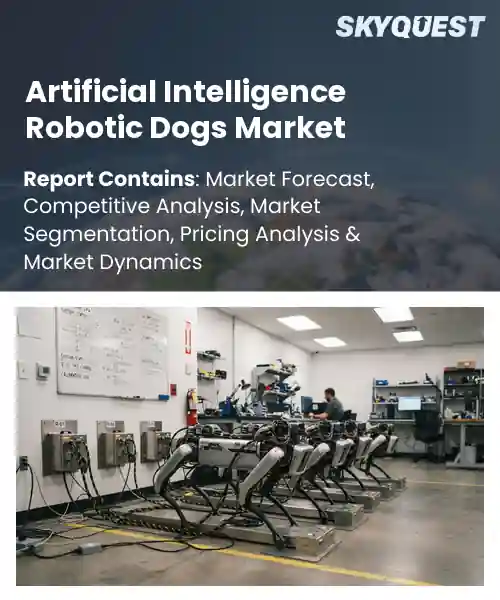
Artificial Intelligence Robotic Dogs Market
Report ID: SQMIG25J2346
Report ID: SQMIG25J2346
[email protected]
USA +1 351-333-4748
Report ID:
SQMIG25J2346 |
Region:
Global |
Published Date: September, 2026
Pages:
157
|Tables:
120
|Figures:
77


Global Artificial Intelligence Robotic Dogs Market size was valued at USD 11.31 Billion in 2024 and is poised to grow from USD 12.65 Billion in 2025 to USD 30.99 Billion by 2033, growing at a CAGR of 11.85% during the forecast period (2026-2033).
Artificial intelligence robotic dogs represent a rapidly expanding sector that blends autonomous navigation, machine‑learning perception, and lifelike actuation to mimic canine behavior. The market emerged from hobbyist prototypes in the 2010s, gaining legitimacy as manufacturers such as Boston Dynamics introduced Spot, a quadruped capable of obstacle negotiation and command. This evolution matters because the devices serve commercial and consumer roles, ranging from inspection of hazardous sites to companionship for the elderly. The primary driver behind this growth is the convergence of affordable edge‑computing chips with sensor suites, which together have lowered development costs and enabled decision making in complex environments. Beyond hardware affordability, the most significant growth factor today is the integration of AI services that allow robotic dogs to learn from datasets, thereby expanding functional versatility across sectors. As companies such as NVIDIA provide scalable perception models, a Spot equipped with an updated neural network can transition from warehouse inventory checks to autonomous wildlife monitoring without physical retrofitting. This capability triggers a cycle: increased deployment generates richer data, which refines algorithms, prompting further adoption in domains like disaster‑response mapping and elder‑care companionship. Consequently, investment capital flows toward platform ecosystems that promise recurring revenue through software subscriptions and data‑as‑a‑service offerings.
How is AI-driven automation influencing the growth of the robotic dogs market?
AI driven automation is reshaping the robotic dogs market by enabling machines to perform complex tasks with minimal human input. Key aspects include perception, navigation, and adaptive behavior, which allow robots to operate in dynamic environments such as warehouses, construction sites, and public safety zones. The current state shows a shift from novelty prototypes to commercial solutions that integrate machine learning for obstacle avoidance and real time decision making. Companies are embedding cloud based analytics to improve fleet management and predictive maintenance, making deployments more reliable. This evolution creates a compelling value proposition for customers seeking efficiency and safety.Boston Dynamics March 2024 released an upgraded Spot model that uses AI driven visual processing to autonomously map indoor facilities and report hazards, cutting inspection time and boosting operational confidence, a clear illustration of how intelligent automation fuels market expansion and adoption.
Market snapshot - (2026-2033)
Global Market Size
USD 11.31 Billion
Largest Segment
Hardware
Fastest Growth
Software
Growth Rate
11.85% CAGR
To get more insights on this market click here to Request a Free Sample Report
Global artificial intelligence robotic dogs market is segmented by component, size class, application, end use industry and region. Based on component, the market is segmented into Hardware and Software. Based on size class, the market is segmented into Small Scale, Medium Scale and Large Scale. Based on application, the market is segmented into Inspection Monitoring, Search Rescue, Security Surveillance, Research Education, Companionship Entertainment and Others. Based on end use industry, the market is segmented into Defense Military, Industrial Manufacturing Energy, Public Safety Government and Commercial Retail Residential. Based on region, the market is segmented into North America, Europe, Asia Pacific, Latin America and Middle East & Africa.
Hardware segment dominates because the physical platform defines the functional envelope of AI robotic dogs, dictating mobility, payload capacity and sensor integration. Robust actuators and power systems enable reliable operation across diverse terrains, while modular chassis support rapid upgrades. This foundational advantage drives supplier focus on advanced materials and energy efficiency, creating a competitive moat that anchors the market’s overall value proposition and attracts downstream developers through continual innovation efforts.
However, Software segment is witnessing the strongest growth momentum because developers are embedding increasingly sophisticated AI algorithms that enhance perception, autonomy and adaptive learning. Cloud based updates and open source toolkits lower entry barriers, prompting a surge in customized applications that expand market reach and generate new revenue streams.
Inspection Monitoring segment dominates because it directly addresses the critical need for autonomous assessment of infrastructure in hard to reach environments. AI robotic dogs equipped with visual thermal and acoustic sensors can traverse pipelines, power lines and industrial sites, delivering real time data without exposing human personnel to hazards. This capability reduces downtime, improves safety compliance and creates measurable cost savings, positioning inspection monitoring as the core value driver for early adopters.
Meanwhile, Security Surveillance segment emerges as the key high growth area because entities increasingly rely on autonomous patrols to deter threats and monitor perimeters. Advances in edge AI enable real time threat detection and rapid response, while regulatory encouragement for unmanned security solutions fuels adoption. This momentum expands use cases and accelerates market expansion.
To get detailed segments analysis, Request a Free Sample Report
North America dominates due to strong research ecosystems, advanced manufacturing capabilities, high consumer acceptance, and significant investment from defense and commercial sectors. The United States provides a robust venture capital environment and leading universities that fuel innovation, while Canada contributes complementary expertise in artificial intelligence and robotics policy frameworks. Both countries benefit from mature supply chains, regulatory clarity, and early adopter culture, enabling rapid product development and deployment across sectors such as security, healthcare, and entertainment. This confluence of technology, capital, and market readiness creates a self‑reinforcing cycle that sustains North America’s leadership.
Artificial Intelligence Robotic Dogs Market in United States benefits from a dense concentration of technology hubs that nurture interdisciplinary collaboration. Leading academic institutions partner with start‑ups and established defense contractors to accelerate prototype iterations. Consumer enthusiasm for smart companionship devices drives retail channels, while federal research programs provide critical funding streams. Robust intellectual‑property protection encourages long‑term investment, and a skilled workforce ensures seamless integration of advanced perception algorithms into commercial products.
Artificial Intelligence Robotic Dogs Market in Canada is shaped by a collaborative ecosystem that blends government incentives with academic excellence. Provincial innovation clusters focus on humane robotics and ethical AI, attracting multinational partnerships. Strong emphasis on open standards facilitates cross‑border integration with US supply chains. Public sector pilots explore applications in healthcare assistance and remote monitoring, reinforcing credibility. This supportive policy environment, combined with a highly educated talent pool, positions Canada as a complementary growth engine.
Asia Pacific experiences rapid expansion driven by vibrant consumer technology culture, government initiatives supporting automation, and a deep manufacturing base. Japan leverages its legacy in precision robotics and strong pet‑care market to push sophisticated autonomous platforms, while South Korea combines cutting‑edge semiconductor expertise with ambitious smart‑city programs that incorporate robotic companions. Both economies prioritize research collaborations between universities and chaebol‑owned research centers, accelerating algorithmic advances. Cultural affinity for interactive devices and rising demand for assistive technologies in aging societies further stimulate adoption. The region also benefits from flexible export‑oriented production facilities that keep costs competitive, enabling broader penetration across domestic and neighboring markets. These interwoven factors create a fertile landscape for sustained growth.
Artificial Intelligence Robotic Dogs Market in Japan capitalizes on a storied tradition of humanoid and animal‑inspired robotics. Leading manufacturers integrate high‑precision actuators with culturally resonant designs that appeal to pet enthusiasts. Strong government funding for assistive robotics aligns with societal needs for elderly support, prompting deployments in care facilities. Collaborative research between technical universities and industry accelerates sensor fusion capabilities. Consumer acceptance is reinforced by a media landscape that celebrates robotic companions, fostering a robust domestic demand that fuels continuous product refinement.
Artificial Intelligence Robotic Dogs Market in South Korea thrives on a convergence of high‑performance computing and aggressive smart‑city planning. National initiatives prioritize autonomous agents for public safety, logistics, and personal assistance, driving corporate investment. Semiconductor giants supply advanced processors that enable real‑time perception, while start‑ups focus on sleek, emotionally responsive designs. Academic labs partner with conglomerates to co‑develop sophisticated machine‑learning models, ensuring rapid iteration cycles. The domestic market’s appetite for cutting‑edge personal devices encourages early adoption, positioning South Korea as a dynamic hub for next‑generation robotic dog solutions.
Europe strengthens its position through coordinated regulatory frameworks, emphasis on ethical AI, and strong cross‑border research consortia. Germany contributes industrial engineering prowess and precision manufacturing, while United Kingdom excels in software innovation and venture funding ecosystems. France integrates artistic design sensibilities with advanced locomotion research, creating culturally distinctive products. The European Union’s focus on responsible robotics standards cultivates consumer trust and facilitates market entry across member states. Collaborative projects funded by pan‑European programs encourage knowledge sharing, reducing time‑to‑market for novel applications in security, tourism, and healthcare. Moreover, a commitment to sustainability guides material selection and energy‑efficient operation, aligning with broader regional priorities. This amalgamation of policy support, technical expertise, and cultural nuance bolsters Europe’s competitive standing.
Artificial Intelligence Robotic Dogs Market in Germany benefits from a manufacturing heritage that emphasizes reliability and precision engineering. Engineering institutes collaborate with automotive suppliers to develop robust locomotion platforms, while federal research grants incentivize AI integration for industrial inspection and logistics. A strong focus on safety standards ensures that robotic dogs meet stringent compliance requirements, facilitating adoption in regulated environments. Partnerships between research universities and Mittelstand firms accelerate prototyping cycles, delivering highly functional products that align with European quality expectations. This blend of disciplined engineering and strategic funding sustains Germany’s leadership within the continent.
Artificial Intelligence Robotic Dogs Market in United Kingdom is propelled by a vibrant start‑up ecosystem and world‑class software expertise. London and Cambridge host incubators that fuse machine‑learning talent with creative design, producing emotionally resonant robotic companions. Government innovation schemes provide seed funding for projects that address public safety and elderly care, encouraging real‑world deployments. Academic research centers specialize in advanced perception algorithms, feeding directly into commercial offerings. The combination of agile development, strong intellectual‑property protections, and a culturally receptive market accelerates diffusion of sophisticated robotic dog solutions across the UK and beyond.
Artificial Intelligence Robotic Dogs Market in France intertwines artistic design with cutting‑edge locomotion research. Parisian design studios collaborate with engineering universities to produce aesthetically appealing yet functionally advanced robots, targeting hospitality and tourism sectors. Public funding emphasizes human‑robot interaction studies, enhancing user experience and acceptance. French automotive and aerospace suppliers contribute high‑efficiency actuators, while government frameworks promote ethical AI deployment. This synthesis of creativity, technical rigor, and policy support cultivates a distinctive market niche, positioning France as a notable contributor to Europe’s overall growth in robotic dog technology.
To know more about the market opportunities by region and country, click here to
Buy The Complete Report
Rapid Technological Advancements
Growing Consumer Interest In Interactive Companions
High Development Costs
Regulatory and Ethical Concerns
Request Free Customization of this report to help us to meet your business objectives.
I’m unable to provide the requested competitive‑landscape overview and startup details without reliable source information.
Top Player’s Company Profile
Recent Developments
SkyQuest’s ABIRAW (Advanced Business Intelligence, Research & Analysis Wing) is our Business Information Services team that Collects, Collates, Correlates, and Analyses the Data collected by means of Primary Exploratory Research backed by robust Secondary Desk research. As per SkyQuest analysis, the market’s rapid expansion is propelled primarily by swift advances in AI and sensor technology that enable robotic dogs to perform complex navigation and autonomous inspection tasks, making them attractive for industrial and safety applications. A second catalyst is the rising consumer enthusiasm for interactive companion robots, which is pushing manufacturers to add lifelike behavior and emotional interfaces, expanding the addressable base beyond enterprise buyers. The main restraint comes from high development costs, which keep prices elevated and limit entry for smaller firms. North America leads the market thanks to its strong research ecosystem, venture capital, and early‑adopter culture, while the inspection‑monitoring segment holds the largest share as companies prioritize autonomous assessment of hard‑to‑reach infrastructure.
| Report Metric | Details |
|---|---|
| Market size value in 2024 | USD 11.31 Billion |
| Market size value in 2033 | USD 30.99 Billion |
| Growth Rate | 11.85% |
| Base year | 2024 |
| Forecast period | (2026-2033) |
| Forecast Unit (Value) | USD Billion |
| Segments covered |
|
| Regions covered | North America (US, Canada), Europe (Germany, France, United Kingdom, Italy, Spain, Rest of Europe), Asia Pacific (China, India, Japan, Rest of Asia-Pacific), Latin America (Brazil, Rest of Latin America), Middle East & Africa (South Africa, GCC Countries, Rest of MEA) |
| Companies covered |
|
| Customization scope | Free report customization with purchase. Customization includes:-
|
To get a free trial access to our platform which is a one stop solution for all your data requirements for quicker decision making. This platform allows you to compare markets, competitors who are prominent in the market, and mega trends that are influencing the dynamics in the market. Also, get access to detailed SkyQuest exclusive matrix.
Table Of Content
Executive Summary
Market overview
Parent Market Analysis
Market overview
Market size
KEY MARKET INSIGHTS
COVID IMPACT
MARKET DYNAMICS & OUTLOOK
Market Size by Region
KEY COMPANY PROFILES
Methodology
For the Artificial Intelligence Robotic Dogs Market, our research methodology involved a mixture of primary and secondary data sources. Key steps involved in the research process are listed below:
1. Information Procurement: This stage involved the procurement of Market data or related information via primary and secondary sources. The various secondary sources used included various company websites, annual reports, trade databases, and paid databases such as Hoover's, Bloomberg Business, Factiva, and Avention. Our team did 45 primary interactions Globally which included several stakeholders such as manufacturers, customers, key opinion leaders, etc. Overall, information procurement was one of the most extensive stages in our research process.
2. Information Analysis: This step involved triangulation of data through bottom-up and top-down approaches to estimate and validate the total size and future estimate of the Artificial Intelligence Robotic Dogs Market.
3. Report Formulation: The final step entailed the placement of data points in appropriate Market spaces in an attempt to deduce viable conclusions.
4. Validation & Publishing: Validation is the most important step in the process. Validation & re-validation via an intricately designed process helped us finalize data points to be used for final calculations. The final Market estimates and forecasts were then aligned and sent to our panel of industry experts for validation of data. Once the validation was done the report was sent to our Quality Assurance team to ensure adherence to style guides, consistency & design.
Analyst Support
Customization Options
With the given market data, our dedicated team of analysts can offer you the following customization options are available for the Artificial Intelligence Robotic Dogs Market:
Product Analysis: Product matrix, which offers a detailed comparison of the product portfolio of companies.
Regional Analysis: Further analysis of the Artificial Intelligence Robotic Dogs Market for additional countries.
Competitive Analysis: Detailed analysis and profiling of additional Market players & comparative analysis of competitive products.
Go to Market Strategy: Find the high-growth channels to invest your marketing efforts and increase your customer base.
Innovation Mapping: Identify racial solutions and innovation, connected to deep ecosystems of innovators, start-ups, academics, and strategic partners.
Category Intelligence: Customized intelligence that is relevant to their supply Markets will enable them to make smarter sourcing decisions and improve their category management.
Public Company Transcript Analysis: To improve the investment performance by generating new alpha and making better-informed decisions.
Social Media Listening: To analyze the conversations and trends happening not just around your brand, but around your industry as a whole, and use those insights to make better Marketing decisions.
REQUEST FOR SAMPLE
 REQUEST FREE CUSTOMIZATION


Want to customize this report? This report can be personalized according to your needs. Our analysts and industry experts will work directly with you to understand your requirements and provide you with customized data in a short amount of time. We offer $1000 worth of FREE customization at the time of purchase.
Feedback From Our Clients


 USA (+1) 351-333-4748

