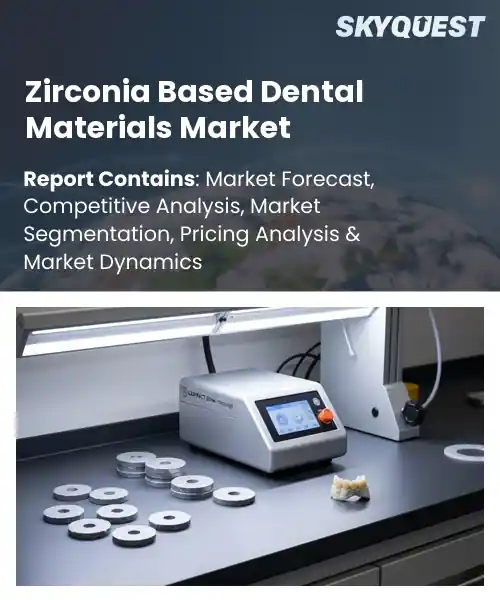
Zirconia Based Dental Materials Market
Report ID: SQMIG35A3418
Report ID: SQMIG35A3418
[email protected]
USA +1 351-333-4748
Report ID:
SQMIG35A3418 |
Region:
Global |
Published Date: May, 2026
Pages:
157
|Tables:
184
|Figures:
79


Global Zirconia Based Dental Materials Market size was valued at USD 354.9 Million in 2024 and is poised to grow from USD 380.81 Million in 2025 to USD 669.12 Million by 2033, growing at a CAGR of 7.3% during the forecast period (2026-2033).
Zirconia-based dental materials constitute a segment of restorative and prosthetic dentistry focused on engineered zirconium dioxide ceramics used for crowns, bridges, implant abutments and frameworks. The primary driver is a combined patient and clinician demand for high-strength, tooth-colored restorations that resist fracture while offering excellent biocompatibility; this demand has grown as populations age and aesthetic expectations rise. Historically the market shifted from porcelain-fused-to-metal toward monolithic zirconia and layered high-translucency formulations, and adoption accelerated with CAD/CAM milling and sintering workflows in dental labs and chairside units.
For example, molar monolithic zirconia replaced metal porcelains to reduce chipping and simplify laboratory processes.Technological innovation and digital workflow integration act as the pivotal factor driving global zirconia based dental materials market growth because material improvements change clinical decision-making and open new applications. Higher-translucency multilayer zirconia has caused clinicians to choose monolithic restorations even for anterior teeth, which in turn expanded laboratory demand for advanced milling and sintering equipment. As labs scale production and manufacturers optimize formulations, unit costs decline and training proliferates, enabling wider uptake in emerging markets. Clinical use cases such as full-arch zirconia implant prostheses for edentulous patients and monolithic crowns for bruxers demonstrate tangible outcomes, creating clear commercial opportunities for suppliers and channels.
How is AI improving clinical outcomes in the zirconia-based dental materials market?
AI is making a difference in the clinical outcomes of many restorative procedures using zirconia-based dental materials. Through the use of AI-assisted digital workflow systems, restorative procedures have become more predictable than ever before. Key areas of improvement include margin detection using AI-assisted scan analysis and occlusion setup, as well as automated design proposal generation that allow for less need for chairside adjustments and improved fit. Today, there is an increasing volume of AI being used for both laboratory and chairside systems, with automated processes both speeding up the design process and standardizing the quality of the finished product. These laboratory systems using AI will work together to provide improved aesthetics, a more uniform product, and a more durable product through the use of new materials that minimize processing times. Examples of how these new technologies have changed would be AI-assisted bite alignment and margin detection.
3Shape introduced their new AI-powered dental system in February 2026, which will provide fully automated procedures for both bite alignment and margin detection as well as editable bridge proposal generation, thereby reducing both laboratory cycle times and adjustments. The accuracy produced through AI will give clinicians much more predictable zirconia restorations, resulting in more efficient clinical outcomes for both laboratories and clinics.
Market snapshot - (2026-2033)
Global Market Size
USD 354.9 Million
Largest Segment
Zirconia Discs
Fastest Growth
Multilayer Zirconia Materials
Growth Rate
7.3% CAGR
To get more insights on this market click here to Request a Free Sample Report
Global zirconia based dental materials market is segmented by product type, material type, application, manufacturing method, end user, distribution channel and region. Based on product type, the market is segmented into Zirconia Discs, Zirconia Blocks, Zirconia Powders, Pre-Shaded Zirconia Materials, Multilayer Zirconia Materials and Others. Based on material type, the market is segmented into Monolithic Zirconia, High Translucent Zirconia, Partially Stabilized Zirconia, Full Contour Zirconia, Zirconia Toughened Alumina (ZTA) and Others. Based on application, the market is segmented into Dental Crowns, Dental Bridges, Dental Implants, Dentures, Veneers, Abutments, Inlays & Onlays and Others. Based on manufacturing method, the market is segmented into CAD/CAM Milling, Conventional Fabrication and 3D Printing/Additive Manufacturing. Based on end user, the market is segmented into Dental Laboratories, Dental Clinics, Hospitals, Academic & Research Institutes and Others. Based on distribution channel, the market is segmented into Direct Sales, Third-Party Distributors and Online Sales. Based on region, the market is segmented into North America, Europe, Asia Pacific, Latin America and Middle East & Africa.
As per zirconia based dental materials market outlook, multilayer zirconia materials dominate this segment because of their ability to provide superior lifelike restorations with a built-in gradient of translucency and shade while allowing fewer technical layering steps. With improved optical continuity, multilayer zirconia also allow for fewer adjustments and fewer remakes, thus increasing technician and clinician preference for multilayer. Manufacturers emphasis on multilayer production has led to improved material consistency and CAD/CAM compatibility, which allows for streamlined workflows, reduced chairside and laboratory time and efficiency beyond CAD/CAM and predictability in aesthetics.
As per zirconia based dental materials market forecast, pre-shaded zirconia materials are quickly becoming the fastest growing segment of the zirconia market due to their ease of color matching and reduction in finishing steps, making them very appealing to laboratories with high throughput. With easier integration into the digital shade selection process and faster turnaround times, laboratories and clinics are increasingly adopting pre-shaded zirconia materials, thus expanding their use cases and providing manufacturers an opportunity to offer standardised, time-saving products.
The CAD/CAM milling segment leads zirconia based dental materials market share by providing a predictable and precise means of producing restorations with high compatibility to zirconia discs and blocks, thus consistently matching the fit and occlusion of restorations. The digital workflow has matured and most of the manual variability has been removed, and in addition, it fully integrates with both the scanning and design software, greatly increasing the throughput at labs and improving repeatability. The widespread familiarity of clinicians and technicians with milling is driving procurement and material formulation, thereby creating a greater reliance on standardized production protocols throughout the industry.
As per zirconia based dental materials market analysis, the 3D printing/additive manufacturing segment is rapidly becoming the fastest growing manufacturing pathway due to technological advances with printable ceramic inks, as well as refinement of the processes to enable the creation of complex geometries with minimal waste. In addition, the growing acceptance among clinicians, the ability to customize and manufacture on demand encourages investment, and adds a regulatory pathway to new restorative designs and to new opportunities for distributed manufacturing, thereby enhancing the involvement of suppliers and end users.
To get detailed segments analysis, Request a Free Sample Report
Factors such as strong digital dentistry workflows, advanced clinical infrastructure, and effective manufacturer-dental lab collaboration dominate regional markets. A friendly regulatory framework that balances patient safety with patient access and favourable academic centres and industry research provides a speedy time to market for new products through clinical validation. Well-established reimbursement structures and high patient demand for aesthetics and long-lasting restorative solutions help clinicians get started with these products.
U.S. zirconia based dental materials market is aided by strong clinical acceptance of ceramic restorations as well as extensive laboratory capacity to provide for their fabrication via conventional means. Familiarity among clinicians with the digital design and milling processes improves the ability to incorporate new zirconia products into practice and access to continuing education via many channels allows for growth in practitioner proficiency with these systems. The existence of established distribution networks and strong relationships between manufacturers and buying groups allows for prompt availability for buyers to access these materials.
Zirconia based dental materials market activity reflects a blend of private practice demand and academic research that informs material selection and processing standards. Practitioners show increasing interest in ceramic solutions that balance strength and translucency, prompting laboratories to expand CAD CAM capabilities. Collaboration between suppliers and clinical networks facilitates product trials and technical training. Focus on patient centric aesthetics and minimally invasive restorative approaches sustains interest across dental disciplines broadly.
Expansion in Europe is driven by a convergence of advanced restorative dentistry practices, strong laboratory ecosystems, and focused research on high performance ceramic materials. There is an increasing number of CAD CAM and digital prosthetic workflows being adopted by practitioners and laboratories, allowing for more efficient completion of product development and consistency of quality. Well-established regulatory organizations have developed standard guidelines for manufacture and distribution; thereby allowing manufacturers to predictably introduce products into the market and gain clinical acceptance.
Zirconia based dental materials market in Germany is well-established due to a strong industrial base, which is further strengthened by the large number of dental laboratories that have been developed within close proximity to one another. The level of engineering precision and scientific rigor applied to manufacturing custom zirconia products makes the processing of zirconia-based materials quicker, safer, and more efficient. German clinical practitioners and academic institutions have created strong working relationships with manufacturers to help validate the performance of zirconia materials in many clinical applications. In addition to providing the essential infrastructure for manufacturers and dental laboratories, the German distribution and service networks enable manufacturers to provide their customers with immediate access to technical assistance and increase clinicians' confidence in using zirconia-based products.
As per zirconia based dental materials market regonal outlook, continued growth in the UK market is being driven by the rapid growth of digital workflows combined with significant implementation of agile clinical networks and strong interest in aesthetic dentistry which is positively influencing the uptake of advanced ceramic solutions. The growing utilization of digital workflows in both private and institutional settings has provided the means for the rapid introduction of zirconia restorations.
French zirconia based dental materials market is benefiting from a growing popularity of aesthetic restorative options and the modernization of dental laboratories. The clinical review of zirconia's ability to support both crowns and implant prosthetics is being supported by increased interest in academic-based clinical research relating to translucency and wear and strength improvements. In addition, the level of geographic presence of manufacturers local distributors allows for greater access to training and technical support for dentists relative to the evaluation and introduction of materials of widespread clinical trial. The gradual adoption of minimally invasive methods and patient demand for cosmetic proportionality are driving the expansion of the use of zirconia-based materials within urban dental practices in France.
As per zirconia based dental materials industry analysis, Asia-Pacific region is working to improve its position through coordinated investments in dental infrastructure, creating local manufacturing capability, and speeding up the adoption of digital restorative workflows. Manufacturers in this region are working on developing materials and customising them to meet the varying demands of clinical and aesthetic use, and are relying on partnering with international technology companies to transfer knowledge about how to manufacture products and ensure that they meet quality standards. The increasing number of dental laboratories and training centres are helping to provide hands-on experience with zirconia systems.
As per zirconia based dental materials market regonal forecast, Japan has a strong tradition of materials science and precision manufacturing, which is helping drive the development of zirconia products and improve product quality. The digitalization of dentistry within both clinics and laboratories has allowed for the creation of high-quality prosthetic workflows, and many universities are conducting research on how to improve the performance of zirconia products and refine their protocols. By working together, suppliers of both equipment and materials can improve the way that they manufacture zirconia products.
In South Korea, the quick adoption of digital workflows and the ability to manufacture products with precision are creating significant opportunities for zirconia to be integrated in more advanced ways. The domestic manufacturers in this country are focusing their attention on continuing to innovate their materials and ensure that they are compatible with milling equipment. Interest from dental practitioners in aesthetic restorations and minimally invasive procedures is also driving the increase of zirconia products, and a variety of training programs and demonstration centres exist to help drive the uptake of zirconia products.
To know more about the market opportunities by region and country, click here to
Buy The Complete Report
Rising Demand For Aesthetic Restorations
Technological Advancements In Manufacturing
High Material And Processing Costs
Limited Clinical Awareness and Training
Request Free Customization of this report to help us to meet your business objectives.
Globally, the competitive landscape for zirconia dental materials has been formed by a culture of consolidating as well as integrating digital workflows, therefore, rivalry is mainly determined by how companies differentiate their own materials and by how quickly they can get into a clinical practice via either chairside or laboratory. Some of the currently ongoing strategies for companies competing in this market involve acquiring digital workflow design platforms (ISO), designing new digital product designs for shortening the amount of time it takes for dentists to provide chairside zirconia solutions using CEREC and allied fabrication technologies.
SkyQuest’s ABIRAW (Advanced Business Intelligence, Research & Analysis Wing) is our Business Information Services team that Collects, Collates, Correlates, and Analyses the Data collected by means of Primary Exploratory Research backed by robust Secondary Desk research.
As per SkyQuest analysis, the zirconia based dental materials industry is propelled by rising patient and clinician demand for high strength tooth colored restorations as a key driver, while high material and processing costs remain a clear restraint. The dominating region is North America due to advanced digital dentistry adoption and established lab networks, and the dominating segment is multilayer zirconia materials due to superior translucency and workflow compatibility. A second driver is rapid technological innovation and digital workflow integration, including CAD/CAM, AI assisted design and emerging 3D printing, which improve predictability and expand indications, positioning suppliers and labs to scale adoption despite cost pressures.
| Report Metric | Details |
|---|---|
| Market size value in 2024 | USD 354.9 Million |
| Market size value in 2033 | USD 669.12 Million |
| Growth Rate | 7.3% |
| Base year | 2024 |
| Forecast period | (2026-2033) |
| Forecast Unit (Value) | USD Million |
| Segments covered |
|
| Regions covered | North America (US, Canada), Europe (Germany, France, United Kingdom, Italy, Spain, Rest of Europe), Asia Pacific (China, India, Japan, Rest of Asia-Pacific), Latin America (Brazil, Rest of Latin America), Middle East & Africa (South Africa, GCC Countries, Rest of MEA) |
| Companies covered |
|
| Customization scope | Free report customization with purchase. Customization includes:-
|
To get a free trial access to our platform which is a one stop solution for all your data requirements for quicker decision making. This platform allows you to compare markets, competitors who are prominent in the market, and mega trends that are influencing the dynamics in the market. Also, get access to detailed SkyQuest exclusive matrix.
Table Of Content
Executive Summary
Market overview
Parent Market Analysis
Market overview
Market size
KEY MARKET INSIGHTS
COVID IMPACT
MARKET DYNAMICS & OUTLOOK
Market Size by Region
KEY COMPANY PROFILES
Methodology
For the Zirconia Based Dental Materials Market, our research methodology involved a mixture of primary and secondary data sources. Key steps involved in the research process are listed below:
1. Information Procurement: This stage involved the procurement of Market data or related information via primary and secondary sources. The various secondary sources used included various company websites, annual reports, trade databases, and paid databases such as Hoover's, Bloomberg Business, Factiva, and Avention. Our team did 45 primary interactions Globally which included several stakeholders such as manufacturers, customers, key opinion leaders, etc. Overall, information procurement was one of the most extensive stages in our research process.
2. Information Analysis: This step involved triangulation of data through bottom-up and top-down approaches to estimate and validate the total size and future estimate of the Zirconia Based Dental Materials Market.
3. Report Formulation: The final step entailed the placement of data points in appropriate Market spaces in an attempt to deduce viable conclusions.
4. Validation & Publishing: Validation is the most important step in the process. Validation & re-validation via an intricately designed process helped us finalize data points to be used for final calculations. The final Market estimates and forecasts were then aligned and sent to our panel of industry experts for validation of data. Once the validation was done the report was sent to our Quality Assurance team to ensure adherence to style guides, consistency & design.
Analyst Support
Customization Options
With the given market data, our dedicated team of analysts can offer you the following customization options are available for the Zirconia Based Dental Materials Market:
Product Analysis: Product matrix, which offers a detailed comparison of the product portfolio of companies.
Regional Analysis: Further analysis of the Zirconia Based Dental Materials Market for additional countries.
Competitive Analysis: Detailed analysis and profiling of additional Market players & comparative analysis of competitive products.
Go to Market Strategy: Find the high-growth channels to invest your marketing efforts and increase your customer base.
Innovation Mapping: Identify racial solutions and innovation, connected to deep ecosystems of innovators, start-ups, academics, and strategic partners.
Category Intelligence: Customized intelligence that is relevant to their supply Markets will enable them to make smarter sourcing decisions and improve their category management.
Public Company Transcript Analysis: To improve the investment performance by generating new alpha and making better-informed decisions.
Social Media Listening: To analyze the conversations and trends happening not just around your brand, but around your industry as a whole, and use those insights to make better Marketing decisions.
REQUEST FOR SAMPLE
 REQUEST FREE CUSTOMIZATION
Global Zirconia Based Dental Materials Market size was valued at USD 354.9 Million in 2024 and is poised to grow from USD 380.81 Million in 2025 to USD 669.12 Million by 2033, growing at a CAGR of 7.3% during the forecast period (2026-2033).
Competitive landscape in global zirconia dental materials is shaped by consolidation and digital workflow integration, where material differentiation and access to chairside and lab digital chains drive rivalry. Real strategies include platform acquisitions to secure IOS and design ecosystems and product innovation to shorten chairside zirconia workflows, as seen in Straumann’s AlliedStar deal and Dentsply Sirona’s CEREC zirconia integrations. '3M ESPE', 'Dentsply Sirona', 'Ivoclar Vivadent', 'Kuraray Noritake Dental', 'Glidewell Laboratories', 'Aidite Technology Co., Ltd.', 'Zirkonzahn', 'Sagemax Bioceramics', 'GC Corporation', 'VITA Zahnfabrik', 'Argen Corporation', 'Pritidenta GmbH', 'Huge Dental', 'Dental Direkt', 'Kulzer GmbH', 'Aurident, Inc.', 'Upcera Dental Technology Co., Ltd.', 'YUCERA', 'Audental Bio-Material Co., Ltd.', 'Shofu Inc.'
The global increase in patient preference for natural-looking dental restorations has encouraged clinicians and laboratories to select zirconia based materials for crowns and bridges, because these materials combine translucency with strength. As aesthetic expectations grow, dentists prioritize restorative options that deliver lifelike appearance while maintaining durability, which drives adoption of zirconia solutions across cosmetic and functional procedures. This preference supports investment in zirconia processing technologies and supplier capacity, reinforcing market expansion through broader clinical acceptance and integration into treatment planning workflows.
Digital Workflow Integration: Adoption of integrated digital workflows is accelerating demand for zirconia materials optimized for CAD/CAM milling and chairside fabrication. Seamless transfer of scan data through design software to milling equipment improves prosthetic accuracy and turnaround, prompting suppliers to offer compatible pre sintered blanks and clearer processing guidance. Collaboration among dental laboratories, clinics, and technology providers is strengthening, with greater emphasis on software validation, streamlined supply chains, and service models that emphasize reproducibility, predictability, and comprehensive technical and clinical support services offerings.
Why does North America Dominate the Global Zirconia Based Dental Materials Market? |@12


Want to customize this report? This report can be personalized according to your needs. Our analysts and industry experts will work directly with you to understand your requirements and provide you with customized data in a short amount of time. We offer $1000 worth of FREE customization at the time of purchase.
Feedback From Our Clients


 USA (+1) 351-333-4748

