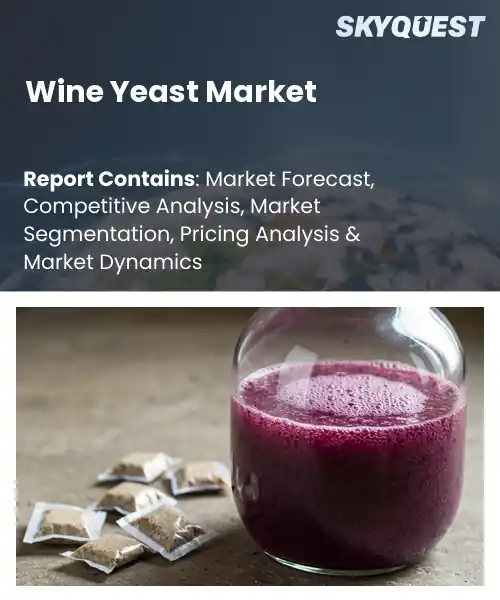
Wine Yeast Market
Report ID: SQMIG20I2896
Report ID: SQMIG20I2896
[email protected]
USA +1 351-333-4748
Report ID:
SQMIG20I2896 |
Region:
Global |
Published Date: April, 2026
Pages:
157
|Tables:
90
|Figures:
76


Global Wine Yeast Market size was valued at USD 842.1 Million in 2024 and is poised to grow from USD 894.31 Million in 2025 to USD 846.8 Million by 2033, growing at a CAGR of 6.2% during the forecast period (2026-2033).
The primary driver of the wine yeast market is the winemaking pursuit of consistent flavor profiles and fermentation control, which supports producers at scale. Wine yeast comprises Saccharomyces and non-Saccharomyces strains used to convert grape sugars into alcohol while influencing aromatic and textural attributes. This market matters because consumer preferences, appellation rules, and vintage variability create demand for reliable starter cultures and strain blends. Over time the market evolved from reliance on indigenous fermentations toward commercial inoculants as scientific understanding advanced, exemplified by 20th century adoption of pure Saccharomyces cerevisiae and recent interest in biodiversity to craft regionally distinctive wines.A key factor driving global wine yeast market growth is innovation in strain development that enhances fermentation predictability and creates differentiated sensory outcomes, which attracts premiumization. As producers adopt genetically selected or hybrid strains, fermentation times shorten and spoilage risks decline, enabling consistent vintages that meet retailer specifications and consumer expectations. For example, New World wineries leverage specialized non-Saccharomyces blends to boost fruity esters, increasing appeal in younger markets and commanding higher margins. Moreover regulatory acceptance of strain characterization and investments in starter culture production cause expanded distribution networks, thereby opening emerging regions to commercialized winemaking practices and scaling demand.
How is AI improving strain selection and fermentation control in the wine yeast market?
AI is improving strain selection and fermentation control in the wine yeast market by linking genomic insight with sensor driven process models and high throughput experimentation. In strain selection machine learning sorts genetic and metabolite profiles to flag yeasts that deliver desired aroma and mouthfeel while tolerating vineyard and cellar stress. For fermentation control AI ingests temperature, sugar and cell activity data to predict sluggish ferments and recommend corrective actions before quality is affected. The market is shifting from artisanal guesswork to data guided decisions and suppliers and wineries are deploying automated screening platforms and digital fermentation monitoring to protect style and reduce risk.Lesaffre June 2025, announced a strategic move that accelerated its biofoundry and AI driven strain development work, supporting faster selection of specialty yeasts and tighter fermentation control which helps wineries scale new strains with greater confidence and efficiency.
Market snapshot - (2026-2033)
Global Market Size
USD 842.1 Million
Largest Segment
Fastest Growth
Growth Rate
6.2% CAGR
To get more insights on this market click here to Request a Free Sample Report
Global wine yeast market is segmented by market focus (vaccine type), target age group (strategic breakout), distribution channel and region. Based on market focus (vaccine type), the market is segmented into Tdap Vaccine (Tetanus, Diphtheria, Acellular Pertussis). Based on target age group (strategic breakout), the market is segmented into Adolescent Booster Doses (11-18 Years), Adult Booster Doses (19-64 Years) and Pregnant Women (Maternal Immunization). Based on distribution channel, the market is segmented into Public Healthcare Agencies & CDC, Private Clinics & Hospitals and Retail Pharmacies. Based on region, the market is segmented into North America, Europe, Asia Pacific, Latin America and Middle East & Africa.
Pregnant Women (Maternal Immunization) segment dominates because shifting consumer priorities toward health-conscious and alcohol-avoiding choices have pushed producers to prioritize yeast strains that preserve aroma and mouthfeel while minimizing ethanol formation, aligning product development with maternal safety concerns. This demand drives targeted R&D into low-ethanol metabolic pathways and aroma-retentive strains, prompting ingredient suppliers and winemakers to reallocate resources to formulations that meet perceived safety and sensory expectations.
However, Adult Booster Doses (19-64 Years) are witnessing the strongest growth momentum as broad adult consumer interest in craft, low-alcohol and experimental wines increases adoption of novel Saccharomyces and non-Saccharomyces strains. Innovation in strain diversity, collaboration with boutique producers, and the adult market’s willingness to pay for premium sensory experiences accelerate product development and expand downstream opportunities for yeast suppliers across multiple beverage categories.
Retail Pharmacies segment dominates because their widespread retail footprint and consumer trust enable convenient placement of packaged yeast products and home fermentation kits that appeal to convenience-oriented and novice users, increasing product visibility and impulse trial. This channel’s emphasis on accessibility and shelf-ready formats encourages manufacturers to develop stable, easy-to-use yeast preparations and co-branded merchandising, shaping distribution strategies and prioritizing retail-oriented product design.
On the other hand, Private Clinics & Hospitals are emerging as the key high-growth channel as institutional research units and clinical laboratories expand pilot fermentation and sensory studies requiring high-purity, traceable yeast strains. Institutional procurement fosters deeper collaboration on strain characterization, quality systems and specialized formulations, creating demand for bespoke yeast offerings and stimulating higher-value service and manufacturing partnerships that drive future market advancement.
To get detailed segments analysis, Request a Free Sample Report
Europe dominates the global wine yeast market through a combination of historic winemaking tradition, concentrated centers of production, and a mature ecosystem of research and supply. Deep expertise in strain selection and sensory profiling is embedded within academic institutions, commercial suppliers and longstanding wineries, enabling customized yeast development for diverse varietals and regional styles. A robust network of consultants and enologists supports rapid knowledge transfer between laboratory innovation and cellar practice. Strong supply chains and regulatory frameworks ensure consistent availability of specialized yeast solutions for both boutique and large producers. The emphasis on terroir expression and premiumization drives demand for indigenous and selected strains that enhance complexity, reinforcing Europe as a primary hub for product development and market leadership.
Wine Yeast Market Germany blends academic research and practical winery experience to deliver refined strain selection for diverse fermentation styles. Established suppliers and consultants work with boutique and larger producers to optimize sensory outcomes while maintaining rigorous quality standards. Regional emphasis on tradition and innovation encourages tailored yeast use and collaborative development across winemaking networks. Access to pan European distribution channels accelerates trialing and adoption of novel strains across regions.
Wine Yeast Market United Kingdom draws on a lively wine culture and growing interest in artisanal production to support diverse yeast adoption. Research institutions and independent consultants advise on strain selection that enhances regional character and stylistic innovation. Producers emphasize sensory differentiation and experimental fermentations while supply networks provide access to specialized yeast products. Collaborative initiatives foster knowledge sharing and technical support across producer communities and international sourcing options broadly.
Wine Yeast Market France remains central to varietal expression and tradition driven fermentation approaches, shaping strong demand for both indigenous and selected yeast strains. Research centers and established enological consultancies collaborate with estates of varying scale to refine strain applications that preserve terroir while enabling stylistic consistency. Emphasis on sensory complexity and regional authenticity drives experimentation alongside adherence to quality controls and traceability measures across production networks and market integration.
Rapid expansion in North America reflects dynamic consumer tastes, diverse production scales and an industry focus on quality and experimentation. A thriving community of small producers and boutique wineries seeks strain diversity to create distinctive flavor profiles, while larger operations pursue reliable yeast solutions for consistency across varied growing conditions. Collaborative research and private innovation accelerate the development of strains tailored to local varietals and processing needs. Improved distribution and supplier partnerships facilitate access to specialized yeasts, enabling faster trialing and wider adoption. Extension services and applied research enhance technical capacity among producers, and practical knowledge exchange between academia and industry supports both premiumization and niche product development that broaden market uptake. Regulatory clarity and consumer education further support experimentation and acceptance of novel fermentation approaches across the region.
Wine Yeast Market United States benefits from an innovative wine sector characterized by diverse production scales, experimental winemaking and strong consumer interest in novel flavor profiles. Research partnerships and commercial suppliers provide access to customized yeast options that support varietal expression and process efficiency. Boutique producers often trial targeted strains while larger operations prioritize reliability and scalability. Dynamic distribution channels accelerate availability and adoption across market segments and expert advice.
Wine Yeast Market Canada combines a growing interest in cool climate varietals with focused research support and cooperative industry networks to drive yeast utilization. Winemakers emphasize strains that enhance aromatic clarity and fermentation robustness, suited to regional conditions. Local suppliers and cross border partnerships enable access to both heritage and innovative yeast solutions. Emphasis on sustainability and traceability further motivates methodical strain selection and collaborative trials that inform broader adoption across producing areas.
Asia Pacific is strengthening its position through targeted investment in enological research, expanding domestic industries and deeper collaboration with international suppliers. Growing expertise in fermentation science supports adaptation of yeast strains to regional grape varieties and climatic conditions, enabling producers to balance traditional approaches with modern techniques. Initiatives in technical training and pilot projects foster practical know how and accelerate localized innovation. Improved logistics and regional distribution networks increase consistent access to specialized yeast products, while partnerships among stakeholders promote shared learning. This combination of science led development, market oriented innovation and strengthened supply pathways raises regional competitiveness and supports branding of distinctive regional wine styles.
Wine Yeast Market Japan leverages advanced fermentation science, strong academic institutions and focused industry expertise to pursue precise strain selection and innovative enological techniques. Domestic producers experiment with yeast options that complement traditional styles and modern varietal expressions, emphasizing aromatic nuance and balanced texture. Collaboration among researchers, craft wineries and suppliers fosters localized solutions adapted to climate and grape characteristics. Quality orientation and boutique production encourage cautious yet strategic adoption.
Wine Yeast Market South Korea exhibits growing enological sophistication, with producers exploring yeast strains that suit interpretation of international varietals and experimental styles. Academic institutions and industry partners support fermentation research and practical trials that inform strain selection for aromatic clarity and robust fermentations. Urban and coastal wineries pursue boutique offerings while improved supplier networks expand access to specialized yeast solutions. Focus on quality and innovation promotes adoption across producers.
To know more about the market opportunities by region and country, click here to
Buy The Complete Report
Rising Demand For Premium Wines
Advancements In Strain Development
Regulatory Approval Challenges
High Production And Quality Costs
Request Free Customization of this report to help us to meet your business objectives.
Competition in the global wine yeast market is shaped by rapid strain innovation non-Saccharomyces blends and supplier consolidation which intensify technical differentiation. Major firms pursue targeted acquisitions and licensing deals for proprietary strains for example AB Mauri’s repositioning of its specialty yeast business alongside recent product launches by Chr Hansen while R&D investment in genetic and downstream processing drives competitive advantage and service bundling.
Top Player’s Company Profile
Recent Developments
SkyQuest’s ABIRAW (Advanced Business Intelligence, Research & Analysis Wing) is our Business Information Services team that Collects, Collates, Correlates, and Analyses the Data collected by means of Primary Exploratory Research backed by robust Secondary Desk research. As per SkyQuest analysis, the global wine yeast market is propelled primarily by innovation in strain development that improves fermentation predictability and sensory differentiation, while growth is constrained by regulatory approval challenges across jurisdictions. Europe remains the dominant region owing to deep winemaking tradition and mature supply networks, and the Pregnant Women (Maternal Immunization) segment leads market share as demand for low-ethanol, aroma-retentive strains rises. A second influential driver is the rising consumer appetite for premium and artisanal wines, which encourages bespoke yeast solutions and closer collaboration between suppliers and vintners to meet quality and provenance expectations and expands opportunities for sensor and AI-driven fermentation tools.
| Report Metric | Details |
|---|---|
| Market size value in 2024 | USD 842.1 Million |
| Market size value in 2033 | USD 846.8 Million |
| Growth Rate | 6.2% |
| Base year | 2024 |
| Forecast period | (2026-2033) |
| Forecast Unit (Value) | USD Million |
| Segments covered |
|
| Regions covered | North America (US, Canada), Europe (Germany, France, United Kingdom, Italy, Spain, Rest of Europe), Asia Pacific (China, India, Japan, Rest of Asia-Pacific), Latin America (Brazil, Rest of Latin America), Middle East & Africa (South Africa, GCC Countries, Rest of MEA) |
| Companies covered |
|
| Customization scope | Free report customization with purchase. Customization includes:-
|
To get a free trial access to our platform which is a one stop solution for all your data requirements for quicker decision making. This platform allows you to compare markets, competitors who are prominent in the market, and mega trends that are influencing the dynamics in the market. Also, get access to detailed SkyQuest exclusive matrix.
Table Of Content
Executive Summary
Market overview
Parent Market Analysis
Market overview
Market size
KEY MARKET INSIGHTS
COVID IMPACT
MARKET DYNAMICS & OUTLOOK
Market Size by Region
KEY COMPANY PROFILES
Methodology
For the Wine Yeast Market, our research methodology involved a mixture of primary and secondary data sources. Key steps involved in the research process are listed below:
1. Information Procurement: This stage involved the procurement of Market data or related information via primary and secondary sources. The various secondary sources used included various company websites, annual reports, trade databases, and paid databases such as Hoover's, Bloomberg Business, Factiva, and Avention. Our team did 45 primary interactions Globally which included several stakeholders such as manufacturers, customers, key opinion leaders, etc. Overall, information procurement was one of the most extensive stages in our research process.
2. Information Analysis: This step involved triangulation of data through bottom-up and top-down approaches to estimate and validate the total size and future estimate of the Wine Yeast Market.
3. Report Formulation: The final step entailed the placement of data points in appropriate Market spaces in an attempt to deduce viable conclusions.
4. Validation & Publishing: Validation is the most important step in the process. Validation & re-validation via an intricately designed process helped us finalize data points to be used for final calculations. The final Market estimates and forecasts were then aligned and sent to our panel of industry experts for validation of data. Once the validation was done the report was sent to our Quality Assurance team to ensure adherence to style guides, consistency & design.
Analyst Support
Customization Options
With the given market data, our dedicated team of analysts can offer you the following customization options are available for the Wine Yeast Market:
Product Analysis: Product matrix, which offers a detailed comparison of the product portfolio of companies.
Regional Analysis: Further analysis of the Wine Yeast Market for additional countries.
Competitive Analysis: Detailed analysis and profiling of additional Market players & comparative analysis of competitive products.
Go to Market Strategy: Find the high-growth channels to invest your marketing efforts and increase your customer base.
Innovation Mapping: Identify racial solutions and innovation, connected to deep ecosystems of innovators, start-ups, academics, and strategic partners.
Category Intelligence: Customized intelligence that is relevant to their supply Markets will enable them to make smarter sourcing decisions and improve their category management.
Public Company Transcript Analysis: To improve the investment performance by generating new alpha and making better-informed decisions.
Social Media Listening: To analyze the conversations and trends happening not just around your brand, but around your industry as a whole, and use those insights to make better Marketing decisions.
REQUEST FOR SAMPLE
 REQUEST FREE CUSTOMIZATION


Want to customize this report? This report can be personalized according to your needs. Our analysts and industry experts will work directly with you to understand your requirements and provide you with customized data in a short amount of time. We offer $1000 worth of FREE customization at the time of purchase.
Feedback From Our Clients


 USA (+1) 351-333-4748

