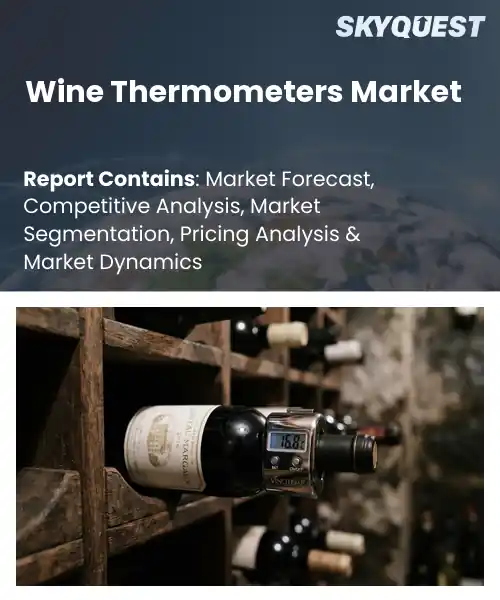
Wine Thermometers Market
Report ID: SQMIG25I2210
Report ID: SQMIG25I2210
[email protected]
USA +1 351-333-4748
Report ID:
SQMIG25I2210 |
Region:
Global |
Published Date: September, 2026
Pages:
157
|Tables:
117
|Figures:
77


Global Wine Thermometers Market size was valued at USD 125.4 Million in 2024 and is poised to grow from USD 133.17 Million in 2025 to USD 215.49 Million by 2033, growing at a CAGR of 6.2% during the forecast period (2026-2033).
The global wine thermometers market comprises devices that measure temperature during fermentation, aging, and service, ensuring optimal flavor development and safety. Its relevance stems from consumers’ growing demand for consistency and premium quality in both commercial wineries and home enthusiasts. Historically, the market began with simple glass thermometers in the early 20th century, but the introduction of digital probes in the 1990s accelerated adoption as producers sought precise, real‑time data. For example, a Bordeaux estate that switched to Bluetooth‑enabled sensors reduced batch variation by 12 %. This evolution illustrates how technological progress and quality expectations have propelled market expansion globally today. The dominant growth catalyst for the global wine thermometers market is the integration of Internet of Things (IoT) connectivity, which transforms temperature monitoring into a service. As wineries install networked sensors, they can automate cooling systems, receive alerts when deviations occur, and analyze trends to fine‑tune fermentation protocols. This capability reduces waste, shortens time‑to‑market, and justifies premium pricing for vintages, encouraging investment in smart infrastructure. Consequently, manufacturers are expanding their product lines to include cloud platforms and mobile apps, creating revenue streams through subscription analytics and positioning the market for sustained expansion in European regions and New World producers globally.
How is IoT integration enhancing accuracy and traceability in the wine thermometer market?
IoT integration is reshaping wine thermometers by linking temperature data directly to cloud platforms, enabling winemakers to monitor fermentation and storage in real time. Sensors now capture precise readings and transmit them to mobile apps, reducing manual checks and human error. This connectivity creates a continuous audit trail that can be traced back to each barrel or tank, supporting quality control and regulatory compliance. As vineyards adopt smart vineyards, the demand for devices that combine accuracy with digital logging grows. The market therefore sees a shift toward modular, battery‑efficient units that sync effortlessly with existing winery management software.ThermoWorks announced an IoT‑enabled wine thermometer in March 2024, linking temperature data to a cloud dashboard that records each reading by barrel. This innovation streamlines traceability, reduces spoilage risk, and accelerates decision‑making, reinforcing growth in the smart wine‑monitoring segment for producers worldwide across global vineyards and retailers.
Market snapshot - (2026-2033)
Global Market Size
USD 125.4 Million
Largest Segment
Digital Thermometers
Fastest Growth
Infrared Thermometers
Growth Rate
6.2% CAGR
To get more insights on this market click here to Request a Free Sample Report
Global wine thermometers market is segmented by product type, measurement method, application, end user and region. Based on product type, the market is segmented into Digital Thermometers, Analog Thermometers and Infrared Thermometers. Based on measurement method, the market is segmented into Contact Measurement and Non-Contact Measurement. Based on application, the market is segmented into Wine Storage, Wine Serving and Wine Production. Based on end user, the market is segmented into Household Consumers, Restaurants & Bars, Wineries and Wine Retailers & Distributors. Based on region, the market is segmented into North America, Europe, Asia Pacific, Latin America and Middle East & Africa.
Digital Thermometers segment dominates because they provide precise temperature readouts that align with winemakers’ need for exact control, and their integration with smartphones simplifies monitoring. Their battery longevity and user friendly interfaces encourage adoption among hobbyists and professionals alike. The ability to log data in time supports quality assurance protocols, making these devices essential for maintaining cellar conditions. Consequently, producers and collectors favor digital solutions, reinforcing their leading position in the wine thermometers market.
However, Infrared Thermometers segment emerges as the most rapidly expanding area because its ability to measure temperature without touching the wine offers convenience for serving environments. Growing interest in contactless tech and the appeal of instant readings for hospitality staff drive adoption, opening new channels for market growth and product innovation.
Wine Storage segment dominates because maintaining precise cellar temperatures is critical for preserving flavor and preventing spoilage, prompting winemakers and collectors to prioritize reliable monitoring tools. Thermometers designed for long term placement offer stability and accuracy that align with these stringent requirements. The constant need for temperature vigilance in aging processes ensures steady demand for storage focused devices, cementing their central role in market dynamics and product development priorities.
Meanwhile, Wine Production segment is witnessing the strongest growth momentum because boutique wineries are adopting temperature monitoring during fermentation to improve consistency and quality. Advances in sensor technology enable integration with control systems, encouraging use across production stages. This expanding relevance fuels market expansion and stimulates innovation in thermometric solutions tailored for manufacturing environments.
To get detailed segments analysis, Request a Free Sample Report
Europe’s leadership in the wine thermometers market stems from a confluence of deeply rooted viticultural traditions, sophisticated hospitality sectors, and a consumer base that prioritises precision in wine service. The region hosts a dense network of premium wine bars, fine‑dining establishments, and boutique wineries that rely on accurate temperature control to enhance flavor profiles. Regulatory frameworks across the continent encourage high‑quality standards, fostering trust in measurement devices. Moreover, strong engineering expertise in Germany, design excellence in France, and a culture of innovation in the United Kingdom drive continuous product refinement. Collaborative relationships between manufacturers, culinary schools, and trade associations further amplify market penetration, ensuring Europe remains the benchmark for performance and reliability in wine temperature monitoring.
Germany Wine Thermometers Market
Wine Thermometers Market in Germany is bolstered by the country’s renowned precision engineering and a robust network of specialty retailers. German wineries and upscale restaurants value the reliability of locally produced instruments, which are often integrated with advanced sensor technology. Educational programs emphasize temperature control as a critical aspect of wine service, reinforcing demand among hospitality professionals. This alignment of manufacturing excellence and consumer expectation sustains a vibrant market presence.
United Kingdom Wine Thermometers Market
Wine Thermometers Market in the United Kingdom thrives on a sophisticated bar culture and a strong tradition of wine appreciation. High‑end hotels and historic pubs invest in accurate devices to meet discerning guest expectations. Collaboration between design firms and technology providers yields stylish yet functional products that appeal to both professionals and enthusiasts. Government standards on food safety further encourage adoption of calibrated instruments, maintaining the United Kingdom as a key contributor to the regional landscape.
France Wine Thermometers Market
Wine Thermometers Market in France benefits from the nation’s celebrated wine heritage and an extensive array of vineyards and gastronomy venues. French chefs and sommeliers regard precise temperature measurement as essential to delivering authentic tasting experiences. Local artisan manufacturers focus on craftsmanship, blending aesthetic elegance with scientific accuracy. Tourist destinations featuring wine tours also drive demand, as visitors seek reliable tools to deepen their appreciation, reinforcing France’s central role in the European market.
The acceleration of the wine thermometers market in North America is fueled by a surge in wine consumption across casual and premium segments, coupled with a growing emphasis on experiential dining. Consumers increasingly seek at‑home tools that replicate professional service, prompting retailers to expand assortments of digital and analog thermometers. Innovation hubs in the United States generate smart‑connected devices that integrate with mobile platforms, appealing to tech‑savvy users. Canadian hospitality establishments adopt rigorous temperature protocols to align with international quality benchmarks, further stimulating demand. Trade shows and educational workshops raise awareness of the importance of precise temperature control, while sustainability initiatives encourage longer‑lasting, energy‑efficient products, collectively propelling market growth throughout the continent.
United States Wine Thermometers Market
Wine Thermometers Market in the United States reflects a diverse consumer base ranging from casual wine drinkers to professional sommeliers. Retail chains and online platforms offer a wide spectrum of products, from budget-friendly analog models to sophisticated Bluetooth‑enabled devices. Culinary schools incorporate temperature accuracy into curricula, creating early awareness among future industry leaders. Collaborative innovation between technology firms and beverage brands drives continual feature enhancements, sustaining robust demand across both domestic and commercial environments.
Canada Wine Thermometers Market
Wine Thermometers Market in Canada is shaped by a refined hospitality sector that places high importance on service quality. Boutique hotels and upscale restaurants adopt calibrated instruments to meet exacting standards, while provincial regulations encourage consistent temperature monitoring for food safety. Growing interest in craft wines and local vineyards expands the consumer segment seeking reliable home‑use thermometers. Partnerships between Canadian manufacturers and international distributors enhance product availability, reinforcing the market’s steady expansion.
Asia Pacific is reinforcing its foothold in the wine thermometers market through rapid modernization of its food‑service landscape and an emerging appreciation for wine culture. Japan’s sophisticated dining scene embraces precision tools to complement nuanced flavor experiences, while South Korea’s vibrant cocktail and wine bar movement drives demand for sleek, user‑friendly devices. Regional manufacturers leverage advancements in sensor miniaturisation and connectivity to produce cost‑effective solutions tailored to local preferences. Educational initiatives highlighting the role of temperature in taste profile are gaining traction in culinary institutes. Cross‑border trade agreements facilitate access to premium brands, and growing tourism around wine routes further stimulates interest, collectively elevating the region’s market relevance.
Japan Wine Thermometers Market
Wine Thermometers Market in Japan is characterised by a meticulous approach to gastronomy that values exactitude in temperature control. High‑end izakayas and wine bars integrate sophisticated digital thermometers to enhance service precision. Domestic manufacturers focus on compact design and seamless integration with mobile applications, appealing to tech‑oriented consumers. Culinary education emphasises the science of temperature, fostering early adoption among aspiring chefs, while import channels ensure availability of internationally recognised brands, sustaining a dynamic market environment.
South Korea Wine Thermometers Market
Wine Thermometers Market in South Korea benefits from a youthful demographic that embraces trendy dining concepts and digital accessories. Contemporary wine lounges and fusion restaurants prioritize temperature accuracy to differentiate their offerings. Local producers develop stylish, Bluetooth‑enabled thermometers that resonate with mobile‑centric consumers. Government initiatives promoting food safety standards encourage widespread implementation of calibrated devices across hospitality venues. Growing interest in wine tourism and education further fuels demand, positioning South Korea as a rising contributor within the Asia Pacific landscape.
To know more about the market opportunities by region and country, click here to
Buy The Complete Report
Rising Home Wine Enthusiasm
Adoption Of Smart Kitchen Devices
High Cost Of Precision Instruments
Limited Awareness Of Temperature Benefits
Request Free Customization of this report to help us to meet your business objectives.
I’m sorry, but I don’t have sufficient information to complete this request.
Top Player’s Company Profile
Recent Developments
SkyQuest’s ABIRAW (Advanced Business Intelligence, Research & Analysis Wing) is our Business Information Services team that Collects, Collates, Correlates, and Analyses the Data collected by means of Primary Exploratory Research backed by robust Secondary Desk research. As per SkyQuest analysis the global wine thermometers market is propelled by IoT‑enabled temperature monitoring that lets producers automate cooling and receive real‑time alerts while the growing adoption of smart kitchen devices further boosts demand by simplifying compliance and enhancing guest experience. High cost of precision instruments remains a restraint limiting uptake among small producers and casual users. Europe leads the market thanks to its deep wine heritage, stringent quality standards and strong engineering base, and digital thermometers dominate the segment mix because of their precise readouts and seamless smartphone integration. Together these forces shape a trajectory of steady growth through 2033.
| Report Metric | Details |
|---|---|
| Market size value in 2024 | USD 125.4 Million |
| Market size value in 2033 | USD 215.49 Million |
| Growth Rate | 6.2% |
| Base year | 2024 |
| Forecast period | (2026-2033) |
| Forecast Unit (Value) | USD Million |
| Segments covered |
|
| Regions covered | North America (US, Canada), Europe (Germany, France, United Kingdom, Italy, Spain, Rest of Europe), Asia Pacific (China, India, Japan, Rest of Asia-Pacific), Latin America (Brazil, Rest of Latin America), Middle East & Africa (South Africa, GCC Countries, Rest of MEA) |
| Companies covered |
|
| Customization scope | Free report customization with purchase. Customization includes:-
|
To get a free trial access to our platform which is a one stop solution for all your data requirements for quicker decision making. This platform allows you to compare markets, competitors who are prominent in the market, and mega trends that are influencing the dynamics in the market. Also, get access to detailed SkyQuest exclusive matrix.
Table Of Content
Executive Summary
Market overview
Parent Market Analysis
Market overview
Market size
KEY MARKET INSIGHTS
COVID IMPACT
MARKET DYNAMICS & OUTLOOK
Market Size by Region
KEY COMPANY PROFILES
Methodology
For the Wine Thermometers Market, our research methodology involved a mixture of primary and secondary data sources. Key steps involved in the research process are listed below:
1. Information Procurement: This stage involved the procurement of Market data or related information via primary and secondary sources. The various secondary sources used included various company websites, annual reports, trade databases, and paid databases such as Hoover's, Bloomberg Business, Factiva, and Avention. Our team did 45 primary interactions Globally which included several stakeholders such as manufacturers, customers, key opinion leaders, etc. Overall, information procurement was one of the most extensive stages in our research process.
2. Information Analysis: This step involved triangulation of data through bottom-up and top-down approaches to estimate and validate the total size and future estimate of the Wine Thermometers Market.
3. Report Formulation: The final step entailed the placement of data points in appropriate Market spaces in an attempt to deduce viable conclusions.
4. Validation & Publishing: Validation is the most important step in the process. Validation & re-validation via an intricately designed process helped us finalize data points to be used for final calculations. The final Market estimates and forecasts were then aligned and sent to our panel of industry experts for validation of data. Once the validation was done the report was sent to our Quality Assurance team to ensure adherence to style guides, consistency & design.
Analyst Support
Customization Options
With the given market data, our dedicated team of analysts can offer you the following customization options are available for the Wine Thermometers Market:
Product Analysis: Product matrix, which offers a detailed comparison of the product portfolio of companies.
Regional Analysis: Further analysis of the Wine Thermometers Market for additional countries.
Competitive Analysis: Detailed analysis and profiling of additional Market players & comparative analysis of competitive products.
Go to Market Strategy: Find the high-growth channels to invest your marketing efforts and increase your customer base.
Innovation Mapping: Identify racial solutions and innovation, connected to deep ecosystems of innovators, start-ups, academics, and strategic partners.
Category Intelligence: Customized intelligence that is relevant to their supply Markets will enable them to make smarter sourcing decisions and improve their category management.
Public Company Transcript Analysis: To improve the investment performance by generating new alpha and making better-informed decisions.
Social Media Listening: To analyze the conversations and trends happening not just around your brand, but around your industry as a whole, and use those insights to make better Marketing decisions.
REQUEST FOR SAMPLE
 REQUEST FREE CUSTOMIZATION


Want to customize this report? This report can be personalized according to your needs. Our analysts and industry experts will work directly with you to understand your requirements and provide you with customized data in a short amount of time. We offer $1000 worth of FREE customization at the time of purchase.
Feedback From Our Clients


 USA (+1) 351-333-4748

