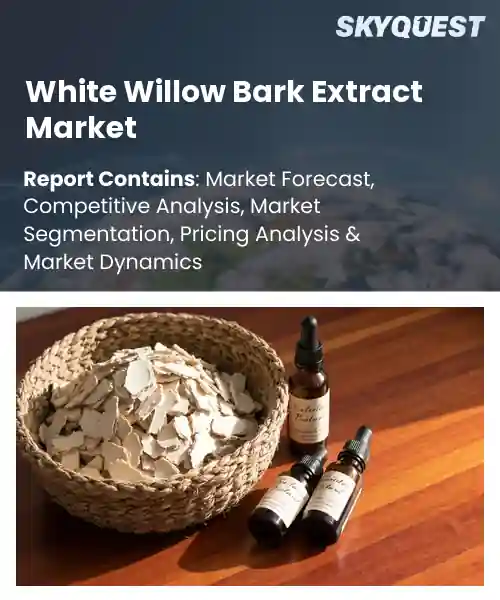
White Willow Bark Extract Market
Report ID: SQMIG30L2447
Report ID: SQMIG30L2447
[email protected]
USA +1 351-333-4748
Report ID:
SQMIG30L2447 |
Region:
Global |
Published Date: July, 2026
Pages:
157
|Tables:
148
|Figures:
78


Global White Willow Bark Extract Market size was valued at USD 840.1 Million in 2024 and is poised to grow from USD 888.83 Million in 2025 to USD 1395.41 Million by 2033, growing at a CAGR of 5.8% during the forecast period (2026-2033).
Rising consumer preference for natural health products, rising demand for plant-based pain relief solutions, increasing awareness of herbal medicines, advancements in botanical extraction technologies, and expanding applications in nutraceuticals are driving demand for white willow bark extract.
A growing demand for natural anti-inflammatory and pain relievers is accelerating the need for white willow bark extract in dietary supplements, functional foods, beverages and sports nutrition products. Advanced extraction techniques, rising standardization of products and increasing importance of quality certification ensures healthy and consumer friendly applications. The increasing consumption of herbal products among aging population to overcome joint pain and mobility issues, along with the acceptance of herbals by regulatory authorities in different regions of globe are responsible for creating new opportunities. High preference for herbal and plant-based ingredients coupled with increasing awareness regarding the adverse effects of synthetic pain medications are expected to primarily drive white willow bark extract market growth.
On the contrary, limited clinical evidence for certain health claims, fluctuations in raw material availability, stringent regulatory requirements for herbal products, and competition from conventional pain relief medications are anticipated to slow down white willow bark extract market penetration going forward.
How is AI Influencing Supply Chain Optimization for White Willow Bark Extract Companies?
AI is revolutionizing the white willow bark extract industry through optimization of sourcing, quality control, and logistics processes. AI applications help to forecast the results of harvesting based on climate and soil parameters, thereby enabling better purchasing decisions of the raw materials for production. AI-assisted computer vision is used to detect problems with bark quality, thereby preventing possible waste. Predictive algorithms help to determine optimal stock levels, while route planning based on AI reduces delivery costs and time.
Market snapshot - (2026-2033)
Global Market Size
USD 840.1 Million
Largest Segment
Powder
Fastest Growth
Liquid
Growth Rate
5.8% CAGR
To get more insights on this market click here to Request a Free Sample Report
Global white willow bark extract market is segmented by form, active compound standardization, target indication, end user, distribution channel, and region. Based on form, the market is segmented into powder and liquid. Based on active compound standardization, the market is segmented into 15% salicin standardized, 25% salicin standardized, 50% salicin standardized, and others. Based on target indication, the market is segmented into arthritis, low back pain, menstrual cramps, muscle soreness, and others. Based on end user, the market is segmented into dietary supplements manufacturers, pharmaceuticals manufacturers, cosmetics manufacturers, personal care product manufacturers, and food and beverage manufacturers. Based on distribution channel, the market is segmented into direct B2B procurement, offline retail, and online e-commerce platforms. Based on region, the market is segmented into North America, Europe, Asia Pacific, Latin America, and Middle East & Africa.
The powder segment is forecasted to lead the global white willow bark extract market revenue generation across the study period. Due to the focus on ease of handling, accurate dosage, and compatibility with solid dosage forms like tablets and capsules. The powder form is easier to blend, requires less processing time, and matches the existing manufacturing equipment. This is why it is favored in the manufacture of supplements and drugs in large-scale industrial operations. The efficiency and cost-effectiveness of this form make it the dominant product in the market.
However, liquid emerges as the most rapidly expanding segment as per this white willow bark extract market forecast, since it can provide flexible integration into drinks and functional beverages which address the demands of consumers regarding portable health solutions. The solubility and fast absorption characteristics make it appealing to various product brands looking to distinguish themselves in the market.
The low salicin standardized segment is anticipated to account for the highest global white willow bark extract market share going forward. It offers a milder therapeutic effect which is in sync with the consumer preference of using something which causes minimum pain and adverse effects. The formulators like the wider safety range which makes it possible to add this product to a daily health drink without requiring any labeling. It’s this combination of efficacy and acceptability that has made it an important part of the white willow bark extract market.
Meanwhile, high salicin standardized segment is witnessing the strongest growth momentum since the process of extraction allows for greater active concentration levels while still ensuring purity. This is attractive to those developing specific therapies and functional foods that require an increase in efficacy, thus resulting in more investment and creating new lucrative market niches.
To get detailed segments analysis, Request a Free Sample Report
Mature health-supplement ecosystem, strong consumer awareness of natural analgesic options, and extensive research infrastructure that drives innovation helps cement the dominance of this region. There are existing and established channels for distribution that link the manufacturers to retailers and other online vendors, guaranteeing quick availability of the products. The existence of sound regulatory systems gives confidence to the producers as well as the consumers, and a culture of preventive medicine ensures that the demand remains consistent. Networking of suppliers of botanic materials, extractors, and pharmaceutical companies strengthens the market by allowing the production of quality ingredients. Moreover, the availability of some of the best academic institutions provides clinical validation, and the consumer preference for locally grown botanic materials bolsters the brands.
White willow bark extract market in the United States benefits from a sophisticated wellness culture that embraces botanical solutions for pain relief and inflammation. Consumer confidence is reinforced by transparent labeling and high standards of product safety, while strong ties between research universities and commercial firms accelerate formulation improvements. Retail distribution spans health‑food chains, pharmacies, and e‑commerce platforms, providing broad access and encouraging continual market refresh with innovative new blends.
White willow bark extract market in Canada is shaped by a strong preference for natural health products and an emphasis on sustainable sourcing. Cooperative programs involving indigenous knowledge custodians and contemporary extraction experts improve the authenticity of products, while strict regulations by health authorities ensure their safety and effectiveness. The distribution network consists of specialized natural food stores, health centers, and Internet retailers, enabling people to get quality extracts about the overall environmentally friendly approach.
Heightened consumer interest in plant-based therapeutics and supportive regulatory environments that encourage natural product innovation are helping boost the sales of white willow bark extract in Europe. The existence of robust research cultures on the region facilitates the clinical validation of the pain-relieving nature of the extract, while the presence of an integrated supply chain links sustainable willow plantations to state-of-the-art extraction centers. Customer satisfaction is boosted by clear labeling requirements and a culture that values preventative health care. Concerns for green production techniques and the advent of personalized wellness regimes spur demand, thus prompting both existing companies and new ventures to conduct research and enter the market.
White willow bark extract market in Germany is anchored by a scientific community that validates therapeutic efficacy through laboratory studies. The consumer confidence is bolstered by the quality standards and historical integration of herbs with traditional medicines. The distribution system utilizes the health food stores, pharmacy chains, and even the internet to ensure easy availability. The partnerships with research institutes and the industry help formulate novel solutions and establish Germany as a reference market in Europe.
White willow bark extract demand in the United Kingdom is propelled by a consumer base that seeks alternatives for pain management and wellbeing. Clarity in regulations regarding botanicals promotes innovation, while the existence of medicine makes use of the extract in formulations for nutraceuticals and topicals. The retail network includes specialty health stores, pharmaceutical chains, and markets. Cooperation between research universities and commercial companies promotes improvement in the efficiency and range of products produced.
White willow bark extract sales in France are emerging as consumers value wellness solutions. Growing awareness of botanical pain relief drives interest in products that combine French herbal knowledge with extraction techniques. Regulatory support for health ingredients facilitates market entry, while boutique pharmacies and specialty stores provide curated distribution channels. Collaborative initiatives between local growers and research laboratories enhance sustainable sourcing, positioning France as a hub for white willow applications.
Traditional herbal heritage, expanding consumer interest in natural health products, and rapid advancements in extraction technology are supporting steady demand for white willow bark extract in the region. Numerous countries within the region are tapping into their rich stores of willows and incorporating them into their latest nutraceutical and cosmetic products based on increasing knowledge about the benefits of natural pain treatments from plants. Research efforts undertaken in partnership between educational institutions and biotechnology companies help increase the purity of willow extracts, while government policies encourage sustainable extraction methods. E-commerce websites and the presence of a health-focused middle-class population ensure that there are sufficient marketing avenues for both existing and new businesses to expand their customer base.
White willow bark extract market in Japan blends a respect for traditional Kampo medicine with scientific research. Demand from consumers for plant-based painkillers leads to the development of new products, whereas strict quality control ensures purity and safety. The distribution networks include health specialty stores, large pharmacies, and an internet environment that enables access by consumers. Cooperation between academic organizations and extraction companies promotes innovations and helps Japan to be at the forefront in using white willow.
White willow bark extract market in South Korea benefits from an aging population that seeks solutions for joint discomfort and chronic pain. Investment in botanical research promotes cooperation between educational institutions and biotech companies, which contributes to the improvement of extraction efficiency and formulation accuracy. Retail distribution covers stores of health food, pharmacy chains, as well as e-commerce. Promotion of health products fits consumer expectations and proves the importance of South Korea in the white willow segment.
To know more about the market opportunities by region and country, click here to
Buy The Complete Report
Increasing Demand for Natural Analgesics
Regulatory Support for Herbal Supplements
Limited Scientific Validation of Efficacy
Supply Constraints of Sustainable Harvesting
Request Free Customization of this report to help us to meet your business objectives.
Archer Daniels Midland Company, Givaudan S.A., International Flavors & Fragrances Inc., and Sensient are actively expanding their natural extracts portfolios to include white willow bark extract, leveraging large‑scale processing capabilities and advanced purification techniques to meet rising demand for clean‑label anti‑inflammatory ingredients. These incumbents are pursuing strategic partnerships with flavor manufacturers and investing in proprietary extraction technologies, positioning themselves to capture premium market segments while differentiating through higher purity and sustainable sourcing.
SkyQuest’s ABIRAW (Advanced Business Intelligence, Research & Analysis Wing) is our Business Information Services team that Collects, Collates, Correlates, and Analyses the Data collected by means of Primary Exploratory Research backed by robust Secondary Desk research.
As per SkyQuest analysis, rising demand for plant-based pain relief solutions, increasing awareness of herbal medicines, and expanding applications in nutraceuticals are anticipated to drive the demand for white willow bark extract going forward. However, limited clinical evidence for certain health claims and stringent regulatory requirements for herbal products are slated to slow down the adoption of white willow bark extract in the future. North America is slated to spearhead the demand for white willow bark extract owing to high consumer awareness of herbal supplements, strong demand for natural wellness products, established nutraceutical manufacturers, and well-developed retail and e-commerce distribution channels. AI-powered supply chain optimization and advancements in botanical extraction and product standardization are anticipated to be key trends driving the white willow bark extract sector in the long run.
| Report Metric | Details |
|---|---|
| Market size value in 2024 | USD 840.1 Million |
| Market size value in 2033 | USD 1395.41 Million |
| Growth Rate | 5.8% |
| Base year | 2024 |
| Forecast period | (2026-2033) |
| Forecast Unit (Value) | USD Million |
| Segments covered |
|
| Regions covered | North America (US, Canada), Europe (Germany, France, United Kingdom, Italy, Spain, Rest of Europe), Asia Pacific (China, India, Japan, Rest of Asia-Pacific), Latin America (Brazil, Rest of Latin America), Middle East & Africa (South Africa, GCC Countries, Rest of MEA) |
| Companies covered |
|
| Customization scope | Free report customization with purchase. Customization includes:-
|
To get a free trial access to our platform which is a one stop solution for all your data requirements for quicker decision making. This platform allows you to compare markets, competitors who are prominent in the market, and mega trends that are influencing the dynamics in the market. Also, get access to detailed SkyQuest exclusive matrix.
Table Of Content
Executive Summary
Market overview
Parent Market Analysis
Market overview
Market size
KEY MARKET INSIGHTS
COVID IMPACT
MARKET DYNAMICS & OUTLOOK
Market Size by Region
KEY COMPANY PROFILES
Methodology
For the White Willow Bark Extract Market, our research methodology involved a mixture of primary and secondary data sources. Key steps involved in the research process are listed below:
1. Information Procurement: This stage involved the procurement of Market data or related information via primary and secondary sources. The various secondary sources used included various company websites, annual reports, trade databases, and paid databases such as Hoover's, Bloomberg Business, Factiva, and Avention. Our team did 45 primary interactions Globally which included several stakeholders such as manufacturers, customers, key opinion leaders, etc. Overall, information procurement was one of the most extensive stages in our research process.
2. Information Analysis: This step involved triangulation of data through bottom-up and top-down approaches to estimate and validate the total size and future estimate of the White Willow Bark Extract Market.
3. Report Formulation: The final step entailed the placement of data points in appropriate Market spaces in an attempt to deduce viable conclusions.
4. Validation & Publishing: Validation is the most important step in the process. Validation & re-validation via an intricately designed process helped us finalize data points to be used for final calculations. The final Market estimates and forecasts were then aligned and sent to our panel of industry experts for validation of data. Once the validation was done the report was sent to our Quality Assurance team to ensure adherence to style guides, consistency & design.
Analyst Support
Customization Options
With the given market data, our dedicated team of analysts can offer you the following customization options are available for the White Willow Bark Extract Market:
Product Analysis: Product matrix, which offers a detailed comparison of the product portfolio of companies.
Regional Analysis: Further analysis of the White Willow Bark Extract Market for additional countries.
Competitive Analysis: Detailed analysis and profiling of additional Market players & comparative analysis of competitive products.
Go to Market Strategy: Find the high-growth channels to invest your marketing efforts and increase your customer base.
Innovation Mapping: Identify racial solutions and innovation, connected to deep ecosystems of innovators, start-ups, academics, and strategic partners.
Category Intelligence: Customized intelligence that is relevant to their supply Markets will enable them to make smarter sourcing decisions and improve their category management.
Public Company Transcript Analysis: To improve the investment performance by generating new alpha and making better-informed decisions.
Social Media Listening: To analyze the conversations and trends happening not just around your brand, but around your industry as a whole, and use those insights to make better Marketing decisions.
REQUEST FOR SAMPLE
 REQUEST FREE CUSTOMIZATION
Global White Willow Bark Extract Market size was valued at USD 840.1 Million in 2024 and is poised to grow from USD 888.83 Million in 2025 to USD 1395.41 Million by 2033, growing at a CAGR of 5.8% during the forecast period (2026-2033).
Archer Daniels Midland Company, Givaudan S.A., International Flavors & Fragrances Inc., and Sensient are actively expanding their natural extracts portfolios to include white willow bark extract, leveraging large‑scale processing capabilities and advanced purification techniques to meet rising demand for clean‑label anti‑inflammatory ingredients. These incumbents are pursuing strategic partnerships with flavor manufacturers and investing in proprietary extraction technologies, positioning themselves to capture premium market segments while differentiating through higher purity and sustainable sourcing. 'Givaudan SA', 'Sabinsa Corporation', 'Frutarom Industries Ltd.', 'Martin Bauer Group', 'Indena S.p.A.', 'Arnet Pharmaceutical Corp.', 'Biomed Ingredients', 'Nutra Green Biotechnology Co. Ltd.', 'Axiom Foods Inc.', 'Xi'an Sost Biological Science & Technology Co. Ltd.', 'Hunan Changsha Organic Herb Inc.', 'Naturalin Bio-Resources Co. Ltd.', 'Arisun ChemPharm Co. Ltd.', 'Shaanxi Guanjie Technology Co. Ltd.', 'Phyto Life Sciences P. Ltd.', 'Creative Enzymes', 'Alchem International Pvt. Ltd.', 'Acetar Bio-Tech Inc.', 'Aovva Bio-Tech Inc.', 'Xian Plant Bio-Engineering Co. Ltd'
Consumers are seeking alternatives to synthetic pain relievers, and the soothing properties of white willow bark extract align with this preference. The extract’s historical use as a natural source of salicin, which the body converts to a gentle analgesic, reinforces confidence among health‑conscious buyers. Manufacturers therefore incorporate the ingredient into topical creams, dietary supplements, and functional beverages, expanding product portfolios and stimulating demand across multiple therapeutic categories, which collectively drive market expansion. Retail channels are also promoting these products as part of wellness trends, further enhancing visibility and consumer acceptance.
Natural Wellness Integration: Consumers are increasingly seeking holistic health solutions, prompting manufacturers to incorporate white willow bark extract into broader natural wellness portfolios. This shift encourages product developers to position the extract alongside adaptogens, botanical teas, and functional beverages, emphasizing its historical reputation for gentle support. Brands are leveraging storytelling that connects traditional use with modern lifestyle demands, fostering stronger consumer trust and opening cross‑category collaborations that expand market reach beyond conventional nutraceuticals and creating enduring brand loyalty among health‑conscious shoppers worldwide markets.
Why does North America Dominate the Global White Willow Bark Extract Market? |@12


Want to customize this report? This report can be personalized according to your needs. Our analysts and industry experts will work directly with you to understand your requirements and provide you with customized data in a short amount of time. We offer $1000 worth of FREE customization at the time of purchase.
Feedback From Our Clients


 USA (+1) 351-333-4748

