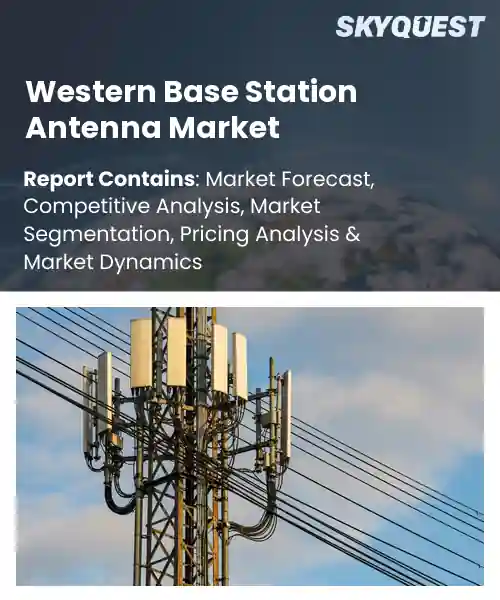
Western Base Station Antenna Market
Report ID: SQMIG45H2255
Report ID: SQMIG45H2255
[email protected]
USA +1 351-333-4748
Report ID:
SQMIG45H2255 |
Region:
Global |
Published Date: July, 2026
Pages:
157
|Tables:
143
|Figures:
78


Global Western Base Station Antenna Market size was valued at USD 1.78 Billion in 2024 and is poised to grow from USD 1.89 Billion in 2025 to USD 2.98 Billion by 2033, growing at a CAGR of 5.9% during the forecast period (2026-2033).
The rapid rollout of 5G networks across North America and Europe is the primary driver of the global Western base station antenna market. Telecom operators are investing heavily in upgrading existing infrastructure to support higher data speeds, lower latency, and massive device connectivity. This expansion increases the need for advanced multi-band, Massive MIMO, and beamforming antennas capable of handling greater network capacity. As mobile data traffic continues to surge due to video streaming, cloud computing, and IoT adoption, operators deploy more high-performance base stations. Consequently, demand for efficient, energy-saving, and high-capacity base station antennas continues to grow.
The growing emphasis on intelligent network optimization is a key trend driving the global western base station antenna sector. Network operators are integrating AI-powered antenna management, beam steering, and self-optimizing network technologies to improve spectrum efficiency and reduce operating costs. These smart antenna systems dynamically adjust coverage based on traffic demand, minimizing energy consumption while enhancing service quality. As sustainability goals and network efficiency become strategic priorities, manufacturers continue developing compact, AI-enabled, and energy-efficient antenna solutions. This technological evolution improves network performance, lowers total ownership costs, and accelerates deployment across advanced wireless communication networks.
How is AI-Driven Automation Reshaping the Western Base Station Antenna Market?
AI-driven automation is streamlining design, testing and deployment of base‑station antennas across the West. Machine‑learning models now predict optimal array configurations, reducing manual engineering cycles. Real‑time data from network nodes feed algorithms that adjust beam patterns on the fly, improving coverage while cutting energy use. Virtual twins simulate environmental impacts before a tower is built, allowing planners to avoid costly rework. These capabilities are accelerating rollout of 5G infrastructure and making upgrades more agile, which keeps operators competitive in a fast‑moving market.
In February 2026, Ericsson introduced AI-ready radios, antennas, and AI RAN software featuring neural-network accelerators, AI-managed beamforming, and AI-powered coverage optimization. The innovations enable real-time antenna optimization, improved spectral efficiency, and lower energy consumption, strengthening next-generation base station antenna performance for evolving 5G and AI-driven mobile networks.
Market snapshot - (2026-2033)
Global Market Size
USD 1.78 Billion
Largest Segment
Omni Directional
Fastest Growth
Smart Antennas
Growth Rate
5.9% CAGR
To get more insights on this market click here to Request a Free Sample Report
Global western base station antenna market is segmented by antenna type, frequency band, technology era, application setting, sales channel and region. Based on antenna type, the market is segmented into omni directional, directional panel, smart antennas and MIMO arrays. Based on frequency band, the market is segmented into low band, mid band and high band. Based on technology era, the market is segmented into 4G LTE, 5G sub-6GHz and 5G mmWave. Based on application setting, the market is segmented into macro cells and small cells. Based on sales channel, the market is segmented into telecom OEMs and direct operators. Based on region, the market is segmented into North America, Europe, Asia Pacific, Latin America and Middle East & Africa.
Based on the global western base station antenna market growth, smart antennas segment dominates because they enable dynamic beamforming that maximizes coverage while reducing interference, a critical need as network operators densify deployments. Their ability to adapt radiation patterns in real time aligns with the market’s push for higher spectral efficiency and lower operational expenses. Integration with advanced radio access networks further enhances capacity, making them the preferred choice for operators seeking flexible, future‑proof infrastructure and resilient long term solutions.
Meanwhile, directional panel segment emerges as the fastest growing because its compact form factor suits the rapid rollout of small cells in dense urban environments. Operators value the precise coverage it provides, and ongoing cost reductions in manufacturing accelerate adoption, creating fresh opportunities for network expansion and capacity enhancement.
Mid band segment dominates because it offers an optimal balance between coverage range and capacity, meeting operators’ need to fill the performance gap between low and high frequencies. The propagation characteristics support reliable indoor and outdoor service while accommodating wider bandwidths for enhanced data rates. Consequently, network planners prioritize mid band deployments, driving investment and reinforcing its central role in the market’s evolution through strategic spectrum allocation policies and industry support.
Conversely, high band segment is witnessing the strongest growth momentum as carriers accelerate 5G mmWave rollouts to deliver ultra high speed services. The demand for massive capacity in hotspots drives investment in antennas that operate at these frequencies, and evolving device ecosystems are unlocking new revenue streams, propelling market expansion.
To get detailed segments analysis, Request a Free Sample Report
As per the global western base station antenna market share, North America benefits from a mature telecommunications ecosystem where carriers prioritize network densification and advanced antenna solutions. The region enjoys a strong culture of innovation supported by leading research institutions and a prolific supply chain that accelerates design, testing and deployment. Robust regulatory frameworks encourage spectrum efficiency and the rollout of next‑generation services, creating steady demand for high‑performance western base station antennas. Investment capital is readily available, fostering collaboration between equipment manufacturers and service providers. Skilled engineering talent and a focus on quality assurance reinforce the market’s reputation for reliability, making North America a preferred source for cutting‑edge antenna technology worldwide.
Western base station antenna market in the United States thrives on extensive carrier initiatives to expand coverage and capacity across diverse geographic landscapes. Innovation hubs promote rapid prototyping and integration of new materials, while strong partnerships with component suppliers streamline production cycles. The market benefits from a collaborative environment where telecom operators, device manufacturers and technical standards bodies work closely to shape product specifications that meet evolving service requirements. Consumer expectations for high‑speed connectivity further propel demand for sophisticated antenna designs that support dense urban deployments and emerging rural projects alike.
Western base station antenna market in Canada is driven by a national emphasis on digital infrastructure and broadband accessibility across remote and urban areas. Close alignment between telecom operators and government programs encourages the adoption of advanced antenna solutions that enhance signal reliability in challenging terrains. Research collaborations with Canadian universities foster the development of innovative antenna architectures, while a skilled workforce ensures high‑quality manufacturing standards. Environmental considerations also play a role, prompting the selection of energy‑efficient designs that align with sustainability goals.
Based on global western base station antenna regional forecast, Europe’s expansion is propelled by a coordinated push toward unified spectrum policies and cross‑border harmonization that simplify deployment of advanced antenna systems. Strong emphasis on sustainability encourages the integration of eco‑friendly materials and modular designs that reduce waste and improve lifecycle efficiency. Collaborative research initiatives across the continent foster rapid innovation, while carrier competition intensifies the need for higher capacity and superior coverage solutions. The presence of established manufacturing hubs, combined with a skilled engineering talent pool, ensures that European firms can deliver high‑quality, customizable antenna products that meet diverse market requirements across the region.
Western base station antenna market in Germany is anchored by world‑class engineering expertise and a dense network of specialized manufacturers. Close cooperation between telecom operators and research institutes accelerates the development of high‑performance antenna technologies tailored for both urban density and industrial applications. Regulatory alignment supports efficient spectrum utilization, prompting carriers to adopt advanced antenna configurations that enhance network resilience. The market’s reputation for precision engineering reinforces its position as a leading supplier within Europe and beyond.
Western base station antenna market in the United Kingdom experiences swift growth due to aggressive network rollout strategies aimed at boosting capacity and coverage. Strong collaboration between service providers and technology innovators drives the adoption of next‑generation antenna designs that support dense small‑cell deployments. Market participants benefit from a dynamic regulatory environment that encourages spectrum sharing and efficient use of resources. A vibrant ecosystem of startups and established firms contributes to a rapid pace of product development, positioning the United Kingdom as a hotbed of antenna innovation.
Western base station antenna market in France is emerging as a focal point for sustainable telecom infrastructure development. Emphasis on green technology motivates the integration of low‑power, recyclable antenna solutions that align with national environmental objectives. Collaborative projects between academic research centers and industry players foster novel design approaches tailored to urban and suburban environments. The market’s evolution is further supported by policy incentives that encourage modernization of network assets, creating a fertile ground for emerging antenna manufacturers to expand their presence.
As per global western base station antenna regional outlook, Asia Pacific advances its position through a combination of aggressive network densification and a flourishing ecosystem of original equipment manufacturers. The region’s commitment to rapid deployment of advanced wireless services drives demand for versatile antenna solutions that can adapt to varied geographic and demographic conditions. Strong investment in research and development, often supported by government incentives, fuels innovation in antenna miniaturization and performance optimization. Close ties between carriers and local manufacturers shorten time‑to‑market, while a cost‑competitive manufacturing base enhances export potential, allowing the region to emerge as a key supplier of cutting‑edge western base station antenna technology.
Western base station antenna market in Japan benefits from a culture of precision engineering and a longstanding focus on high‑frequency spectrum utilization. Telecom operators prioritize network resilience and capacity, prompting the adoption of sophisticated antenna designs that support dense urban environments. Collaborative research programs between universities and industry leaders drive continuous improvement in antenna performance and integration. The market’s emphasis on reliability and advanced materials positions Japan as a distinguished contributor to the global antenna landscape.
Western base station antenna market in South Korea is propelled by a relentless drive toward ultra‑fast connectivity and ubiquitous coverage. The country’s leading telecom operators aggressively upgrade infrastructure, demanding antenna solutions that deliver exceptional performance in compact form factors. Strong government support for technology advancement encourages close partnerships between manufacturers and research institutions, fostering rapid prototyping and deployment. This environment cultivates a highly competitive market that continually pushes the boundaries of antenna efficiency and integration.
To know more about the market opportunities by region and country, click here to
Buy The Complete Report
Rising Adoption of 5G Networks
Expansion Of Small Cell Deployments
High Cost Of Advanced Antennas
Regulatory Challenges In Spectrum Allocation
Request Free Customization of this report to help us to meet your business objectives.
The global western base station antenna market outlook is intensely competitive, with incumbents leveraging strategic partnerships and tech innovation to secure market share. Nokia, backed by Cisco Investments, has accelerated its 5G antenna portfolio through joint development programs, while defense‑tech investors such as Nokia and AT&T are backing emerging antenna‑focused startups to expand capabilities. This race for advanced massive‑MIMO designs drives rapid product cycles.
Top Player’s Company Profile
Recent Developments
SkyQuest’s ABIRAW (Advanced Business Intelligence, Research & Analysis Wing) is our Business Information Services team that Collects, Collates, Correlates, and Analyses the Data collected by means of Primary Exploratory Research backed by robust Secondary Desk research.
As per SkyQuest analysis, the global western base station antenna industry is being propelled primarily by the rising adoption of 5G networks, which forces operators to seek higher‑frequency, beam‑forming solutions, while a second important catalyst is the rapid expansion of small‑cell deployments that demand compact, high‑performance units. The market’s growth is moderated by the high cost of advanced antenna technologies, which can deter investment, especially in cost‑sensitive regions. North America remains the dominant region thanks to its mature telecom ecosystem and strong innovation pipeline, and smart antennas are the leading segment owing to their dynamic beamforming capabilities that meet densification needs today.
| Report Metric | Details |
|---|---|
| Market size value in 2024 | USD 1.78 Billion |
| Market size value in 2033 | USD 2.98 Billion |
| Growth Rate | 5.9% |
| Base year | 2024 |
| Forecast period | (2026-2033) |
| Forecast Unit (Value) | USD Billion |
| Segments covered |
|
| Regions covered | North America (US, Canada), Europe (Germany, France, United Kingdom, Italy, Spain, Rest of Europe), Asia Pacific (China, India, Japan, Rest of Asia-Pacific), Latin America (Brazil, Rest of Latin America), Middle East & Africa (South Africa, GCC Countries, Rest of MEA) |
| Companies covered |
|
| Customization scope | Free report customization with purchase. Customization includes:-
|
To get a free trial access to our platform which is a one stop solution for all your data requirements for quicker decision making. This platform allows you to compare markets, competitors who are prominent in the market, and mega trends that are influencing the dynamics in the market. Also, get access to detailed SkyQuest exclusive matrix.
Table Of Content
Executive Summary
Market overview
Parent Market Analysis
Market overview
Market size
KEY MARKET INSIGHTS
COVID IMPACT
MARKET DYNAMICS & OUTLOOK
Market Size by Region
KEY COMPANY PROFILES
Methodology
For the Western Base Station Antenna Market, our research methodology involved a mixture of primary and secondary data sources. Key steps involved in the research process are listed below:
1. Information Procurement: This stage involved the procurement of Market data or related information via primary and secondary sources. The various secondary sources used included various company websites, annual reports, trade databases, and paid databases such as Hoover's, Bloomberg Business, Factiva, and Avention. Our team did 45 primary interactions Globally which included several stakeholders such as manufacturers, customers, key opinion leaders, etc. Overall, information procurement was one of the most extensive stages in our research process.
2. Information Analysis: This step involved triangulation of data through bottom-up and top-down approaches to estimate and validate the total size and future estimate of the Western Base Station Antenna Market.
3. Report Formulation: The final step entailed the placement of data points in appropriate Market spaces in an attempt to deduce viable conclusions.
4. Validation & Publishing: Validation is the most important step in the process. Validation & re-validation via an intricately designed process helped us finalize data points to be used for final calculations. The final Market estimates and forecasts were then aligned and sent to our panel of industry experts for validation of data. Once the validation was done the report was sent to our Quality Assurance team to ensure adherence to style guides, consistency & design.
Analyst Support
Customization Options
With the given market data, our dedicated team of analysts can offer you the following customization options are available for the Western Base Station Antenna Market:
Product Analysis: Product matrix, which offers a detailed comparison of the product portfolio of companies.
Regional Analysis: Further analysis of the Western Base Station Antenna Market for additional countries.
Competitive Analysis: Detailed analysis and profiling of additional Market players & comparative analysis of competitive products.
Go to Market Strategy: Find the high-growth channels to invest your marketing efforts and increase your customer base.
Innovation Mapping: Identify racial solutions and innovation, connected to deep ecosystems of innovators, start-ups, academics, and strategic partners.
Category Intelligence: Customized intelligence that is relevant to their supply Markets will enable them to make smarter sourcing decisions and improve their category management.
Public Company Transcript Analysis: To improve the investment performance by generating new alpha and making better-informed decisions.
Social Media Listening: To analyze the conversations and trends happening not just around your brand, but around your industry as a whole, and use those insights to make better Marketing decisions.
REQUEST FOR SAMPLE
 REQUEST FREE CUSTOMIZATION
Global Western Base Station Antenna Market size was valued at USD 1.78 Billion in 2024 and is poised to grow from USD 1.89 Billion in 2025 to USD 2.98 Billion by 2033, growing at a CAGR of 5.9% during the forecast period (2026-2033).
The Western base station antenna market is intensely competitive, with incumbents leveraging strategic partnerships and tech innovation to secure market share. Nokia, backed by Cisco Investments, has accelerated its 5G antenna portfolio through joint development programs, while defense‑tech investors such as Nokia and AT&T are backing emerging antenna‑focused startups to expand capabilities. This race for advanced massive‑MIMO designs drives rapid product cycles. 'CommScope Holding Company Inc', 'Amphenol Corporation', 'Ericsson AB', 'Nokia Corporation', 'Kathrein SE', 'Galtronics USA Inc', 'CCI Antennas', 'Communication Components Systems Inc', 'JMA Wireless', 'John Mezzalingua Associates LLC', 'MatSing Inc', 'Gamma Nu', 'Rosenberger Hochfrequenztechnik GmbH & Co KG', 'Huber+Suhner AG', 'Comba Telecom Systems Holdings Ltd', 'PCTEL Inc', 'Alpha Wireless Ltd', 'Filtronic plc', 'Proxim Wireless Corporation', 'Aviat Networks Inc'
The migration toward 5G networks is prompting mobile operators to seek antennas capable of supporting higher frequencies and increased data throughput, which directly drives demand for advanced western base station antenna solutions; these antennas offer improved gain, beamforming capabilities, and compact form factors that align with the densification strategies of network providers, thereby accelerating market expansion as service providers aim to deliver seamless connectivity and meet growing consumer expectations for high‑speed wireless experiences across diverse urban and rural environments, reinforcing the technology rollout momentum.
5G Densification Drive: The rollout of mid‑band 5G networks is compelling operators to deploy a dense layer of small cells, prompting manufacturers to redesign base‑station antennas for compact form factors and rapid installation. Integrated arrays with adaptive beamforming are becoming standard, enabling precise coverage in urban canyons and indoor venues. This shift accelerates demand for versatile, low‑profile antenna solutions that can be mounted on street furniture, building facades, and lamp posts, driving innovation in modular designs and streamlined supply chains for global operators.
Why does North America Dominate the Global Western Base Station Antenna Market? |@12


Want to customize this report? This report can be personalized according to your needs. Our analysts and industry experts will work directly with you to understand your requirements and provide you with customized data in a short amount of time. We offer $1000 worth of FREE customization at the time of purchase.
Feedback From Our Clients


 USA (+1) 351-333-4748

