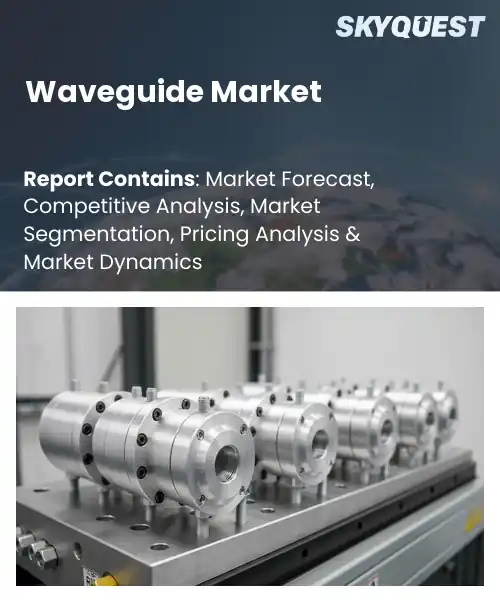
Waveguide Market
Report ID: SQMIG45H2202
Report ID: SQMIG45H2202
[email protected]
USA +1 351-333-4748
Report ID:
SQMIG45H2202 |
Region:
Global |
Published Date: June, 2026
Pages:
157
|Tables:
124
|Figures:
77


Global Waveguide Market size was valued at USD 1.2 Billion in 2024 and is poised to grow from USD 1.35 Billion in 2025 to USD 3.55 Billion by 2033, growing at a CAGR of 12.8% during the forecast period (2026-2033).
The waveguide market centers on technologies that channel electromagnetic energy between components, and its primary driver is the relentless demand for higher-frequency, higher-capacity communications infrastructure. As a research analyst today, I view waveguides as critical hardware used in microwave links, satellite payloads, radar arrays and emerging millimeter-wave 5G radios because they offer lower loss and precise mode control compared with coaxial alternatives. Historically the market expanded from military radar applications during the mid-20th century into commercial telecom and satellite sectors, and more recently has adapted to mmWave needs for autonomous vehicles and high-throughput satellites, illustrated by suppliers producing additive-manufactured assemblies.
Demand for mmWave and higher-bandwidth systems, supply-chain advancements in manufacturing precision and materials drive market expansion because lower-cost, repeatable production reduces entry barriers and enables wider deployment in commercial applications. For example, additive manufacturing and aluminum brazing techniques cut lead times and allow custom complex bends, which causes telecom operators to integrate waveguide-based backhaul in dense urban 5G networks, while satellite OEMs adopt lightweight waveguide feeds to increase payload efficiency. Consequently vendors capture opportunities in defense upgrades, automotive radar modules and private wireless, and sustained R&D into low-loss coatings will further expand addressable markets and export markets.
How is AI enhancing performance and adoption in the waveguide market?
AI is raising performance and speeding adoption in the waveguide market by automating design optimization and enabling predictive control. Key aspects include AI driven inverse design that discovers compact waveguide geometries, machine learning models that predict fabrication tolerance and reduce yield loss, and data driven test and calibration that shortens time to production. The current state shows closer integration between photonic engineers and AI EDA tools so designs are more efficient and robust. Market context is strong because demand for high bandwidth optical interconnects for AI data centers is pushing investment and scale which makes AI enabled development tools highly valuable.
POET Technologies May 2026, their May 14 2026 joint announcement with Lumilens on wafer level photonic integration shows how AI augmented design and packaging co optimization accelerates manufacturability and reduces development risk which supports faster adoption and better in system performance.
Market snapshot - (2026-2033)
Global Market Size
USD 1.2 Billion
Largest Segment
Rectangular Waveguides
Fastest Growth
Flexible Waveguides
Growth Rate
12.8% CAGR
To get more insights on this market click here to Request a Free Sample Report
Global waveguide market is segmented by type, component, application, end-use industry and region. Based on type, the market is segmented into Rectangular Waveguides, Circular Waveguides, Elliptical Waveguides, Flexible Waveguides and Others. Based on component, the market is segmented into Couplers, Adapters, Terminators and Loads and Others. Based on application, the market is segmented into Radar Systems, Satellite Communication, Telecommunication Networks, Medical Systems and Others. Based on end-use industry, the market is segmented into Aerospace and Defense, IT and Telecom, Healthcare, Industrial and Others. Based on region, the market is segmented into North America, Europe, Asia Pacific, Latin America and Middle East & Africa.
Rectangular Waveguides segment dominates because rectangular geometry provides predictable mode control and low transmission loss across common microwave and millimeter wave bands, enabling designers to rely on proven performance for high power and precision applications. Their well established manufacturing processes and compatibility with standard flanges simplify integration into radar, satellite and telecom systems. These practical advantages reduce design risk and total system cost, driving broad adoption across conservative and high reliability markets.
However, Flexible Waveguides are emerging as the most rapidly expanding area in the Waveguide Market due to bendability and compact routing that enable installations in constrained platforms and conformal antennas. Material and fabrication advances are enabling lighter, more reliable flexible interconnects, unlocking new mobile and integrated system applications and broadening future design opportunities.
Couplers segment dominates because couplers provide essential power division, combining and sampling functions that underpin beamforming, channel routing and system calibration in complex waveguide assemblies. Their role in enabling distributed transmitter and receiver architectures and in facilitating precise phase and amplitude control makes them indispensable for advanced radar and communication systems. The maturity of coupling designs and predictable performance reduces integration complexity, driving widespread specification by system architects focused on scalability and signal integrity.
Meanwhile, Adapters are witnessing the strongest growth momentum in the Waveguide Market as interoperability needs and mixed component architectures demand flexible interface conversion. Compact broadband adapter innovations and rising retrofit activity accelerate adoption across modern equipment, enabling faster upgrades and expanding aftermarket opportunities that broaden supplier reach and underpin ecosystem growth.
To get detailed segments analysis, Request a Free Sample Report
Asia Pacific leads the global waveguide market through a combination of concentrated manufacturing strength, deep electronics and telecommunications ecosystems, and targeted investment in advanced infrastructure. Strong collaboration between research institutions and industry accelerates development of high performance, application specific waveguide components. Regional supply chain specialization and proximity to component fabricators create efficiency advantages, while engineering talent and supportive policy frameworks encourage adoption of novel materials and modular designs. Consumer electronics, satellite communications, and defense demand together form an integrated value chain that supports both local suppliers and multinational players. Regional manufacturing clusters also facilitate partnerships with global vendors to meet evolving technical specifications and certification requirements.
Waveguide Market in Japan benefits from deep engineering expertise, advanced materials research, and close ties between electronics manufacturers and system integrators. Domestic suppliers focus on precision fabrication and miniaturization to serve high frequency and compact needs. Strong emphasis on quality assurance and regulatory compliance supports adoption in commercial and defense programs. Collaboration with research institutes accelerates innovation in novel waveguide geometries and materials, reinforcing Japan position as critical technology provider.
Waveguide Market in South Korea is characterized by rapid adoption of advanced communications technologies, strong local manufacturing capability, and integration with semiconductor supply chains. Industrial focus on high frequency applications and system architectures drives demand for tailored waveguide solutions. Collaboration between conglomerates and specialized suppliers supports scalable production and quality standards. Investment in material science and research enables efficient development of performance components suited to commercial networks and defense platforms.
North America expansion in the waveguide market is driven by a dynamic mix of advanced research ecosystems, prominent defense and aerospace procurement activity, and rapid deployment of next generation wireless networks. Strong collaboration among universities, industry consortia, and specialized suppliers accelerates prototyping and validation of novel waveguide architectures. A mature supplier base and flexible manufacturing capabilities support adaptation to demanding technical specifications for defense, satellite, and commercial telecom applications. Customer focus on reliability, performance, and integration with semiconductor platforms encourages development of sophisticated materials and modular solutions. Ongoing investment in manufacturing automation and emphasis on miniaturization and energy efficient designs position North America to deliver compact, high reliability waveguide products for emerging commercial and government missions.
Waveguide Market in United States is supported by extensive research and development infrastructure, a diverse supplier ecosystem, and strong linkage to defense programs. Emphasis on performance validation and certification fosters development of mission critical solutions. Collaboration between system integrators and semiconductor firms accelerates integration of waveguide components into transceiver modules. Demand from satellite communications, radar modernization, and commercial telecom deployments encourages innovation in materials, manufacturing automation, and scalable production processes.
Waveguide Market in Canada draws strength from a collaborative research network, advanced manufacturing facilities, and specialized suppliers focused on reliability applications. Emphasis on manufacturing practices and certification aligns offerings with aerospace and defense procurement needs. Partnerships between universities and industry accelerate prototype testing and material innovation. Market participants prioritize modular designs and production flexibility to serve satellite communications, radar systems, and telecom solutions with emphasis on durability and lifecycle performance.
Europe is strengthening its role in the waveguide market through coordinated research initiatives, robust standards frameworks, and a focus on precision manufacturing. Public and private research collaborations foster specialization in novel materials and advanced fabrication techniques that improve performance and reliability. European firms leverage established aerospace and industrial clusters to integrate waveguide solutions into complex systems with rigorous certification requirements. Emphasis on sustainability and efficient production processes encourages adoption of recyclable materials and energy conscious manufacturing practices. Cross border partnerships and strategic supply chain diversification reduce dependency on single sources while enabling knowledge sharing. Targeted funding instruments and technology transfer programs further accelerate commercialization and foster resilience across component supply chains.
Waveguide Market in Germany benefits from precision engineering, strong automation capabilities, and collaboration between research institutes and manufacturers. Focus on process optimization and quality control supports production of high tolerance components for aerospace applications. German suppliers emphasize integration with automated assembly and testing platforms for repeatable outputs. Strategic partnerships with system integrators accelerate adaptation of waveguide designs into complex systems, reinforcing Germany position as reliable supplier of engineered communication components.
Waveguide Market in United Kingdom is supported by strong academic research, a vibrant defense and satellite sector, a growing ecosystem of innovative suppliers. Emphasis on system integration and electromagnetic design expertise enables development of specialized waveguide solutions for challenging operational environments. Industry collaboration and access to testing facilities facilitate validation of prototypes. UK firms prioritize modularity and compliance with international standards, positioning offerings for export across commercial and government segments.
Waveguide Market in France leverages public research laboratories, specialized component manufacturers, and aerospace and satellite clusters. Emphasis on materials research and precision machining supports development of waveguide components for high performance systems. French suppliers focus on integration with complex platforms and rigorous testing regimes to meet certification requirements. Collaboration across industry, academia, and government agencies facilitates technology transfer and supports commercialization of innovative waveguide geometries for civil and defense applications.
To know more about the market opportunities by region and country, click here to
Buy The Complete Report
Expansion Of Telecom Infrastructure
Growing Demand For High Frequency
High Production and Material Costs
Complex Integration and Compatibility Challenges
Request Free Customization of this report to help us to meet your business objectives.
Competition in the global waveguide market centers on AR optics and integrated photonics, with incumbent acquisitions, manufacturing partnerships and engineering innovations shaping positioning. Large M&A deals such as Snap's 2021 purchase of WaveOptics, supply and production partnerships with manufacturers and glass suppliers, and focused silicon photonics startups accelerating on chip scale integration are primary competitive drivers in recent market activity.
Top Player’s Company Profile
Recent Developments
SkyQuest’s ABIRAW (Advanced Business Intelligence, Research & Analysis Wing) is our Business Information Services team that Collects, Collates, Correlates, and Analyses the Data collected by means of Primary Exploratory Research backed by robust Secondary Desk research. As per SkyQuest analysis, the global waveguide market is driven primarily by growing demand for higher-frequency, higher-capacity communications infrastructure, with manufacturing and materials advances such as additive manufacturing and improved fabrication serving as a second driver that enables lighter, lower-loss, and more customizable components. Growth is tempered by high production and material costs that constrain wider adoption and scale. Asia Pacific emerges as the dominant region due to concentrated manufacturing ecosystems and telecom investment, while rectangular waveguides remain the leading segment because of their predictable mode control, low loss and proven integration in radar, satellite and telecom systems and ongoing research and development sustains competitive innovation.
| Report Metric | Details |
|---|---|
| Market size value in 2024 | USD 1.2 Billion |
| Market size value in 2033 | USD 3.55 Billion |
| Growth Rate | 12.8% |
| Base year | 2024 |
| Forecast period | (2026-2033) |
| Forecast Unit (Value) | USD Billion |
| Segments covered |
|
| Regions covered | North America (US, Canada), Europe (Germany, France, United Kingdom, Italy, Spain, Rest of Europe), Asia Pacific (China, India, Japan, Rest of Asia-Pacific), Latin America (Brazil, Rest of Latin America), Middle East & Africa (South Africa, GCC Countries, Rest of MEA) |
| Companies covered |
|
| Customization scope | Free report customization with purchase. Customization includes:-
|
To get a free trial access to our platform which is a one stop solution for all your data requirements for quicker decision making. This platform allows you to compare markets, competitors who are prominent in the market, and mega trends that are influencing the dynamics in the market. Also, get access to detailed SkyQuest exclusive matrix.
Table Of Content
Executive Summary
Market overview
Parent Market Analysis
Market overview
Market size
KEY MARKET INSIGHTS
COVID IMPACT
MARKET DYNAMICS & OUTLOOK
Market Size by Region
KEY COMPANY PROFILES
Methodology
For the Waveguide Market, our research methodology involved a mixture of primary and secondary data sources. Key steps involved in the research process are listed below:
1. Information Procurement: This stage involved the procurement of Market data or related information via primary and secondary sources. The various secondary sources used included various company websites, annual reports, trade databases, and paid databases such as Hoover's, Bloomberg Business, Factiva, and Avention. Our team did 45 primary interactions Globally which included several stakeholders such as manufacturers, customers, key opinion leaders, etc. Overall, information procurement was one of the most extensive stages in our research process.
2. Information Analysis: This step involved triangulation of data through bottom-up and top-down approaches to estimate and validate the total size and future estimate of the Waveguide Market.
3. Report Formulation: The final step entailed the placement of data points in appropriate Market spaces in an attempt to deduce viable conclusions.
4. Validation & Publishing: Validation is the most important step in the process. Validation & re-validation via an intricately designed process helped us finalize data points to be used for final calculations. The final Market estimates and forecasts were then aligned and sent to our panel of industry experts for validation of data. Once the validation was done the report was sent to our Quality Assurance team to ensure adherence to style guides, consistency & design.
Analyst Support
Customization Options
With the given market data, our dedicated team of analysts can offer you the following customization options are available for the Waveguide Market:
Product Analysis: Product matrix, which offers a detailed comparison of the product portfolio of companies.
Regional Analysis: Further analysis of the Waveguide Market for additional countries.
Competitive Analysis: Detailed analysis and profiling of additional Market players & comparative analysis of competitive products.
Go to Market Strategy: Find the high-growth channels to invest your marketing efforts and increase your customer base.
Innovation Mapping: Identify racial solutions and innovation, connected to deep ecosystems of innovators, start-ups, academics, and strategic partners.
Category Intelligence: Customized intelligence that is relevant to their supply Markets will enable them to make smarter sourcing decisions and improve their category management.
Public Company Transcript Analysis: To improve the investment performance by generating new alpha and making better-informed decisions.
Social Media Listening: To analyze the conversations and trends happening not just around your brand, but around your industry as a whole, and use those insights to make better Marketing decisions.
REQUEST FOR SAMPLE
 REQUEST FREE CUSTOMIZATION
Global Waveguide Market size was valued at USD 1.2 Billion in 2024 and is poised to grow from USD 1.35 Billion in 2025 to USD 3.55 Billion by 2033, growing at a CAGR of 12.8% during the forecast period (2026-2033).
Competition in the global waveguide market centers on AR optics and integrated photonics, with incumbent acquisitions, manufacturing partnerships and engineering innovations shaping positioning. Large M&A deals such as Snap's 2021 purchase of WaveOptics, supply and production partnerships with manufacturers and glass suppliers, and focused silicon photonics startups accelerating on chip scale integration are primary competitive drivers in recent market activity. 'Quantic Electronics', 'Cobham', 'Ducommun', 'Smiths Group', 'Global Invacom Group', 'Flann Microwave', 'Penn Engineering', 'Jupiter Microwave Components', 'SAS Industries', 'ARRA', 'Centric RF', 'DEEWAVE', 'Microtech', 'ETL Systems', 'Huber+Suhner', 'Maury Microwave', 'Millitech', 'Space Machine & Engineering', 'The Waveguide Solution', 'Vector Telecom'
Expansion of telecom and datacenter networks has increased requirement for reliable signal transmission components such as waveguides, because operators prioritize low-loss, high-capacity pathways to support growing traffic and spectrum-intensive services. As infrastructure projects progress, system integrators prefer standardized, scalable waveguide solutions to ensure compatibility and ease of maintenance across deployments. This steady deployment activity drives demand for diverse waveguide types across frequency bands and form factors, encouraging vendors to invest in manufacturing capacity and product development to meet evolving network architectures.
𝐏𝐡𝐨𝐭𝐨𝐧𝐢𝐜𝐬 𝐈𝐧𝐭𝐞𝐠𝐫𝐚𝐭𝐢𝐨𝐧 𝐆𝐫𝐨𝐰𝐭𝐡: The convergence of photonics and electronics is elevating demand for compact, low loss waveguides within optical interconnects and sensor modules. Designers prioritize integrated solutions that reduce board area, improve signal fidelity, and enable scalable manufacturing. Collaboration between semiconductor foundries and optical component makers is accelerating standardized platforms and kits. As ecosystems mature, customers seek customizable waveguide geometries for diverse applications including datacom, telecom, and instrumentation, prompting vendors to invest in process optimization, packaging, and system level validation.
Why does Asia Pacific Dominate the Global Waveguide Market? |@12


Want to customize this report? This report can be personalized according to your needs. Our analysts and industry experts will work directly with you to understand your requirements and provide you with customized data in a short amount of time. We offer $1000 worth of FREE customization at the time of purchase.
Feedback From Our Clients


 USA (+1) 351-333-4748

