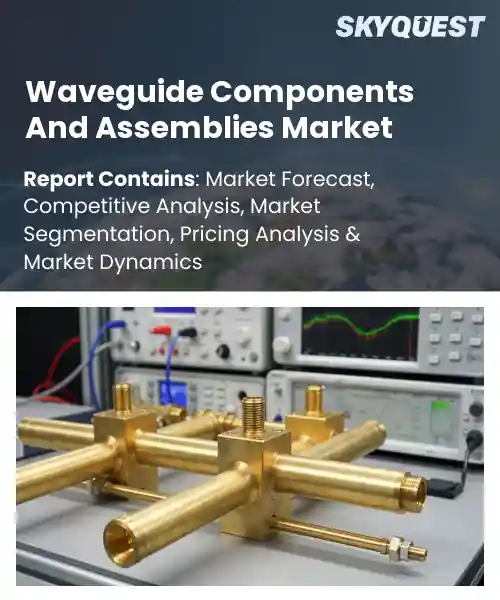
Waveguide Components And Assemblies Market
Report ID: SQMIG45K2243
Report ID: SQMIG45K2243
[email protected]
USA +1 351-333-4748
Report ID:
SQMIG45K2243 |
Region:
Global |
Published Date: February, 2026
Pages:
157
|Tables:
157
|Figures:
77


Global Waveguide Components And Assemblies Market size was valued at USD 1.76 Billion in 2024 and is poised to grow from USD 1.84 Billion in 2025 to USD 2.66 Billion by 2033, growing at a CAGR of 4.7% during the forecast period (2026-2033).
The waveguide components and assemblies industry is a subset of the microwave/millimeter-wave industry and focuses on the metallic or dielectric components used to transmit electromagnetic energy with minimal losses. Waveguide components play an important role in high-frequency communications and radar systems. Demand waveguide products grew from their original use in military applications during the cold war; and many companies, such as Cobham, have developed products and technology to support reduced size and improved tolerance. Current drivers for demand in the waveguide component and assembly market are due to the increasing number of high-capacity data links and modernization of the defense industry, which create new opportunities for developing innovative systems utilizing additional data capacity.
A major driving force in waveguide components and assemblies markets is due to millimeter wave technology being commercialized and subsequently increasing demand for precision components that will allow manufacturers to develop compact, minimal-loss assemblies. As telecom operators move forward with deploying 5G networks and satellite constellations, network designers will require waveguide components that maintain signal integrity at these higher frequency ranges, which has resulted in manufacturers adopting advanced machining processes.
How is AI Improving Manufacturing Efficiency in the Waveguide Components and Assemblies Market?
The waveguide components and assemblies industry is seeing an increase in efficiency due to the utilization of artificial intelligence (AI). This is done through the acceleration of design processes, tighter control of processes, and the automation of inspection processes. The major elements of this use of AI include electromagnetic simulation optimization through AI, machine learning to tune the process parameters of CNC and additive manufacturing, and computer vision to detect surfaces and assembly defects. The increasing demands for higher frequency performance from telecommunications, aerospace, and defense are driving increased tolerances for components. Ultimately, suppliers are leveraging AI to shorten the prototyping process, reduce the amount of rework required, and produce complex geometries for components that are reproducible on the manufacturing floor. By utilizing AI to improve the design of the manufacturing process, the overall throughput and reliability of the products have increased.
In June 2025, Rosenberger showcased how it has used AI to improve the footprint of its HPX interconnect at the IMS 2025 conference. By using AI/machine learning, Rosenberger was able to match simulated and measured signal integrity to create a manufacturable design that reduced engineering iterations and increased throughput with high-frequency connectors.
Market snapshot - (2026-2033)
Global Market Size
USD 1.76 Billion
Largest Segment
Couplers
Fastest Growth
Phase Shifters
Growth Rate
4.7% CAGR
To get more insights on this market click here to Request a Free Sample Report
Global waveguide components and assemblies market is segmented into component, sector, waveguide type, frequency band, application and region. Based on component, the market is segmented into adapters, couplers, loads and filters, isolators and circulators, duplexers, phase shifters, power combiners and others. Based on sector, the market is segmented into aviation and defense and space. Based on waveguide type, the market is segmented into rectangular waveguide, circular waveguide, flexible waveguide, and rigid waveguide. Based on frequency band, the market is segmented into radio frequency (RF), microwave, millimeter wave, EO/IR, ultraviolet, x-ray and gamma ray. Based on application, the market is segmented into telecommunications, aerospace & defense, space & satellite communication, medical, industrial, automotive and research & scientific. Based on region, the market is segmented into North America, Europe, Asia Pacific, Latin America and Middle East & Africa.
As per waveguide components and assemblies market outlook, the isolators and circulators segment is the most dominant in waveguide assemblies because isolators and circulators are necessary to prevent damage to transmitters and to prevent reflected signals. These capabilities are why isolators and circulators are preferred for critical applications in both aerospace and defense, as well as satellite systems. There is a demand for isolators and circulators because of the protection they offer to sensitive systems.
As per waveguide components and assemblies market forecast, the fastest growing component in waveguide assemblies is phase shifters, primarily due to the increased use of phased array and beam forming technologies. Continued improvements in low losses, compact phase shifter design, and semiconductor controls have allowed for improved accuracy in steering beams and providing adaptive performance. As a result, the use of phased array technology is increasing rapidly within both radar systems and advanced communication systems that rely on modular software-controlled RF subsystems.
As per waveguide components and assemblies market analysis, rectangular waveguide segment leads because its geometric simplicity and well-established manufacturing standards deliver predictable low loss transmission and high-power handling across key microwave and millimeter wave applications. They are cost-competitive and readily available from suppliers with extensive histories of performance in high-technology industries such as aerospace, defense, and satellite communications. Thus, they are the preferred choice for designers looking for reliable and interoperable components, reinforcing their central role in the design of waveguide components and assemblies.
Flexible waveguide is the fastest growing type of waveguide, as demand for adaptable routing of signals on small, compact platforms is on the rise. Improved bend performance, higher material durability, and simplified monitorization contribute to more straightforward integration into enclosed equipment and telecommunications and aerospace deployments. Therefore, flexible waveguides are helping to bring new levels of design flexibility and new ways to create system-level assemblies into reality.
To get detailed segments analysis, Request a Free Sample Report
As per waveguide components and assemblies market regional outlook, with a wealth of advanced aerospace, defense, and telecommunications applications, North America continues to lead the global market for complex waveguide solutions. A mature ecosystem of OEMs, specialized suppliers and accredited test and certification facilities work to support fast design-to-production cycles and high-quality production standards. Significant research institutions and corporate R&D drive innovation in the materials and precision manufacturing techniques.
The waveguide components and assemblies market in the United States has a highly concentrated cluster of satellite operators, defense primes, and telecommunication companies, which demand high-reliability products. Over the past ten years, established production facilities have been leveraged into rapid prototyping capabilities. Rapid prototyping and certification are made possible by having well-established test facilities located in the same manufacturing centers as the OEMs and satellite operators. Close collaboration between research institutions and industry enhances material and packaging innovation and accelerates time-to-market.
The waveguide components and assemblies market in Canada is mainly composed of specialized manufacturers that service the defense, satellite communications and research institution sectors. The market benefits from an advanced laboratory network and engineering support to ensure quality production and custom-developed products. Close cooperative relationships with system integrators and partners provide access to broader supply chains. Expertise in materials, precision assembly, and testing services will position the market to have highly specialized opportunities in complex communications and sensing.
The explosion of growth seen in the Asia Pacific region is driven by a combination of strong electronics manufacturing, high-speed telecommunications deployments and increased defense spending with all three together creating increased demand for waveguide components and assemblies. Throughout the region, manufacturers are shifting their operations from contract manufacturing to higher-value design and systems integration through the support of new testing facilities and innovations in materials science. In addition, governments and industry consortiums are focusing on building the capability of domestic manufacturers and diversifying their supply chains, through partnerships with global technology providers.
As per waveguide components and assemblies market regional forecast, Japan market place is built on a long tradition of excellence in precision manufacturing and material science-based capabilities that help meet the robust requirements for Aerospace, satellite and high-frequency telecommunications. Large electronics companies as well as niche-focused SMEs have established collaborative relationships with research institutes to refine waveguide components packaging and miniaturization. Additionally, major developments have been made in the areas of quality assurance and reliability of waveguide components. Thereby enhancing the capability of these components for use in mission-critical applications.
In South Korea, the waveguide components and assemblies market is heavily influenced by manufacturers of electronic and semiconductor products that require interconnects and high-frequency assembly. With a domestic focus on millimetre wave communication systems and defence systems, there is a push for localization of the design and the production of waveguide components. There are several contract manufacturers and suppliers of materials in support of rapid prototyping and volume ramp-up.
Europe is further consolidating its global power through a wide range of industrial strategies that strengthen collaboration between companies in aerospace, defence and telecommunications; industry experts; and SMEs by coordinating technical standards between them. This is combined with a drive to improve domestic supply chains by reshoring of critical manufacturing capabilities, and by focusing on long-term investments in high-reliability production. Advances in the fields of advanced materials, precision machining and environmental compliance are providing additional opportunities for differentiating products through product development and manufacturing technologies. The establishment of close working relationships between prime contractors and niche component manufacturers is accelerating the rate of transfer of technology and the ability of the prime to produce custom complex integrated systems.
Germany is currently leveraging its precision engineering expertise to develop and manufacture high reliability components for the aerospace, radar, and other industries through the waveguide component and assembly market. An extensive network of SMEs, testing laboratories and machine tool suppliers supports and facilitates the manufacturing of high reliability components within the framework of established procedures for precision fabrication and stringent quality control processes. Collaboration between R&D institutions and manufacturing companies will also continue to foster innovation in material development and scalability of production. The focus on export markets along with strong adherence to rigid quality and manufacturing standards further solidifies Germany’s status as a trusted global supplier of complex assemblies.
In the United Kingdom, waveguide components and assemblies market trends benefit from a well-established ecosystem comprised of defense prime contractors along with satellite system integrators and research institutions. These organizations help influence the demand for complex assemblies used in waveguide products. In addition, there are a wide variety of small to medium enterprises that specialize in manufacturing, precision machining, and testing. As such, system integration and ruggedization efforts have been developed to meet the specific aerospace and defense needs of their customer base. Furthermore, by working together with academic institutions, new innovations regarding material and packaging are being developed.
As per waveguide components and assemblies industry analysis, waveguide components and assemblies in the France are driven mainly by a robust aerospace industry combined with defense procurement that requires high-performance components. As a result, many of the major system integrators are working with small to medium enterprises and research laboratories to design compact ruggedized assemblies for satellite platforms and radar systems. In addition, qualification, supply chain traceability, and lifecycle support are all extremely important when choosing a supplier. France also has the national capabilities required to produce advanced materials and precision machined components used in customized solutions for extreme mission profiles as well as for exporting.
To know more about the market opportunities by region and country, click here to
Buy The Complete Report
Expansion of High-Speed Networks
Advances in Optical Technology
Complex Manufacturing Processes
Supply Chain Vulnerabilities
Request Free Customization of this report to help us to meet your business objectives.
The competitive landscape for waveguide components and assemblies is evolving through consolidation through strategic partnerships with exclusive OEMs, acquisitions and technology alliances between companies. Examples include Snap acquiring WaveOptics and Goertek making investments and arrangements to ensure that it can manufacture components at high volume. In addition, companies are also developing and manufacturing differentiated intellectual property (IP) for both diffractive and silicon nitride waveguides to win design wins and long-term supply contracts.
SkyQuest’s ABIRAW (Advanced Business Intelligence, Research & Analysis Wing) is our Business Information Services team that Collects, Collates, Correlates, and Analyses the Data collected by means of Primary Exploratory Research backed by robust Secondary Desk research.
As per SkyQuest analysis, the global waveguide components and assemblies market is supported mainly by commercialization of millimeter wave technologies, which increases demand for precision, low loss assemblies, and by the expansion of high-speed networks that require higher capacity links. However, complex manufacturing processes remain a key restraint due to tight tolerances and specialized equipment that raise entry barriers and limit scaling. North America remains in the dominating region due to its defense, aerospace, and telecom ecosystem, while isolators and circulators stand out as the dominating segment because they protect transmitters and ensure directional control in critical systems. Suppliers focusing on AI and additive manufacturing will capture growth opportunities. The market reflects a moderately consolidated waveguide components and assemblies market share, with key global players dominating through advanced RF technologies. The market is experiencing a steady waveguide components and assemblies market trend driven by rising demand for high-frequency communication systems.
| Report Metric | Details |
|---|---|
| Market size value in 2024 | USD 1.76 Billion |
| Market size value in 2033 | USD 2.66 Billion |
| Growth Rate | 4.7% |
| Base year | 2024 |
| Forecast period | (2026-2033) |
| Forecast Unit (Value) | USD Billion |
| Segments covered |
|
| Regions covered | North America (US, Canada), Europe (Germany, France, United Kingdom, Italy, Spain, Rest of Europe), Asia Pacific (China, India, Japan, Rest of Asia-Pacific), Latin America (Brazil, Rest of Latin America), Middle East & Africa (South Africa, GCC Countries, Rest of MEA) |
| Companies covered |
|
| Customization scope | Free report customization with purchase. Customization includes:-
|
To get a free trial access to our platform which is a one stop solution for all your data requirements for quicker decision making. This platform allows you to compare markets, competitors who are prominent in the market, and mega trends that are influencing the dynamics in the market. Also, get access to detailed SkyQuest exclusive matrix.
Table Of Content
Executive Summary
Market overview
Parent Market Analysis
Market overview
Market size
KEY MARKET INSIGHTS
COVID IMPACT
MARKET DYNAMICS & OUTLOOK
Market Size by Region
KEY COMPANY PROFILES
Methodology
For the Waveguide Components And Assemblies Market, our research methodology involved a mixture of primary and secondary data sources. Key steps involved in the research process are listed below:
1. Information Procurement: This stage involved the procurement of Market data or related information via primary and secondary sources. The various secondary sources used included various company websites, annual reports, trade databases, and paid databases such as Hoover's, Bloomberg Business, Factiva, and Avention. Our team did 45 primary interactions Globally which included several stakeholders such as manufacturers, customers, key opinion leaders, etc. Overall, information procurement was one of the most extensive stages in our research process.
2. Information Analysis: This step involved triangulation of data through bottom-up and top-down approaches to estimate and validate the total size and future estimate of the Waveguide Components And Assemblies Market.
3. Report Formulation: The final step entailed the placement of data points in appropriate Market spaces in an attempt to deduce viable conclusions.
4. Validation & Publishing: Validation is the most important step in the process. Validation & re-validation via an intricately designed process helped us finalize data points to be used for final calculations. The final Market estimates and forecasts were then aligned and sent to our panel of industry experts for validation of data. Once the validation was done the report was sent to our Quality Assurance team to ensure adherence to style guides, consistency & design.
Analyst Support
Customization Options
With the given market data, our dedicated team of analysts can offer you the following customization options are available for the Waveguide Components And Assemblies Market:
Product Analysis: Product matrix, which offers a detailed comparison of the product portfolio of companies.
Regional Analysis: Further analysis of the Waveguide Components And Assemblies Market for additional countries.
Competitive Analysis: Detailed analysis and profiling of additional Market players & comparative analysis of competitive products.
Go to Market Strategy: Find the high-growth channels to invest your marketing efforts and increase your customer base.
Innovation Mapping: Identify racial solutions and innovation, connected to deep ecosystems of innovators, start-ups, academics, and strategic partners.
Category Intelligence: Customized intelligence that is relevant to their supply Markets will enable them to make smarter sourcing decisions and improve their category management.
Public Company Transcript Analysis: To improve the investment performance by generating new alpha and making better-informed decisions.
Social Media Listening: To analyze the conversations and trends happening not just around your brand, but around your industry as a whole, and use those insights to make better Marketing decisions.
REQUEST FOR SAMPLE
 REQUEST FREE CUSTOMIZATION
Global Waveguide Components And Assemblies Market size was valued at USD 1.76 Billion in 2024 and is poised to grow from USD 1.84 Billion in 2025 to USD 2.66 Billion by 2033, growing at a CAGR of 4.7% during the forecast period (2026-2033).
Competitive landscape in the global waveguide components and assemblies market is driven by consolidation via strategic acquisitions, exclusive OEM manufacturing partnerships, and specialist technology alliances. Examples include Snap's acquisition of WaveOptics and Goertek's production and financing arrangements that secure high volume manufacturing. Firms also pursue differentiated IP in diffractive and silicon nitride waveguides to win design wins and long term supply contracts. 'Quantic Electronics', 'Millimeter Wave Products Inc.', 'Cobham Limited', 'Ducommun Incorporated', 'Etl Systems', 'Teledyne Technologies Inc.', 'Northrop Grumman Corporation', 'M2 Global Technology Ltd.', 'Eravant', 'Space Machine & Engineering Corporation', 'Kete Microwave Electronics Co. Ltd.', 'Ute Microwave, Inc.', 'Rf Lambda', 'Amplitech, Inc.', 'Aeralis', 'Ansys, Inc.', 'Elsys', 'M/A-Com Technology Solutions', 'Ecommutechvirtio'
Photonics Integration Acceleration: The push toward higher levels of photonic integration is reshaping demand for waveguide components and assemblies as designers seek compact, low-loss interconnects that enable tighter integration with active devices. This trend encourages closer collaboration between component suppliers, foundries and system OEMs, drives investment in advanced packaging and automated alignment solutions, and prioritizes modular, standardized building blocks that shorten development cycles. Rising integration focus expands addressable markets across communications, sensing and computing while elevating requirements for design-for-manufacture and supply chain collaboration.
As per waveguide components and assemblies market regional outlook, with a wealth of advanced aerospace, defense, and telecommunications applications, North America continues to lead the global market for complex waveguide solutions.


Want to customize this report? This report can be personalized according to your needs. Our analysts and industry experts will work directly with you to understand your requirements and provide you with customized data in a short amount of time. We offer $1000 worth of FREE customization at the time of purchase.
Feedback From Our Clients


 USA (+1) 351-333-4748

