

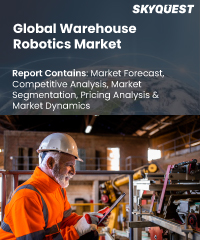
Warehouse Robotics Market
Report ID: SQMIG20E2129
Skyquest Technology's expert advisors have carried out comprehensive research and identified these companies as industry leaders in the Warehouse Robotics Market. This Analysis is based on comprehensive primary and secondary research on the corporate strategies, financial and operational performance, product portfolio, market share and brand analysis of all the leading Warehouse Robotics industry players.


The global warehouse robotics market is experiencing growth due to several pivotal factors that are changing supply chain operations across the globe. Rising e-commerce activities and growing consumer demand for faster order fulfillment are pushing warehouse operators to adopt robotic solutions that can handle high volumes with speed and accuracy. Robots can execute repetitive tasks effectively, with predictability, and it is this predictability that makes them attractive to employers. Furthermore, recent advancements in robotics, including artificial intelligence (AI), machine learning (ML), and autonomous navigation tools are enabling smarter, flexible operations, including real-time inventory management and dynamic task allocations.
According to SkyQuest Technology “Warehouse Robotics Market size is estimated to reach USD 53.48 billion by 2032" By Product (Mobile Robots, Articulated Robots, Cylindrical Robots, Scara Robots, Parallel Robots, Cartesian Robots), By Function (Pick & Place, Palletizing & De-palletizing, Transportation, Packaging), By Application Capacity, By Region - Industry Forecast 2025-2032,” Global warehouse robotics market is projected to grow at a CAGR of over 19.6% by 2032, on account of urgent need for automating quantified data. The global warehouse robotics market has been significantly boosted by rapid technological advancements, which are enhancing efficiency, flexibility, and intelligence in warehouse operations. Key advancements include the development of autonomous mobile robots (AMRs) capable of navigating complex warehouse environments without human intervention or fixed pathways.
|
Company |
Est. Year |
Headquarters |
Revenue |
Key Services |
|
Amazon Robotics |
2003 |
North Reading, Massachusetts, USA |
$500 billion (2024) |
AI-powered robots like Proteus and Sequoia for order fulfillment, inventory management and warehouse automation |
|
Symbotich |
2007 |
Wilmington, Massachusetts, USA
|
$ 1.5 billion (2024) |
AI-driven robotics and automation solutions for warehouse operations, including robotic arms and autonomous mobile robots |
|
Geek+ |
2015 |
Beijing, China |
$100 million (2024) |
Autonomous mobile robots (AMRs), robotic arms, and warehouse automation solutions for logistics and supply chain management |
|
KION Group |
2006 |
Frankfurt, Germany |
$3.5 billion (2024) |
Integrated automation technologies, including automated storage and retrieval systems (AS/RS), conveyors, and sorting systems |
|
Locus Robotics |
2014 |
Wilmington, Massachusetts, USA |
$200 million (2024) |
Autonomous mobile robots (AMRs) designed to work collaboratively with human workers, optimizing warehouse workflows |
|
Daifuku |
1937 |
Osaka, Japan |
$8.5 billion (2024) |
Material handling systems, including automated storage and retrieval systems (AS/RS), conveyors and sorting systems |
|
Swisslog
|
1900 |
Buchs, Switzerland |
$3.6 billion (2024) |
Warehouse automation solutions, including robotic systems, warehouse management software, and automated material handling equipment |
|
Honeywell Intelligrated |
2001 |
Mason, Ohio, USA |
$41.8 billion (2024) |
Warehouse automation solutions, including robotic systems, conveyor systems, and warehouse control software |
|
Vecna Robotics |
2018 |
Waltham, Massachusetts, USA |
$100 million (2024) |
Autonomous mobile robots (AMRs) for material handling and warehouse automation |
|
Standard Bots |
2011 |
Austin, Texas, USA |
$$50 million (2024) |
Affordable, AI-driven collaborative robots (cobots) designed for small to medium-sized warehouses |
Amazon Robotics, a company under Amazon, is a leading international warehouse automation company whose mission is to sustain momentum, drive down costs, and keep pace with the expansion of e-commerce. Established in 2003 as Kiva Systems and acquired by Amazon in 2012, Amazon Robotics has developed hundreds of thousands of autonomous mobile robots (AMRs) and robotic arms for use in fulfillment centers around the world. Its specialties are focused on order fulfillment, inventory management, and material handling, which has modified warehouse workflows.
Symbotic is an American company that employs AI-based warehouse automation solutions which combine robotics, artificial intelligence and machine learning to optimize matters. Founded in 2007 and located in Wilmington, Massachusetts, Symbotic implements high-density automation platforms to create better efficiency, accuracy and flexibility for large retailers and logistics companies. Symbotic's warehouse automation solutions address complex inventory flows and assist faster order fulfillment giving companies ways to enhance their supply chain sped.
Geek+ is a Chinese warehouse robotics company focused on autonomous mobile robots (AMRs) and intelligent logistics systems. Founded in 2015 and headquartered in Beijing, Geek+ services e-commerce, retail and manufacturing organizations. Geek+'s robotics systems use AI-based robotic operations to enhance warehouse operations and improve efficiency, accuracy and safety.
KION Group, with its headquarters located in Frankfurt, Germany, is a global leader in industrial trucks and warehouse automation solutions. The company-initiated operations in 2006 and conducts business through brands, including Dematic, that produce products, such as automated storage and retrieval systems (AS/RS), conveyors, and sorting solutions. KION Group incorporates AI, digitization, and robotics into its automation solutions, which allow companies to improve productivity, transparency, and safety in operations.
Founded in 2014 and headquartered in Wilmington, Massachusetts, USA, Locus Robotics develops autonomous mobile robots for warehouse automation. Locus Robotics' autonomous mobile robots (AMRs) closely work with human workers to increase productivity, optimize workflows, and reduce operating costs. Locus Robotics serves e-commerce fulfillment centers and third-party logistics providers globally with scalable and flexible automation solutions. Locus Robotics continues to innovate in human-robot collaboration and intelligent warehouse operations.
Daifuku was founded in 1937 and is headquartered in Osaka, Japan. Daifuku is the global leader in material handling systems and warehouse automation. Daifuku manufactures automated storage and retrieval systems (AS/RS), sortation systems, conveyors, and integrated solutions that improve efficiency and reliability in logistics and manufacturing. Daifuku combines years of engineering knowledge with innovative technologies to deliver scalable and adaptive warehouse automation solutions to customers worldwide.
Swisslog was formed in 1900 and is located in Buchs, Switzerland, making it one of the top experts in warehouse automation and robotics. The company provides solutions from start to finish for warehousing, distribution, and production logistics solutions, robotic systems, warehouse management software, and automated material handling equipment.
Honeywell Intelligrated, founded in 2001 and headquartered in Mason, Ohio, USA, specializes in warehouse automation solutions, robotic systems, conveyors, and warehouse control software. As a division of Honeywell, Automation and Control Solutions develops solutions that maximize warehouse storage, improve throughput and minimize operation costs.
Vecna Robotics, founded in 2018 and headquartered in Waltham, Massachusetts, USA develops autonomous mobile robots (AMRs) and AI based warehouse automation. The company is focused on flexible and scalable systems that drive up productivity and reduce labor costs within fulfillment and distribution centers. Looking ahead, Vecna Robotics will continue the present innovation, create an interface for robotics and software, and support organizations with solutions to streamline warehouse workflows to meet growing needs for smarter material handling.
Standard Bots was founded in 2011 and is based in Austin, Texas. Standard Bots's focus is low cost, AI powered collaborative robots (cobots) for small and medium warehouses. Standard Bots robots can work alongside human coworkers, increasing productivity, improving workflow and reducing labor costs.
The global warehouse robotics market is expected to witness phenomenal growth. Automation is being increasingly adopted by businesses in many sectors to drive efficiency, reduce operational costs, and accommodate the growing demand for faster order fulfillment. Innovations such as autonomous mobile robots, AI-enabled analytics, collaborative robots, and cloud-connected systems are changing warehouse operations to be smarter, safer, and more flexible. The market is driven by challenges such as labor shortages, growth in e-commerce, and the necessities of optimized supply chains, new start-ups emerging with cutting-edge solutions add to the drive via investment and atypical players entering the space factoring heavily for established players as they innovate and scale. Ultimately, the warehouse robotics market sets to redefine logistics and material handling.
REQUEST FOR SAMPLE
 REQUEST FREE CUSTOMIZATION
Want to customize this report? This report can be personalized according to your needs. Our analysts and industry experts will work directly with you to understand your requirements and provide you with customized data in a short amount of time. We offer $1000 worth of FREE customization at the time of purchase.
Feedback From Our Clients
Report ID: SQMIG20E2129
[email protected]
USA +1 351-333-4748
 USA (+1) 351-333-4748

