Service Robotics Market
Report ID: SQMIG45J2161
Report ID: SQMIG45J2161
[email protected]
USA +1 351-333-4748
Report ID:
SQMIG45J2161 |
Region:
Global |
Published Date: June, 2025
Pages:
196
|Tables:
67
|Figures:
70


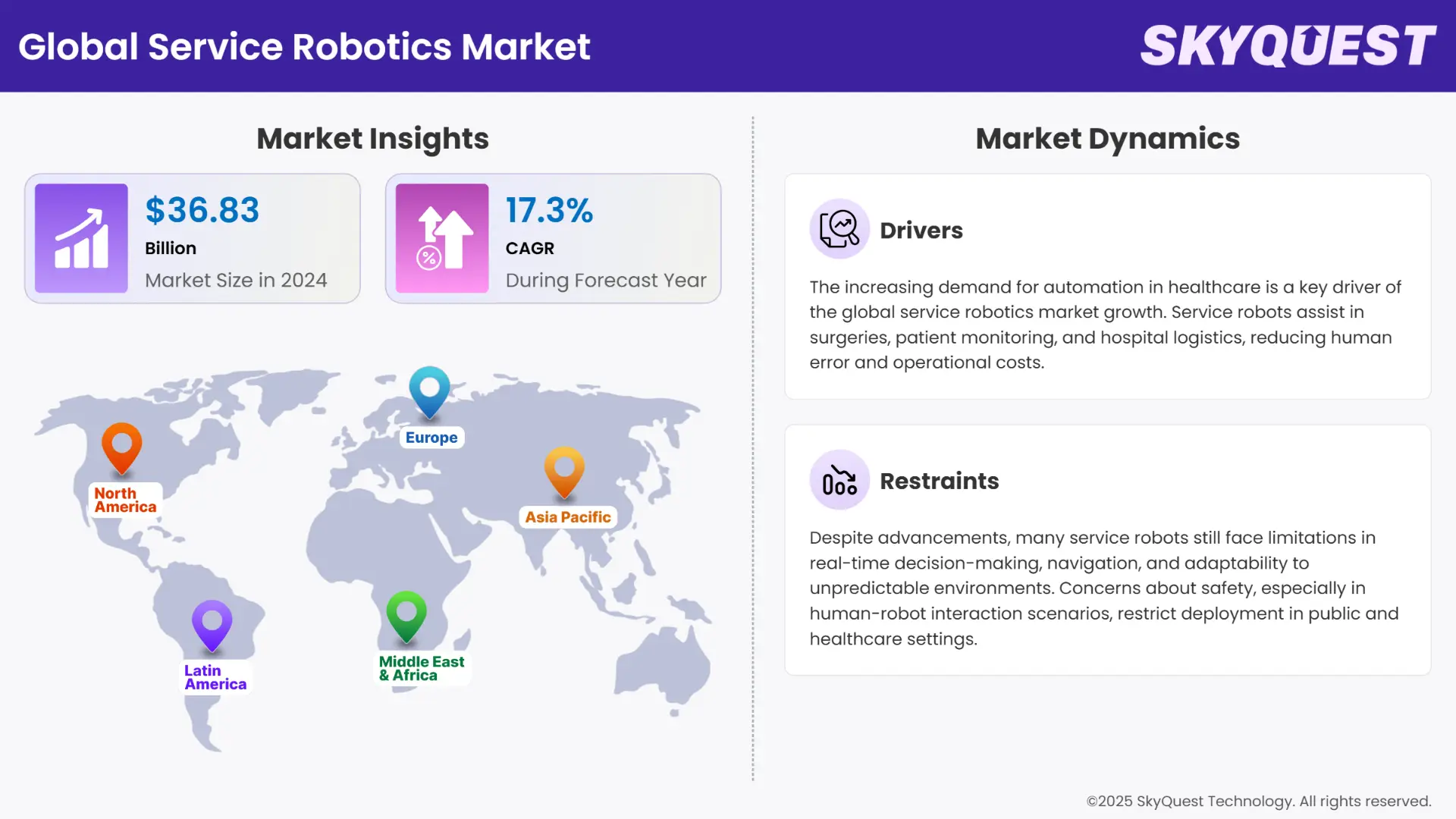
Global Service Robotics Market size was valued at USD 36.83 Billion in 2024 poised to grow from USD 43.2 Billion in 2025 to USD 154.84 Billion by 2033, growing at a CAGR of 17.3% in the forecast period (2026–2033).
The global rise in labor costs, coupled with a rapidly aging population—particularly in countries like Japan, Germany, and the U.S.—is driving the demand for service robotics. Industries such as healthcare, hospitality, and logistics are struggling to maintain adequate human staffing due to both economic pressures and demographic shifts. Service robots offer a cost-effective and reliable solution, performing tasks like patient monitoring, cleaning, and delivery with minimal human intervention. As labor shortages intensify and wage demands grow, organizations are increasingly turning to robots to ensure operational continuity, improve productivity, and deliver consistent service in environments facing severe workforce constraints.
Breakthroughs in artificial intelligence and sensor technology have been key trends driving the global service robotics sector. Modern robots are now equipped with advanced machine learning algorithms, computer vision, LIDAR, and tactile sensors, enabling them to perceive surroundings, make real-time decisions, and interact intelligently with humans. These technological improvements allow robots to navigate unpredictable environments, adapt to new tasks, and function autonomously in sectors like healthcare, retail, and domestic assistance. As AI and sensor costs decline and performance improves, more industries are integrating service robots into daily operations, expanding their applications from structured industrial settings to dynamic, real-world environments.
In which Sectors are AI-Powered Service Robots Seeing the Fastest Adoption?
Artificial intelligence (AI) is directly transforming the global service robotics market by enabling robots to perform complex, adaptive tasks with minimal human input. AI-powered robots can process large datasets, recognize speech and faces, navigate dynamic environments, and learn from user interactions—making them ideal for roles in healthcare, hospitality, and customer service. Indirectly, AI also accelerates development cycles through simulation and predictive modeling. A notable development is Tesla’s humanoid robot “Optimus,” designed to perform repetitive factory tasks using AI and vision systems. Such innovations highlight AI’s pivotal role in expanding robotic capabilities, market demand, and the shift toward intelligent, autonomous service systems.
In March 2025, Google DeepMind launched Gemini Robotics and Gemini Robotics‑ER, AI models that enable robots to perform complex real-world tasks—like folding origami, organizing desks, wrapping wires, and even “slam-dunking” miniature basketballs—through advanced reasoning and spatial understanding. These models, built on large language model (LLM) capabilities, greatly enhance robot dexterity, perception, and adaptability.
To get more insights on this market click here to Request a Free Sample Report
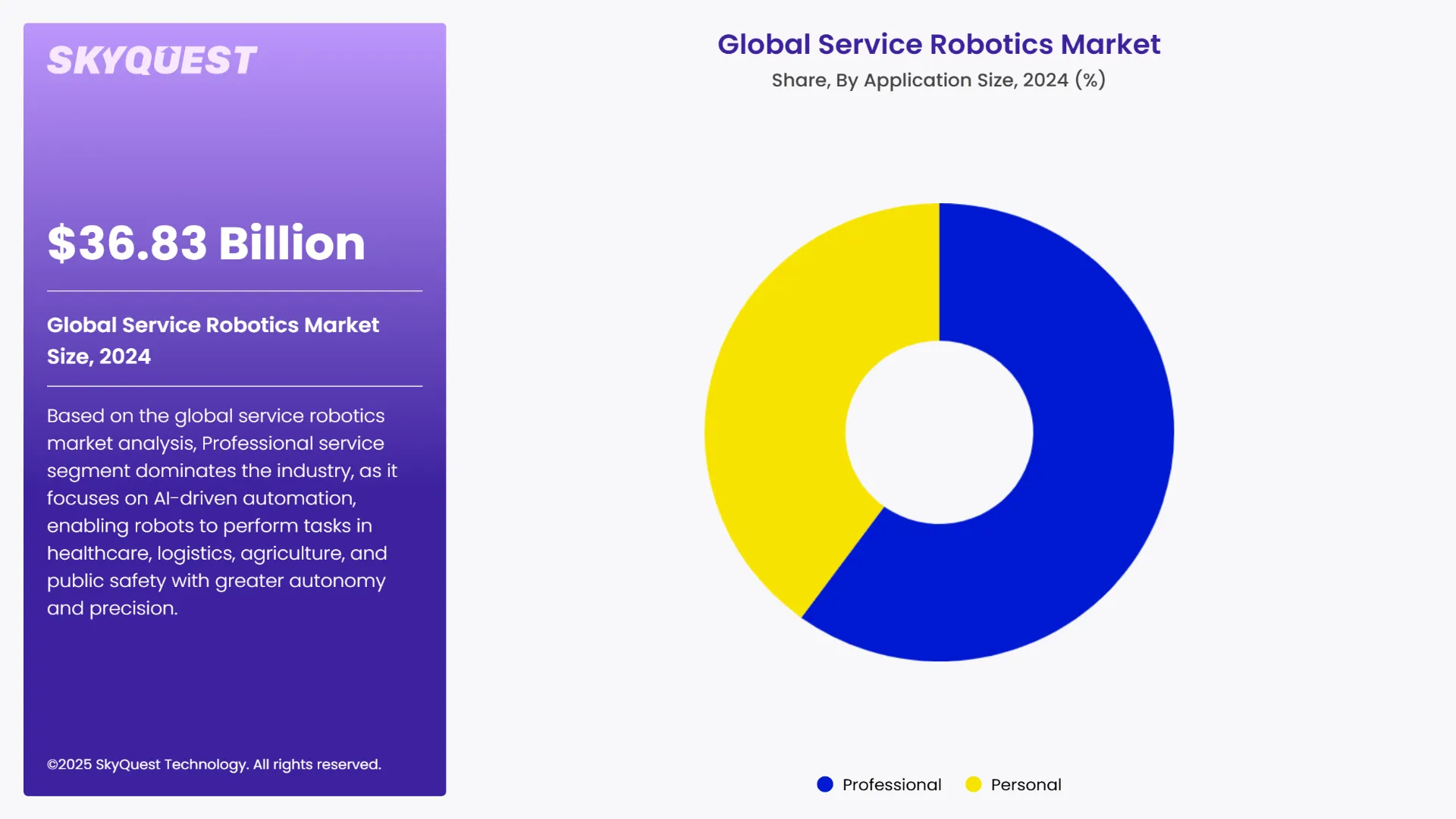
The global service robotics market is segmented based on application, end use, and region. In terms of application, the market is divided into professional and personal. Based on end use, the market is grouped into defense, field, medical, transportation & logistics, mobile platforms, underwater systems, construction, and others. Based on region, the market is segmented into North America, Europe, Asia-Pacific, Central & South America and the Middle East & Africa.
Based on the global service robotics market analysis, Professional service segment dominates the industry, as it focuses on AI-driven automation, enabling robots to perform tasks in healthcare, logistics, agriculture, and public safety with greater autonomy and precision. Technologies like machine vision, autonomous navigation, and cloud-based coordination are accelerating adoption. Professional applications dominate the market due to rising labor shortages, demand for 24/7 operational efficiency, and growing use cases across critical industries where consistency, accuracy, and reliability are paramount.
Personal applications are expected to be the fastest-growing segment in the global service robotics market due to rising consumer demand for convenience, aging populations needing home assistance, and increasing affordability of smart technologies. Advancements in AI, voice recognition, and mobility are driving adoption of robots for domestic tasks, companionship, and personal care, especially in urban and tech-savvy households.
Mobile platform end‑use is dominating in the global service robotics market emphasizes AI-driven Autonomous Mobile Robots (AMRs) equipped with advanced machine vision, sensor fusion, and cloud connectivity to efficiently handle repetitive tasks like warehouse logistics, inspections, cleaning, and delivery. These robots deliver high precision and real-time navigation, optimizing workflows across industries from healthcare to retail. Mobile platforms dominate due to their versatility, ability to operate in dynamic environments, and significant cost savings achieved through labor reduction and improved efficiency.
Underwater systems are poised to be the fastest-growing end-use in global service robotics market as autonomous underwater vehicles (AUVs) with advanced AI navigation and sensor fusion are increasingly used for defense, offshore oil/gas, and deep-sea exploration. Enhanced autonomy enables long-duration missions, safer infrastructure inspection, and mineral mapping—making them vital in high-demand marine operations.
To get detailed segments analysis, Request a Free Sample Report
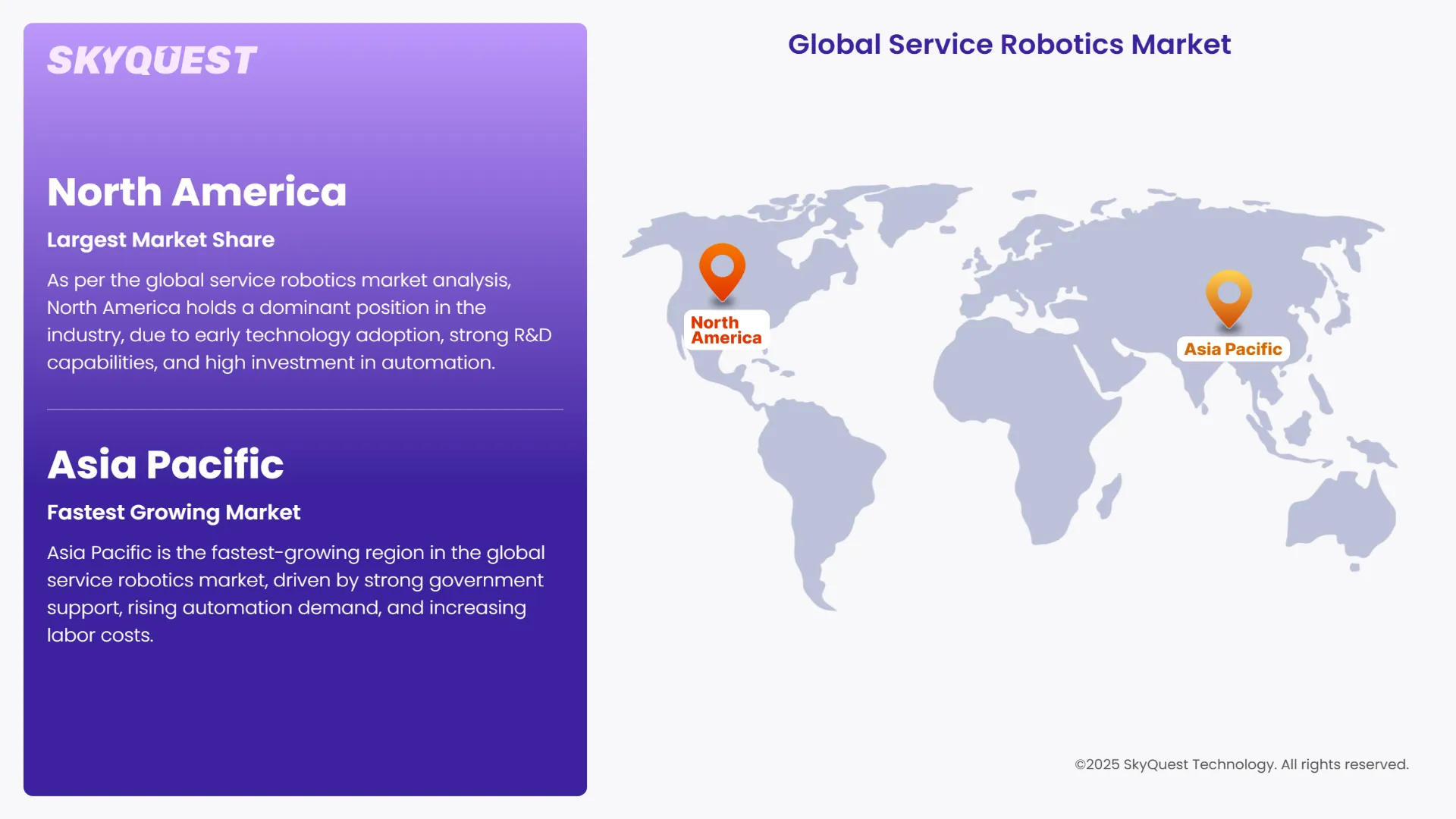
As per the global service robotics market analysis, North America holds a dominant position in the industry, due to early technology adoption, strong R&D capabilities, and high investment in automation. The region sees extensive use of service robots in healthcare, logistics, defense, and agriculture. Rising labor costs and an aging population further fuel demand. Additionally, supportive government initiatives and collaborations between tech firms and research institutions continue to accelerate innovation and market expansion.
The United States significantly contributes to the North American service robotics market through advanced R&D, strong investment from tech giants, and widespread adoption in sectors like healthcare, logistics, and defense. With a robust startup ecosystem and government support for automation, the U.S. leads in deploying AI-powered robots for surgery, delivery, and eldercare. Institutions and companies collaborate actively, ensuring continuous innovation and reinforcing the country’s dominant position in service robotics.
Canada plays a growing role in North America’s service robotics market, driven by innovation in healthcare robotics, warehouse automation, and agriculture. The presence of companies like Kinova and Clearpath Robotics showcases the country’s focus on assistive and mobile robotic platforms. Government funding and university research contribute to technological progress, while rising demand for labor-saving solutions in industries like logistics and eldercare further supports Canada’s expanding robotics landscape.
Asia Pacific is the fastest-growing region in the global service robotics market, driven by strong government support, rising automation demand, and increasing labor costs. Countries like China, Japan, South Korea, and India are leading in healthcare, logistics, agriculture, and underwater robotics. Rapid advancements in AI, sensor technologies, and local manufacturing capabilities are accelerating adoption. The region’s large population and expanding industrial base further fuel innovation and service robot deployment across sectors.
Japan is a global leader in Asia Pacific service robotics market, driven by its aging population and cultural acceptance of robotic assistance. The country excels in healthcare, hospitality, and personal robotics, supported by major players like Panasonic, Toyota, and SoftBank. Continuous government investment in AI and robotics R&D strengthens innovation. Japan’s strong manufacturing ecosystem and emphasis on automation ensure its prominent role in advancing and exporting high-quality service robotic technologies globally.
South Korea contributes significantly to the Asia Pacific service robotics market through rapid technological advancements and strong government backing. The country focuses on robotics for healthcare, education, and logistics, with major companies like Samsung, LG, and Doosan Robotics leading development. National initiatives promote AI-integrated robots and smart automation. High robot density, a skilled workforce, and strategic investments have positioned South Korea as a hub for next-generation service robotics innovation and deployment.
Europe is a steadily growing region in the global service robotics market, driven by strong government funding, advanced research institutions, and high demand across healthcare, logistics, and agriculture. Countries like Germany, France, and the UK are at the forefront of innovation, especially in professional and medical robotics. Aging populations, labor shortages, and a push for automation in public and private sectors continue to boost adoption and market expansion across the regional analysis.
Germany is a major contributor to the Europe service robotics market, driven by its strong engineering expertise and advanced manufacturing infrastructure. The country leads in deploying professional service robots in healthcare, logistics, and industrial environments. Supportive government initiatives and collaboration between research institutions and tech firms further boost innovation. With a focus on automation and AI integration, Germany continues to shape the development and export of high-performance service robotic solutions globally.
France’s contribution to the Europe service robotics market is marked by rapid growth in healthcare, defense, and consumer robotics. Government-backed initiatives like "France 2030" support AI and robotics innovation. French companies and research centers are advancing robotic applications in elderly care and medical assistance. The country's proactive investment in smart technologies and aging population needs are fueling domestic adoption and reinforcing France’s influence in shaping future service robotic applications.
The United Kingdom plays a vital role in the Europe service robotics market through innovations in medical, domestic, and delivery robotics. UK-based firms like CMR Surgical have gained international recognition, while strong academic research supports continual advancement. Government incentives and a growing demand for automation across sectors enhance adoption. The UK’s strategic focus on AI and robotics commercialization ensures its competitiveness and sustained contribution to global service robotics expansion.
To know more about the market opportunities by region and country, click here to
Buy The Complete Report
Growing Demand for Automation in Healthcare
Advancements in Artificial Intelligence and Machine Learning
Technical Limitations and Safety Concerns
Regulatory and Ethical Challenges
Request Free Customization of this report to help us to meet your business objectives.
The global service robotics market outlook is competitive and marked by rapid innovation and strategic collaborations. Key players include iRobot Corporation, Intuitive Surgical, KUKA AG, SoftBank Robotics, and ABB Ltd. Intuitive Surgical focuses on expanding its da Vinci surgical systems, while iRobot emphasizes home automation integration. SoftBank invests in AI-driven humanoid robots, and KUKA partners with tech firms to enhance mobile robotics, strengthening their positions in diverse application segments.
As per the global service robotics market industry analysis, the startup ecosystem in the industry is thriving, driven by advancements in AI, machine learning, and automation. Startups are targeting niche applications across healthcare, logistics, hospitality, and manufacturing, addressing labor shortages and operational inefficiencies. These agile firms often pioneer groundbreaking innovations and attract strong investor interest. Their adaptability, focus on real-world challenges, and collaborative ventures with larger tech companies position them as key disruptors and enablers of next-generation robotics solutions.
SkyQuest’s ABIRAW (Advanced Business Intelligence, Research & Analysis Wing) is our Business Information Services team that Collects, Collates, Correlates, and Analyses the Data collected by means of Primary Exploratory Research backed by robust Secondary Desk research.
As per SkyQuest analysis, the global service robotics industry is undergoing rapid transformation, driven by technological advancements, demographic shifts, and increasing labor shortages. The convergence of AI, machine learning, and sensor technologies enables robots to operate autonomously, perform complex tasks, and integrate seamlessly into healthcare, logistics, domestic, and industrial settings.
With regions like North America, Europe, and Asia Pacific pushing innovation through strong R&D, funding, and supportive regulations, service robots are becoming indispensable tools for efficiency and reliability. Emerging trends such as Robotics-as-a-Service (RaaS) and the rise of Autonomous Mobile Robots (AMRs) are accelerating adoption. Despite regulatory and technical hurdles, the global service robotics market strategies remain highly competitive, with startups and global giants alike shaping the future of intelligent, adaptive, and human-assistive robotic systems.
| Report Metric | Details |
|---|---|
| Market size value in 2024 | USD 36.83 Billion |
| Market size value in 2033 | USD 154.84 Billion |
| Growth Rate | 17.3% |
| Base year | 2024 |
| Forecast period | 2026-2033 |
| Forecast Unit (Value) | USD Billion |
| Segments covered |
|
| Regions covered | North America (US, Canada), Europe (Germany, France, United Kingdom, Italy, Spain, Rest of Europe), Asia Pacific (China, India, Japan, Rest of Asia-Pacific), Latin America (Brazil, Rest of Latin America), Middle East & Africa (South Africa, GCC Countries, Rest of MEA) |
| Companies covered |
|
| Customization scope | Free report customization with purchase. Customization includes:-
|
To get a free trial access to our platform which is a one stop solution for all your data requirements for quicker decision making. This platform allows you to compare markets, competitors who are prominent in the market, and mega trends that are influencing the dynamics in the market. Also, get access to detailed SkyQuest exclusive matrix.
Table Of Content
Executive Summary
Market overview
Parent Market Analysis
Market overview
Market size
KEY MARKET INSIGHTS
COVID IMPACT
MARKET DYNAMICS & OUTLOOK
Market Size by Region
KEY COMPANY PROFILES
Methodology
For the Service Robotics Market, our research methodology involved a mixture of primary and secondary data sources. Key steps involved in the research process are listed below:
1. Information Procurement: This stage involved the procurement of Market data or related information via primary and secondary sources. The various secondary sources used included various company websites, annual reports, trade databases, and paid databases such as Hoover's, Bloomberg Business, Factiva, and Avention. Our team did 45 primary interactions Globally which included several stakeholders such as manufacturers, customers, key opinion leaders, etc. Overall, information procurement was one of the most extensive stages in our research process.
2. Information Analysis: This step involved triangulation of data through bottom-up and top-down approaches to estimate and validate the total size and future estimate of the Service Robotics Market.
3. Report Formulation: The final step entailed the placement of data points in appropriate Market spaces in an attempt to deduce viable conclusions.
4. Validation & Publishing: Validation is the most important step in the process. Validation & re-validation via an intricately designed process helped us finalize data points to be used for final calculations. The final Market estimates and forecasts were then aligned and sent to our panel of industry experts for validation of data. Once the validation was done the report was sent to our Quality Assurance team to ensure adherence to style guides, consistency & design.
Analyst Support
Customization Options
With the given market data, our dedicated team of analysts can offer you the following customization options are available for the Service Robotics Market:
Product Analysis: Product matrix, which offers a detailed comparison of the product portfolio of companies.
Regional Analysis: Further analysis of the Service Robotics Market for additional countries.
Competitive Analysis: Detailed analysis and profiling of additional Market players & comparative analysis of competitive products.
Go to Market Strategy: Find the high-growth channels to invest your marketing efforts and increase your customer base.
Innovation Mapping: Identify racial solutions and innovation, connected to deep ecosystems of innovators, start-ups, academics, and strategic partners.
Category Intelligence: Customized intelligence that is relevant to their supply Markets will enable them to make smarter sourcing decisions and improve their category management.
Public Company Transcript Analysis: To improve the investment performance by generating new alpha and making better-informed decisions.
Social Media Listening: To analyze the conversations and trends happening not just around your brand, but around your industry as a whole, and use those insights to make better Marketing decisions.
REQUEST FOR SAMPLE
 REQUEST FREE CUSTOMIZATION


Want to customize this report? This report can be personalized according to your needs. Our analysts and industry experts will work directly with you to understand your requirements and provide you with customized data in a short amount of time. We offer $1000 worth of FREE customization at the time of purchase.
Feedback From Our Clients


 USA (+1) 351-333-4748

