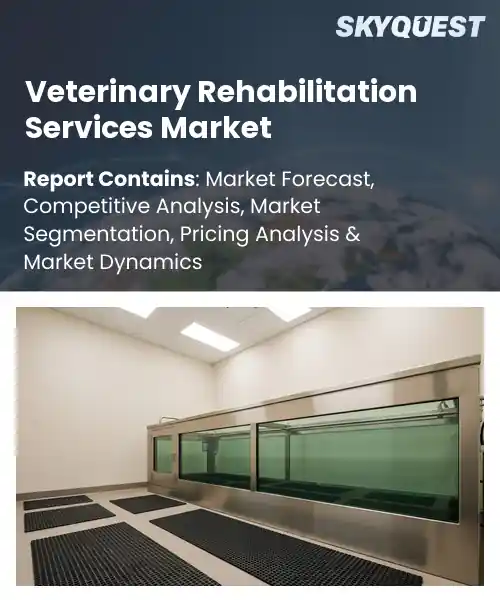
Veterinary Rehabilitation Services Market
Report ID: SQMIG35D2416
Report ID: SQMIG35D2416
[email protected]
USA +1 351-333-4748
Report ID:
SQMIG35D2416 |
Region:
Global |
Published Date: May, 2026
Pages:
157
|Tables:
131
|Figures:
77


Global Veterinary Rehabilitation Services Market size was valued at USD 1.4 Billion in 2024 and is poised to grow from USD 1.52 Billion in 2025 to USD 2.92 Billion by 2033, growing at a CAGR of 8.5% during the forecast period (2026-2033).
Rise in pet ownership, increasing spending on advanced animal healthcare, rising awareness regarding animal mobility and pain management, advancements in veterinary rehabilitation technologies, and expansion of specialty veterinary care services are driving demand for veterinary rehabilitation services.
Collaborations among rehabilitation centers, tele-rehabilitation platforms, pet insurance providers, and veterinary networks boost adoption of veterinary rehabilitation services going forward. Increasing development of standardized rehabilitation protocols along with advanced diagnostic techniques is likely to aid the rise in demand for veterinary rehabilitation. The use of gait analysis, wearable sensors, underwater treadmills, and physiotherapy programs in veterinary clinics and specialty hospitals for better recovery after surgery and orthopedic procedures is increasing. Growing use of therapeutic exercises, hydrotherapy, laser therapy, acupuncture, and physiotherapy in companion animals is slated to boost business scope in the future. High focus on improving animal mobility, recovery, and quality of life around the world coupled with increasing willingness of pet owners to invest in advanced veterinary treatments are expected to primarily drive veterinary rehabilitation services market growth.
On the contrary, high treatment and equipment costs, limited availability of trained rehabilitation professionals, low awareness regarding rehabilitation therapies in developing regions, and lack of standardized reimbursement policies are anticipated to slow down veterinary rehabilitation services market penetration in the long run.
How is AI Enhancing Treatment Outcomes Through Veterinary Rehabilitation Services?
AI is being incorporated into the provision of veterinary rehabilitation services to help improve the quality of assessment, treatment, monitoring, and decision-making for clinicians. Over the past few years, the incorporation of AI technologies within veterinary clinics to help them provide rehabilitation services has been a common practice. The use of motion detectors, remote monitoring technologies, and recovery monitoring systems using data analytics is assisting veterinarians in making adjustments to their rehabilitation practices and identifying any delays in the recovery process.
Market snapshot - (2026-2033)
Global Market Size
USD 1.4 Billion
Largest Segment
Companion Animals
Fastest Growth
Wildlife & Exotic Animals
Growth Rate
8.5% CAGR
To get more insights on this market click here to Request a Free Sample Report
Global veterinary rehabilitation services market is segmented by animal type, therapy type, indication, end user, and region. Based on animal type, the market is segmented into companion animals, production animals, and wildlife & exotic animals. Based on therapy type, the market is segmented into therapeutic exercise therapy, hydrotherapy, manual therapy, electrotherapy, acupuncture, shockwave therapy, thermal therapy, laser therapy, and others. Based on indication, the market is segmented into post-surgical rehabilitation, orthopedic & musculoskeletal disorders, neurological disorders, sports & performance injuries, chronic pain management, obesity & mobility management, traumatic injuries, developmental & degenerative conditions, and others. Based on end user, the market is segmented into pet owners, veterinary professionals, animal shelters & rescue organizations, equine training & sports facilities, and others. Based on region, the market is segmented into North America, Europe, Asia Pacific, Latin America, and Middle East & Africa.
The companion animals segment is forecasted to lead the global veterinary rehabilitation services market revenue generation in the future. The high concentration of client interest in elective, postoperative, and chronic care procedures steers clinics towards providing a full array of rehabilitation services that cater to pets. The strong readiness of owners to try out advanced treatment methods leads to investments on the part of veterinarians into multi-disciplinary staff, specialized training, and equipment, which translates into a level of expertise and protocol among clinicians that underscores the range of services offered.
Nevertheless, production animals segment is becoming the fastest growing one because of the increasing awareness of the importance of mobility management on the herd level. The increasing focus on return-to-work programs, preventative rehabilitation by farmers, and veterinary advisory services is leading to the creation of new applications. These trends generate increased need for special services and equipment, thus opening up new market opportunities for herd rehabilitation solutions.
The hydrotherapy segment is slated to account for the highest global veterinary rehabilitation services market share going forward. The ability of hydrotherapy to provide controlled resistance and buoyancy that enable progressive and low-impact loading to speed up recovery in patients with both orthopedic and neurological problems make it an important modality in physical therapy. The capability of the treatment modality to promote early mobilization and controlled strengthening of muscles motivates the establishment of pools and trained personnel within facilities, thus contributing to the standardization of the therapy modality.
Meanwhile, laser therapy segment is witnessing the strongest growth momentum as per this veterinary rehabilitation services market forecast. The development of new photobiomodulation technologies has expanded its scope of applications beyond just pain management to include improved tissue regeneration. Portability of the devices, ease of implementation within clinics, and greater knowledge among clinicians are contributing to its increasing use. This innovation-fueled growth is leading to increased service offerings and treatment modules for future market penetration.
To get detailed segments analysis, Request a Free Sample Report
Mature clinical infrastructure, concentrated centers of excellence, and high levels of professional specialization are helping this region hold sway over others. A high level of client awareness along with their readiness to explore more sophisticated forms of treatment, aided by progressive payment systems and investments in rehabilitation facilities cements the dominance of this region. The integration of rehabilitation in specialized hospitals, teaching veterinary schools, and private practices helps to speed up implementation. Robust training pathways, active professional associations, and translational research foster continuous innovation in modalities and outcome measurement. Technology adoption, including diagnostic imaging integration and telehealth for follow up care, further extends reach and efficiency. Together these factors create an ecosystem in which service breadth, clinical expertise, and commercialization are highly developed.
Veterinary Rehabilitation Services Market in United States is characterized by advanced clinical infrastructure, a high concentration of specialized providers, and widespread adoption of multidisciplinary care pathways. Investment in training, integration of rehabilitation with specialty hospitals, and strong client awareness support demand for therapeutic modalities. Cooperation between veterinary universities, associations, and private clinics leads to information dissemination and protocol standardization, emphasizing their leadership in the development of services and clinical practice, which constantly improves.
Integrated systems in public and private practice settings, greater focus on reaching out to rural communities, and more training programs for professionals are contributing towards increasing the uptake of veterinary rehabilitation services in Canada. The collaboration between educational institutions and clinics makes it easier to develop expertise in offering such services through research and training. Standards of practice are promoted by regulators and veterinary organizations. More attention to preventive rehabilitation, telemedicine, and collaboration would make rehabilitation services more accessible.
Increased awareness of the importance of rehabilitation as an integral part of the entire veterinary treatment process backed by increased expertise and cooperation between hospitals, private clinics, and universities are helping create new opportunities in the region. The standardization of professional practices across different regions and initiatives by professional organizations ensures increased adoption of standard procedures and ongoing education. Client demand for improved quality of life, along with greater access to specialized training programs and concepts drawn from human physiotherapy, contributes to the diversification of services offered. Increased investment in technology and facilities dedicated to rehabilitation services also improves the delivery of services and their accessibility.
Specific training programs, highly developed clinics, and close cooperation between research centers and private practices are behind the high demand for veterinary rehabilitation services in Germany. High-quality services are guaranteed by the focus on evidence-based protocols and technologies. The creation of rehabilitation departments and diagnostic equipment by clinics, along with the contribution of associations to the promotion of educational programs, leads to a well-developed system of services based on the achievement of success through interdisciplinary cooperation.
Adoption of innovative care models, strong emphasis on professional education, and clinic expansion supports high demand for veterinary rehabilitation services in the United Kingdom. Data-driven practice, training opportunities, and building up of facilities in clinics facilitate expansion of service networks, while professional organizations advance guidelines for development of standards. The client need for specialty rehabilitation services and quality of life motivates diversification in the provision of therapy services and collaborations with human physiotherapists.
Veterinary rehabilitation services demand in France is backed by increased clinical specialization, educational offerings, and expanding clinician interest in rehabilitative care. Physiotherapy techniques, hydrotherapy facilities, and client education are central to clinics’ efforts to help animals move better. Academic-practice collaboration ensures that research benefits from applied knowledge, and regulation and networking ensure standardization, while investment in training and facilities drives market development.
Enhancement of clinical capabilities, strategic investments in specialized facilities, and expanding professional education resources are generating new opportunities in the region. Efforts towards collaboration between facilities at home and abroad are gaining momentum as knowledge transfer and exchange of best practices become more common. Certifications are gaining favor among practitioners, and equipment suppliers have also increased their footprint in the region, thereby increasing services offered. In combination with state-level policies and investments by private capital into the animal health industry, this helps create new markets. All these efforts will help build a more advanced ecosystem that can offer more rehabilitation services, as well as develop innovations in treatment delivery and measurement of therapy effects.
Advanced clinical research, technology integration, and strong ties between universities and clinics shape veterinary rehabilitation services demand in Japan. Emphasizing quality assurance, education, and multidisciplinary models is a positive move in ensuring that attention is paid to the provision of rehabilitation services. The service providers emphasize evidence-based rehabilitation through accurate diagnosis coupled with customized treatment programs. Training and investment in specialized centers will ensure that practitioners become more competent; while collaboration with equipment manufacturers will enhance innovations.
Veterinary rehabilitation service adoption in South Korea is advancing through clinical adoption of rehabilitation modalities, integration of technology, and growing specialization among veterinary professionals. The focus on outcome-oriented care, certification, and awareness programs makes it easier for rehabilitation facilities to spread within urban clinical settings. The clinics have invested in rehabilitation centers and work together with universities for the development of training and research programs.
To know more about the market opportunities by region and country, click here to
Buy The Complete Report
Rising Pet Owner Awareness
Increased knowledge on the part of pet owners regarding animal welfare and the advantages of rehabilitation therapy has made owners more interested in obtaining veterinary rehabilitation services for their pets' recovery after surgery, treatment of chronic conditions, and improving mobility, thus increasing demand. In addition, as pet owners begin to treat their pets like family members, the interest to spend money to improve their pets' functionality increases, and therefore, veterinarians have the incentive to provide complete rehabilitation services.
Advances In Rehabilitation Technology
Limited Reimbursement Coverage
Shortage Of Skilled Practitioners
Request Free Customization of this report to help us to meet your business objectives.
Competition in global veterinary rehabilitation is driven by consolidation among corporate veterinary chains and clinic-level differentiation that pushes providers to add rehab services and digital care. Firms pursue M&A and strategic partnerships to secure clinical scale and tech capabilities, exemplified by Mars Petcare’s acquisitions of VCA and AniCura, and industry accelerators and pitch stages that surface tele-rehab and motion capture innovators.
SkyQuest’s ABIRAW (Advanced Business Intelligence, Research & Analysis Wing) is our Business Information Services team that Collects, Collates, Correlates, and Analyses the Data collected by means of Primary Exploratory Research backed by robust Secondary Desk research.
As per SkyQuest analysis, surge in pet ownership and increasing spending on advanced animal healthcare are anticipated to drive the demand for veterinary rehabilitation services going forward. However, high treatment costs and limited availability of trained rehabilitation professionals are slated to slow down the adoption of veterinary rehabilitation services in the future. North America is slated to spearhead the demand for veterinary rehabilitation services owing to high pet healthcare expenditure and strong presence of specialty veterinary hospitals and rehabilitation centers. Development of wearable monitoring technologies and increasing adoption of tele-rehabilitation and AI-enabled recovery tracking systems are anticipated to be key trends driving the veterinary rehabilitation services industry in the long run.
| Report Metric | Details |
|---|---|
| Market size value in 2024 | USD 1.4 Billion |
| Market size value in 2033 | USD 2.92 Billion |
| Growth Rate | 8.5% |
| Base year | 2024 |
| Forecast period | (2026-2033) |
| Forecast Unit (Value) | USD Billion |
| Segments covered |
|
| Regions covered | North America (US, Canada), Europe (Germany, France, United Kingdom, Italy, Spain, Rest of Europe), Asia Pacific (China, India, Japan, Rest of Asia-Pacific), Latin America (Brazil, Rest of Latin America), Middle East & Africa (South Africa, GCC Countries, Rest of MEA) |
| Companies covered |
|
| Customization scope | Free report customization with purchase. Customization includes:-
|
To get a free trial access to our platform which is a one stop solution for all your data requirements for quicker decision making. This platform allows you to compare markets, competitors who are prominent in the market, and mega trends that are influencing the dynamics in the market. Also, get access to detailed SkyQuest exclusive matrix.
Table Of Content
Executive Summary
Market overview
Parent Market Analysis
Market overview
Market size
KEY MARKET INSIGHTS
COVID IMPACT
MARKET DYNAMICS & OUTLOOK
Market Size by Region
KEY COMPANY PROFILES
Methodology
For the Veterinary Rehabilitation Services Market, our research methodology involved a mixture of primary and secondary data sources. Key steps involved in the research process are listed below:
1. Information Procurement: This stage involved the procurement of Market data or related information via primary and secondary sources. The various secondary sources used included various company websites, annual reports, trade databases, and paid databases such as Hoover's, Bloomberg Business, Factiva, and Avention. Our team did 45 primary interactions Globally which included several stakeholders such as manufacturers, customers, key opinion leaders, etc. Overall, information procurement was one of the most extensive stages in our research process.
2. Information Analysis: This step involved triangulation of data through bottom-up and top-down approaches to estimate and validate the total size and future estimate of the Veterinary Rehabilitation Services Market.
3. Report Formulation: The final step entailed the placement of data points in appropriate Market spaces in an attempt to deduce viable conclusions.
4. Validation & Publishing: Validation is the most important step in the process. Validation & re-validation via an intricately designed process helped us finalize data points to be used for final calculations. The final Market estimates and forecasts were then aligned and sent to our panel of industry experts for validation of data. Once the validation was done the report was sent to our Quality Assurance team to ensure adherence to style guides, consistency & design.
Analyst Support
Customization Options
With the given market data, our dedicated team of analysts can offer you the following customization options are available for the Veterinary Rehabilitation Services Market:
Product Analysis: Product matrix, which offers a detailed comparison of the product portfolio of companies.
Regional Analysis: Further analysis of the Veterinary Rehabilitation Services Market for additional countries.
Competitive Analysis: Detailed analysis and profiling of additional Market players & comparative analysis of competitive products.
Go to Market Strategy: Find the high-growth channels to invest your marketing efforts and increase your customer base.
Innovation Mapping: Identify racial solutions and innovation, connected to deep ecosystems of innovators, start-ups, academics, and strategic partners.
Category Intelligence: Customized intelligence that is relevant to their supply Markets will enable them to make smarter sourcing decisions and improve their category management.
Public Company Transcript Analysis: To improve the investment performance by generating new alpha and making better-informed decisions.
Social Media Listening: To analyze the conversations and trends happening not just around your brand, but around your industry as a whole, and use those insights to make better Marketing decisions.
REQUEST FOR SAMPLE
 REQUEST FREE CUSTOMIZATION
Global Veterinary Rehabilitation Services Market size was valued at USD 1.4 Billion in 2024 and is poised to grow from USD 1.52 Billion in 2025 to USD 2.92 Billion by 2033, growing at a CAGR of 8.5% during the forecast period (2026-2033).
Competition in global veterinary rehabilitation is driven by consolidation among corporate veterinary chains and clinic-level differentiation that pushes providers to add rehab services and digital care. Firms pursue M&A and strategic partnerships to secure clinical scale and tech capabilities, exemplified by Mars Petcare’s acquisitions of VCA and AniCura, and industry accelerators and pitch stages that surface tele-rehab and motion capture innovators. 'ack on Track Veterinary Rehabilitation Center, LLC', 'Animal Acupuncture and Rehabilitation Center', 'BARC', 'Treasure Coast Animal Rehab & Fitness', 'Animal Rehab Center of Michigan', 'Blue Springs Animal Rehabilitation Center', 'Essex Animal Hospital', 'Triangle Veterinary Referral Hospital', 'Butterwick Animal Rehab Clinic Ltd', 'Animal Rehab and Conditioning Center', 'MedVet', 'IVC Evidensia', 'RehabVet', 'Raintree Veterinary Clinic & Rehabilitation Centre', 'Animal Medical Center', 'CARE Centre Animal Hospital', 'VCA Animal Hospitals', 'Veterinary Orthopedic & Sports Medicine Group', 'Canine Rehabilitation Institute', 'Fit Fur Life'
Growing awareness among pet owners about animal welfare and the benefits of rehabilitation therapies motivates more owners to seek specialized veterinary rehabilitation services for post-operative care, chronic condition management, and mobility improvement, thereby expanding demand. As owners increasingly view pets as family members, willingness to invest in long-term functional outcomes rises, encouraging clinics to offer comprehensive rehabilitation programs. This shift in owner expectations also promotes referrals and continued care adherence, reinforcing service uptake and encouraging providers to enhance accessibility and service quality.
Integrated Telerehabilitation Services: Demand for integrated telerehabilitation services is reshaping how practices deliver veterinary rehabilitation, enabling remote assessments, guided exercise programs, owner coaching, and progress tracking. Digital platforms facilitate collaboration between veterinarians, physiotherapists, and pet owners, improving continuity of care and treatment adherence. Telerehabilitation expands access for clients in underserved areas, supports hybrid care models that combine in clinic and remote therapy, and fosters development of software and training services tailored to animal movement assessment and rehabilitation protocols and evidence informed best practices.
Why does North America Dominate the Global Veterinary Rehabilitation Services Market? |@12


Want to customize this report? This report can be personalized according to your needs. Our analysts and industry experts will work directly with you to understand your requirements and provide you with customized data in a short amount of time. We offer $1000 worth of FREE customization at the time of purchase.
Feedback From Our Clients


 USA (+1) 351-333-4748

