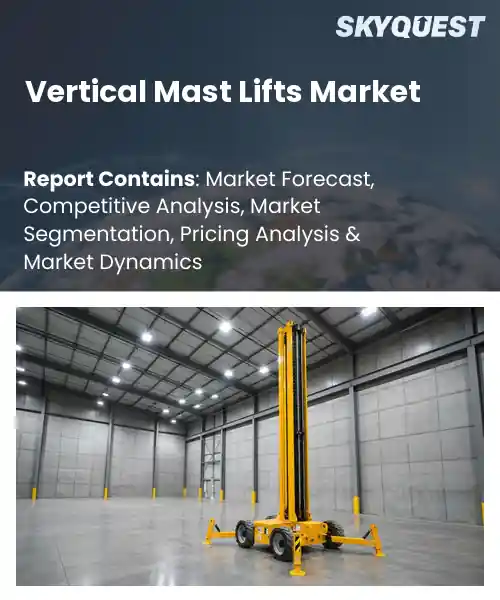
Vertical Mast Lifts Market
Report ID: SQMIG45J2538
Report ID: SQMIG45J2538
[email protected]
USA +1 351-333-4748
Report ID:
SQMIG45J2538 |
Region:
Global |
Published Date: June, 2026
Pages:
157
|Tables:
172
|Figures:
79


Global Vertical Mast Lifts Market size was valued at USD 2.15 Billion in 2024 and is poised to grow from USD 2.28 Billion in 2025 to USD 3.67 Billion by 2033, growing at a CAGR of 6.1% during the forecast period (2026-2033).
The global vertical mast lift market comprises units that extend a mast to provide safe access for maintenance, construction, and industrial tasks. Its importance stems from the increasing demand for ergonomic platforms that reduce worker fatigue and meet stricter occupational‑health regulations. Historically, the market emerged in the late 1990s as manufacturers replaced scaffolding with powered lifts, exemplified by Genie’s early 800‑series. Over the past decade, adoption accelerated as urban density forced contractors onto tighter rooftops and mezzanines, prompting manufacturers to integrate electric power‑trains and telematics. Consequently, the sector now enjoys a base of buyers across North America, Europe, and Asia‑Pacific. The vertical mast lift market is being propelled by electrification and telematics, which lower operating costs and improve safety oversight. Construction firms adopting low‑emission policies replace diesel lifts with battery‑powered units, cutting fuel expenses and carbon footprints; a 2023 case study from a German utilities provider documented a 15 % reduction in maintenance downtime after retrofitting its fleet with lifts equipped with sensors. This efficiency boost creates demand for service contracts and analytics platforms, generating new revenue streams for manufacturers. Consequently, companies that develop batteries and cloud‑based fleet management tools are likely to secure a larger share of the growing market.
How is AI-driven automation reshaping the vertical mast lifts market?
AI‑driven automation is redefining vertical mast lifts by embedding predictive maintenance, real‑time sensor feedback and autonomous positioning into traditionally manual equipment. Machines now analyze vibration and load data to alert operators before components wear, reducing downtime and service costs. Integrated vision systems guide the lift’s extension and retraction, allowing one‑person operation with higher precision on confined job sites. These smart features improve safety, extend asset life and make rentals more attractive, accelerating adoption across construction, aviation and facilities management where efficiency and compliance are paramount.United Rentals, September 2025, introduced a fleet of AI‑enhanced mast lifts that automatically adjust height based on site conditions, showcasing how automation can boost utilization rates and lower operational expenses in the vertical mast lifts market.
Market snapshot - (2026-2033)
Global Market Size
USD 2.15 Billion
Largest Segment
Fastest Growth
Growth Rate
6.1% CAGR
To get more insights on this market click here to Request a Free Sample Report
Global vertical mast lifts market is segmented by product type, working height, power source, end user industry, sales channel, mobility type and region. Based on product type, no specific sub-segments were identified. Based on working height, no specific sub-segments were identified. Based on power source, no specific sub-segments were identified. Based on end user industry, no specific sub-segments were identified. Based on sales channel, no specific sub-segments were identified. Based on mobility type, no specific sub-segments were identified. Based on region, the market is segmented into North America, Europe, Asia Pacific, Latin America and Middle East & Africa.
Electric power segment dominates because manufacturers have refined grid connected designs that deliver consistent torque and minimal downtime, aligning with operator preferences for reliability. The widespread availability of mains infrastructure simplifies installation, while regulatory incentives favor low emission solutions, reinforcing adoption across varied sites. These factors create a self reinforcing loop where service confidence and compliance drive preference for electric driven mast lifts in industrial, commercial, and municipal environments and public works sectors.
However, battery powered segment emerges as the most rapidly expanding area because advancements in energy density enable longer lift cycles without external hookups, appealing to sites with limited grid access. Portable autonomy aligns with flex site deployment trends, and ongoing cost reductions in lithium technology accelerate market penetration, creating fresh growth avenues.
Telecommunications segment dominates because network operators require frequent antenna upgrades and line of sight adjustments, making mast lifts essential for safe and efficient height access. The proliferation of 5G rollouts intensifies the need for rapid, precise positioning of equipment, while service level agreements demand minimal downtime, reinforcing preference for specialized lifts. This convergence of technology refresh cycles and reliability expectations entrenches telecom as the primary driver of lift demand globally across markets.
Meanwhile, construction segment is witnessing the strongest growth momentum because modern building projects increasingly integrate height access solutions for façade work and structural inspections. Urban densification and taller building profiles create continuous demand, while modular design practices favor versatile lifts that can adapt to site constraints, propelling rapid market expansion significantly.
To get detailed segments analysis, Request a Free Sample Report
North America leads the Vertical Mast Lifts market through a confluence of advanced engineering capabilities, extensive industrial infrastructure, and strong demand from construction and maintenance sectors. The region benefits from a mature supply chain that integrates component manufacturers, system integrators, and service providers, creating a seamless delivery model. Robust safety regulations and a focus on productivity drive adoption of mast lift solutions that enhance worker access at height. Innovation hubs in key metropolitan areas foster continuous product development, emphasizing ergonomic design and energy efficiency. Additionally, a culture of investment in capital equipment supports the replacement cycle, ensuring that operators adopt the latest technology. These combined factors reinforce North America’s position as the dominant market for Vertical Mast Lifts.
Vertical Mast Lifts Market in the United States is propelled by large‑scale infrastructure projects and a proactive approach to occupational safety. Leading manufacturers collaborate closely with end users to tailor solutions for diverse applications ranging from commercial construction to industrial maintenance. A well‑established distribution network accelerates product availability, while ongoing training programs ensure skilled operation. This ecosystem sustains high adoption rates and continuous innovation within the United States.
Vertical Mast Lifts Market in Canada reflects a strong emphasis on worker protection and efficiency in sectors such as energy, transportation, and construction. The market is supported by a network of local distributors who prioritize rapid service response and parts availability. Collaborative initiatives between equipment suppliers and regulatory bodies promote compliance with stringent safety standards, encouraging broader deployment of mast lift technologies. These dynamics reinforce steady growth across the Canadian landscape.
Europe’s Vertical Mast Lifts market expands rapidly due to a combination of rigorous occupational safety legislation, a mature construction sector, and heightened awareness of productivity gains. Countries across the region invest in modernising building fleets, favouring equipment that offers precise height control and reduced environmental impact. Collaborative research programmes among engineering institutes and manufacturers drive innovations in lightweight materials and electric power solutions, aligning with sustainability objectives. The presence of well‑integrated logistics networks ensures timely delivery and service support, while a skilled labour force adept at operating advanced machinery further accelerates market uptake. These elements collectively underpin Europe’s swift market expansion.
Vertical Mast Lifts Market in Germany is characterised by strong engineering expertise and a commitment to high safety standards. Domestic manufacturers focus on precision design and integration of electric drive systems, catering to automotive, manufacturing, and construction industries. Close collaboration with technical universities fuels continuous product refinement, while a robust certification framework assures compliance. The well‑developed distribution infrastructure facilitates rapid deployment, reinforcing Germany’s leading role within the European landscape.
Vertical Mast Lifts Market in the United Kingdom experiences accelerated growth driven by intensive renovation activity and a regulatory environment that prioritises elevated work safety. Service providers offer comprehensive maintenance contracts, ensuring equipment reliability across diverse sectors such as property management and utilities. Adoption of compact, battery‑operated mast lifts aligns with urban site constraints and emission reduction goals. Partnerships between manufacturers and trade associations promote best‑practice training, further boosting market momentum in the United Kingdom.
Vertical Mast Lifts Market in France is emerging as a focal point for sustainable construction practices and public infrastructure upgrades. French manufacturers increasingly incorporate recyclable materials and low‑noise operation to meet urban planning requirements. Government incentives for modernising work platforms encourage adoption among small and medium‑sized enterprises. Collaborative platforms linking suppliers with vocational training centres enhance operator competence, supporting gradual market penetration across the French territory.
The Asia Pacific region strengthens its position in the Vertical Mast Lifts market through rapid urbanisation, expanding industrial bases, and a growing emphasis on safety culture. Manufacturers in the region are investing heavily in research and development to produce compact, energy‑efficient mast lifts that address space‑constrained construction sites and rising demand for green technologies. Strategic partnerships with global component suppliers enhance product quality, while localized production reduces lead times and costs. Governments promote adoption through guidelines that encourage modern work‑platform solutions, and a surge in skilled labour training programs ensures competent operation. These combined initiatives propel the Asia Pacific market toward greater relevance on the global stage.
Vertical Mast Lifts Market in Japan focuses on precision engineering and integration of advanced electronic control systems. The market benefits from collaboration between equipment manufacturers and robotics research centres, yielding mast lifts with superior stability and intuitive interfaces. Demand from high‑rise building projects and maintenance of complex infrastructure drives adoption of compact, low‑noise models. Strong after‑sales service networks and rigorous certification processes reinforce customer confidence, establishing Japan as a key contributor to the regional market dynamic.
Vertical Mast Lifts Market in South Korea is propelled by a vibrant manufacturing sector and government initiatives that champion workplace safety. Local firms emphasize lightweight design and electric propulsion to meet strict emissions standards and dense urban environments. Close ties with construction conglomerates enable rapid customization of mast lift solutions for varied project requirements. Investment in operator training and comprehensive warranty programs further accelerates market acceptance, positioning South Korea as an influential player within the Asia Pacific landscape.
To know more about the market opportunities by region and country, click here to
Buy The Complete Report
Growing Demand For Efficient Access
Adoption Of Modular Mast Designs
High Initial Capital Expenditure
Complex Regulatory Approval Processes
Request Free Customization of this report to help us to meet your business objectives.
Top Player’s Company Profile
Recent Developments
SkyQuest’s ABIRAW (Advanced Business Intelligence, Research & Analysis Wing) is our Business Information Services team that Collects, Collates, Correlates, and Analyses the Data collected by means of Primary Exploratory Research backed by robust Secondary Desk research. As per SkyQuest analysis, the market is propelled primarily by the growing demand for efficient vertical access in dense industrial and construction sites, while the shift toward electric‑powered lifts fuels a second growth engine by lowering emissions and operating costs. The electric power source segment remains the clear market leader, and North America continues to dominate thanks to its mature supply chain, strong safety regulations, and high‑value infrastructure projects. However, the high upfront capital required to purchase mast lifts can deter smaller firms and slow adoption. Together these forces shape a market that is expanding rapidly yet faces financing and regulatory hurdles.
| Report Metric | Details |
|---|---|
| Market size value in 2024 | USD 2.15 Billion |
| Market size value in 2033 | USD 3.67 Billion |
| Growth Rate | 6.1% |
| Base year | 2024 |
| Forecast period | (2026-2033) |
| Forecast Unit (Value) | USD Billion |
| Segments covered |
|
| Regions covered | North America (US, Canada), Europe (Germany, France, United Kingdom, Italy, Spain, Rest of Europe), Asia Pacific (China, India, Japan, Rest of Asia-Pacific), Latin America (Brazil, Rest of Latin America), Middle East & Africa (South Africa, GCC Countries, Rest of MEA) |
| Companies covered |
|
| Customization scope | Free report customization with purchase. Customization includes:-
|
To get a free trial access to our platform which is a one stop solution for all your data requirements for quicker decision making. This platform allows you to compare markets, competitors who are prominent in the market, and mega trends that are influencing the dynamics in the market. Also, get access to detailed SkyQuest exclusive matrix.
Table Of Content
Executive Summary
Market overview
Parent Market Analysis
Market overview
Market size
KEY MARKET INSIGHTS
COVID IMPACT
MARKET DYNAMICS & OUTLOOK
Market Size by Region
KEY COMPANY PROFILES
Methodology
For the Vertical Mast Lifts Market, our research methodology involved a mixture of primary and secondary data sources. Key steps involved in the research process are listed below:
1. Information Procurement: This stage involved the procurement of Market data or related information via primary and secondary sources. The various secondary sources used included various company websites, annual reports, trade databases, and paid databases such as Hoover's, Bloomberg Business, Factiva, and Avention. Our team did 45 primary interactions Globally which included several stakeholders such as manufacturers, customers, key opinion leaders, etc. Overall, information procurement was one of the most extensive stages in our research process.
2. Information Analysis: This step involved triangulation of data through bottom-up and top-down approaches to estimate and validate the total size and future estimate of the Vertical Mast Lifts Market.
3. Report Formulation: The final step entailed the placement of data points in appropriate Market spaces in an attempt to deduce viable conclusions.
4. Validation & Publishing: Validation is the most important step in the process. Validation & re-validation via an intricately designed process helped us finalize data points to be used for final calculations. The final Market estimates and forecasts were then aligned and sent to our panel of industry experts for validation of data. Once the validation was done the report was sent to our Quality Assurance team to ensure adherence to style guides, consistency & design.
Analyst Support
Customization Options
With the given market data, our dedicated team of analysts can offer you the following customization options are available for the Vertical Mast Lifts Market:
Product Analysis: Product matrix, which offers a detailed comparison of the product portfolio of companies.
Regional Analysis: Further analysis of the Vertical Mast Lifts Market for additional countries.
Competitive Analysis: Detailed analysis and profiling of additional Market players & comparative analysis of competitive products.
Go to Market Strategy: Find the high-growth channels to invest your marketing efforts and increase your customer base.
Innovation Mapping: Identify racial solutions and innovation, connected to deep ecosystems of innovators, start-ups, academics, and strategic partners.
Category Intelligence: Customized intelligence that is relevant to their supply Markets will enable them to make smarter sourcing decisions and improve their category management.
Public Company Transcript Analysis: To improve the investment performance by generating new alpha and making better-informed decisions.
Social Media Listening: To analyze the conversations and trends happening not just around your brand, but around your industry as a whole, and use those insights to make better Marketing decisions.
REQUEST FOR SAMPLE
 REQUEST FREE CUSTOMIZATION


Want to customize this report? This report can be personalized according to your needs. Our analysts and industry experts will work directly with you to understand your requirements and provide you with customized data in a short amount of time. We offer $1000 worth of FREE customization at the time of purchase.
Feedback From Our Clients


 USA (+1) 351-333-4748

