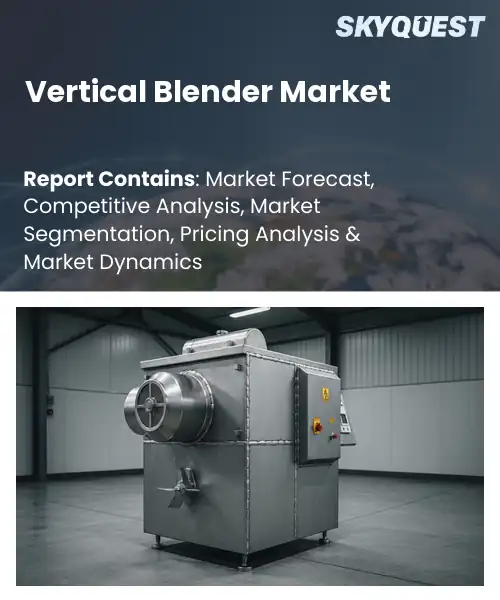
Vertical Blender Market
Report ID: SQMIG40D2054
Report ID: SQMIG40D2054
[email protected]
USA +1 351-333-4748
Report ID:
SQMIG40D2054 |
Region:
Global |
Published Date: April, 2026
Pages:
157
|Tables:
118
|Figures:
77


Global Vertical Blender Market size was valued at USD 864.59 Million in 2024 and is poised to grow from USD 928.05 Million in 2025 to USD 870.3 Million by 2033, growing at a CAGR of 7.34% during the forecast period (2026-2033).
The primary driver of the global vertical blender market is rising demand for efficient powder mixing in industries such as pharmaceuticals, food processing and specialty chemicals. Vertical blenders are compact mixing systems designed to handle dry and wet blending with improved homogeneity and lower product degradation; they matter to manufacturers pursuing consistent quality and regulatory compliance. Historically the market matured from simple loaded vessels to automated sanitary designs with integrated clean in place systems, for example pharmaceutical companies adopting vertical cone blenders to replace inefficient drum mixers. This evolution has been propelled by stricter quality standards and volume growth worldwide.As quality standards and volume growth intensified, automation and sanitary design became a key factor driving vertical blender adoption because they reduce contamination risk and throughput variability, helping firms meet regulations and speed time to market. For example, pharmaceutical manufacturers using closed system mixers achieved consistent dissolution and reduced cross contamination, reducing batch rejections and waste. Food processors blending spices and mixes achieved faster cycles with less segregation, enabling new SKUs. IoT sensors and modular configurations enable predictive maintenance and flexible production, raising asset utilization and improving ROI, opening opportunities in contract manufacturing and emerging markets across developing regions worldwide.
How is AI improving operational efficiency in the vertical blender market?
AI is improving operational efficiency in the vertical blender market by turning discrete machines into connected process assets. Key aspects include real time sensing, adaptive control, predictive maintenance, and recipe validation. Today manufacturers and processors use sensor fusion to monitor torque and temperature and machine learning models to adjust mixing profiles on the fly. This reduces manual intervention and batch rejects while improving consistency for food and pharmaceutical applications. Contextually the market is shifting toward smart lines that prioritize uptime and traceability so vertical blenders become nodes in a larger digital plant. Examples include remote monitoring, automated cleaning cycles, and quality alerts that speed decisions.Tetra Pak November 2025, introduced Factory OS which makes factories AI ready and unifies equipment data. That platform enables vertical blender operators to use predictive maintenance and closed loop control more easily which supports efficiency gains and faster adoption of smart blending across production lines.
Market snapshot - (2026-2033)
Global Market Size
USD 864.59 Million
Largest Segment
Vertical Ribbon Blenders
Fastest Growth
Vertical Screw/Conical Blenders
Growth Rate
7.34% CAGR
To get more insights on this market click here to Request a Free Sample Report
Global vertical blender market is segmented by operational mechanism, material & construction, end-use industry, batch capacity and region. Based on operational mechanism, the market is segmented into Vertical Ribbon Blenders, Vertical Screw/Conical Blenders and High-Shear Vertical Mixers. Based on material & construction, the market is segmented into Stainless Steel Blenders (Food/Pharma Grade) and Carbon Steel & Specialty Alloy Blenders. Based on end-use industry, the market is segmented into Food & Beverage (Spices, Flours, Nutraceuticals), Pharmaceutical & Chemical Processing, Cosmetics & Personal Care and Others (Plastic & Polymer Processing). Based on batch capacity, the market is segmented into Pilot/Lab Scale (Under 100 Liters) and Medium & Large Industrial Scale. Based on region, the market is segmented into North America, Europe, Asia Pacific, Latin America and Middle East & Africa.
Vertical Ribbon Blenders segment dominates because ribbon geometry and countercurrent flow produce efficient gentle mixing suitable for a broad range of dry powders and granules. Their simple, robust design reduces dead zones and facilitates predictable scale up, leading processors to favor them for consistent batch quality. Low shear and easy cleanability lower validation burden in regulated environments, which increases adoption across food, chemical and nutraceutical applications.
However, Vertical Screw/Conical Blenders are emerging as the fastest growing area due to superior handling of cohesive and fragile materials and improved discharge control. Their design enables gentler conveyance, enhanced process intensification through integrated dosing, and easier sealing for containment, attracting formulators pursuing tighter particle size control and higher throughput.
Stainless Steel Blenders (Food/Pharma Grade) segment dominates because their corrosion resistance, surface finish and compatibility with clean in place practices meet stringent hygiene and validation requirements. Smooth surfaces minimize cross contamination and simplify cleaning, which reduces downtime and eases regulatory approval for edible and therapeutic products. Manufacturers prioritize these units to protect product integrity and maintain traceability across production, driving widespread preference in sensitive applications.
However, Carbon Steel & Specialty Alloy Blenders are growing fastest due to demand for tailored metallurgy to handle aggressive chemistries and high temperature processes. Their customizable material options and robust construction let manufacturers process abrasive or reactive formulations, enabling expanded applications in chemical processing, polymer blending and specialty additives where standard equipment is unsuitable.
To get detailed segments analysis, Request a Free Sample Report
Asia Pacific commands the global vertical blender market through concentrated manufacturing capability, integrated supply chains, and deep application expertise across chemicals, pharmaceuticals, and food processing. Strong OEM presence and proximity to component suppliers reduce time to market and enable iterative design improvements. Rapid adoption by contract manufacturers and original equipment purchasers in high volume production environments elevates demand for customization, energy efficiency, and hygiene compliance. Markets in Japan and South Korea emphasize precision engineering and automation, fostering technological spillovers that benefit neighboring economies. Collaborative networks among research institutions, equipment makers, and end users accelerate validation of novel materials and mixing technologies, reinforcing regional leadership and allowing producers to scale sophisticated solutions for diverse industrial requirements. Extensive after-sales support networks and adherence to stringent quality standards further solidify buyer confidence and enable export competitiveness across adjacent markets.
Vertical Blender Market in Japan reflects a focus on high precision, engineering, and stringent hygienic design that meets demanding production standards. Manufacturers prioritize automation integration and modular configurations to support rapid changeovers and processing. Strong collaboration between equipment makers and end users fosters continuous improvement in durability and control systems, while established service networks ensure maintenance continuity. Domestic emphasis on miniaturization and energy efficiency influences product evolution and buyer requirements.
Vertical Blender Market in South Korea is defined by rapid adoption of automation, compact design, and rigorous quality management that suits high mix production environments. Korean suppliers focus on integrating smart controls and interfaces to reduce downtime and enhance process repeatability. Close engagement between manufacturers and electronics suppliers accelerates development of advanced control architectures. Service responsiveness and validation pathways strengthen confidence among contract manufacturers and specialized processors across multiple sectors.
North America expansion is propelled by strong demand from diversified end markets such as pharmaceuticals, food processing, and specialty chemicals that require robust, validated blending solutions. A well developed ecosystem of OEMs, systems integrators, and service providers supports rapid deployment and customization for scale up and regulatory compliance. Emphasis on hygienic design, clean production, and energy management drives procurement of modular, easily maintained vertical blenders. Buyers in the United States and Canada value traceability and automation, prompting suppliers to offer integrated control platforms and aftermarket support packages. Investment in pilot facilities and close partnerships between equipment manufacturers and contract processors accelerates application validation and shortens time from specification to operational readiness. Growing interest in retrofit programs and aftermarket upgrades encourages suppliers to provide modular retrofit kits and remote monitoring services. A regional focus on sustainability and materials stewardship also motivates selection of equipment that improves process yield and minimizes waste.
Vertical Blender Market in United States is shaped by rigorous regulatory requirements and widespread application in pharmaceutical and food manufacturing. Demand centers prioritize validated performance, automation connectivity, and comprehensive documentation to support compliance. Suppliers respond with configurable systems, after-sales training programs, and integrated control solutions that streamline quality assurance. A strong base of contract manufacturers and process development facilities encourages adoption of novel mixing technologies and investment in lifecycle services.
Vertical Blender Market in Canada is driven by demand from specialty food processors and pharmaceuticals that require hygienic, adaptable blending solutions. Buyers emphasize vendor responsiveness, energy efficiency, and compliance with sanitary standards. Suppliers deliver modular designs, remote diagnostics, and service networks to reduce downtime and provide comprehensive support. Collaboration between equipment vendors and research institutions supports validation for niche applications, while retrofit programs enable optimization of installed assets without replacement.
Europe is reinforcing its role in the vertical blender market through a combination of engineering excellence, regulatory harmonization, and focus on sustainability and hygiene standards. German manufacturers contribute precision fabrication and strong aftermarket ecosystems that support long equipment lifecycles. United Kingdom buyers emphasize innovation in process control and rapid integration with digital quality systems, while French users often prioritize sanitary design and modularity for specialty food and pharmaceutical applications. Cross border collaboration in standards development and industry consortia fosters knowledge sharing and accelerates adoption of energy efficient components and advanced sealing technologies. Suppliers across the region invest in service networks, customization capabilities, and pilot support to address varied industrial requirements and to strengthen export potential. Emphasis on operator training, retrofit solutions, and certification pathways further enhances buyer confidence and enables cross sector scalability of vertical blender technologies.
Vertical Blender Market in Germany centers on precision engineering and robust fabrication that ensure process reliability and support export competitiveness. Suppliers emphasize modular construction, hygienic finishes, and duty cycle performance suitable for chemical and pharmaceutical throughput. Strong ties between manufacturers and technical universities facilitate applied research into mixing dynamics and material compatibility. Buyers benefit from extensive retrofit options and national service networks that maintain operational continuity across complex production lines.
Vertical Blender Market in United Kingdom emphasizes integration of advanced process controls, quality assurance, and flexible configurations to meet diverse manufacturing needs. Suppliers focus on connectivity, intuitive human machine interfaces, and traceability that simplify validation workflows. Collaboration with automation specialists and facilities supports rapid application testing and adoption. Strong service offerings, training programs, and retrofit solutions help processors upgrade lines while maintaining compliance with regional production standards and aftercare support.
Vertical Blender Market in France often prioritizes hygienic modular design to meet stringent food and pharmaceutical processing needs. French suppliers tailor solutions for specialty production, offering sanitary finishes, adaptable tooling, and validated cleaning protocols. Close collaboration with culinary and biotech users informs practical configuration options. Service networks and local robust technical support help ensure compliance and uptime, while retrofit and testing services enable processors to refine processes without equipment replacement.
To know more about the market opportunities by region and country, click here to
Buy The Complete Report
Rising Demand From Food Industry
Process Efficiency and Automation
High Initial Capital Costs
Maintenance Complexity and Downtime
Request Free Customization of this report to help us to meet your business objectives.
The competitive landscape for global vertical blenders is marked by consolidation and technology-driven differentiation, with buyers prioritizing throughput, hygiene, and digital integration as primary competitive drivers. Strategic responses include M&A such as Hillenbrand’s Milacron acquisition and vendor alliances that enable digital twin and AI-enabled design work with industrial partners. Product innovation in vertical screw and vacuum-rated blender designs is reshaping supplier positioning and aftermarket service models.
Top Player’s Company Profile
Recent Developments
SkyQuest’s ABIRAW (Advanced Business Intelligence, Research & Analysis Wing) is our Business Information Services team that Collects, Collates, Correlates, and Analyses the Data collected by means of Primary Exploratory Research backed by robust Secondary Desk research. As per SkyQuest analysis, the global vertical blender market is primarily driven by rising demand for efficient powder mixing across pharmaceuticals and food processing, with a second growth driver being increasing automation and sanitary designs that improve throughput and regulatory compliance. Asia Pacific leads the market thanks to extensive manufacturing capability, OEM presence and rapid adoption by contract manufacturers, while Vertical Ribbon Blenders remain the dominating segment due to their gentle, scalable, and easy-to-clean design that ensures batch uniformity. High initial capital costs represent a key restraint, particularly for SMEs weighing retrofit versus replacement, though digitalization and service models are helping mitigate adoption barriers.
| Report Metric | Details |
|---|---|
| Market size value in 2024 | USD 864.59 Million |
| Market size value in 2033 | USD 870.3 Million |
| Growth Rate | 7.34% |
| Base year | 2024 |
| Forecast period | (2026-2033) |
| Forecast Unit (Value) | USD Million |
| Segments covered |
|
| Regions covered | North America (US, Canada), Europe (Germany, France, United Kingdom, Italy, Spain, Rest of Europe), Asia Pacific (China, India, Japan, Rest of Asia-Pacific), Latin America (Brazil, Rest of Latin America), Middle East & Africa (South Africa, GCC Countries, Rest of MEA) |
| Companies covered |
|
| Customization scope | Free report customization with purchase. Customization includes:-
|
To get a free trial access to our platform which is a one stop solution for all your data requirements for quicker decision making. This platform allows you to compare markets, competitors who are prominent in the market, and mega trends that are influencing the dynamics in the market. Also, get access to detailed SkyQuest exclusive matrix.
Table Of Content
Executive Summary
Market overview
Parent Market Analysis
Market overview
Market size
KEY MARKET INSIGHTS
COVID IMPACT
MARKET DYNAMICS & OUTLOOK
Market Size by Region
KEY COMPANY PROFILES
Methodology
For the Vertical Blender Market, our research methodology involved a mixture of primary and secondary data sources. Key steps involved in the research process are listed below:
1. Information Procurement: This stage involved the procurement of Market data or related information via primary and secondary sources. The various secondary sources used included various company websites, annual reports, trade databases, and paid databases such as Hoover's, Bloomberg Business, Factiva, and Avention. Our team did 45 primary interactions Globally which included several stakeholders such as manufacturers, customers, key opinion leaders, etc. Overall, information procurement was one of the most extensive stages in our research process.
2. Information Analysis: This step involved triangulation of data through bottom-up and top-down approaches to estimate and validate the total size and future estimate of the Vertical Blender Market.
3. Report Formulation: The final step entailed the placement of data points in appropriate Market spaces in an attempt to deduce viable conclusions.
4. Validation & Publishing: Validation is the most important step in the process. Validation & re-validation via an intricately designed process helped us finalize data points to be used for final calculations. The final Market estimates and forecasts were then aligned and sent to our panel of industry experts for validation of data. Once the validation was done the report was sent to our Quality Assurance team to ensure adherence to style guides, consistency & design.
Analyst Support
Customization Options
With the given market data, our dedicated team of analysts can offer you the following customization options are available for the Vertical Blender Market:
Product Analysis: Product matrix, which offers a detailed comparison of the product portfolio of companies.
Regional Analysis: Further analysis of the Vertical Blender Market for additional countries.
Competitive Analysis: Detailed analysis and profiling of additional Market players & comparative analysis of competitive products.
Go to Market Strategy: Find the high-growth channels to invest your marketing efforts and increase your customer base.
Innovation Mapping: Identify racial solutions and innovation, connected to deep ecosystems of innovators, start-ups, academics, and strategic partners.
Category Intelligence: Customized intelligence that is relevant to their supply Markets will enable them to make smarter sourcing decisions and improve their category management.
Public Company Transcript Analysis: To improve the investment performance by generating new alpha and making better-informed decisions.
Social Media Listening: To analyze the conversations and trends happening not just around your brand, but around your industry as a whole, and use those insights to make better Marketing decisions.
REQUEST FOR SAMPLE
 REQUEST FREE CUSTOMIZATION


Want to customize this report? This report can be personalized according to your needs. Our analysts and industry experts will work directly with you to understand your requirements and provide you with customized data in a short amount of time. We offer $1000 worth of FREE customization at the time of purchase.
Feedback From Our Clients


 USA (+1) 351-333-4748

