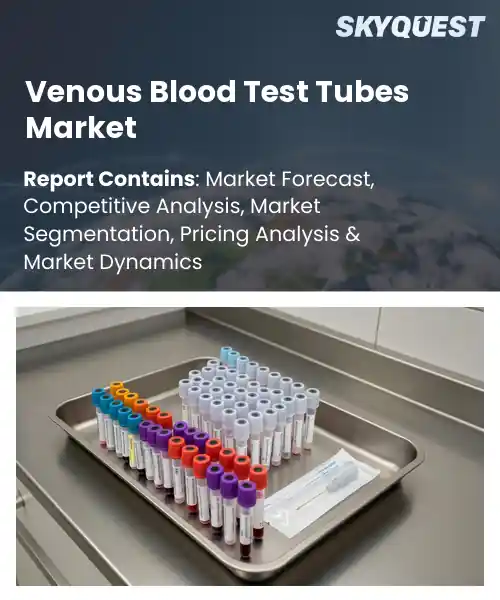
Venous Blood Test Tubes Market
Report ID: SQMIG35B2432
Report ID: SQMIG35B2432
[email protected]
USA +1 351-333-4748
Report ID:
SQMIG35B2432 |
Region:
Global |
Published Date: July, 2026
Pages:
157
|Tables:
145
|Figures:
78


Global Venous Blood Test Tubes Market size was valued at USD 2.18 Billion in 2024 and is poised to grow from USD 2.33 Billion in 2025 to USD 3.91 Billion by 2033, growing at a CAGR of 6.7% during the forecast period (2026-2033).
The global venous blood test tube market provides containers that collect, preserve, and transport blood for analysis. Its importance stems from the vital role these tubes play in diagnosing disease, monitoring therapy, and supporting research across hospitals and reference labs. In the last decade the market moved from simple glass tubes to polymeric systems with integrated additives that stabilize anticoagulated or serum samples, a shift driven by demand for faster turnaround and stricter regulations. Growth of routine screening and chronic‑disease management programs generates a steady flow of specimens and compels manufacturers to expand capacity, improve safety, and lower unit costs. A key growth factor for the global venous blood test tube market is the adoption of automated high‑throughput diagnostics in centralized laboratories and point‑of‑care networks. As hospitals implement robotic sample‑handling lines, demand rises for tubes with dimensions, bar‑coding, and pre‑filled anticoagulant formulations, prompting manufacturers to invest in plastics and technology. This shift creates opportunities to supply consumable kits that streamline workflow, lower error rates, and satisfy accreditation requirements. For example, large health systems that replaced manual phlebotomy with automated draw stations reported a 20 % drop in specimen contamination and an increase in laboratory efficiency, driving demand for next‑generation test tubes.
How is AI-driven automation impacting the venous blood test tubes market?
AI driven automation is reshaping the venous blood test tube segment by linking collection devices directly to laboratory information systems. Real time barcode generation, robotic sorting and predictive quality checks cut manual handling and lower error rates. Producers are embedding sensors that transmit temperature and anticoagulant data, enabling immediate verification of sample integrity. These capabilities accelerate turnaround times and reduce waste, making the product more attractive to high volume clinical labs. As hospitals seek faster, more reliable diagnostics, the demand for tubes that work seamlessly with automated workflows is steadily rising, reinforcing overall market momentum. The streamlined process also supports cost efficiency for providers.January 2025, Becton, Dickinson, and Company launched a new line of blood collection tubes, showcasing product innovation that dovetails with automated laboratory practices. The updated design simplifies integration with robotic handling systems, helping labs achieve higher throughput and consistent sample quality while reducing manual steps and improving overall efficiency significantly.
Market snapshot - (2026-2033)
Global Market Size
USD 2.18 Billion
Largest Segment
Serum Tubes
Fastest Growth
Plasma Tubes
Growth Rate
6.7% CAGR
To get more insights on this market click here to Request a Free Sample Report
Global venous blood test tubes market is segmented by tube type, material, application, end user, sterility and region. Based on tube type, the market is segmented into Serum Tubes, Plasma Tubes, EDTA Tubes, Citrate Tubes and Heparin Tubes. Based on material, the market is segmented into Plastic and Glass. Based on application, the market is segmented into Clinical Chemistry, Hematology, Coagulation Testing and Molecular Diagnostics. Based on end user, the market is segmented into Hospitals, Diagnostic Laboratories and Blood Banks. Based on sterility, the market is segmented into Sterile and Non-Sterile. Based on region, the market is segmented into North America, Europe, Asia Pacific, Latin America and Middle East & Africa.
Serum tubes segment dominates because they provide a stable medium for a wide range of clinical chemistry assays, offering reliable clotting and clear separation of serum. Their compatibility with established automated analyzers and long standing acceptance among laboratories reinforce demand. Clinicians favor serum for biochemical testing, driving manufacturers to prioritize production and innovation in this category. This widespread use also simplifies inventory management for healthcare providers, further cementing its leading position.
Meanwhile, plasma tubes segment emerges as the most rapidly expanding area within the venous blood test tubes market. Their ability to preserve anticoagulated whole blood makes them essential for molecular diagnostics, prompting labs to adopt them for a broader assay portfolio. Additive technologies and growing demand for rapid turnaround accelerate market expansion.
Plastic segment stands out because its lightweight nature reduces shipping costs and handling risks, encouraging bulk procurement by hospitals and laboratories. The material’s resistance to breakage enhances safety for staff, while its compatibility with modern manufacturing processes enables customization of additives, fostering broader acceptance across diverse diagnostic workflows. Furthermore, regulatory agencies often favor plastic containers for their sterility assurance, and clinicians appreciate the clear visibility of sample volume, which together drive sustained preference over alternative materials.
On the other hand, glass segment is witnessing the strongest growth momentum within the venous blood test tubes market. Its inert surface and superior chemical stability meet the exacting standards of advanced molecular and coagulation testing, prompting laboratories to invest in glass tubes for high precision assays. Emerging standards for traceability and renewed focus on sample integrity are propelling its expansion.
To get detailed segments analysis, Request a Free Sample Report
North America retains a leading position because of a mature healthcare ecosystem that emphasizes precision diagnostics and stringent quality standards. Extensive research institutions collaborate closely with manufacturers to accelerate innovation in tube materials and anticoagulant formulations. Regulatory bodies enforce rigorous safety and performance criteria, fostering confidence among hospitals and laboratories. A well‑integrated distribution network ensures rapid availability of specialized tubes across both urban and remote care settings. Moreover, the region benefits from substantial investment in digital health platforms that streamline specimen handling and traceability, reinforcing demand for high‑quality venous blood collection solutions. These combined factors cement North America’s dominance in the global market. A highly skilled workforce dedicated to biotechnology and clinical services further elevates the market. Strategic partnerships between tube producers and major diagnostic firms create tailored solutions that meet evolving clinical protocols.
Venous Blood Test Tubes Market in the United States benefits from an extensive network of research hospitals and a culture of continuous innovation. Close collaboration between academic labs and manufacturers drives rapid adoption of advanced tube technologies. Strong emphasis on patient safety and compliance with rigorous standards encourages preference for premium products. The supply chain is highly responsive, ensuring consistent availability for a broad spectrum of diverse clinical settings today.
Venous Blood Test Tubes Market in Canada is shaped by a strong public health framework that prioritizes uniform diagnostic standards. Collaborative research initiatives between provincial health authorities and tube manufacturers foster development of specialized solutions for a wide range of testing requirements. Emphasis on environmental stewardship drives interest in tubes with reduced plastic footprints. The distribution infrastructure efficiently services both urban hospitals and remote community clinics, reinforcing market stability today.
Europe experiences rapid expansion driven by coordinated healthcare policies that promote standardized diagnostic practices across member states. Investment in translational research bridges academic discoveries with commercial tube production, resulting in innovative anticoagulant chemistries and ergonomic designs. Regulatory harmonization under European frameworks simplifies market entry while maintaining high safety thresholds, encouraging manufacturers to broaden product portfolios. Growing emphasis on patient‑centered care fuels demand for tubes that enhance sample integrity and reduce handling errors. Additionally, sustainability initiatives encourage adoption of recyclable or reduced‑volume containers, aligning market offerings with environmental commitments. These combined forces create a robust ecosystem that propels the European segment ahead of many peers. Cross‑border collaboration among diagnostic laboratories further accelerates best‑practice sharing, while reimbursement frameworks increasingly recognize the clinical value of high‑quality collection systems.
Venous Blood Test Tubes Market Germany benefits from a strong industrial base that supports precision manufacturing of glass and polymeric containers. Close ties between leading medical device clusters and research universities accelerate development of tubes with enhanced barrier properties. National health agencies emphasize compliance with rigorous quality certifications, fostering confidence among clinicians. The logistics network efficiently reaches both large urban hospitals and specialized regional labs, reinforcing market depth today worldwide.
United Kingdom sees the fastest growing momentum as healthcare providers prioritize rapid turnaround and traceability in specimen handling. Collaborative initiatives between NHS laboratories and tube manufacturers focus on integrating barcode technologies and smart labeling. Emphasis on clinical efficiency drives preference for tubes that minimize clotting risk and support automated workflows. The country’s strong regulatory alignment with European standards simplifies adoption of innovative products across public and private sectors today broadly.
France Venous Blood Test Tubes Market France emerges as an emerging hub where national health initiatives encourage adoption of standardized collection systems. Partnerships between academic research centers and tube producers stimulate creation of containers optimized for a variety of assay types. Focus on patient comfort drives development of ergonomically designed tubes with reduced draw volumes. Distribution channels are well integrated, ensuring reliable supply to both metropolitan hospitals and peripheral clinics.
Asia Pacific is strengthening its position through a combination of expanding clinical infrastructure and heightened focus on quality assurance in specimen collection. Governments across the region are investing in modern laboratory networks that require reliable blood collection devices, prompting manufacturers to localize production and adapt designs to regional workflow preferences. Growing emphasis on cost‑effective healthcare solutions drives adoption of tubes that balance performance with affordability. Collaborative research programs between universities and medical device firms accelerate introduction of innovative materials that improve sample stability. Additionally, increasing awareness of environmental impact encourages development of recyclable or low‑plastic‑volume containers, aligning market offerings with sustainable objectives. These dynamics collectively elevate the region’s relevance in the global supply chain. The accelerating adoption of digital pathology and tele‑medicine further reinforces the need for reliable, traceable blood collection solutions across diverse healthcare settings.
Venous Blood Test Tubes Market Japan benefits from a precision‑driven medical culture that values meticulous specimen handling. Strong collaboration between leading biotech firms and tube manufacturers yields products tailored for high‑throughput clinical assays. National health policies emphasize compliance with stringent safety standards, reinforcing demand for tubes with superior barrier performance. The efficient distribution framework ensures prompt delivery to both large metropolitan hospitals and remote diagnostic centers, supporting consistent market penetration.
Venous Blood Test Tubes Market South Korea leverages its advanced manufacturing capabilities and rapid adoption of cutting‑edge diagnostic technologies. Close partnerships between hospital networks and tube suppliers facilitate swift integration of new anticoagulant formulations that meet evolving clinical protocols. Emphasis on operational efficiency drives preference for tubes that enhance sample stability and streamline workflow automation. A well‑organized logistics system guarantees reliable supply across a densely populated market, reinforcing the country’s competitive stance in the region.
To know more about the market opportunities by region and country, click here to
Buy The Complete Report
Rising Prevalence Of Chronic Diseases
Advancements In Anticoagulant Technologies
Stringent Regulatory Compliance Requirements
High Cost Of Specialized Tubes
Request Free Customization of this report to help us to meet your business objectives.
The competitive landscape is shaped by established manufacturers expanding through strategic acquisitions and partnerships, such as recent joint ventures between leading tube producers and diagnostic firms to integrate advanced anticoagulant technologies, while innovators are accelerating product pipelines with proprietary polymer coatings that enhance sample stability and reduce hemolysis. These moves intensify rivalry and drive differentiation in a market where supply chain optimization and regulatory compliance remain critical success factors.
Top Player’s Company Profile
Recent Developments
SkyQuest’s ABIRAW (Advanced Business Intelligence, Research & Analysis Wing) is our Business Information Services team that Collects, Collates, Correlates, and Analyses the Data collected by means of Primary Exploratory Research backed by robust Secondary Desk research. As per SkyQuest analysis, the global venous blood test tubes market is being propelled primarily by the rising prevalence of chronic diseases, which drives frequent blood testing and expands demand for specialized collection tubes. A second important driver is the rapid adoption of automated high‑throughput diagnostics and AI‑enabled workflows that require tubes compatible with robotic handling and real‑time data capture. The market is led by North America, where mature healthcare systems and strict quality standards support widespread use, and serum tubes dominate the segment mix because of their versatility for clinical chemistry assays. However, stringent regulatory compliance requirements act as a restraint, increasing validation costs and limiting entry for smaller manufacturers.
| Report Metric | Details |
|---|---|
| Market size value in 2024 | USD 2.18 Billion |
| Market size value in 2033 | USD 3.91 Billion |
| Growth Rate | 6.7% |
| Base year | 2024 |
| Forecast period | (2026-2033) |
| Forecast Unit (Value) | USD Billion |
| Segments covered |
|
| Regions covered | North America (US, Canada), Europe (Germany, France, United Kingdom, Italy, Spain, Rest of Europe), Asia Pacific (China, India, Japan, Rest of Asia-Pacific), Latin America (Brazil, Rest of Latin America), Middle East & Africa (South Africa, GCC Countries, Rest of MEA) |
| Companies covered |
|
| Customization scope | Free report customization with purchase. Customization includes:-
|
To get a free trial access to our platform which is a one stop solution for all your data requirements for quicker decision making. This platform allows you to compare markets, competitors who are prominent in the market, and mega trends that are influencing the dynamics in the market. Also, get access to detailed SkyQuest exclusive matrix.
Table Of Content
Executive Summary
Market overview
Parent Market Analysis
Market overview
Market size
KEY MARKET INSIGHTS
COVID IMPACT
MARKET DYNAMICS & OUTLOOK
Market Size by Region
KEY COMPANY PROFILES
Methodology
For the Venous Blood Test Tubes Market, our research methodology involved a mixture of primary and secondary data sources. Key steps involved in the research process are listed below:
1. Information Procurement: This stage involved the procurement of Market data or related information via primary and secondary sources. The various secondary sources used included various company websites, annual reports, trade databases, and paid databases such as Hoover's, Bloomberg Business, Factiva, and Avention. Our team did 45 primary interactions Globally which included several stakeholders such as manufacturers, customers, key opinion leaders, etc. Overall, information procurement was one of the most extensive stages in our research process.
2. Information Analysis: This step involved triangulation of data through bottom-up and top-down approaches to estimate and validate the total size and future estimate of the Venous Blood Test Tubes Market.
3. Report Formulation: The final step entailed the placement of data points in appropriate Market spaces in an attempt to deduce viable conclusions.
4. Validation & Publishing: Validation is the most important step in the process. Validation & re-validation via an intricately designed process helped us finalize data points to be used for final calculations. The final Market estimates and forecasts were then aligned and sent to our panel of industry experts for validation of data. Once the validation was done the report was sent to our Quality Assurance team to ensure adherence to style guides, consistency & design.
Analyst Support
Customization Options
With the given market data, our dedicated team of analysts can offer you the following customization options are available for the Venous Blood Test Tubes Market:
Product Analysis: Product matrix, which offers a detailed comparison of the product portfolio of companies.
Regional Analysis: Further analysis of the Venous Blood Test Tubes Market for additional countries.
Competitive Analysis: Detailed analysis and profiling of additional Market players & comparative analysis of competitive products.
Go to Market Strategy: Find the high-growth channels to invest your marketing efforts and increase your customer base.
Innovation Mapping: Identify racial solutions and innovation, connected to deep ecosystems of innovators, start-ups, academics, and strategic partners.
Category Intelligence: Customized intelligence that is relevant to their supply Markets will enable them to make smarter sourcing decisions and improve their category management.
Public Company Transcript Analysis: To improve the investment performance by generating new alpha and making better-informed decisions.
Social Media Listening: To analyze the conversations and trends happening not just around your brand, but around your industry as a whole, and use those insights to make better Marketing decisions.
REQUEST FOR SAMPLE
 REQUEST FREE CUSTOMIZATION


Want to customize this report? This report can be personalized according to your needs. Our analysts and industry experts will work directly with you to understand your requirements and provide you with customized data in a short amount of time. We offer $1000 worth of FREE customization at the time of purchase.
Feedback From Our Clients


 USA (+1) 351-333-4748

