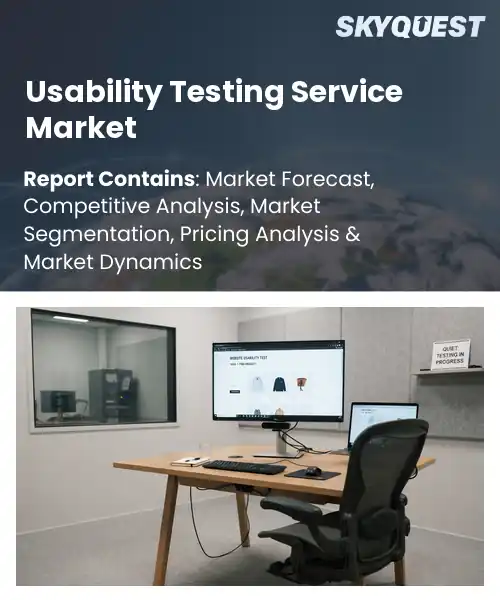
Usability Testing Service Market
Report ID: SQMIG45B2408
Report ID: SQMIG45B2408
[email protected]
USA +1 351-333-4748
Report ID:
SQMIG45B2408 |
Region:
Global |
Published Date: September, 2026
Pages:
157
|Tables:
129
|Figures:
77


Global Usability Testing Service Market size was valued at USD 2.64 Billion in 2024 and is poised to grow from USD 2.81 Billion in 2025 to USD 4.7 Billion by 2033, growing at a CAGR of 6.6% during the forecast period (2026-2033).
The primary engine propelling the global usability testing service market is the accelerating demand for seamless digital experiences. As consumers migrate toward mobile apps, e‑commerce platforms, and SaaS solutions, organizations must verify that interfaces operate intuitively across devices. Historically, early usability studies were limited to academic labs in the 1990s, but the rise of agile development and cloud‑based recruiting platforms has democratized access to real‑world participants. Companies such as Netflix and Shopify now embed rapid testing cycles into product roadmaps, illustrating how market maturity translates into measurable reductions in abandonment rates and heightened loyalty for customers worldwide and stakeholders. Another decisive factor shaping the global usability testing service market is the integration of artificial intelligence into test orchestration, which accelerates insight generation and lowers cost per study. When AI algorithms analyze clickstreams and eye‑tracking data, they reveal friction points that manual observation might miss, prompting designers to iterate faster and allocate resources more efficiently. This capability has spurred adoption among financial technology startups, where rapid compliance testing reduces regulatory risk, and among healthcare providers that must certify patient portals for accessibility. Consequently, the market expands as vendors introduce subscription‑based platforms, creating a virtuous cycle of data‑driven improvements and heightened demand for growth.
How is AI-driven automation reshaping the usability testing services market?
AI-driven automation is transforming usability testing by streamlining participant recruitment, data collection, and insight generation. Machine‑learning models now analyze clickstreams, eye‑tracking and verbal feedback in real time, turning raw interactions into actionable patterns without manual coding. This shift enables faster test cycles, allowing teams to iterate designs multiple times within a single development sprint. Companies are integrating AI‑powered sentiment analysis and anomaly detection to surface hidden usability issues that traditional methods might miss. The result is a more efficient workflow that reduces cost and expands the scope of testing to cover diverse user groups, making usability insights more readily available across product lifecycles.A recent development is UserZoom’s AI‑enhanced testing platform launched in March 2024, which automates participant screening and real‑time heat‑map generation, boosting test efficiency and supporting market growth.
Market snapshot - (2026-2033)
Global Market Size
USD 2.64 Billion
Largest Segment
Remote Usability Testing
Fastest Growth
Mobile Usability Testing
Growth Rate
6.6% CAGR
To get more insights on this market click here to Request a Free Sample Report
Global usability testing service market is segmented by testing type, testing method, application, end-use industry and region. Based on testing type, the market is segmented into Moderated Usability Testing, Unmoderated Usability Testing, Remote Usability Testing, In-Person Usability Testing, Mobile Usability Testing and Others. Based on testing method, the market is segmented into User Interviews, Task-Based Testing, A/B Testing, Eye Tracking, Clickstream Analysis and Others. Based on application, the market is segmented into Website Testing, Mobile Application Testing, Software Testing, Product Testing, E-Commerce Testing and Others. Based on end-use industry, the market is segmented into IT & Telecom, BFSI, Healthcare, Retail & E-Commerce, Media & Entertainment and Others. Based on region, the market is segmented into North America, Europe, Asia Pacific, Latin America and Middle East & Africa.
Remote Usability Testing segment dominates because enterprises prioritize flexible, cost effective evaluation that can be conducted across dispersed user bases without travel constraints. The ability to capture authentic user interactions in natural environments enhances insight relevance, encouraging product teams to adopt remote protocols for iterative design. Moreover, integration with digital collaboration tools streamlines data collection, while pandemic induced shifts accelerated acceptance, making remote testing the preferred choice for scalable usability assessments.
Meanwhile, Mobile Usability Testing is witnessing the strongest growth momentum as smartphone penetration deepens and apps become central to consumer experiences. Developers seek feedback on touch gestures, screen sizes, and performance, driving demand for specialized mobile focused evaluations. This surge fuels platform diversification and creates revenue streams for service providers.
User Interviews segment leads because they provide nuanced qualitative insights that uncover user motivations, frustrations, and contextual factors beyond quantitative metrics. By facilitating open ended dialogue, interviewers can probe deeper into pain points, enabling designers to prioritize improvements that resonate emotionally with target audiences. Organizations value this depth for shaping product roadmaps, and the flexibility to conduct interviews remotely or in person amplifies adoption across diverse project phases.
On the other hand, Eye Tracking is emerging as the key growth area because advances in affordable hardware and AI driven heatmap analytics enable measurement of attention. Brands leverage this capability to optimize UI layouts and content hierarchy, driving heightened demand that accelerates market expansion and spurs innovative service offerings.
To get detailed segments analysis, Request a Free Sample Report
North America maintains its lead in the global Usability Testing Service Market through a combination of deep technological expertise, a concentration of world‑class digital product companies, and an entrenched culture of user‑centered design. The region benefits from extensive research institutions that supply a steady flow of specialized talent, while mature market practices encourage early integration of usability testing into product lifecycles. Strong investment ecosystems support innovative service models, and a collaborative ecosystem between agencies, consultants, and in‑house teams accelerates knowledge sharing. Regulatory frameworks that prioritize consumer protection further reinforce the need for rigorous testing, prompting organizations to allocate substantial resources toward refining user experiences across platforms. Additionally, the rise of digital health platforms and sustainable fintech solutions amplifies demand for rigorous usability assessment, ensuring that complex interfaces meet both functional and ethical expectations.
United States Usability Testing Service Market
Usability Testing Service Market in United States thrives on a dense network of technology innovators, venture‑backed startups, and established enterprises that embed testing early in design pipelines. Academic programs produce a continuous stream of UX specialists, while professional associations foster best‑practice standards. Clients across finance, healthcare, and entertainment demand rigorous validation, prompting service providers to offer multimodal testing environments that span mobile, voice, and immersive interfaces for enhanced customer satisfaction and brand loyalty.
Canada Usability Testing Service Market
Usability Testing Service Market in Canada benefits from strong governmental support for digital innovation and a collaborative ecosystem that links research universities with industry players. The bilingual environment encourages testing across linguistic contexts, while a focus on accessibility standards elevates inclusive design practices. Financial services, public sector agencies, and emerging gaming studios leverage usability insights to refine interactions, prompting providers to integrate remote testing labs and analytics into service offerings.
Europe experiences a swift expansion of the Usability Testing Service Market as organizations increasingly recognize the strategic value of user‑centric innovation across diverse regulatory landscapes. Strong public‑sector initiatives promote digital inclusion, while industry clusters in key economies foster collaborative research between academia and technology firms. A heightened emphasis on privacy and data protection pushes companies toward transparent testing methodologies, encouraging the adoption of remote and moderated solutions. The convergence of multilingual markets and cross‑border e‑commerce intensifies the need for culturally aware testing, prompting service providers to build specialized expertise in language, accessibility, and regional compliance. Together, these forces generate a fertile environment where usability testing is viewed as a core component of competitive differentiation. Furthermore, the rise of digital health platforms and sustainable fintech solutions amplifies demand for rigorous usability assessment, ensuring that complex interfaces meet both functional and ethical expectations.
Germany Usability Testing Service Market
Usability Testing Service Market in Germany is anchored by robust engineering traditions and a dense network of Mittelstand firms that prioritize precision in digital products. Governmental incentives encourage research collaborations, while standards bodies advance rigorous usability protocols. Automotive, manufacturing, and fintech sectors increasingly embed testing to optimize complex interfaces, prompting providers to offer hybrid labs and high‑fidelity simulations that reflect real‑world usage scenarios for enhanced customer satisfaction and brand loyalty.
United Kingdom Usability Testing Service Market
Usability Testing Service Market in United Kingdom accelerates through a startup ecosystem and strong financial services hub that demand agile user experience validation. Academic research centers specialize in human‑computer interaction, feeding methodologies into commercial practice. Regulatory focus on accessibility and consumer rights drives companies to adopt inclusive testing frameworks, while the prevalence of remote work expands the use of distributed testing platforms that capture diverse user contexts across the island.
France Usability Testing Service Market
Usability Testing Service Market in France is gaining momentum through digital agencies and cultural organizations that prioritize user experiences. Emphasis on design thinking in university programs nurtures talent capable of conducting testing across markets. Government programs promote transformation in retail and services, prompting providers to offer testing solutions that adhere to data protection norms. The combination of sensibility and technical rigor positions France as a hub for innovative usability approaches.
Asia Pacific is rapidly strengthening its position in the Usability Testing Service Market by leveraging a combination of technological advancement, a burgeoning mobile‑first consumer base, and deep integration of testing within product development cycles. Nations across the region invest heavily in digital infrastructure, enabling high‑speed connectivity that supports sophisticated remote testing environments. The proliferation of e‑commerce, fintech, and gaming platforms creates a relentless demand for seamless user interactions, prompting service providers to adopt AI‑driven analytics and immersive simulation tools. Collaborative ecosystems linking startups, multinational corporations, and research institutes foster knowledge exchange and accelerate the adoption of best‑practice methodologies. Cultural diversity and multilingual markets further compel organizations to refine localized testing strategies, positioning Asia Pacific as a catalyst for innovative usability solutions on a global scale.
Japan Usability Testing Service Market
Usability Testing Service Market in Japan is driven by a culture of quality assurance and a strong automotive and electronics sector that demands precise interface design. Leading research universities collaborate with corporations to develop sophisticated lab environments, while government initiatives promote digital innovation across services. Companies increasingly employ a blend of on‑site and remote testing to capture user behavior, integrating eye‑tracking and biometric feedback to enhance product ergonomics and satisfaction.
South Korea Usability Testing Service Market
Usability Testing Service Market in South Korea benefits from an electronics landscape and an ecosystem that embraces user testing. Conglomerates and startups alike prioritize rapid prototyping, leveraging cloud‑based platforms to conduct remote sessions with groups. Government support for city initiatives fuels demand for interfaces, while academic centers specialize in research. This convergence encourages providers to integrate real‑time analytics and AI‑assisted moderation, delivering responsive testing solutions that align with market expectations.
To know more about the market opportunities by region and country, click here to
Buy The Complete Report
Increasing Digital Product Complexity
Shift Toward Remote User Research
Limited Awareness Among Small Enterprises
Data Privacy and Compliance Concerns
Request Free Customization of this report to help us to meet your business objectives.
The usability testing services market is shaped by intense rivalry as firms vie for enterprise contracts, with major players accelerating growth through strategic acquisitions such as UserTesting’s purchase of PlaybookUX and partnerships like UserZoom’s integration with SAP to embed testing into enterprise workflows; technology innovation, including AI‑driven session analysis and remote lab platforms, further intensifies competition and drives market expansion.
Top Player’s Company Profile
Recent Developments
SkyQuest’s ABIRAW (Advanced Business Intelligence, Research & Analysis Wing) is our Business Information Services team that Collects, Collates, Correlates, and Analyses the Data collected by means of Primary Exploratory Research backed by robust Secondary Desk research. As per SkyQuest analysis, the market is being propelled primarily by the growing complexity of digital products which forces firms to validate user interactions early, a second engine is the rapid infusion of AI‑driven automation that streamlines participant recruitment, data collection and insight generation, cutting costs and cycle times. The remote usability testing type commands the largest share as companies favor flexible, cost‑effective evaluations across dispersed user bases. North America remains the dominant region thanks to its deep tech talent pool, mature product ecosystems and strong investment in user‑centred design. However, limited awareness among small and midsize enterprises restrains broader adoption, keeping a sizable segment untapped.
| Report Metric | Details |
|---|---|
| Market size value in 2024 | USD 2.64 Billion |
| Market size value in 2033 | USD 4.7 Billion |
| Growth Rate | 6.6% |
| Base year | 2024 |
| Forecast period | (2026-2033) |
| Forecast Unit (Value) | USD Billion |
| Segments covered |
|
| Regions covered | North America (US, Canada), Europe (Germany, France, United Kingdom, Italy, Spain, Rest of Europe), Asia Pacific (China, India, Japan, Rest of Asia-Pacific), Latin America (Brazil, Rest of Latin America), Middle East & Africa (South Africa, GCC Countries, Rest of MEA) |
| Companies covered |
|
| Customization scope | Free report customization with purchase. Customization includes:-
|
To get a free trial access to our platform which is a one stop solution for all your data requirements for quicker decision making. This platform allows you to compare markets, competitors who are prominent in the market, and mega trends that are influencing the dynamics in the market. Also, get access to detailed SkyQuest exclusive matrix.
Table Of Content
Executive Summary
Market overview
Parent Market Analysis
Market overview
Market size
KEY MARKET INSIGHTS
COVID IMPACT
MARKET DYNAMICS & OUTLOOK
Market Size by Region
KEY COMPANY PROFILES
Methodology
For the Usability Testing Service Market, our research methodology involved a mixture of primary and secondary data sources. Key steps involved in the research process are listed below:
1. Information Procurement: This stage involved the procurement of Market data or related information via primary and secondary sources. The various secondary sources used included various company websites, annual reports, trade databases, and paid databases such as Hoover's, Bloomberg Business, Factiva, and Avention. Our team did 45 primary interactions Globally which included several stakeholders such as manufacturers, customers, key opinion leaders, etc. Overall, information procurement was one of the most extensive stages in our research process.
2. Information Analysis: This step involved triangulation of data through bottom-up and top-down approaches to estimate and validate the total size and future estimate of the Usability Testing Service Market.
3. Report Formulation: The final step entailed the placement of data points in appropriate Market spaces in an attempt to deduce viable conclusions.
4. Validation & Publishing: Validation is the most important step in the process. Validation & re-validation via an intricately designed process helped us finalize data points to be used for final calculations. The final Market estimates and forecasts were then aligned and sent to our panel of industry experts for validation of data. Once the validation was done the report was sent to our Quality Assurance team to ensure adherence to style guides, consistency & design.
Analyst Support
Customization Options
With the given market data, our dedicated team of analysts can offer you the following customization options are available for the Usability Testing Service Market:
Product Analysis: Product matrix, which offers a detailed comparison of the product portfolio of companies.
Regional Analysis: Further analysis of the Usability Testing Service Market for additional countries.
Competitive Analysis: Detailed analysis and profiling of additional Market players & comparative analysis of competitive products.
Go to Market Strategy: Find the high-growth channels to invest your marketing efforts and increase your customer base.
Innovation Mapping: Identify racial solutions and innovation, connected to deep ecosystems of innovators, start-ups, academics, and strategic partners.
Category Intelligence: Customized intelligence that is relevant to their supply Markets will enable them to make smarter sourcing decisions and improve their category management.
Public Company Transcript Analysis: To improve the investment performance by generating new alpha and making better-informed decisions.
Social Media Listening: To analyze the conversations and trends happening not just around your brand, but around your industry as a whole, and use those insights to make better Marketing decisions.
REQUEST FOR SAMPLE
 REQUEST FREE CUSTOMIZATION


Want to customize this report? This report can be personalized according to your needs. Our analysts and industry experts will work directly with you to understand your requirements and provide you with customized data in a short amount of time. We offer $1000 worth of FREE customization at the time of purchase.
Feedback From Our Clients


 USA (+1) 351-333-4748

