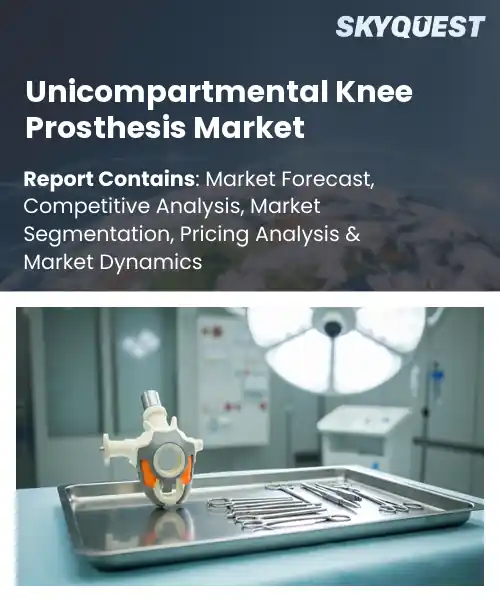
Unicompartmental Knee Prosthesis Market
Report ID: SQMIG35A3763
Report ID: SQMIG35A3763
[email protected]
USA +1 351-333-4748
Report ID:
SQMIG35A3763 |
Region:
Global |
Published Date: June, 2026
Pages:
157
|Tables:
139
|Figures:
78


Global Unicompartmental Knee Prosthesis Market size was valued at USD 970.2 Million in 2024 and is poised to grow from USD 1004.16 Million in 2025 to USD 1322.28 Million by 2033, growing at a CAGR of 3.5% during the forecast period (2026-2033).
Primary driver behind the unicompartmental knee prosthesis industry is the increasing adoption of less invasive orthopedic solutions that conserve healthy tissue and shorten recovery time, prompting surgeons and patients to prefer partial replacement for isolated compartment disease. The market covers implants that replace the medial or lateral knee compartment, and it matters because targeted interventions lower hospitalization durations, reduce rehabilitation burden and preserve postoperative function compared with total knee arthroplasty. Historically the sector progressed from basic metal on polyethylene implants to modular designs and patient specific instruments, while integration of robotics with advanced biomaterials significantly improved alignment accuracy and survivorship.
The principal growth factor in the global unicompartmental knee prosthesis industry is technological innovation combined with refined patient selection, because greater surgical precision lowers complication rates and thus raises surgeon confidence and procedural uptake. For example, robotic assisted implantation has produced more accurate alignment and fewer early revisions in multicenter studies, which prompts health systems to shift suitable cases to ambulatory surgical centers where shorter stays reduce per case costs. Consequently manufacturers prioritize modular, patient specific implants and training programs, generating opportunities across aging populations and emerging markets with rising osteoarthritis and unmet surgical demand.
How is AI improving patient selection for unicompartmental knee prosthesis procedures?
AI is improving patient selection for unicompartmental knee prosthesis by integrating imaging analysis machine learning and predictive modeling to define candidate suitability more precisely. Key aspects include automated detection of compartmental cartilage loss assessment of ligament integrity and simulation of postoperative alignment. The current state shows surgeons pairing AI driven risk stratification with robotic planning and intraoperative digital tension assessment to reduce unexpected conversions to total knee replacement. In a market where selective adoption of partial implants depends on reliable outcomes these tools make indications more transparent and help match implant design and surgical workflow to individual anatomy which improves clinician confidence and patient experience.
Johnson & Johnson in June 2025, announced first European cases using the VELYS robotic assisted solution for unicompartmental knee procedures, demonstrating how AI enabled planning and robotic execution streamline candidate assessment and operative precision which supports market efficiency and broader uptake.
Market snapshot - (2026-2033)
Global Market Size
USD 970.2 Million
Largest Segment
Fastest Growth
Growth Rate
3.5% CAGR
To get more insights on this market click here to Request a Free Sample Report
Global unicompartmental knee prosthesis market is segmented by component construction, fixation methodology, alignment technology, end-user, distribution channel and region. Based on component construction, the market is segmented into Femoral Components and Tibial Trays & Polyethylene Inserts. Based on fixation methodology, the market is segmented into Cemented Fixation Prostheses and Cementless Porous Fixation Prostheses. Based on alignment technology, the market is segmented into Traditional Manual Instrument Systems and Robotic-Assisted & Computer-Navigated Systems. Based on end-user, the market is segmented into Hospitals & Orthopedic Specialty Centers and Ambulatory Surgical Centers. Based on distribution channel, the market is segmented into Direct and Indirect. Based on region, the market is segmented into North America, Europe, Asia Pacific, Latin America and Middle East & Africa.
As per unicompartmental knee prosthesis market outlook, tibial trays & polyethylene inserts segment dominates because these elements directly govern articulation mechanics, load transfer, and long term wear characteristics that define clinical success in unicompartmental implants. Innovations in polyethylene chemistry and tray design reduce abrasive pathways and influence surgeon selection, so manufacturers and clinicians prioritize these components during product development and procurement, driving standardization and directing R&D investments toward durability and functional outcomes.
As per unicompartmental knee prosthesis market forecast, femoral components is the most rapidly expanding area, witnessing the strongest growth momentum in the market due to advances in anatomic geometry, surface engineering, and modularity that address bone preservation and kinematic replication. Enhanced femoral designs expand surgical indications, support minimally invasive techniques, and generate new clinical evidence that accelerates adoption and creates aftermarket opportunities for implant customization and upgraded offerings.
Traditional manual instrument systems segment leads with large unicompartmental knee prosthesis market forecast because established surgical workflows, lower upfront costs, and widespread surgeon familiarity make manual instrumentation the default for many unicompartmental procedures, ensuring predictable theater scheduling and procurement simplicity. Proven training pathways and reliable instrument sets reduce intraoperative variability and resistance to change, so hospitals and centers continue to rely on incremental improvements to manual kits while maintaining procedural throughput and economic predictability.
As per unicompartmental knee prosthesis market analysis, robotic-assisted & computer-navigated systems is the most rapidly expanding segment experiencing strong growth as demand for precision, reproducible alignment, and data driven outcomes converges with vendor investment in guidance platforms. These systems enable refined planning, intraoperative feedback, and outcome tracking, which foster clinical evidence of alignment fidelity, encourage surgeon adoption in complex cases, and create recurring software and service revenue streams that expand market opportunity.
To get detailed segments analysis, Request a Free Sample Report
As per global unicompartmental knee prosthesis market regional outlook, North America has a major share of market and this can be attributed to a combination of structural advantages and market dynamics. Having good clinical research networks and an early acceptance of minimally invasive orthopedic procedures means there is a wide range of surgeon experience and technique optimization. Established reimbursement models and sophisticated hospital infrastructure across care contexts support consistent access to procedures. The high density of device makers and specialized distributors supports rapid deployment of incremental design enhancements and instrumentation. Strong collaboration between academic centers and industry speeds evidence creation and guideline implementation, which in turn increases clinician trust. Demand increasingly sustains with patient understanding and preference for tissue preservation choices . Barriers to adoption are also being further reduced through clearer regulation and targeted training efforts across a variety of care settings.
As per global unicompartmental knee prosthesis market regional forecast, United States represents developed clinical ecosystems and focused surgeon knowledge across specialized orthopedic centers. Extensive training programs and industry partnerships help to more widely implement better surgical procedures and implant types. Health systems favour care paths that emphasize tissue preservation choices for appropriate individuals. Ongoing device development and strong clinician confidence in unicompartmental solutions are supported by payer frameworks and institutional support, as well as active clinical research.
As per global unicompartmental knee prosthesis industry analysis, Canada is characterized by integrated public health systems, regional orthopedic facilities and increased clinical interest in less invasive joint replacement choices. Networks of collaboration between hospitals and device providers facilitate the distribution of enhanced implants and apparatus. Structured training and focus on patient outcomes help clinician uptake. Policy-driven procurement and integrated care pathways connect incentives across stakeholders, creating an enabling environment for widespread adoption and continuous review.
European unicompartmental knee prosthesis market is growing rapidly, a consequence of combined clinical, policy and economic forces backing less invasive joint preservation measures. There has been a strong emphasis on evidence based medicine and increasing clinical consensus on patient selection criteria that has boosted surgeon confidence in partial knee treatments. In many markets, reimbursement mechanisms that promote outcomes and shorter hospital stays drive adoption in both public and private systems. Engagement of device companies with surgical societies and investment in surgeon education expedite the proliferation of improved implants and instruments. Demand is also driven by the growing patient preference for speedier recovery and function-preserving options. Fragmented but collaborative health care environments make it possible for pilot projects and regional centers to expand best practices across jurisdictions. They build market momentum together.
Germany is supported by robust clinical research and specialized orthopedic centers that emphasize guideline driven practice. Concentrated specialist units and surgeon training cultivate procedural expertise and refinement. Hospitals and rehabilitation teams adopt enhanced recovery approaches that align with tissue conserving strategies. Collaboration between academic institutions, clinical sites, and industry underpins health technology assessment and evidence generation, which sustains clinician confidence and uptake across care settings.
United Kingdom is shaped by active surgical education, clinical audit, and emphasis on outcome transparency. Professional societies promote best practice pathways and evaluation that encourage use of partial knee solutions. Mixed public and private care environment creates multiple adoption avenues, targeted training and minimally invasive programs expand surgeon capability. Growing patient awareness and outcome reporting strengthen clinician and payer support for tissue conserving approaches.
France is emerging through clinical initiatives that emphasize outcome driven care pathways. Surgeons and hospitals are adopting partial knee options within defined patient selection frameworks. Investment in specialized training and pilot programs increases procedural familiarity. Health policy dialogue and payer engagement support measured adoption. As practice networks broaden and local evidence develops, clinician confidence and institutional uptake advance in a deliberate manner increasingly over time.
Asia Pacific is strengthening its role in the unicompartmental knee prosthesis market through a combination of capacity building, technology adoption, and expanding clinical capabilities. Regional centers are investing in surgeon training and mentorship programs that transfer skills in minimally invasive partial knee procedures. Local manufacturing and partnerships with global device companies support greater supply chain resilience and customization to regional anatomical and clinical needs. Growing hospital infrastructure and private sector investment create multiple pathways for adoption, while increasing clinical research activity contributes to an evolving evidence base. Regulatory modernization and targeted reimbursement initiatives in several markets are reducing barriers to market entry. Together these elements are promoting wider clinician familiarity, improving patient access, and enabling the region to play a larger role in global device development and refinement.
Japan is driven by advanced hospitals, refined surgical skills, and a strong focus on clinical evidence. Orthopedic teams and training support precise patient selection and procedure performance. Partnerships between domestic manufacturers and international firms yield implant and instrument improvements tailored to local anatomy. Coordinated care and rehabilitation emphasize functional recovery. Regulatory clarity and active research networks foster cautious adoption of partial knee approaches across centers.
South Korea is supported by a strong biomedical industry, clinical adoption of less invasive techniques, and collaborative development between hospitals and manufacturers. Surgical proficiency enables precise implantation and positive patient outcomes. Local device innovation emphasizes anatomical fit and practical instrumentation for regional needs. Training programs and active peer networks accelerate surgeon skill transfer. Coordinated regulatory support helps integrate partial knee options into standard orthopedic practice.
To know more about the market opportunities by region and country, click here to
Buy The Complete Report
Increasing Preference For Less Invasive Procedures
Technological Advances In Implant Design
Limited Surgeon Experience And Training
Reimbursement And Cost Considerations
Request Free Customization of this report to help us to meet your business objectives.
Global unicompartmental knee prosthesis competition is technology-driven, with players using M&A, partnerships and product innovation to secure clinical differentiation and ASC adoption. For example Smith+Nephew acquired Engage Surgical for its cementless partial knee in 2022 and Stryker acquired MAKO to own robotics platforms; meanwhile specialist innovators such as OSSTEC and Conformis advance 3D-printed and patient-specific solutions, accelerating trials and surgeon partnerships. Startups:
SkyQuest’s ABIRAW (Advanced Business Intelligence, Research & Analysis Wing) is our Business Information Services team that Collects, Collates, Correlates, and Analyses the Data collected by means of Primary Exploratory Research backed by robust Secondary Desk research.
As per SkyQuest analysis, the global unicompartmental knee prosthesis market growth is driven primarily by growing preference for less invasive procedures that preserve healthy tissue and shorten recovery, supported by a second driver of rapid technological advances such as robotic-assisted systems, AI-enabled patient selection and improved implant design and materials. Adoption is restrained by limited surgeon experience and training, which increases technical variability and limits procedural uptake. North America remains the dominant region due to mature clinical networks and reimbursement frameworks, and tibial trays and polyethylene inserts are the dominating segment because they directly govern articulation mechanics, load transfer and long-term wear characteristics.
| Report Metric | Details |
|---|---|
| Market size value in 2024 | USD 970.2 Million |
| Market size value in 2033 | USD 1322.28 Million |
| Growth Rate | 3.5% |
| Base year | 2024 |
| Forecast period | (2026-2033) |
| Forecast Unit (Value) | USD Million |
| Segments covered |
|
| Regions covered | North America (US, Canada), Europe (Germany, France, United Kingdom, Italy, Spain, Rest of Europe), Asia Pacific (China, India, Japan, Rest of Asia-Pacific), Latin America (Brazil, Rest of Latin America), Middle East & Africa (South Africa, GCC Countries, Rest of MEA) |
| Companies covered |
|
| Customization scope | Free report customization with purchase. Customization includes:-
|
To get a free trial access to our platform which is a one stop solution for all your data requirements for quicker decision making. This platform allows you to compare markets, competitors who are prominent in the market, and mega trends that are influencing the dynamics in the market. Also, get access to detailed SkyQuest exclusive matrix.
Table Of Content
Executive Summary
Market overview
Parent Market Analysis
Market overview
Market size
KEY MARKET INSIGHTS
COVID IMPACT
MARKET DYNAMICS & OUTLOOK
Market Size by Region
KEY COMPANY PROFILES
Methodology
For the Unicompartmental Knee Prosthesis Market, our research methodology involved a mixture of primary and secondary data sources. Key steps involved in the research process are listed below:
1. Information Procurement: This stage involved the procurement of Market data or related information via primary and secondary sources. The various secondary sources used included various company websites, annual reports, trade databases, and paid databases such as Hoover's, Bloomberg Business, Factiva, and Avention. Our team did 45 primary interactions Globally which included several stakeholders such as manufacturers, customers, key opinion leaders, etc. Overall, information procurement was one of the most extensive stages in our research process.
2. Information Analysis: This step involved triangulation of data through bottom-up and top-down approaches to estimate and validate the total size and future estimate of the Unicompartmental Knee Prosthesis Market.
3. Report Formulation: The final step entailed the placement of data points in appropriate Market spaces in an attempt to deduce viable conclusions.
4. Validation & Publishing: Validation is the most important step in the process. Validation & re-validation via an intricately designed process helped us finalize data points to be used for final calculations. The final Market estimates and forecasts were then aligned and sent to our panel of industry experts for validation of data. Once the validation was done the report was sent to our Quality Assurance team to ensure adherence to style guides, consistency & design.
Analyst Support
Customization Options
With the given market data, our dedicated team of analysts can offer you the following customization options are available for the Unicompartmental Knee Prosthesis Market:
Product Analysis: Product matrix, which offers a detailed comparison of the product portfolio of companies.
Regional Analysis: Further analysis of the Unicompartmental Knee Prosthesis Market for additional countries.
Competitive Analysis: Detailed analysis and profiling of additional Market players & comparative analysis of competitive products.
Go to Market Strategy: Find the high-growth channels to invest your marketing efforts and increase your customer base.
Innovation Mapping: Identify racial solutions and innovation, connected to deep ecosystems of innovators, start-ups, academics, and strategic partners.
Category Intelligence: Customized intelligence that is relevant to their supply Markets will enable them to make smarter sourcing decisions and improve their category management.
Public Company Transcript Analysis: To improve the investment performance by generating new alpha and making better-informed decisions.
Social Media Listening: To analyze the conversations and trends happening not just around your brand, but around your industry as a whole, and use those insights to make better Marketing decisions.
REQUEST FOR SAMPLE
 REQUEST FREE CUSTOMIZATION
Global Unicompartmental Knee Prosthesis Market size was valued at USD 970.2 Million in 2024 and is poised to grow from USD 1004.16 Million in 2025 to USD 1322.28 Million by 2033, growing at a CAGR of 3.5% during the forecast period (2026-2033).
Global unicompartmental knee prosthesis competition is technology-driven, with players using M&A, partnerships and product innovation to secure clinical differentiation and ASC adoption. For example Smith+Nephew acquired Engage Surgical for its cementless partial knee in 2022 and Stryker acquired MAKO to own robotics platforms; meanwhile specialist innovators such as OSSTEC and Conformis advance 3D-printed and patient-specific solutions, accelerating trials and surgeon partnerships. Startups: 'Zimmer Biomet Holdings', 'Stryker Corporation', 'Johnson & Johnson', 'Smith & Nephew', 'Enovis Corporation', 'Medacta International', 'MicroPort Scientific Corporation', 'Corin Group', 'United Orthopedic Corporation', 'Linkos Medical', 'Exactech', 'B. Braun SE', 'Waldemar Link GmbH', 'Corentec', 'Baumer SA', 'Implantcast GmbH', 'Mathys AG Bettlach', 'LimaCorporate', 'Peter Brehm GmbH', 'Group FH Ortho'
Patients and surgeons increasingly favor less invasive surgical options that preserve native tissue and joint kinematics, which directly benefits adoption of unicompartmental knee prostheses. The procedure’s smaller incisions, reduced soft tissue disruption, and preservation of healthy compartments frequently lead to perceptions of faster functional recovery and lower rehabilitation burden, encouraging surgeon preference and referral patterns. These clinical advantages support greater utilization in appropriately selected patients, stimulate development of targeted surgical techniques and instruments, and reinforce payer and provider interest in offering unicompartmental solutions as a standard care pathway.
Minimally Invasive Surgery Shift: Growing preference for less disruptive unicompartmental procedures emphasizes tissue-sparing approaches that support accelerated rehabilitation and shorter hospital stays. Manufacturers and clinicians are aligning around implant designs and instrumentation that prioritize preservation of native anatomy and joint kinematics, enabling earlier mobilization and patient-centered recovery pathways. This trend is driven by demand for treatments that balance pain relief with functional restoration, increased focus on outpatient orthopedic care models, and the pursuit of approaches perceived as delivering quicker return to daily activities.
Why does North America Dominate the Global Unicompartmental Knee Prosthesis Market? |@12


Want to customize this report? This report can be personalized according to your needs. Our analysts and industry experts will work directly with you to understand your requirements and provide you with customized data in a short amount of time. We offer $1000 worth of FREE customization at the time of purchase.
Feedback From Our Clients


 USA (+1) 351-333-4748

