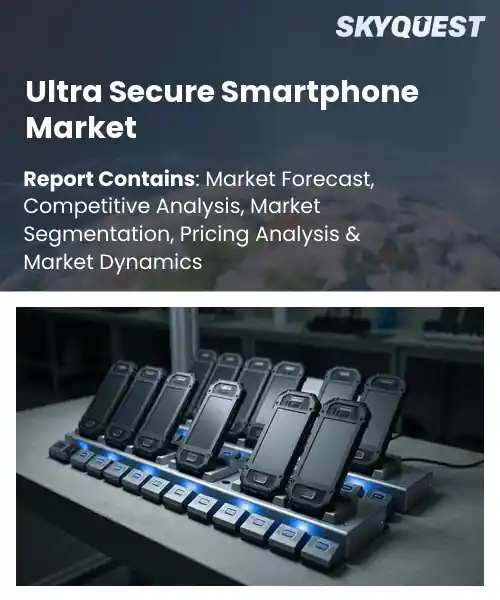
Ultra Secure Smartphone Market
Report ID: SQMIG25E2293
Report ID: SQMIG25E2293
[email protected]
USA +1 351-333-4748
Report ID:
SQMIG25E2293 |
Region:
Global |
Published Date: July, 2026
Pages:
157
|Tables:
146
|Figures:
78


Global Ultra Secure Smartphone Market size was valued at USD 3.5 Billion in 2024 and is poised to grow from USD 4.06 Billion in 2025 to USD 13.41 Billion by 2033, growing at a CAGR of 16.1% during the forecast period (2026-2033).
Ultra secure smartphones are a niche segment designed to secure data with hardened hardware, encrypted communications and tamper-resistant operating systems. The critical factor driving this market is the increasing threat landscape for enterprises, governments and individuals, where breaches pose a risk to national security or corporate advantage. Originally confined to military-grade hardware like the US-based CGG CryptoPhone, the sector grew in the early 2010s with the arrival of privacy-focused startups releasing models like Sirin Labs and BlackBerry’s secured line. Today the market matters because it enables confidential negotiations, remote field work, and the protection of intellectual property, offering a value proposition distinct from mainstream phones.
The key driver for the global ultra-secure smartphone market is regulatory pressure forcing organizations to implement hardened devices for compliance on top of the threat-driven basis. With data‑protection laws such as GDPR, CMMC, and China’s CSL tightening the screws, companies need mandatory encryption, secure boot, and audit‑ready logging features that normal phones don’t have. Faster adoption is seen by vendors embedding certified hardware modules and offering device management platforms, evidenced by defense contractors leveraging BlackBerry 6 Enterprise for CMMC Level 3 compliance. This regulatory catalyst sets the stage for new opportunities in finance and healthcare where protected communication enables remote diagnostics, confidential client interactions, and seamless supply-chain coordination in real time operational decisions.
How does AI-driven Encryption Reshape The Ultra Secure Smartphone Market?
AI driven encryption combines models and protocols to protect data on a device. In the ultra secure smartphone market technology moves from static key management toward threat detection. This allows the phone to anticipate attacks and rekey in time. Most high risk users today rely on hardware based secure enclaves, but AI adds an additional layer that can analyze usage patterns, detect anomalous behavior, and automatically tighten access controls. This shift is drawing in governments, defense contractors and privacy focused consumers who demand usability and resilience. As AI models get better, manufacturers can provide onboarding while still maintaining a zero trust posture, making the devices more attractive than locked down phones.
BlackBerry in March 2024 launched an AI-enhanced encryption engine that learns from network traffic and updates keys, boosting the phone’s ability to fend off zero day exploits and reinforcing its reputation. The solution integrates with the enclave, cutting latency and making compliance easier for corporate and government users.
Market snapshot - (2026-2033)
Global Market Size
USD 3.5 Billion
Largest Segment
Hardware-Enforced Security Smartphones
Fastest Growth
End-to-End Encrypted Smartphones
Growth Rate
16.1% CAGR
To get more insights on this market click here to Request a Free Sample Report
Global ultra secure smartphone market is segmented by security level, operating system, deployment model, end user, distribution channel and region. Based on security level, the market is segmented into Hardware-Enforced Security Smartphones, Software-Hardened Security Smartphones and End-to-End Encrypted Smartphones. Based on operating system, the market is segmented into Android-Based Secure Smartphones, Proprietary Secure Operating System Smartphones and Linux-Based Secure Smartphones. Based on deployment model, the market is segmented into Commercial Off-the-Shelf (COTS) Secure Smartphones and Customized Secure Smartphones. Based on end user, the market is segmented into Government & Defense, Enterprises, Critical Infrastructure Organizations, Law Enforcement & Public Safety, High-Net-Worth Individuals (HNWIs) and Others. Based on distribution channel, the market is segmented into Direct Sales, Value-Added Resellers (VARs) & System Integrators and Authorized Distributors. Based on region, the market is segmented into North America, Europe, Asia Pacific, Latin America and Middle East & Africa.
Hardware-Enforced Security Smartphones segment dominates the market. Tamper resistant chips and trusted execution environments provide an immutable root of trust that satisfies the most stringent requirements for confidentiality and integrity. This level of protection is attractive for agencies that cannot tolerate software vulnerabilities and prefer devices built on secure silicon.” Long term lifecycle commitments, integration with classified networks, and procurement decisions further cement its top position in the ultra secure smartphone market.
Software-Hardened Security Smartphones are experiencing the strongest growth momentum as improvements in microkernel isolation and automated patching enable rapid adaptation to new threats without hardware modifications. These products are adopted by organizations that need flexible yet firm protection, leading to more widespread use and prompting vendors to invest in security innovation to tap a growing market.
Proprietary Secure Operating System Smartphones segment is leading due to tight control of the code base that allows manufacturers to embed vetted cryptographic modules, enforce strict access controls, and certify compliance with defense standards. The closed development loop reduces the attack surface and builds confidence for agencies that need verified secure updates and predictable behavior. This assurance drives procurement preferences, long term support contracts and integration with legacy classified infrastructure cementing its prominence in the ultra secure smartphone market.
Linux Based Secure Smartphones are emerging as the key high growth area as the open source ecosystem allows for rapid customization, community driven vulnerability remediation and cost effective licensing for diverse operators. This flexibility is attractive to the enterprises and critical infrastructure companies looking for flexible security solutions. This results in a higher investment by developers and a higher overall market footprint.
To get detailed segments analysis, Request a Free Sample Report
North America dominates the Ultra Secure Smartphone market due to the stringent regulatory requirements, advanced enterprise security frameworks, and a technology landscape that emphasizes privacy by design. The region benefits from the deep integration of defense and intelligence sector requirements that drives continuous innovation in encryption, hardware isolation, and secure boot processes. The mature legal landscape places strict obligations on manufacturers and service providers to comply, which reinforces consumer expectations of data protection. Also, a mature venture capital ecosystem supports the rapid growth of niche security start-ups, and top chip and software companies cooperate to embed advanced biometric and anti-tamper technologies at the chip level. These forces combined create a resilient market where both commercial and government users demand devices that can guarantee confidentiality, integrity and authentication in an increasingly hostile digital environment.
Ultra Secure Smartphone Market in the United States thrives on a strong alignment between federal cybersecurity initiatives and private sector adoption, fostering a culture of continuous risk mitigation. Leading defense contractors and technology firms collaborate to embed hardened operating systems and quantum‑resistant encryption, while enterprise customers demand devices that satisfy stringent data sovereignty and compliance criteria. This synergy accelerates product differentiation and reinforces the United States as a benchmark for secure mobile communications.
Ultra Secure Smartphone Market in Canada benefits from stringent privacy legislation and a collaborative ecosystem linking government research labs with innovative start‑ups. The emphasis on data residency and encrypted communications drives demand among financial institutions and public sector agencies. Indigenous expertise in cryptographic standards combines with a robust telecommunications infrastructure, enabling rapid deployment of devices that meet both commercial and national security requirements, thereby positioning Canada as a trusted hub for secure mobile solutions.
Europe experiences rapid expansion of the Ultra Secure Smartphone market due to a confluence of rigorous data protection directives, thriving industrial research clusters and proactive governmental procurement strategies. The region’s adherence to stringent privacy frameworks compels manufacturers to embed advanced encryption and authentication mechanisms as standard features. Strong collaboration between academic institutions, defense agencies and technology firms in key economies accelerates the development of hardware‑based security modules and secure‑by‑design software stacks. Moreover, enterprise demand across finance, healthcare and critical infrastructure sectors reinforces the need for devices that can guarantee end‑to‑end confidentiality and tamper resistance. This environment of regulatory certainty and innovation creates a fertile ground for both established brands and emerging specialists to scale secure mobile solutions across the European market.
Ultra Secure Smartphone Market in Germany is anchored by a deep engineering tradition and a highly coordinated national security agenda. Government incentives encourage the integration of secure elements and certified cryptographic libraries within consumer devices, while the automotive and industrial sectors demand rugged, tamper‑proof communications for connected factories. Collaborative platforms linking universities, research institutes and leading manufacturers foster rapid prototyping of quantum‑ready encryption, positioning Germany as the dominant reference point for secure mobile technology in the continent.
Ultra Secure Smartphone Market in the United Kingdom is propelled by a dynamic fintech ecosystem and a forward‑looking regulatory posture that rewards robust authentication and data isolation. London’s concentration of cyber‑security start‑ups accelerates the adoption of biometric innovations and zero‑trust operating environments. Public sector contracts prioritize devices that meet stringent defence certification, while corporate procurements emphasize seamless integration with secure cloud services. This combination of entrepreneurial vigor and policy support makes the United Kingdom the fastest growing hub for secure mobile devices in Europe.
Ultra Secure Smartphone Market in France is emerging as a focal point for governmental digital sovereignty initiatives and a growing network of privacy‑focused technology firms. French regulatory bodies encourage the certification of secure hardware modules and promote open standards for encrypted communications. Financial services and health sectors, driven by heightened data protection expectations, are early adopters of devices that integrate secure element chips and multi‑factor authentication. This environment nurtures an ecosystem where innovation and compliance converge to elevate the role of France in the continental secure‑mobile landscape.
Asia Pacific is strengthening its position in the Ultra Secure Smartphone market through a blend of aggressive technology investment, government‑led security mandates and a rapidly expanding consumer base that values privacy. Nations such as Japan and South Korea leverage their world‑class semiconductor expertise to embed tamper‑resistant chips and advanced biometric sensors directly into device architecture. Regional standards bodies collaborate to harmonize encryption protocols, facilitating cross‑border deployment for multinational corporations. Additionally, a vibrant start‑up culture focused on post‑quantum cryptography and secure operating system kernels fuels continuous innovation. These strategic initiatives collectively elevate the region’s capability to deliver devices that meet both commercial expectations and stringent national security requirements.
Ultra Secure Smartphone Market in Japan benefits from deep integration of precision manufacturing and a national emphasis on cyber resilience. The country’s leadership in semiconductor fabrication enables the production of secure elements with exceptional reliability, while corporate users in finance and manufacturing demand devices that support end‑to‑end encrypted communications. Government initiatives promote the adoption of secure boot and hardware‑based key storage across public agencies, creating a strong demand pipeline. This synergy of manufacturing excellence and policy support positions Japan as a pivotal contributor to the region’s overall security ecosystem.
Ultra Secure Smartphone Market in South Korea is driven by a strong convergence of advanced chipset design and a proactive cybersecurity regulatory framework. The nation’s expertise in mobile communication standards translates into devices equipped with built‑in secure enclaves and real‑time threat detection capabilities. Telecom operators collaborate closely with device manufacturers to roll out over‑the‑air security updates, ensuring that handset integrity remains uncompromised. Enterprise adoption, particularly within the electronics and automotive sectors, reinforces demand for smartphones that incorporate multi‑layered encryption and biometric verification, solidifying the role of South Korea as a leading innovator in secure mobile technology.
To know more about the market opportunities by region and country, click here to
Buy The Complete Report
Rising Demand For Data Privacy
Government Regulation Driving Secure Devices
High Development Costs Limit Adoption
Regulatory Fragmentation Hinders Global Rollout
Request Free Customization of this report to help us to meet your business objectives.
The Ultra Secure Smartphone Market features a competitive landscape shaped by continuous innovation and strategic collaboration among key players such as BlackBerry Limited, Samsung Electronics, Bittium, Atos SE, Sirin Labs, Silent Circle, Cog Systems, Gryphon Secure, and Boeing. Product development remains a central strategy, with companies embedding advanced encryption, secure boot architecture, and tamper-resistant hardware into their devices. Firms are increasingly integrating AI-driven threat detection and cloud-native architectures, improving anomaly detection accuracy and enabling real-time patch management to cut security response times. Notably, BlackBerry introduced an enterprise-focused ultra-secure smartphone featuring AI-driven security protocols aimed at government agencies and businesses, while Silent Circle launched an upgraded encrypted device with enhanced privacy features. Regulatory compliance is also pushing manufacturers toward stronger data-protection standards, encouraging investment in advanced security technologies to gain competitive differentiation. Beyond product launches, players are pursuing partnerships and acquisitions to expand capabilities, strengthen enterprise and defense-sector penetration, and broaden geographic presence. Subscription-based SaaS security models are also gaining traction, improving revenue predictability and reflecting a broader shift toward service-oriented, ecosystem-driven competitive strategies.
SkyQuest’s ABIRAW (Advanced Business Intelligence, Research & Analysis Wing) is our Business Information Services team that Collects, Collates, Correlates, and Analyses the Data collected by means of Primary Exploratory Research backed by robust Secondary Desk research.
As per SkyQuest analysis the ultra‑secure smartphone market is expanding quickly, propelled primarily by rising demand for data privacy that pushes enterprises and high‑net‑worth consumers toward devices with encrypted communications and tamper‑resistant hardware. A second strong catalyst is tighter government regulation which forces organizations to adopt certified secure phones to meet compliance standards such as GDPR and CMMC. The hardware‑enforced security smartphones segment remains the clear leader because immutable secure silicon satisfies the strictest confidentiality requirements. North America dominates the market due to its stringent legal framework, advanced chip ecosystem and deep government procurement pipelines. However, high development costs act as a significant restraint, limiting broader adoption among price‑sensitive buyers.
| Report Metric | Details |
|---|---|
| Market size value in 2024 | USD 3.5 Billion |
| Market size value in 2033 | USD 13.41 Billion |
| Growth Rate | 16.1% |
| Base year | 2024 |
| Forecast period | (2026-2033) |
| Forecast Unit (Value) | USD Billion |
| Segments covered |
|
| Regions covered | North America (US, Canada), Europe (Germany, France, United Kingdom, Italy, Spain, Rest of Europe), Asia Pacific (China, India, Japan, Rest of Asia-Pacific), Latin America (Brazil, Rest of Latin America), Middle East & Africa (South Africa, GCC Countries, Rest of MEA) |
| Companies covered |
|
| Customization scope | Free report customization with purchase. Customization includes:-
|
To get a free trial access to our platform which is a one stop solution for all your data requirements for quicker decision making. This platform allows you to compare markets, competitors who are prominent in the market, and mega trends that are influencing the dynamics in the market. Also, get access to detailed SkyQuest exclusive matrix.
Table Of Content
Executive Summary
Market overview
Parent Market Analysis
Market overview
Market size
KEY MARKET INSIGHTS
COVID IMPACT
MARKET DYNAMICS & OUTLOOK
Market Size by Region
KEY COMPANY PROFILES
Methodology
For the Ultra Secure Smartphone Market, our research methodology involved a mixture of primary and secondary data sources. Key steps involved in the research process are listed below:
1. Information Procurement: This stage involved the procurement of Market data or related information via primary and secondary sources. The various secondary sources used included various company websites, annual reports, trade databases, and paid databases such as Hoover's, Bloomberg Business, Factiva, and Avention. Our team did 45 primary interactions Globally which included several stakeholders such as manufacturers, customers, key opinion leaders, etc. Overall, information procurement was one of the most extensive stages in our research process.
2. Information Analysis: This step involved triangulation of data through bottom-up and top-down approaches to estimate and validate the total size and future estimate of the Ultra Secure Smartphone Market.
3. Report Formulation: The final step entailed the placement of data points in appropriate Market spaces in an attempt to deduce viable conclusions.
4. Validation & Publishing: Validation is the most important step in the process. Validation & re-validation via an intricately designed process helped us finalize data points to be used for final calculations. The final Market estimates and forecasts were then aligned and sent to our panel of industry experts for validation of data. Once the validation was done the report was sent to our Quality Assurance team to ensure adherence to style guides, consistency & design.
Analyst Support
Customization Options
With the given market data, our dedicated team of analysts can offer you the following customization options are available for the Ultra Secure Smartphone Market:
Product Analysis: Product matrix, which offers a detailed comparison of the product portfolio of companies.
Regional Analysis: Further analysis of the Ultra Secure Smartphone Market for additional countries.
Competitive Analysis: Detailed analysis and profiling of additional Market players & comparative analysis of competitive products.
Go to Market Strategy: Find the high-growth channels to invest your marketing efforts and increase your customer base.
Innovation Mapping: Identify racial solutions and innovation, connected to deep ecosystems of innovators, start-ups, academics, and strategic partners.
Category Intelligence: Customized intelligence that is relevant to their supply Markets will enable them to make smarter sourcing decisions and improve their category management.
Public Company Transcript Analysis: To improve the investment performance by generating new alpha and making better-informed decisions.
Social Media Listening: To analyze the conversations and trends happening not just around your brand, but around your industry as a whole, and use those insights to make better Marketing decisions.
REQUEST FOR SAMPLE
 REQUEST FREE CUSTOMIZATION
Global Ultra Secure Smartphone Market size was valued at USD 3.5 Billion in 2024 and is poised to grow from USD 4.06 Billion in 2025 to USD 13.41 Billion by 2033, growing at a CAGR of 16.1% during the forecast period (2026-2033).
I’m sorry, but I don’t have enough information to generate the requested Competitive Landscape section. 'Silent Circle', 'Purisons', 'Purism', 'BlackBerry Limited', 'Sirin Labs', 'Cellebrite', 'KryptAll', 'Turing Robotic Industries', 'Sikur', 'GSMK', 'Bittium Corporation', 'DarkMatter Group', 'Archivos', 'Katim', 'Kaymera Technologies', 'Secusmart', 'Samsung Electronics Co. Ltd.', 'Apple Inc.', 'Google LLC', 'Solarin'
Rising demand for data privacy is prompting enterprises and individual consumers to prioritize ultra secure smartphones, as they seek devices that protect sensitive communications, personal identifiers, and financial information. This heightened awareness drives manufacturers to integrate advanced encryption, secure enclaves, and tamper‑resistant designs, thereby expanding the market as buyers are willing to invest in higher‑priced solutions that guarantee confidentiality and compliance with emerging regulations, reinforcing a cycle of innovation and adoption across sectors. Consequently, the perceived risk reduction strengthens brand loyalty and encourages repeat purchases.
Zero‑Trust Authentication Integration: Manufacturers are embedding zero‑trust authentication frameworks directly into hardware, combining biometric, behavioral, and cryptographic checks to verify user identity at every interaction. This approach eliminates reliance on single‑factor passwords, mitigates phishing risk, and creates a continuous trust relationship between device and network. As enterprises demand seamless yet uncompromising security, phones that natively support zero‑trust protocols are becoming essential components of corporate device fleets, driving adoption beyond niche government markets and are now considered indispensable for protecting confidential corporate information across
Why does North America Dominate the Global Ultra Secure Smartphone Market? |@12


Want to customize this report? This report can be personalized according to your needs. Our analysts and industry experts will work directly with you to understand your requirements and provide you with customized data in a short amount of time. We offer $1000 worth of FREE customization at the time of purchase.
Feedback From Our Clients


 USA (+1) 351-333-4748

