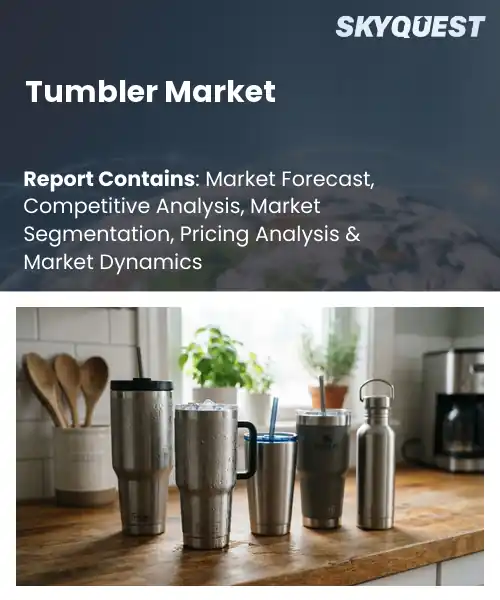
Tumbler Market
Report ID: SQMIG25I2176
Report ID: SQMIG25I2176
[email protected]
USA +1 351-333-4748
Report ID:
SQMIG25I2176 |
Region:
Global |
Published Date: August, 2026
Pages:
157
|Tables:
145
|Figures:
78


Global Tumbler Market size was valued at USD 4.8 Billion in 2024 and is poised to grow from USD 5.24 Billion in 2025 to USD 10.51 Billion by 2033, growing at a CAGR of 9.1% during the forecast period (2026-2033).
The primary engine of the global tumbler market is the escalating consumer demand for sustainable, reusable drinkware that reduces single‑use plastic waste. This market encompasses insulated steel bottles, glass and BPA‑free plastic tumblers, and smart temperature‑controlled models, each designed for on‑the‑go consumption. Its importance lies in mitigating environmental impact while meeting lifestyle expectations for convenience and temperature retention. Over the past two decades the sector has evolved from inexpensive disposable cups to premium, double‑wall insulated vessels; notable milestones include Yeti’s 2009 launch of a vacuum‑sealed series and Starbucks’ 2018 incentive program for reusable tumblers, which together spurred broader retail adoption. The next critical factor shaping the global tumbler market is the integration of smart technology and personalization, which unlocks new revenue streams and deepens consumer engagement. As manufacturers embed Bluetooth sensors, temperature displays, and app‑linked hydration tracking, users gain real‑time feedback that promotes healthier drinking habits and justifies pricing. This technological infusion has triggered partnerships between beverage brands and tech firms; for example, a coffee chain recently rolled out a QR‑enabled tumbler that syncs with its loyalty app, boosting repeat visits by 12 percent. Consequently, retailers see expanded shelf space for models, while investors identify opportunities in IoT‑enabled accessories and marketing.
How is AI-driven personalization influencing consumer preferences in the tumbler market?
AI driven personalization is reshaping how shoppers choose tumblers by turning the buying experience into a tailored interaction. Algorithms analyze past purchases, social media cues and climate data to suggest colors, insulation levels and graphic themes that match individual lifestyles. Brands now offer online configurators that adapt in real time, showing users how a design will look on their favorite beverage container. This level of relevance encourages consumers to seek out products that reflect personal identity rather than generic options. As a result, demand shifts toward premium, customizable models that promise both functionality and a sense of ownership.Hydro Flask June 2024 launched an AI design platform that lets shoppers preview personalized graphics and insulation settings instantly, driving stronger engagement and faster purchase decisions. The system learns from each interaction, refining recommendations and reducing return rates, which supports overall market growth by aligning product offerings with evolving consumer tastes.
Market snapshot - (2026-2033)
Global Market Size
USD 4.8 Billion
Largest Segment
Stainless Steel Tumblers
Fastest Growth
Glass Tumblers
Growth Rate
9.1% CAGR
To get more insights on this market click here to Request a Free Sample Report
Global tumbler market is segmented by product type, material, capacity, distribution channel, end user and region. Based on product type, the market is segmented into Insulated Tumblers, Non-Insulated Tumblers, Travel Tumblers and Other Tumblers. Based on material, the market is segmented into Stainless Steel, Plastic, Glass and Other Materials. Based on capacity, the market is segmented into Up to 16 oz, 17–24 oz, 25–32 oz and Above 32 oz. Based on distribution channel, the market is segmented into Offline and Online. Based on end user, the market is segmented into Residential and Commercial. Based on region, the market is segmented into North America, Europe, Asia Pacific, Latin America and Middle East & Africa.
Insulated tumblers segment dominates because consumers prioritize temperature retention for both hot and cold beverages, driving manufacturers to invest heavily in double wall vacuum technology. The convenience of prolonged drink freshness aligns with lifestyle trends that emphasize on the go consumption, prompting retailers to allocate prominent shelf space. This focus on performance and durability creates a strong brand narrative that resonates across residential and commercial users, reinforcing market leadership and drives repeat purchases.
However, travel tumblers segment emerges as the key high growth area because lightweight designs and spill proof lids cater to active lifestyles, encouraging adoption among commuters and outdoor enthusiasts. Innovative materials and ergonomic features expand usage scenarios, prompting brands to launch new collections that fuel demand and open fresh revenue streams.
Stainless steel segment leads because its perceived premium quality and durability meet consumer expectations for long lasting products, encouraging loyalty and willingness to pay a higher price. The material’s resistance to corrosion and ability to maintain temperature aligns with health focused narratives, prompting manufacturers to highlight eco friendly recyclability. This combination of functional benefits and brand storytelling strengthens its position across both home and business environments and drives sustained market growth for years.
Meanwhile, glass segment is witnessing the strongest growth momentum because consumers seek aesthetic appeal and a pure taste experience, prompting designers to introduce stylish patterns. The rise of boutique coffee shops and premium beverage venues fuels demand for elegant presentation, encouraging manufacturers to invest in tempered glass technology that balances elegance with safety.
To get detailed segments analysis, Request a Free Sample Report
North America commands the global tumbler market through a blend of affluent consumer bases, well‑established retail networks, and a deep cultural emphasis on on‑the‑go convenience. The United States and Canada benefit from mature e‑commerce platforms that accelerate product visibility while traditional brick‑and‑mortar channels reinforce brand loyalty. A pervasive awareness of environmental stewardship drives demand for reusable solutions, prompting manufacturers to invest heavily in design innovation and material quality. Supply‑chain efficiency, supported by sophisticated logistics infrastructure, ensures rapid product turnover and consistent market presence. In addition, proactive regulatory frameworks that encourage reduction of single‑use plastics create a favorable policy environment. Collectively these factors generate a resilient demand engine that sustains North America’s position as the dominant region for tumbler consumption throughout the continent.
Tumbler Market dynamics in the United States are shaped by a high degree of consumer willingness to adopt reusable containers, reinforced by extensive promotional activities across lifestyle and outdoor segments. Brands leverage influencer collaborations and sustainability narratives to deepen engagement, while retailers prioritize shelf visibility and cross‑category bundling. The convergence of tech‑enabled shopping experiences with strong environmental advocacy creates a fertile ecosystem that continuously propels product innovation and market penetration.
Tumbler Market activity in Canada reflects a consumer culture that intertwines outdoor recreation with a strong emphasis on environmental responsibility. Retail channels emphasize locally sourced designs and accentuate durability, resonating with shoppers who prioritize long‑term value. Collaborative campaigns between manufacturers and provincial sustainability programs amplify awareness, while seamless integration of online and in‑store experiences enhances accessibility. This synergistic approach sustains demand and encourages ongoing product refinement tailored to regional preferences.
Europe’s tumbler market expansion is propelled by a confluence of stringent regulatory targets, heightened consumer consciousness, and vibrant design culture across the continent. Legislative measures that restrict single‑use plastic encourage both retailers and manufacturers to prioritize reusable alternatives, while lifestyle trends celebrate functional aesthetics that align with sustainability ideals. Collaborative innovation hubs in key economies foster material breakthroughs, enabling premium yet affordable offerings. Retail ecosystems integrate eco‑focused sections within supermarkets and specialty stores, amplifying product discoverability. Moreover, cross‑border trade facilitated by a harmonized market framework accelerates diffusion of best practices and brand visibility. Collectively these dynamics embed reusable tumblers into everyday routines, reinforcing Europe’s reputation as a fast‑moving and environmentally attuned market. This ecosystem also nurtures consumer loyalty through continuous education and community engagement initiatives.
Tumbler Market presence in Germany is anchored by a strong engineering heritage that translates into durable products favored by environmentally conscious consumers. Retail channels emphasize local manufacturing credentials, reinforcing trust and premium positioning. Collaborative efforts between industry associations and government programs drive material research, fostering innovative biopolymer solutions. Consumer education campaigns highlight lifecycle benefits, encouraging widespread adoption across urban and suburban households. This combination sustains robust demand and product evolution.
Tumbler Market growth in the United Kingdom accelerates through urban lifestyles and waste‑reduction policies that resonate with younger demographics. Retailers integrate tumblers into fashion‑forward displays, positioning them as lifestyle accessories as well as functional items. Partnerships with coffee chains and sports events amplify visibility, while platforms enable personalized product recommendations. Educational outreach highlighting carbon footprint reduction reinforces purchase intent, fostering a shift toward reusable solutions across on‑the‑go and home environments.
Tumbler Market emergence in France is driven by a consumer base that values reusable solutions as part of life. Retailers showcase sleek, locally inspired designs that appeal to shoppers and artisans. Partnerships between municipalities and manufacturers promote distribution through community hubs, enhancing accessibility. Media narratives emphasizing lifestyle integration and carbon reduction reinforce purchase motivation, while social media influencers amplify brand awareness. This environment cultivates adoption across cafés, workplaces and homes.
Asia Pacific’s ascent in the tumbler arena is fueled by a combination of rapid urbanization, evolving consumer expectations, and a cultural shift toward sustainable living. Growing metropolitan populations prioritize convenience, creating demand for portable, reusable containers that align with health‑focused lifestyles. Regional manufacturers leverage advanced material technologies and cost‑effective production methods, delivering stylish yet functional designs that resonate with both young professionals and traditional households. Government incentives that support circular‑economy initiatives further encourage adoption, while retail ecosystems increasingly integrate eco‑focused product lines within hypermarkets and specialty outlets. Collaborative platforms that connect designers, suppliers and sustainability NGOs accelerate innovation and market penetration. This synergistic environment enables Asia Pacific to expand its influence, positioning the region as a pivotal growth engine for the global tumbler market.
Tumbler Market in Japan is characterized by attention to craftsmanship and an appreciation for minimalist design that appeals to environmentally aware consumers. Retail channels feature compact products suited to small‑space living and commuting. Partnerships with tea houses and vending networks broaden distribution, while government‑backed recycling programs reinforce the value proposition of reusability. Consumer education emphasizing waste reduction and health benefits sustains demand, encouraging manufacturers to refine ergonomics and material sustainability.
Tumbler Market in South Korea thrives on a blend of manufacturing capability and a youthful culture that prizes convenience and environmental responsibility. Retail environments prominently display sleek designs that cater to urban routines. Collaboration between tech firms and beverage brands introduces tumblers with temperature‑control features, enhancing user experience. Government campaigns that promote circular‑economy concepts reinforce consumer willingness to invest in durable products. This synergy fuels market expansion and product diversification.
To know more about the market opportunities by region and country, click here to
Buy The Complete Report
Rising Consumer Preference for Reusables
Increasing Emphasis on Sustainability
Higher Production Costs Compared
Limited Awareness in Emerging Markets
Request Free Customization of this report to help us to meet your business objectives.
The competitive landscape of the global tumbler market is shaped by intense sustainability‑driven rivalry, with leading firms securing partnerships with major beverage brands and acquiring niche eco‑material innovators to broaden their reusable product lines. Companies are accelerating tech innovation by integrating insulated designs with biodegradable polymers, while strategic M&A activity focuses on consolidating fragmented regional players to achieve scale and distribution efficiency.
Top Player’s Company Profile
Recent Developments
SkyQuest’s ABIRAW (Advanced Business Intelligence, Research & Analysis Wing) is our Business Information Services team that Collects, Collates, Correlates, and Analyses the Data collected by means of Primary Exploratory Research backed by robust Secondary Desk research. As per SkyQuest analysis the global tumbler market is expanding rapidly, driven primarily by a rising consumer preference for reusable drinkware that cuts single‑use plastic waste, while a second strong force comes from growing sustainability commitments of businesses that are adopting branded tumbler programs. The market is led by insulated tumblers, whose double‑wall vacuum technology meets demand for temperature retention across both residential and commercial users. North America remains the dominant region thanks to affluent consumers, robust retail networks and supportive regulations. However, higher production costs relative to disposable alternatives pose a restraint, limiting price‑sensitivity in some segments and slowing broader adoption.
| Report Metric | Details |
|---|---|
| Market size value in 2024 | USD 4.8 Billion |
| Market size value in 2033 | USD 10.51 Billion |
| Growth Rate | 9.1% |
| Base year | 2024 |
| Forecast period | (2026-2033) |
| Forecast Unit (Value) | USD Billion |
| Segments covered |
|
| Regions covered | North America (US, Canada), Europe (Germany, France, United Kingdom, Italy, Spain, Rest of Europe), Asia Pacific (China, India, Japan, Rest of Asia-Pacific), Latin America (Brazil, Rest of Latin America), Middle East & Africa (South Africa, GCC Countries, Rest of MEA) |
| Companies covered |
|
| Customization scope | Free report customization with purchase. Customization includes:-
|
To get a free trial access to our platform which is a one stop solution for all your data requirements for quicker decision making. This platform allows you to compare markets, competitors who are prominent in the market, and mega trends that are influencing the dynamics in the market. Also, get access to detailed SkyQuest exclusive matrix.
Table Of Content
Executive Summary
Market overview
Parent Market Analysis
Market overview
Market size
KEY MARKET INSIGHTS
COVID IMPACT
MARKET DYNAMICS & OUTLOOK
Market Size by Region
KEY COMPANY PROFILES
Methodology
For the Tumbler Market, our research methodology involved a mixture of primary and secondary data sources. Key steps involved in the research process are listed below:
1. Information Procurement: This stage involved the procurement of Market data or related information via primary and secondary sources. The various secondary sources used included various company websites, annual reports, trade databases, and paid databases such as Hoover's, Bloomberg Business, Factiva, and Avention. Our team did 45 primary interactions Globally which included several stakeholders such as manufacturers, customers, key opinion leaders, etc. Overall, information procurement was one of the most extensive stages in our research process.
2. Information Analysis: This step involved triangulation of data through bottom-up and top-down approaches to estimate and validate the total size and future estimate of the Tumbler Market.
3. Report Formulation: The final step entailed the placement of data points in appropriate Market spaces in an attempt to deduce viable conclusions.
4. Validation & Publishing: Validation is the most important step in the process. Validation & re-validation via an intricately designed process helped us finalize data points to be used for final calculations. The final Market estimates and forecasts were then aligned and sent to our panel of industry experts for validation of data. Once the validation was done the report was sent to our Quality Assurance team to ensure adherence to style guides, consistency & design.
Analyst Support
Customization Options
With the given market data, our dedicated team of analysts can offer you the following customization options are available for the Tumbler Market:
Product Analysis: Product matrix, which offers a detailed comparison of the product portfolio of companies.
Regional Analysis: Further analysis of the Tumbler Market for additional countries.
Competitive Analysis: Detailed analysis and profiling of additional Market players & comparative analysis of competitive products.
Go to Market Strategy: Find the high-growth channels to invest your marketing efforts and increase your customer base.
Innovation Mapping: Identify racial solutions and innovation, connected to deep ecosystems of innovators, start-ups, academics, and strategic partners.
Category Intelligence: Customized intelligence that is relevant to their supply Markets will enable them to make smarter sourcing decisions and improve their category management.
Public Company Transcript Analysis: To improve the investment performance by generating new alpha and making better-informed decisions.
Social Media Listening: To analyze the conversations and trends happening not just around your brand, but around your industry as a whole, and use those insights to make better Marketing decisions.
REQUEST FOR SAMPLE
 REQUEST FREE CUSTOMIZATION


Want to customize this report? This report can be personalized according to your needs. Our analysts and industry experts will work directly with you to understand your requirements and provide you with customized data in a short amount of time. We offer $1000 worth of FREE customization at the time of purchase.
Feedback From Our Clients


 USA (+1) 351-333-4748

