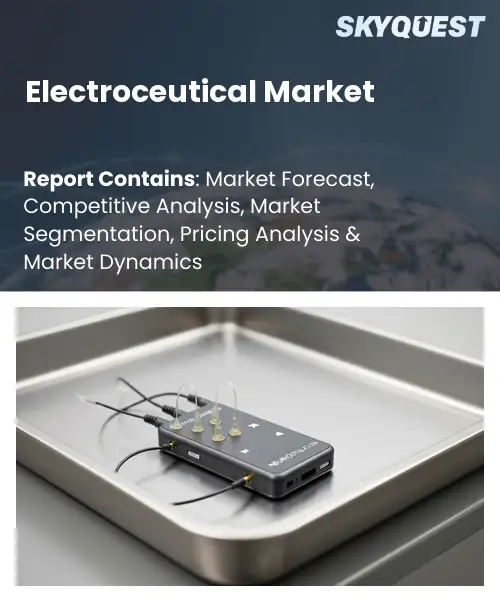
Electroceutical Market
Report ID: SQMIG35A4178
Report ID: SQMIG35A4178
[email protected]
USA +1 351-333-4748
Report ID:
SQMIG35A4178 |
Region:
Global |
Published Date: July, 2026
Pages:
157
|Tables:
142
|Figures:
78


Global Electroceutical Market size was valued at USD 23.8 Billion in 2024 and is poised to grow from USD 25.49 Billion in 2025 to USD 44.12 Billion by 2033, growing at a CAGR of 7.1% during the forecast period (2026-2033).
The electroceutical industry comprises therapies that modulate electrical signals in nerves or organs to treat disease, integrating bioelectronic devices with precision medicine. Primary driver of this expansion is the rising prevalence of lifestyle‑linked disorders such as diabetes and hypertension, creating demand for interventions that avoid systemic drugs. Consequently, venture capital has surged, funding startups that convert neural circuitry insights into implantable or wearable platforms, reshaping treatment paradigms globally significantly.
Key growth factor for the global electroceutical market is the convergence of advanced sensor technology with artificial‑intelligence analytics, which enables real‑time feedback loops that improve therapeutic efficacy. When devices capture physiological data, AI algorithms interpret patterns and adjust stimulation parameters, leading to reduced hospitalization rates and lower medication costs; hospitals therefore prioritize procurement of such systems. Real‑world examples include glucose‑responsive insulin pumps that autonomously modulate insulin delivery and spinal‑cord stimulators approved for opioid‑free postoperative pain management, both demonstrating cost‑saving outcomes. These successes attract reimbursement reforms, expand insurer coverage, and stimulate multinational manufacturers to invest in R&D, thereby widening market reach.
How is AI-driven personalization influencing growth in the electroceutical market?
AI‑driven personalization is reshaping electroceuticals by tailoring stimulation protocols to individual neural signatures. Machine‑learning models analyze patient data in real time, adjusting pulse amplitude, frequency and timing to maximize therapeutic outcomes while minimizing side effects. This adaptive approach accelerates clinical adoption because clinicians can rely on data‑backed dosing rather than fixed regimens. It also fuels investment as developers showcase faster trial results and higher patient adherence. By integrating wearable biosensors, AI platforms create closed‑loop systems that continuously refine treatment, making electroceutical therapies more precise, scalable and attractive to healthcare providers seeking cost‑effective solutions.
SetPoint Medical in August 2022, introduced an AI‑enabled neuromodulation platform that customizes therapy parameters for each patient, illustrating how personalization drives market expansion and operational efficiency.
Market snapshot - (2026-2033)
Global Market Size
USD 23.8 Billion
Largest Segment
Stainless Steel Tumblers
Fastest Growth
Plastic Polycarbonate Tumblers
Growth Rate
7.1% CAGR
To get more insights on this market click here to Request a Free Sample Report
Global electroceutical market is segmented by core material composition, volumetric capacity, end-user, sales channel, distribution channel and region. Based on core material composition, the market is segmented into Stainless Steel Tumblers, Plastic Polycarbonate Tumblers and Glass Tumblers. Based on volumetric capacity, the market is segmented into Under 16 oz, 16 oz to 24 oz and Above 24 oz. Based on end-user, the market is segmented into Residential Consumers, Commercial Hospitality and Corporate Sector. Based on sales channel, the market is segmented into Online and Offline. Based on distribution channel, the market is segmented into Direct and Indirect. Based on region, the market is segmented into North America, Europe, Asia Pacific, Latin America and Middle East & Africa.
Stainless steel tumblers segment dominates with large electroceutical market share because they provide superior biocompatibility and durability essential for delivering precise electrical stimulation in electroceutical devices. Their inert surface reduces corrosion risk, ensuring consistent therapeutic output, while their robust construction supports miniaturized circuitry. These attributes meet stringent clinical reliability standards, encouraging manufacturers to favor stainless steel for implantable and wearable platforms, thereby driving its preeminence in the market across applications and fostering long‑term patient adherence trends globally.
As per electroceutical market outlook, plastic polycarbonate tumblers are witnessing the strongest growth momentum in the electroceutical market as they enable cost‑effective scaling for disposable therapeutic patches and prototype devices. Their lightweight nature and design flexibility accelerate innovation cycles, attracting startups and expanding applications in personalized neuromodulation, which propels future market expansion significantly soon.
Residential consumers segment leads because home users prioritize non‑invasive, user‑friendly electroceutical solutions for chronic condition management, driving manufacturers to tailor devices with intuitive interfaces and safety features. This focus on personal health empowerment fuels product development that integrates seamlessly with daily routines, increasing adoption rates. The heightened awareness of self‑care and the convenience of at‑home therapy reinforce this segment’s leadership within the overall market landscape for future growth and innovation.
As per electroceutical market analysis, commercial hospitality is emerging as the key high‑growth area in the electroceutical market as hotels and wellness resorts integrate therapeutic devices into guest experiences. This environment‑driven adoption stimulates demand for scalable, service‑oriented solutions, encouraging providers to develop robust maintenance and analytics platforms, thereby accelerating market expansion and creating new revenue streams.
To get detailed segments analysis, Request a Free Sample Report
North America benefits from a confluence of deep scientific expertise, extensive clinical research networks, and a regulatory environment that balances innovation encouragement with patient safety. Robust venture capital ecosystems and strong collaboration between academic institutions, technology firms, and healthcare providers accelerate product development cycles. Integrated healthcare delivery systems facilitate rapid adoption and real‑world validation, while reimbursement frameworks increasingly recognize value‑based therapeutic outcomes. These factors together create a fertile landscape for pioneering electroceutical solutions, reinforcing the region’s leadership and attracting global partnerships.
As per electroceutical market regional outlook, United States is propelled by leading research universities and a dynamic biotech corridor that nurtures breakthrough device engineering. Strong intellectual property protections and a venture capital community provide critical funding pathways, while large healthcare organizations adopt pilot programs that generate clinical evidence. Collaborative ecosystems linking clinicians, engineers, and regulators streamline pathway to market, fostering a continuous pipeline of innovative therapies.
As per electroceutical market regional forecast, Canada is supported by a government‑backed health innovation framework that emphasizes patient‑centric solutions. Academic medical centers collaborate closely with emerging start‑ups, creating technology transfer hubs that bridge laboratory discoveries and clinical implementation. A publicly funded healthcare system offers a testing ground for cost‑effective therapies, encouraging integration of electroceutical devices into chronic disease management pathways.
Europe’s expansion is driven by a strong commitment to precision medicine, harmonized regulatory guidelines, and extensive cross‑border collaboration among research institutions. Deep clinical expertise across major medical centers, coupled with supportive reimbursement policies, facilitates swift adoption of novel electroceutical therapies. Public‑private partnerships and pan‑European funding mechanisms enable shared risk and accelerated development of next‑generation devices. A focus on patient outcomes and health economics encourages integration of electroceutical solutions into chronic disease treatment algorithms, positioning Europe as a hub of innovation and market growth.
Germany reflects a robust engineering heritage and a dense network of specialized research institutes. Close ties between medical device manufacturers and university hospitals accelerate translation of novel concepts into clinical practice. Reimbursement structures that reward therapeutic efficacy promote early uptake, while collaborative consortia across the region streamline regulatory navigation, fostering a vibrant ecosystem for electroceutical advancement.
United Kingdom is characterized by an agile regulatory framework and a thriving life‑science cluster that attracts global talent. National health service initiatives prioritize innovative therapies that improve long‑term outcomes, creating pathways for early implementation. Strong venture capital presence and collaborative research programs between universities and industry accelerate product iteration, positioning the United Kingdom as a fast‑moving market leader.
France benefits from a strategic focus on translational research and strong public health investment. Integrated clinical networks support multi‑center trials that generate robust evidence, while reimbursement policies increasingly accommodate emerging technologies. Partnerships between biotech firms and academic centers nurture a pipeline of novel devices, establishing France as an emerging player in the European electroceutical landscape.
Asia Pacific is consolidating its role through strategic government initiatives, growing biomedical manufacturing capabilities, and increasing clinical adoption of digital health solutions. Regional emphasis on technology transfer and skill development equips local firms with advanced engineering capacity. Collaborative ecosystems that link multinational corporations with indigenous research institutions accelerate knowledge exchange. Health systems that prioritize cost‑effective, patient‑focused interventions create demand for electroceutical therapies, while regulatory reforms streamline approval processes, collectively elevating the region’s market presence.
Japan is driven by a mature medical device sector and a culture of meticulous clinical evaluation. Strong ties between university laboratories and industry foster continuous innovation, while national health insurance frameworks encourage incorporation of cost‑effective therapies. Government programs that support advanced manufacturing and regulatory harmonization further strengthen Japan’s position as a leader in electroceutical development.
South Korea is underpinned by rapid digital health adoption and a vibrant start‑up ecosystem. Collaborative platforms that unite conglomerates, research institutes, and clinical centers accelerate prototype testing and market introduction. Proactive regulatory pathways and government incentives for high‑tech healthcare solutions promote swift commercialization, positioning South Korea as an emerging hub for electroceutical innovation.
To know more about the market opportunities by region and country, click here to
Buy The Complete Report
Enhanced Patient Acceptance
Technological Advancements Reducing Complexity
Regulatory Approval Uncertainty
High Cost of Development and Therapy
Request Free Customization of this report to help us to meet your business objectives.
The competitive landscape of the global electroceutical industry is highly dynamic, with leading medical device companies competing through technological innovation, clinical research, and strategic collaborations to expand their neuromodulation and bioelectronic medicine portfolios. Medtronic, Abbott, and Boston Scientific dominate the market with advanced spinal cord stimulation, deep brain stimulation, cardiac rhythm management, and vagus nerve stimulation devices.
SkyQuest’s ABIRAW (Advanced Business Intelligence, Research & Analysis Wing) is our Business Information Services team that Collects, Collates, Correlates, and Analyses the Data collected by means of Primary Exploratory Research backed by robust Secondary Desk research.
As per SkyQuest analysis the global electroceutical market growth is being propelled primarily by AI‑driven personalization that tailors stimulation parameters to individual neural signatures while a second important driver is the continual simplification of devices through miniaturization wireless connectivity and biofeedback algorithms that lower adoption barriers. A notable restraint is the lingering uncertainty surrounding regulatory approvals across regions which slows investment and market entry. North America remains the dominant region due to deep scientific expertise strong venture capital and integrated healthcare systems. The global electroceutical market trend is witnessing rapid growth driven by increasing adoption of bioelectronic medicine, rising prevalence of chronic diseases, and advancements in neuromodulation technologies.
| Report Metric | Details |
|---|---|
| Market size value in 2024 | USD 23.8 Billion |
| Market size value in 2033 | USD 44.12 Billion |
| Growth Rate | 7.1% |
| Base year | 2024 |
| Forecast period | (2026-2033) |
| Forecast Unit (Value) | USD Billion |
| Segments covered |
|
| Regions covered | North America (US, Canada), Europe (Germany, France, United Kingdom, Italy, Spain, Rest of Europe), Asia Pacific (China, India, Japan, Rest of Asia-Pacific), Latin America (Brazil, Rest of Latin America), Middle East & Africa (South Africa, GCC Countries, Rest of MEA) |
| Companies covered |
|
| Customization scope | Free report customization with purchase. Customization includes:-
|
To get a free trial access to our platform which is a one stop solution for all your data requirements for quicker decision making. This platform allows you to compare markets, competitors who are prominent in the market, and mega trends that are influencing the dynamics in the market. Also, get access to detailed SkyQuest exclusive matrix.
Table Of Content
Executive Summary
Market overview
Parent Market Analysis
Market overview
Market size
KEY MARKET INSIGHTS
COVID IMPACT
MARKET DYNAMICS & OUTLOOK
Market Size by Region
KEY COMPANY PROFILES
Methodology
For the Electroceutical Market, our research methodology involved a mixture of primary and secondary data sources. Key steps involved in the research process are listed below:
1. Information Procurement: This stage involved the procurement of Market data or related information via primary and secondary sources. The various secondary sources used included various company websites, annual reports, trade databases, and paid databases such as Hoover's, Bloomberg Business, Factiva, and Avention. Our team did 45 primary interactions Globally which included several stakeholders such as manufacturers, customers, key opinion leaders, etc. Overall, information procurement was one of the most extensive stages in our research process.
2. Information Analysis: This step involved triangulation of data through bottom-up and top-down approaches to estimate and validate the total size and future estimate of the Electroceutical Market.
3. Report Formulation: The final step entailed the placement of data points in appropriate Market spaces in an attempt to deduce viable conclusions.
4. Validation & Publishing: Validation is the most important step in the process. Validation & re-validation via an intricately designed process helped us finalize data points to be used for final calculations. The final Market estimates and forecasts were then aligned and sent to our panel of industry experts for validation of data. Once the validation was done the report was sent to our Quality Assurance team to ensure adherence to style guides, consistency & design.
Analyst Support
Customization Options
With the given market data, our dedicated team of analysts can offer you the following customization options are available for the Electroceutical Market:
Product Analysis: Product matrix, which offers a detailed comparison of the product portfolio of companies.
Regional Analysis: Further analysis of the Electroceutical Market for additional countries.
Competitive Analysis: Detailed analysis and profiling of additional Market players & comparative analysis of competitive products.
Go to Market Strategy: Find the high-growth channels to invest your marketing efforts and increase your customer base.
Innovation Mapping: Identify racial solutions and innovation, connected to deep ecosystems of innovators, start-ups, academics, and strategic partners.
Category Intelligence: Customized intelligence that is relevant to their supply Markets will enable them to make smarter sourcing decisions and improve their category management.
Public Company Transcript Analysis: To improve the investment performance by generating new alpha and making better-informed decisions.
Social Media Listening: To analyze the conversations and trends happening not just around your brand, but around your industry as a whole, and use those insights to make better Marketing decisions.
REQUEST FOR SAMPLE
 REQUEST FREE CUSTOMIZATION
Global Electroceutical Market size was valued at USD 23.8 Billion in 2024 and is poised to grow from USD 25.49 Billion in 2025 to USD 44.12 Billion by 2033, growing at a CAGR of 7.1% during the forecast period (2026-2033).
Top Player’s Company Profile 'Medtronic', 'Boston Scientific Corporation', 'Abbott Laboratories', 'LivaNova', 'Biomet', 'Zimmer Biomet Holdings', 'Stryker Corporation', 'Smith & Nephew', 'Johnson & Johnson', 'Sonova Holding', 'William Demant Holding', 'GN Store Nord', 'Cochlear Limited', 'Nevro Corp', 'ElectroCore', 'Inspire Medical Systems', 'Second Sight Medical Products', 'Pixium Vision', 'Bioness', 'Mainstay Medical'
Personalized Neuromodulation Adoption: Healthcare providers are increasingly integrating electroceutical therapies into personalized treatment plans, leveraging real‑time biofeedback and AI‑driven algorithms to tailor stimulation parameters to individual patient physiology. This shift is driven by growing evidence that patient‑specific modulation improves therapeutic efficacy while reducing side‑effects compared to one‑size‑fits‑all approaches. As clinicians gain confidence in data‑rich platforms, they are recommending electroceutical options earlier in disease pathways, expanding the addressable patient pool across chronic pain, metabolic disorders, and psychiatric conditions and enhancing overall quality of life.
Use "United States".


Want to customize this report? This report can be personalized according to your needs. Our analysts and industry experts will work directly with you to understand your requirements and provide you with customized data in a short amount of time. We offer $1000 worth of FREE customization at the time of purchase.
Feedback From Our Clients


 USA (+1) 351-333-4748

