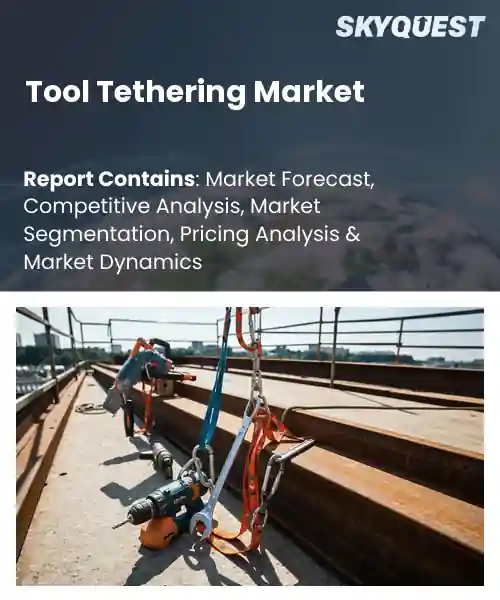
Tool Tethering Market
Report ID: SQMIG20O2026
Report ID: SQMIG20O2026
[email protected]
USA +1 351-333-4748
Report ID:
SQMIG20O2026 |
Region:
Global |
Published Date: June, 2026
Pages:
157
|Tables:
96
|Figures:
76


Global Tool Tethering Market size was valued at USD 1.12 Billion in 2024 and is poised to grow from USD 1.2 Billion in 2025 to USD 2.02 Billion by 2033, growing at a CAGR of 6.8% during the forecast period (2026-2033).
Regulatory and corporate focus on fall-protection and dropped-object prevention is the primary driver of the tool tethering market, transforming tethering from occasional accessory into an expected safety measure. It encompasses engineered anchors and adjustable connections with energy-absorbing features that retain tools during elevated tasks and thereby protect workers while avoiding equipment damage and process disruption. Historically the market matured from simple cord loops to certified systems because incident data highlighted risk while standards tightened and high-profile accidents compelled employers to adopt formal programs. For example, tethered torque wrenches in aerospace maintenance and modular kits for wind-turbine blade work illustrate adoption.
Building on regulatory momentum, a key trend driving the global tool tethering sector is demonstrable return on safety investment because when companies quantify reduced downtime and avoided replacement costs they allocate budget to certified systems. Major infrastructure undertakings and expanded renewable deployments increase the number of elevated maintenance activities and thus create clear procurement pipelines for purpose-designed tether kits. Advances in quick-release fittings combined with embedded tool-tracking cause operators to view tethering as both a safety necessity and a productivity tool, which increases willingness to pay for premium solutions. For example, wind technicians report fewer tool losses, improving uptime.
How is IoT Improving Safety and Compliance in the Tool Tethering Market?
IoT is transforming tool tethering by combining sensor enabled tethers location tracking and cloud reporting to improve safety and compliance. Key aspects include continuous monitoring of attachment status automatic detection of abnormal forces on a tether and persistent digital records that simplify inspections and audits. The market is shifting from passive straps to connected solutions that integrate with site management systems and wearable safety tech. These advances reduce dropped tool incidents and create clearer accountability across crews while enabling faster response to failures. Vendors are linking physical tether hardware to asset tracking and maintenance workflows to make compliance more practical and reliable.
In February 2026, Geotab announced GO Anywhere asset trackers that use bluetooth beacons and satellite connectivity to extend visibility to small portable tools and support tethering programs by enabling remote alerts audit trails and faster recoveries which helps improve compliance and operational efficiency.
Market snapshot - (2026-2033)
Global Market Size
USD 1.12 Billion
Largest Segment
Lanyards
Fastest Growth
Anchors and Connectors
Growth Rate
6.8% CAGR
To get more insights on this market click here to Request a Free Sample Report
Global tool tethering market is segmented by product type, material, end-use industry and region. Based on product type, the market is segmented into lanyards, tool belts and holsters, anchors and connectors, tool pouches and others. Based on material, the market is segmented into nylon and polyester, wire cable, stainless steel and others. Based on end-use industry, the market is segmented into construction, oil and gas, telecommunications, power generation and renewables, manufacturing and industrial and others. Based on region, the market is segmented into North America, Europe, Asia Pacific, Latin America and Middle East & Africa.
Based on the global tool tethering market growth, lanyards segment dominates because lanyards offer unmatched versatility and user acceptance across diverse trades, enabling simple attachment to handheld tools and comfortable wear for workers. Their compatibility with varied connectors and quick release options reduces drop risk while minimizing operational friction. Cost effective manufacturing and proven compliance with safety protocols drive widespread procurement by employers, reinforcing lanyards as the default choice for routine tethering needs across multiple work environments today.
However, anchors and connectors are emerging as the most rapidly expanding area as modular attachment innovations and stronger materials address complex tethering challenges. Rising demand for secure, tool specific interfaces and quick connect designs accelerates adoption among safety teams, enabling suppliers to offer higher value bundled solutions and opening new applications in elevated work environments.
Stainless steel segment dominates because stainless steel tethers provide superior strength and corrosion resistance critical for demanding tool tethering applications where longevity is prioritized. Their resistance to environmental degradation and compatibility with heavy tools reduce inspection and replacement cycles, shaping procurement preferences in sectors facing harsh conditions. The material’s load capacity and fatigue behavior foster engineering confidence, driving specification into safety programs and supplier offerings focused on asset integrity management.
However, wire cable is witnessing the strongest growth as high tensile coated cables deliver flexibility and load performance for evolving drop prevention requirements. Corrosion resistant coatings and compact connectors broaden applicability across tool types, rapidly accelerating adoption among safety driven buyers and enabling new tethering applications in rugged work environments.
To get detailed segments analysis, Request a Free Sample Report
As per the global tool tethering market share, North America leads the industry due to a convergence of mature safety frameworks, a strong culture of workplace risk mitigation, and a well established supplier ecosystem that prioritizes engineered solutions. Contractors and asset owners consistently integrate tethering into broader safety and asset management programs, creating steady demand for certified, durable products. Close collaboration among manufacturers, safety consultants, and large end users supports continuous product refinement and rapid deployment. Robust distribution and service networks facilitate training, inspection, and aftermarket support, while emphasis on ergonomic design and compliance contributes to broad acceptance across construction, energy, and industrial maintenance sectors, reinforcing regional leadership.
Tool tethering market in United States is characterized by deep integration with occupational safety programs and a mature procurement ecosystem. Large contractors and energy operators prioritize certified tethering solutions, driving demand for durable and ergonomic products. Suppliers maintain close collaboration with safety consultants to tailor offerings for complex jobsite conditions. Emphasis on training, inspection services, and aftermarket support anchors tethering as a standard component of tool safety strategies in sectors.
Tool tethering market in Canada benefits from strong regulatory emphasis on worker safety and broad adoption across infrastructure and resource sectors. Procurement favors certified, durable tethering systems that perform in challenging environments. Suppliers work closely with contractors and safety agencies to adapt solutions for remote weather worksites. Service offerings such as on site training, inspection, and support are integral to industry propositions, reinforcing tethering as a core safety practice.
Based on global tool tethering regional forecast, rapid expansion of the tool tethering market in Europe is propelled by a strong regulatory focus on workplace safety, heightened attention to incident prevention in construction and maintenance, and an emphasis on harmonized safety practices across complex project environments. Growing awareness among contractors and asset owners of the operational and reputational benefits of robust tethering has accelerated procurement. Manufacturers and distributors are responding with specialized products, retrofit kits for older equipment, and service bundles that combine inspection and training. Integration of tethering within broader asset and safety management processes, together with active collaboration between standards bodies, industry associations, and manufacturers, has created a receptive environment for adoption and continuous product refinement. Expanding rental and maintenance service models, coupled with rising demand for ergonomic and modular designs, enable flexible deployment across project sizes. Emphasis on digital traceability and inspection records supports compliance and lifecycle management, further encouraging uptake.
Tool tethering market in Germany is driven by a strong industrial manufacturing base and high standards for occupational safety that favor engineered tethering solutions. Suppliers collaborate with equipment makers and contractors to develop robust, certified systems tailored for heavy industry and complex construction projects. Emphasis on engineering quality, modular designs, and documentation supports acceptance among procurement teams. Training, inspection services, and support complete offerings that align with stringent compliance expectations.
Tool tethering market in United Kingdom is marked by rapid adoption among contractors and heightened focus on reducing tool loss and site incidents. Growth is supported by agile suppliers offering lightweight, ergonomic systems and retrofit solutions suited to varied project types. Integration with digital inspection and asset tracking enhances compliance and lifecycle management. Service providers package training and inspection with equipment supply, enabling uptake across construction, utilities, and maintenance operations.
Tool tethering market in France is emerging through targeted adoption in public infrastructure, industrial maintenance, and contractors. Increasing emphasis on workplace safety and project continuity motivates pilot programs and procurement of certified tethering solutions. Local suppliers and distributors focus on adaptable systems that meet diverse site conditions and retrofit older tools. Complementary services such as training, inspection, and support are shaping value propositions that encourage wider acceptance among end users.
As per global tool tethering regional outlook, Asia Pacific is strengthening its position in the industry through targeted industrial innovation, rising safety awareness among industrial operators, and supply chain localization that shortens lead times. Regional manufacturers emphasize compact, high reliability designs tailored for electronics assembly, shipbuilding, and industrial maintenance applications, while distributors expand service offerings that include inspection and on site training. Strategic partnerships between local suppliers and global technology providers enable transfer of best practices and product refinements. Governments and industry bodies in key markets are promoting safety programs that increase demand for certified tethering solutions, and a growing focus on retrofitting equipment in established assets supports steady market momentum. Emerging rental models and integrated asset tracking help smaller contractors access tethering solutions without large upfront investment. Emphasis on user friendly ergonomics and localized support networks is enabling wider adoption across project scales.
Tool tethering market in Japan benefits from a mature manufacturing ecosystem and a strong focus on engineered precision and reliability. Suppliers develop compact, ergonomic tethering systems suited for electronics assembly, automotive, and shipbuilding sectors, integrating with automated workflows. Close collaboration between OEMs, safety consultants, and suppliers drives high quality product development and stringent testing. Aftermarket services, training, and maintenance support are emphasized to sustain consistent performance in demanding production environments.
Tool tethering market in South Korea is advancing through strong demand from shipbuilding, heavy industry, and electronics manufacturing sectors. Local manufacturers concentrate on rugged, high reliability tethering solutions adapted to challenging maritime and industrial environments. Partnerships between suppliers, contractors, and safety authorities promote standardized practices and product validation. Service models that include training, inspection, and rapid replacement are gaining traction, enabling wider use across industrial projects and specialized maintenance operations.
To know more about the market opportunities by region and country, click here to
Buy The Complete Report
Rising Safety And Productivity Demands
Integration With Tool Management Systems
Perceived Cost And Procurement Barriers
Lack Of Universal Regulations And Standards
Request Free Customization of this report to help us to meet your business objectives.
Competitive landscape in the global tool tethering market outlook is consolidation driven, with incumbents using acquisitions, product partnerships and standards alignment to secure large contracts. Recent examples include Pure Safety Group's Stronghold Quick Switch launch, Ergodyne's ANSI ISEA 121 compliant Squids line, and GEARWRENCH adding tether ready systems. Firms compete on tested product innovation and compliance rather than price. Summary of search outcome: public industry analyses and vendor reporting show recent product launches and standards driven innovation from established safety manufacturers and few if any independent startups founded since 2019 that focus exclusively on tool tethering hardware.
Top Player’s Company Profile
Recent Developments
SkyQuest’s ABIRAW (Advanced Business Intelligence, Research & Analysis Wing) is our Business Information Services team that Collects, Collates, Correlates, and Analyses the Data collected by means of Primary Exploratory Research backed by robust Secondary Desk research.
As per SkyQuest analysis, a key driver behind the global tool tethering industry is regulatory and corporate focus on fall-protection and dropped-object prevention, which is converting tethering from an optional accessory into expected safety equipment. A second driver is rapid adoption of IoT and connected tether solutions that improve compliance, asset tracking and productivity. A notable restraint is perceived cost and procurement barriers that slow specification and rollout despite clear safety benefits. North America is the dominating region due to mature safety frameworks and a robust supplier ecosystem, while lanyards are the dominating segment because of versatility, worker acceptance and cost effectiveness, positioning the market for steady, standards-driven growth.
| Report Metric | Details |
|---|---|
| Market size value in 2024 | USD 1.12 Billion |
| Market size value in 2033 | USD 2.02 Billion |
| Growth Rate | 6.8% |
| Base year | 2024 |
| Forecast period | (2026-2033) |
| Forecast Unit (Value) | USD Billion |
| Segments covered |
|
| Regions covered | North America (US, Canada), Europe (Germany, France, United Kingdom, Italy, Spain, Rest of Europe), Asia Pacific (China, India, Japan, Rest of Asia-Pacific), Latin America (Brazil, Rest of Latin America), Middle East & Africa (South Africa, GCC Countries, Rest of MEA) |
| Companies covered |
|
| Customization scope | Free report customization with purchase. Customization includes:-
|
To get a free trial access to our platform which is a one stop solution for all your data requirements for quicker decision making. This platform allows you to compare markets, competitors who are prominent in the market, and mega trends that are influencing the dynamics in the market. Also, get access to detailed SkyQuest exclusive matrix.
Table Of Content
Executive Summary
Market overview
Parent Market Analysis
Market overview
Market size
KEY MARKET INSIGHTS
COVID IMPACT
MARKET DYNAMICS & OUTLOOK
Market Size by Region
KEY COMPANY PROFILES
Methodology
For the Tool Tethering Market, our research methodology involved a mixture of primary and secondary data sources. Key steps involved in the research process are listed below:
1. Information Procurement: This stage involved the procurement of Market data or related information via primary and secondary sources. The various secondary sources used included various company websites, annual reports, trade databases, and paid databases such as Hoover's, Bloomberg Business, Factiva, and Avention. Our team did 45 primary interactions Globally which included several stakeholders such as manufacturers, customers, key opinion leaders, etc. Overall, information procurement was one of the most extensive stages in our research process.
2. Information Analysis: This step involved triangulation of data through bottom-up and top-down approaches to estimate and validate the total size and future estimate of the Tool Tethering Market.
3. Report Formulation: The final step entailed the placement of data points in appropriate Market spaces in an attempt to deduce viable conclusions.
4. Validation & Publishing: Validation is the most important step in the process. Validation & re-validation via an intricately designed process helped us finalize data points to be used for final calculations. The final Market estimates and forecasts were then aligned and sent to our panel of industry experts for validation of data. Once the validation was done the report was sent to our Quality Assurance team to ensure adherence to style guides, consistency & design.
Analyst Support
Customization Options
With the given market data, our dedicated team of analysts can offer you the following customization options are available for the Tool Tethering Market:
Product Analysis: Product matrix, which offers a detailed comparison of the product portfolio of companies.
Regional Analysis: Further analysis of the Tool Tethering Market for additional countries.
Competitive Analysis: Detailed analysis and profiling of additional Market players & comparative analysis of competitive products.
Go to Market Strategy: Find the high-growth channels to invest your marketing efforts and increase your customer base.
Innovation Mapping: Identify racial solutions and innovation, connected to deep ecosystems of innovators, start-ups, academics, and strategic partners.
Category Intelligence: Customized intelligence that is relevant to their supply Markets will enable them to make smarter sourcing decisions and improve their category management.
Public Company Transcript Analysis: To improve the investment performance by generating new alpha and making better-informed decisions.
Social Media Listening: To analyze the conversations and trends happening not just around your brand, but around your industry as a whole, and use those insights to make better Marketing decisions.
REQUEST FOR SAMPLE
 REQUEST FREE CUSTOMIZATION
Global Tool Tethering Market size was valued at USD 1.12 Billion in 2024 and is poised to grow from USD 1.2 Billion in 2025 to USD 2.02 Billion by 2033, growing at a CAGR of 6.8% during the forecast period (2026-2033).
Competitive landscape in the global tool tethering market is consolidation driven, with incumbents using acquisitions, product partnerships and standards alignment to secure large contracts. Recent examples include Pure Safety Group's Stronghold Quick Switch launch, Ergodyne's ANSI ISEA 121 compliant Squids line, and GEARWRENCH adding tether ready systems. Firms compete on tested product innovation and compliance rather than price. Summary of search outcome: public industry analyses and vendor reporting show recent product launches and standards driven innovation from established safety manufacturers and few if any independent startups founded since 2019 that focus exclusively on tool tethering hardware. 'Stanley Black & Decker', '3M Company', 'Snap-on Incorporated', 'Milwaukee Tool', 'Hilti', 'Klein Tools', 'Ergodyne', 'WernerCo', 'Greenlee', 'Beta Utensili', 'Checkmate Lifting', 'FallTech', 'Pure Safety Group', 'Capital Safety', 'Petzl', 'Ridgid', 'Ty-Flot', 'Tether Track', 'Norgren', 'MSA Safety'
Tool tethering addresses heightened emphasis on workplace safety and operational productivity by preventing dropped tools and minimizing related hazards at elevated worksites, thereby aligning with corporate safety initiatives and contractor risk management priorities. By reducing potential for injury and equipment damage, tethering solutions become integral to safety protocols and training, encouraging procurement and standardization across projects. Stronger safety cultures, stricter site controls, and preference for proactive loss-prevention measures collectively motivate investment in tethering devices, driving broader adoption across sectors where fall risk and asset protection are prioritized.
Wearable Integration Driving Efficiency: Tool tethering systems are increasingly being integrated with wearable technologies and personal protective equipment to enhance worker mobility and real-time awareness on job sites. This convergence enables hands-free tool management, seamless communication of tether status, and ergonomic placement that reduces drop risks without impeding task performance. Vendors and manufacturers are collaborating with safety apparel designers to embed anchoring points and quick-release mechanisms, creating cohesive solutions that prioritize both productivity and worker comfort while supporting broader digital workflows and inspection routines.
Why does North America Dominate the Global Tool Tethering Market? |@12


Want to customize this report? This report can be personalized according to your needs. Our analysts and industry experts will work directly with you to understand your requirements and provide you with customized data in a short amount of time. We offer $1000 worth of FREE customization at the time of purchase.
Feedback From Our Clients


 USA (+1) 351-333-4748

