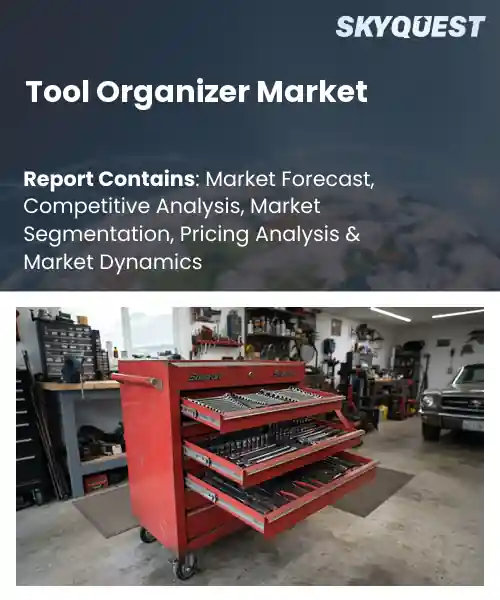
Tool Organizer Market
Report ID: SQMIG20I3773
Report ID: SQMIG20I3773
[email protected]
USA +1 351-333-4748
Report ID:
SQMIG20I3773 |
Region:
Global |
Published Date: August, 2026
Pages:
157
|Tables:
173
|Figures:
79


Global Tool Organizer Market size was valued at USD 2.87 Billion in 2024 and is poised to grow from USD 3.05 Billion in 2025 to USD 4.94 Billion by 2033, growing at a CAGR of 6.2% during the forecast period (2026-2033).
The global tool organizer market comprises a range of products from modular drawer systems to portable roll‑up cases that enable professionals and DIY enthusiasts to store, transport, and access hand and power tools efficiently. Its primary driver is the rising demand for productivity in construction, manufacturing, and home‑improvement sectors, where time saved in tool retrieval directly impacts project costs. Historically, the market grew slowly during the 1990s, but accelerated after 2005 as tool‑intensive workflows expanded and ergonomic design gained prominence. For example, major manufacturers introduced stackable plastic bins with integrated labeling, allowing contractors to reduce inventory loss and improve on‑site organization effectively. Building on the productivity gains highlighted earlier, the market’s next key factor is the convergence of smart‑technology and modular design, which unlocks new growth avenues. As manufacturers embed RFID tags and Bluetooth sensors into trays, firms can monitor tool usage time, reducing loss and enabling predictive maintenance; this lowers operating expenses and justifies higher price points. Consequently, distributors of construction equipment are adopting connected organizer kits for fleet management, while retailers target hobbyists with app‑linked compartments. The cause‑effect chain enhanced data visibility prompting cost savings and user convenience creates a virtuous cycle that expands demand across both professional and consumer segments worldwide.
How is AI-driven automation reshaping the tool organizer market?
AI-driven automation is redefining the tool organizer market by embedding smart sensors, predictive inventory algorithms and voice‑activated retrieval into traditional storage solutions. Manufacturers now embed RFID tags that communicate with cloud platforms, allowing users to locate a specific wrench or drill bit instantly via a mobile app. Machine‑learning models analyze usage patterns, suggesting optimal layout configurations and alerting users when consumables run low. This shift enhances workplace efficiency, reduces time spent searching for tools, and supports a more data‑centric approach to asset management. The integration of AI also enables modular designs that adapt to changing jobsite requirements, making storage systems more flexible and future‑proof.Tool Storage Products announced in November 2025, introduced an AI‑powered organizer that automatically catalogs tools and predicts restocking needs, illustrating how intelligent automation fuels growth and operational efficiency in the sector.
Market snapshot - (2026-2033)
Global Market Size
USD 2.87 Billion
Largest Segment
Tool Boxes
Fastest Growth
Tool Bags
Growth Rate
6.2% CAGR
To get more insights on this market click here to Request a Free Sample Report
Global tool organizer market is segmented by product type, material, application, end user, mobility, distribution channel and region. Based on product type, the market is segmented into Tool Boxes, Tool Cabinets, Tool Bags and Others. Based on material, the market is segmented into Plastic, Metal, Fabric and Others. Based on application, the market is segmented into Household, Automotive, Industrial and Others. Based on end user, the market is segmented into DIY Users, Professional Technicians, Industrial Facilities and Others. Based on mobility, the market is segmented into Portable and Stationary. Based on distribution channel, the market is segmented into Online Retail and Offline Retail. Based on region, the market is segmented into North America, Europe, Asia Pacific, Latin America and Middle East & Africa.
Metal segment dominates because its inherent strength and resistance to wear meet the rigorous demands of professional technicians and industrial facilities. The material’s ability to protect tools from impact and corrosion drives preference among buyers seeking long‑term value. Additionally, metal constructions accommodate modular locking systems, reinforcing security and organization, which reinforces its appeal across diverse applications in the Tool Organizer Market today.
Meanwhile, Fabric segment emerges as the fastest growing because its lightweight nature and flexibility align with rising demand for portable, ergonomic solutions among DIY users. Innovations in reinforced textiles and fibers are expanding its functional scope, enabling stylish durable organizers that attract a younger, sustainability‑focused consumer base, propelling market expansion.
Portable segment dominates because its ease of transport aligns with the on‑the‑go workflow of automotive technicians and DIY enthusiasts. Users can readily move tools between workstations, reducing downtime and enhancing productivity. The convenience of compact handles, quick‑release latches, and modular compartments also satisfies space‑constrained garages, reinforcing purchase decisions. Consequently, mobility drives broad acceptance across varied usage scenarios within the Tool Organizer Market and supports flexibility demanded by modern service environments.
Conversely, Stationary segment emerges as the fastest growing because large‑scale manufacturing plants are standardizing fixed tool storage to improve workflow efficiency and safety. Integration with industrial shelving and smart locking systems expands its appeal, while investment in ergonomic design reduces worker fatigue, creating new demand across the Tool Organizer Market.
To get detailed segments analysis, Request a Free Sample Report
North America leads the market through a combination of mature professional sectors, high consumer expectation for organization, and robust distribution channels. The presence of large construction and manufacturing enterprises fuels demand for durable, high‑performance organizers, while a culture of DIY projects expands the residential segment. Advanced retail networks and e‑commerce platforms ensure rapid product availability, and frequent innovation cycles keep offerings aligned with user preferences. Strong brand loyalty and an emphasis on safety standards further reinforce the region’s commanding position, creating a self‑reinforcing ecosystem that sustains leadership.
Tool Organizer Market in the United States benefits from a diverse range of industrial activities and a pervasive DIY mindset. Wide adoption of modular storage solutions is driven by professional contractors seeking efficiency and homeowners prioritizing workspace tidiness. Extensive retail presence, both brick‑and‑mortar and online, facilitates easy access to a broad portfolio of products. Continuous product innovation and a focus on ergonomic design resonate with end users, reinforcing market depth and resilience.
Tool Organizer Market in Canada reflects strong ties to the construction and natural resources sectors, where reliable storage solutions are essential for operational safety. A growing interest in home improvement projects among consumers supports expansion of the residential segment. Distribution channels emphasize specialized suppliers and major retailers, ensuring product visibility across urban and remote areas. Emphasis on sustainable materials and robust engineering aligns with local preferences, fostering steady demand and market confidence.
Europe’s expansion is propelled by stringent occupational safety regulations and a heightened focus on efficient workspace management across manufacturing hubs. Environmental considerations encourage the adoption of reusable and recyclable organizer designs, resonating with eco‑conscious buyers. A well‑integrated supply chain, featuring both legacy brands and innovative start‑ups, accelerates product diffusion. Consumer trends toward organized home workshops and increasing demand for portable solutions further stimulate growth. Collaborative industry standards and cross‑border trade within the region support seamless market development, positioning Europe as a dynamic growth arena.
Tool Organizer Market in Germany is anchored by a longstanding tradition of precision engineering and a robust manufacturing base. High demand from automotive and machinery sectors drives preference for premium, durable storage systems. Retail networks combine specialized distributors with large home‑improvement chains, ensuring comprehensive market coverage. Emphasis on quality control and product certification aligns with stringent local expectations, reinforcing market confidence and sustaining strong demand.
Tool Organizer Market in the United Kingdom experiences rapid uptake fueled by a vibrant DIY culture and progressive building regulations. Consumers seek versatile, space‑saving solutions that cater to small‑scale renovations and professional trades alike. Distribution channels are highly digitized, with e‑commerce platforms playing a pivotal role in product accessibility. Innovation in lightweight materials and modular designs resonates with a market eager for convenience and adaptability, accelerating expansion.
Tool Organizer Market in France is emerging as a notable segment, driven by increasing investment in construction renovation and a growing enthusiasm for personal workshop projects. Preference for aesthetically pleasing, functional storage aligns with French design sensibilities. Retail presence is expanding through both traditional hardware stores and online marketplaces, broadening consumer reach. Sustainable product attributes and compliance with European safety directives further encourage adoption, positioning France as an upward‑trending market.
Asia Pacific advances its position through rapid industrialization, expanding infrastructure projects, and a surge in middle‑class home ownership that fuels demand for organized living spaces. Manufacturers leverage cost‑efficient production capabilities to deliver competitively priced yet high‑quality organizers, appealing to both professional and consumer segments. Regional trade agreements facilitate cross‑border component sourcing, enhancing product diversity. Technological adoption, including smart storage features, aligns with a tech‑savvy consumer base. Combined, these dynamics elevate the region’s market relevance and competitiveness on the global stage.
Tool Organizer Market in Japan reflects a blend of high‑precision manufacturing standards and a cultural emphasis on orderliness. Professional sectors such as electronics assembly and automotive production prioritize compact, efficient storage solutions. Consumers value minimalist design and functional elegance, driving demand for sleek, space‑optimizing organizers. Distribution channels integrate specialty retailers with advanced online platforms, ensuring broad market penetration. Continuous product refinement and focus on durability sustain market vitality.
Tool Organizer Market in South Korea is shaped by a dynamic construction industry and a youthful demographic enthusiastic about DIY projects. Preference for innovative, multifunctional designs resonates with tech‑oriented consumers. Retail ecosystems combine large‑scale home‑improvement chains with fast‑growing e‑commerce sites, facilitating rapid product diffusion. Emphasis on lightweight, high‑performance materials aligns with local manufacturing expertise, reinforcing market growth and strengthening regional positioning.
To know more about the market opportunities by region and country, click here to
Buy The Complete Report
DIY Projects are Boosting Demand
Smart Home Integration is Expanding Reach
High Material Costs are Limiting Affordability
Regulatory Standards are Restricting Design Flexibility
Request Free Customization of this report to help us to meet your business objectives.
Top Player’s Company Profile
Recent Developments
SkyQuest’s ABIRAW (Advanced Business Intelligence, Research & Analysis Wing) is our Business Information Services team that Collects, Collates, Correlates, and Analyses the Data collected by means of Primary Exploratory Research backed by robust Secondary Desk research. As per SkyQuest analysis, the global tool organizer market is being propelled primarily by a surge in DIY projects that push consumers and contractors to seek versatile storage solutions, while a secondary catalyst is the growing integration of smart‑home connectivity which adds digital inventory tracking and remote tool management; the metal material segment continues to dominate because of its strength and durability for professional use; North America remains the leading region thanks to mature construction sectors, strong DIY culture and extensive retail networks; however, high material costs act as a restraint by inflating price points and limiting adoption among cost‑sensitive buyers, especially in emerging markets.
| Report Metric | Details |
|---|---|
| Market size value in 2024 | USD 2.87 Billion |
| Market size value in 2033 | USD 4.94 Billion |
| Growth Rate | 6.2% |
| Base year | 2024 |
| Forecast period | (2026-2033) |
| Forecast Unit (Value) | USD Billion |
| Segments covered |
|
| Regions covered | North America (US, Canada), Europe (Germany, France, United Kingdom, Italy, Spain, Rest of Europe), Asia Pacific (China, India, Japan, Rest of Asia-Pacific), Latin America (Brazil, Rest of Latin America), Middle East & Africa (South Africa, GCC Countries, Rest of MEA) |
| Companies covered |
|
| Customization scope | Free report customization with purchase. Customization includes:-
|
To get a free trial access to our platform which is a one stop solution for all your data requirements for quicker decision making. This platform allows you to compare markets, competitors who are prominent in the market, and mega trends that are influencing the dynamics in the market. Also, get access to detailed SkyQuest exclusive matrix.
Table Of Content
Executive Summary
Market overview
Parent Market Analysis
Market overview
Market size
KEY MARKET INSIGHTS
COVID IMPACT
MARKET DYNAMICS & OUTLOOK
Market Size by Region
KEY COMPANY PROFILES
Methodology
For the Tool Organizer Market, our research methodology involved a mixture of primary and secondary data sources. Key steps involved in the research process are listed below:
1. Information Procurement: This stage involved the procurement of Market data or related information via primary and secondary sources. The various secondary sources used included various company websites, annual reports, trade databases, and paid databases such as Hoover's, Bloomberg Business, Factiva, and Avention. Our team did 45 primary interactions Globally which included several stakeholders such as manufacturers, customers, key opinion leaders, etc. Overall, information procurement was one of the most extensive stages in our research process.
2. Information Analysis: This step involved triangulation of data through bottom-up and top-down approaches to estimate and validate the total size and future estimate of the Tool Organizer Market.
3. Report Formulation: The final step entailed the placement of data points in appropriate Market spaces in an attempt to deduce viable conclusions.
4. Validation & Publishing: Validation is the most important step in the process. Validation & re-validation via an intricately designed process helped us finalize data points to be used for final calculations. The final Market estimates and forecasts were then aligned and sent to our panel of industry experts for validation of data. Once the validation was done the report was sent to our Quality Assurance team to ensure adherence to style guides, consistency & design.
Analyst Support
Customization Options
With the given market data, our dedicated team of analysts can offer you the following customization options are available for the Tool Organizer Market:
Product Analysis: Product matrix, which offers a detailed comparison of the product portfolio of companies.
Regional Analysis: Further analysis of the Tool Organizer Market for additional countries.
Competitive Analysis: Detailed analysis and profiling of additional Market players & comparative analysis of competitive products.
Go to Market Strategy: Find the high-growth channels to invest your marketing efforts and increase your customer base.
Innovation Mapping: Identify racial solutions and innovation, connected to deep ecosystems of innovators, start-ups, academics, and strategic partners.
Category Intelligence: Customized intelligence that is relevant to their supply Markets will enable them to make smarter sourcing decisions and improve their category management.
Public Company Transcript Analysis: To improve the investment performance by generating new alpha and making better-informed decisions.
Social Media Listening: To analyze the conversations and trends happening not just around your brand, but around your industry as a whole, and use those insights to make better Marketing decisions.
REQUEST FOR SAMPLE
 REQUEST FREE CUSTOMIZATION


Want to customize this report? This report can be personalized according to your needs. Our analysts and industry experts will work directly with you to understand your requirements and provide you with customized data in a short amount of time. We offer $1000 worth of FREE customization at the time of purchase.
Feedback From Our Clients


 USA (+1) 351-333-4748

